For as long as humans have had maps, we’ve also had fictional maps. Renowned cartographers of mythical terrain include Dante Alighieri, Jonathan Swift, Sir Thomas More, and, of course, JRR Tolkien, who pioneered many of the tropes that would come to characterize the fantasy genre, amongst them the inclusion of a map at the start of your story.
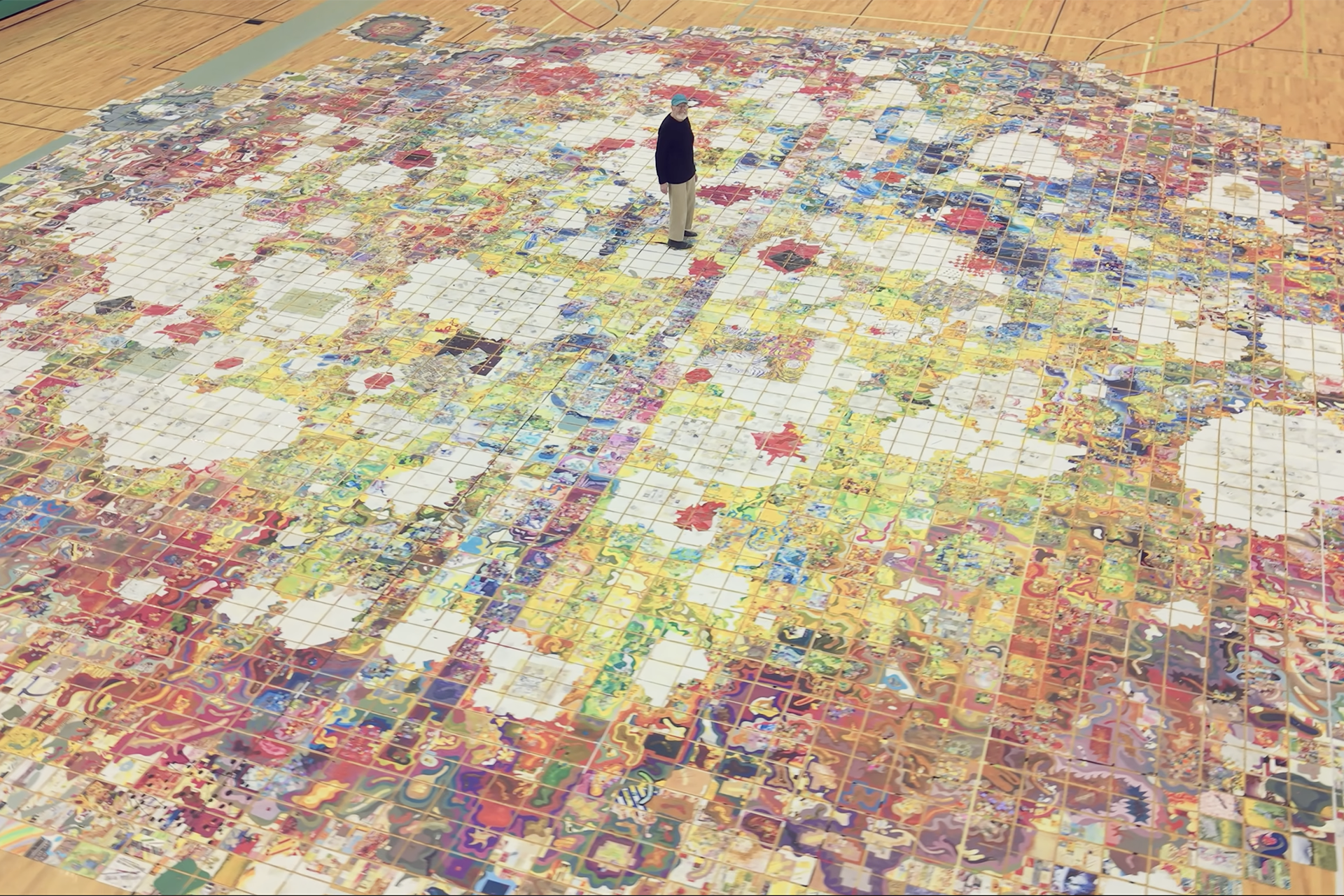
But for all the effort those literary types put into their fictional maps, there’s probably never been anyone quite like Jerry Gretzinger. As explored in a recent video from the YouTube channel People Make Games, Gretzinger—a genial octogenarian from Michigan—has been working on the same fictional map since the 1960s. Today, the map comprises something like 4000 panels, and the channel’s video captures Gretzinger’s first attempt to assemble it in its entirety for over a decade.
Gretzinger works on the map every day, and intriguingly, the nature of the labor to which he devotes any given day is determined by drawing from a deck of cards. This Rhinehart-esque randomness means that the map’s long evolution has itself changed and evolved.
On the day that People Make Games visits him, he draws a card that demands “next higher dimension.” Is this a requirement to try to marry his map to the tenets of string theory? Well, sort of. As Gretzinger explains, “Originally, [that card] was considered to be other dimensions of reality.” Wisely, though, he’s tempered his ambitions in that respect: “The whole map has moved from literal cartography to another abstract form.”
Now, the different dimensions the card refers to are layers of the map. Those various layers are catalogued in a list tacked to a spectacularly overcrowded pegboard, and include the likes of “blank page” and “one-inch square collage,” along with more cryptic layers like “the void—white,” “polka dot grid,” and “black ness.”
It’s fascinating to watch Gretzinger at work—having determined that today’s contribution to the map will be a collage, he simply grabs a glue stick and a handful of material from his “collage folder,” and starts glueing things. “I try to think as little as possible,” he says, heightening the sense that this is as much an exercise in a sort of Burroughsian cut-up creation as it is in cartography. When the collage is finished, he consults another folder to generate a name for his creation. “These are all town names,” he says, “but some towns have been eliminated by the void.”
So, yeah, about the void. This is a two-level map layer; the first is blank white paper, but the second… “That’s all black and white print,” Gretzinger says. And not just any old black-and-white print—it comprises Gretzinger’s own written history, including everything from his own writing to letters he received from friends during his time at college in the 1960s. All of this is cut up and, eventually, fed to the map: “It’s a way for me to preserve it.”
Given the sheer size of the map, it spends most of its time separated into its thousands of component panels, but occasionally Gretzinger assembles it, and the video captures—and contributes to—the first such occasion in more than a decade. This requires the labor of Gretzinger, the video crew, and a battalion of volunteers, with the generous space provided by a local gym. The finished result is amazing to look at, a psychedelic explosion of color that truly feels worthy of being someone’s life’s work. Looking at the map feels not unlike peering at a fractal pattern, in that you can zoom further and further in and see level after level of detail unfold before you.
The final word goes to Gretzinger’s wife, to whom he has been married for 44 years. “He’s always been this extraordinary combination of right and left brain,” she says. “His systemized brain can come up with these [map] co-ordinates, and the whole structure of the map—and yet he tosses it away because he’s willing to take chances. I love that about him.”