In our search for life beyond Earth, we might seek technological traces of an advanced, complex civilization through signals or emissions broadcast through space. A new paper suggests that instead of looking for light or radio signals, we should look for traces of ancient civilians that are long gone.
One of the biggest barriers to finding intelligent life in the universe is time. The universe is roughly 13.8 billion years old, and our chances of overlapping with an advanced civilization during our small window of existence are slim. Accordingly, Brian Lacki, a theoretical astronomer with the Breakthrough Listen Initiative at the University of Oxford, suggests that we are more likely to find the ruins of a dead civilization lingering in the solar system.
Lacki’s recent paper, available as a preprint on arXiv, argues that the dusty remains of long-vanished megastructures, like Dyson spheres, could settle on places like the Moon—assuming, of course, that these advanced aliens exist and go on to build such enormous structures.
Looking for aliens
Scientists look for signs of life in the galaxy by searching for planets that have a recipe of biosignatures that resemble those of Earth. There is a chance, however, that proof of life beyond Earth might not involve biology at all.
Evidence for intelligent alien life might come in the form of technosignatures, such as measurable emissions of electromagnetic waves. These technological traces of intelligent life wouldn’t come from our solar system, but rather from distant exoplanets that we cannot see up close.
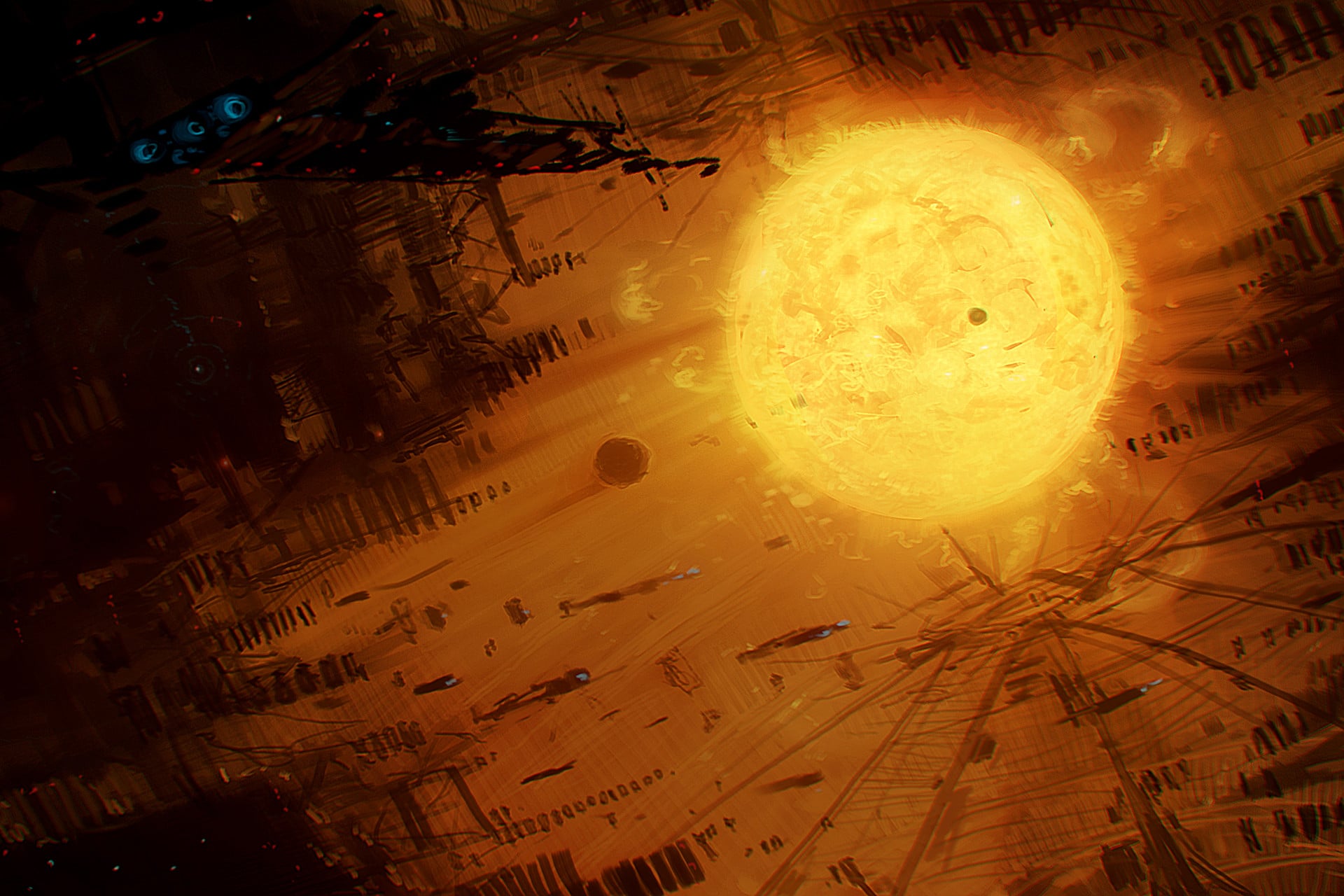
One famous example is the theorized Dyson sphere: an artificial megastructure built around a star to harvest its energy and use it to power an advanced alien civilization. A Dyson sphere is envisioned as a massive swarm of solar collectors surrounding a star.
The builders would have to continuously monitor and correct the orbits around the Dyson sphere to keep it going. Once that civilization dies off and no one is around to keep its parts in place, the swarm’s components would inevitably be drawn together by gravity.
Those parts would smash into each other, turning them into so-called technograins, according to the paper. “A collisional cascade ensues, the hypervelocity fragments from each collision obliterating further elements, initiating a rapid grinding process that smashes everything into dust,” Lacki wrote.
Dust to dust
The ill-fated collision of the Dyson swarm may leave its own traces behind. As each collision creates more debris, which in turn creates more collisions, all that’s left of the megastructure may be nothing more than micron-scale dust.
The tiny technograins could then be ejected from their host star system and swept away by solar wind, journeying across the Milky Way galaxy. The grains would eventually become distributed in the interstellar medium itself.
In the paper, Lacki argues that as our solar system orbits the center of the galaxy, it could pass through the reservoir of artificial grains within the interstellar medium. “As the Solar System passes through this reservoir, the worlds within it would be exposed to a sprinkling of technograins, and a small fraction of those can land softly enough in the regolith of worlds like the Moon,” he wrote.
Therefore, he suggests that the way to find the technological traces of alien civilizations may be to look for microscopic remains that could have unintentionally made their way to the solar system long after their collapse. If Lacki is right, the first evidence of aliens may not come from radio signals but from their microscopic remains currently littering our Moon.