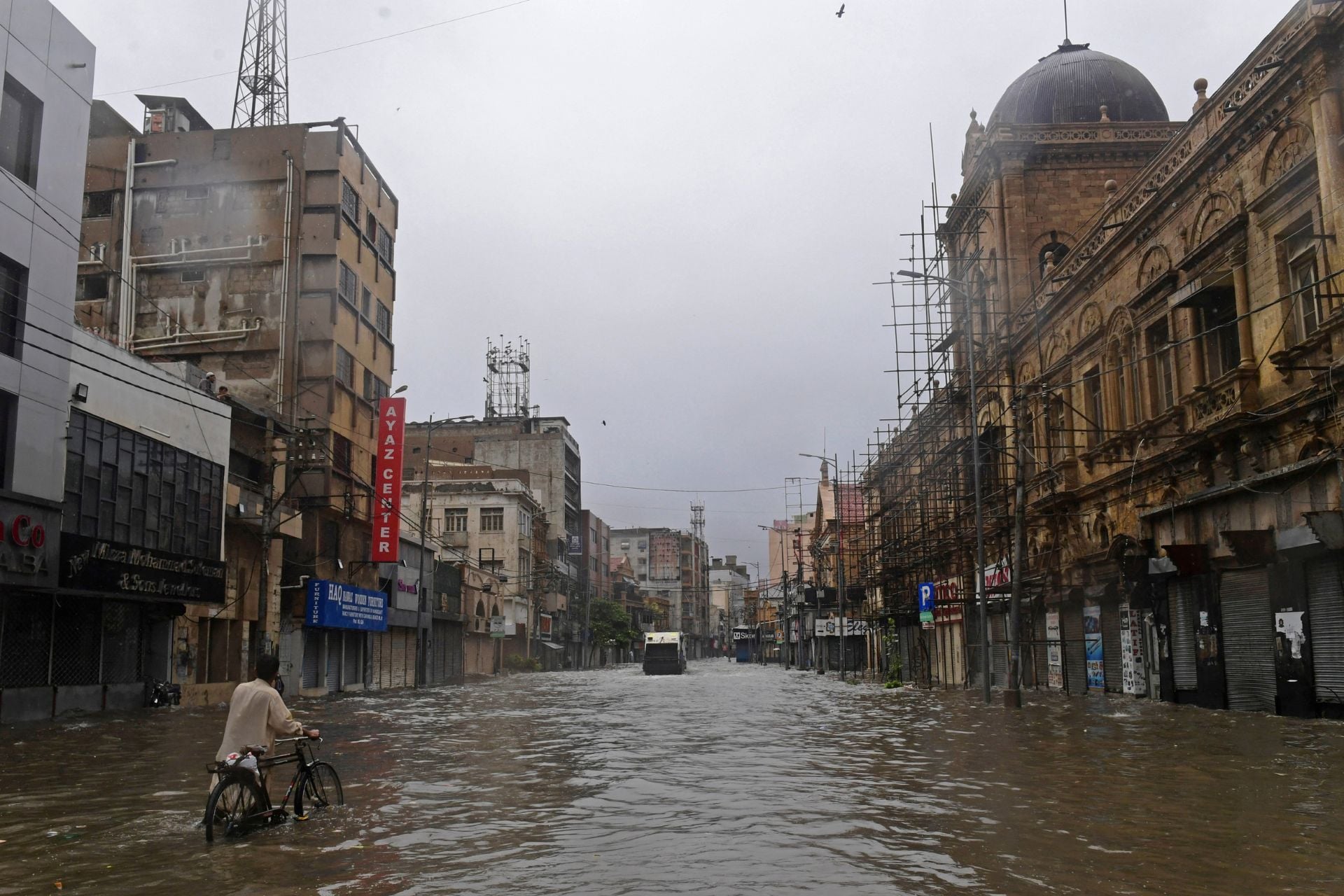
In 2022, the combined impact of devastating floods and a severe heatwave caused over $40 billion of damage and killed more than 1,700 people across Pakistan. The catastrophe was an example of a compound extreme weather event—when multiple natural disasters unfold at the same time. According to a new study, they’re going to become more common.
The findings, published today in Nature, show that the frequency of compound events—such as concurrent hot-wet and drought-heat extremes—is linked to cumulative CO2 emissions. Alarmingly, the researchers predict that the frequency of rarer and more severe compound events will escalate rapidly. Based on their findings, they believe current emissions reduction targets need to be much lower to avoid the most catastrophic impacts of climate change.
“These events are dangerous because their impacts are multifaceted,” co-author Yao Zhang, an assistant professor at Peking University in China, told Gizmodo in an email. “They can impact both natural and socioeconomic systems, and the impacts often get amplified when they occur together.”
Compounding risks
The devastation Pakistan experienced in 2022 speaks to the danger of compound extremes. Heavy monsoon rains destroyed roads, homes, and electrical infrastructure, which increased human exposure to heat and humidity. Hot, wet conditions also encouraged the spread of disease. The floods themselves were amplified by abnormally high temperatures, which induced glacial melt and supercharged precipitation.
Due to their exceptionally hazardous nature, “it is important to understand how climate change, especially human-induced CO2 emissions, can change the occurrence of these events,” Zhang said. “This will help us improve management strategies and raise public awareness about the need for emission reductions.”
To that end, Zhang and his colleagues built a metric called TCoRE (Transient Compound Event Response to cumulative CO2 Emissions). It’s similar to the well-established TCRE metric, which represents the change in global average temperature per unit of cumulative CO2 emissions. But instead of measuring temperature change, TCoRE measures how the likelihood of compound extremes changes as CO2 emissions accumulate.
The researchers used models to simulate how Earth’s climate will respond to future changes in CO2 emissions, then calculated how often compound extreme events will occur under projected conditions. They then expressed this relationship using TCoRE, which quantifies how rapidly compound-event risk increases per unit of cumulative CO2 emissions.
This revealed a near-linear relationship between historically common compound extremes—as cumulative CO2 emissions rise, so will the frequency of these deadly events. However, rarer and more severe events will escalate even faster.
“This is mostly due to the statistical behavior of the extreme events, as warming tends to have a stronger influence on those most extreme events,” Zhang explained. For example, an event that historically occurred once a decade may occur twice a decade under future emissions scenarios, while a once-in-a-century event may occur five times per century.
He and his colleagues believe compound extremes are becoming more common not only because each individual event is occurring more often but also because the connections between events are strengthening. “Heat can exacerbate wet conditions through different pathways, making their linkage stronger and increasing the likelihood that these extremes occur together,” Zhang said.
Rethinking the carbon budget
According to the findings, the response of compound extremes to cumulative CO2 emissions is 37% to 75% higher than previously estimated averages, suggesting that these events will occur more frequently than projected by existing climate models.
Accounting for these changes therefore necessitates a carbon budget rethink, the authors argue. If we want to meaningfully mitigate the rising frequency of compound extremes, emissions reduction targets will need to be lower than those proposed to limit warming to 2.7 degrees Fahrenheit or even 3.6 degrees F (1.5 degrees Celsius or 2 degrees C).
How much lower they need to be differs by region, event severity, and warming targets, Zhang said. But under the 2.7 degrees F (1.5 degrees C) warming scenario, his team estimated the additional reductions in cumulative CO2 emissions required to limit increases in compound extreme events. For moderately severe events, it’s about 0.42 exagrams of carbon—roughly 36 years of emissions at today’s rate. For more extreme compound events, it increases to about 0.56 exagrams of carbon, or about 48 years of current emissions.
In addition to setting more aggressive emissions reduction targets, Zhang and his colleagues urge policymakers to rethink their risk management plans, as current strategies may not be sufficient to protect people and infrastructure from the rising threat of compound extremes.
They hope their new metric will support more comprehensive climate policy and negotiations. As the climate rapidly changes, understanding and preparing for significantly more hazardous extreme weather events will be critical.