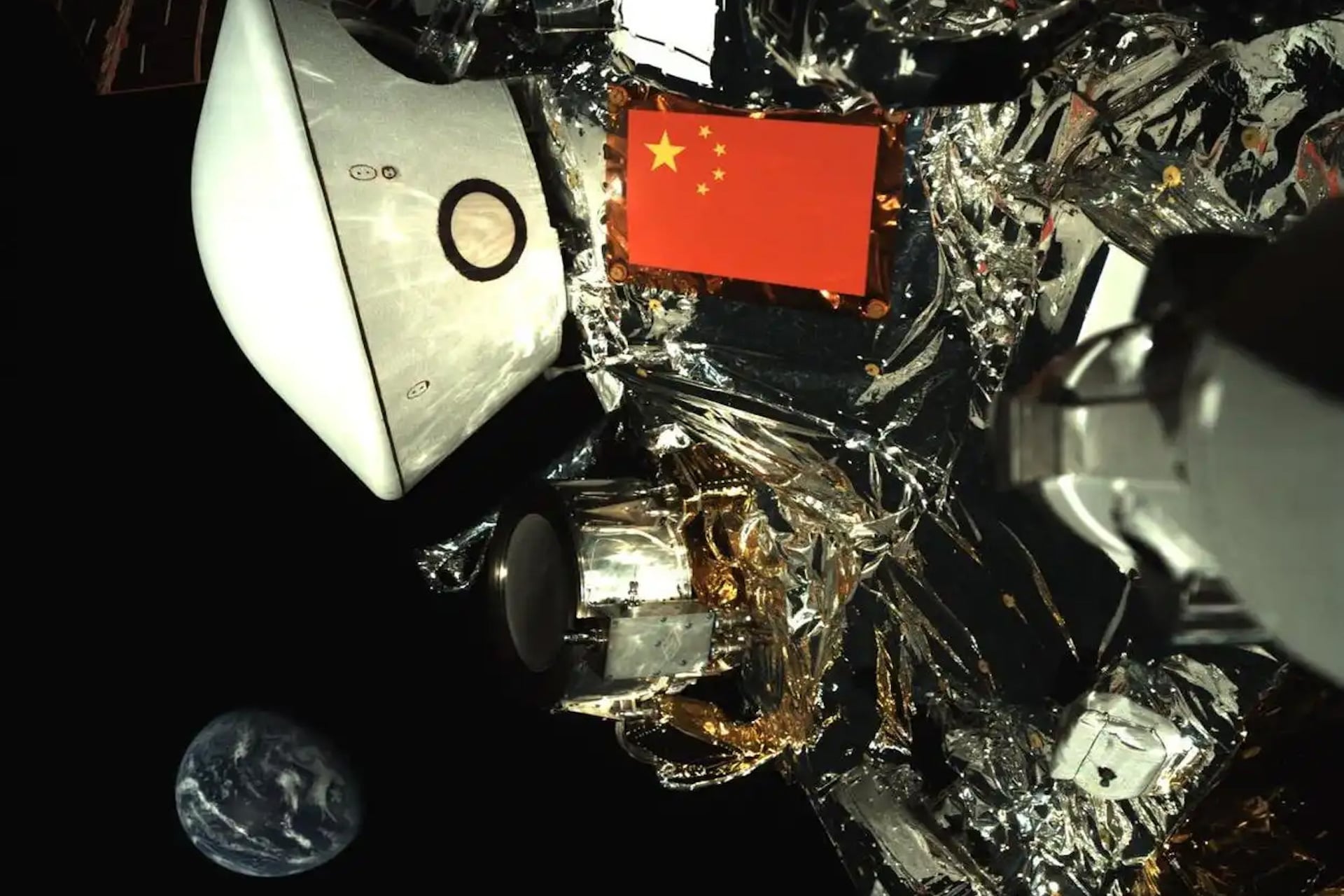
A Chinese probe is set for a historic touchdown on asteroid Kamoʻoalewa, which may have been blasted away from Earth’s Moon millions of years ago after a violent impact.
China’s Tianwen-2 spacecraft launched on May 29, 2025, beginning its year-long journey to the near-Earth asteroid. The spacecraft is expected to arrive at the asteroid in early July, snatch a sample from Kamo’oalewa, and send it back to Earth in a capsule.
If successful, the mission will mark China’s first asteroid sample return mission. The sample will help confirm the origin of the asteroid and piece together clues from the early history of the solar system.
Earth’s quasi-moon
Kamo’oalewa was first discovered in 2016 by the Pan-STARRS 1 asteroid survey telescope on Haleakalā, Hawaii. The space rock measures in at 131 to 328 feet (40 to 100 meters), about the size of the Statue of Liberty.
Kamo’oalewa does not inhabit the solar system’s main asteroid belt between Mars and Jupiter, but instead orbits the Sun at a much closer distance to Earth than other asteroids (at around 9 million miles away from our planet). Following its discovery, Kamo’oalewa (which translates to “oscillating celestial object” in Hawaiian) was found to orbit the Sun in synchronization with Earth. That makes it one of seven of Earth’s known quasi-satellites.
Follow-up observations also revealed that the asteroid’s spectra matched that of lunar rocks from NASA’s Apollo mission. The discovery led scientists to believe that Kamo’oalewa is actually Moon rock, an ancient fragment of the Moon that had broken off by a large impact.
Enter Tianwen-2
Since its discovery, scientists have been fascinated by Kamo’oalewa, as it may hold a piece of the Moon’s early history.
The China National Space Administration (CNSA) launched its Tianwen-2 mission to explore the near-Earth asteroid and uncover its origins. Since its launch, CNSA has shared little information on the spacecraft’s whereabouts and the exact date for its asteroid rendezvous.
Earlier this month, the spacecraft was observed carrying out a series of small propulsive maneuvers that may have been used to set it up for its close approach to the asteroid. Following its rendezvous with Kamo’oalewa, the spacecraft will spend several months conducting remote sensing observations to map the asteroid and pinpoint a potential sample site, according to The Planetary Society.
Tianwen-2 is equipped with 11 science instruments to probe its target and collect between 20 and 100 milligrams of material from Kamo’oalewa. The mission is expected to return the samples back to Earth in April 2027, dropping off a capsule with the material before heading off to explore another asteroid.
The Tianwen-2 mission is also designed to conduct a flyby of main belt asteroid 311P/PANSTARRS. The probe is expected to reach its second target in 2035.