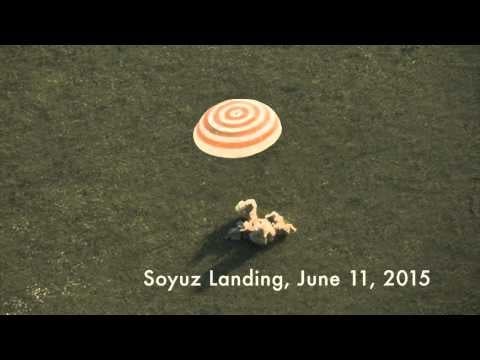
The massive cloud of dust thrown up by the soft landing of astronauts Terry Virts, Samantha Cristoforetti and Anton Shkaplerov when they returned from the International Space Station on Thursday makes it incredibly clear that “soft” is a relative term.
The Soyuz spacecraft made a perfect soft landing near Zhezkazgan, Kazakhstan on June 11, 2015. Image credit: NASA/Bill Ingalls
NASA astronaut Terry Virts, ESA’s Samantha Cristoforetti of ESA, and Roscosmos’ Anton Shkaplerov returned to Earth on June 11, 2015 in this picture-perfect soft landing by the Soyuz spacecraft. But the fiery roar of rockets and massive cloud of dust makes it clear that a “soft” landing is absolutely bone-jarringly harsh.
Virts, Cristoforetti, and Shkaplerov made up half the crew for Expedition 42 on the International Space Station when it launched in November 2014, and in Expedition 43 when it kicked off the Year In Space in March. The mission ran longer than intended after a minor problem cropped up with their Soyuz spacecraft, delaying the return flight.
https://gizmodo.com/an-outpost-nowhere-near-the-end-of-the-universe-1659219637
https://gizmodo.com/year-in-space-for-russian-american-crew-begins-with-spe-1694260890
Today was our original landing date but we got extended, @astrosamantha, @antonastrey and I are very glad to stay! pic.twitter.com/DKDax710XZ
— Terry Virts (@AstroTerry) May 13, 2015
During reentry, the Soyuz TMA spacecraft sheds all non-essential modules, so only the Descent Module containing astronauts returns to Earth. Three hours after undocking, the spacecraft starts heating up from the friction of reentering the atmosphere. Within eight minutes, atmospheric braking slows the craft to the still-blistering 230 meters per second (755 feet/second). Fifteen minutes before landing, two pilot parachutes release, puling a 24 square-meter (258 square foot) drogue shoot that slows the craft to just 80 meters per second (262 feet/second). Finally, the main chute covering 1,000 square meters (10,764 square feet) deploys. It initially re-angles the spacecraft, tilting it to a 30-degree tilt relative to the ground to help Soyuz dissipate heat, then later re-tilts it to vertical, slowing it to just 7 meters per second (24 feet/second). That’s still too fast for landing, so two trios of engines fire to slow Soyuz even further. The end result is a “soft” landing, something still utterly bone-jarring. Thankfully, Soyuz is equipped with some seriously awesome seats to cushion the landing with custom-molded liners fitted to each individual astronauts, easing the shock as they abruptly return to a land of full gravity.
The first training session with «Chibis» suit (lower body negative pressure) – it means a soon returning to the Earth pic.twitter.com/MPVcUMiGJH
— Anton Shkaplerov (@Anton_Astrey) May 26, 2015
By the time they returned home from their second missions, Virts racked up 212 days in space and Shkaplerov made it to 364 days. Meanwhile, as Cristoforetti hit 199 days on her very first venture into space, she’s set a new record for the longest duration single mission for a female astronaut, or for a European Space Agency astronaut.
What a beauty! Our #Soyuz right after undocking – by then, we had been in our seats for well over 2 hrs. #JourneyBack pic.twitter.com/6ujoysj3uD
— Samantha Cristoforetti (@AstroSamantha) June 14, 2015
While in orbit, all three astronauts did a magnificent job of documenting our planet with endless photographs and timelapses.
The last picture I took on this mission. pic.twitter.com/8KqTd8yMOR
— Terry Virts (@AstroTerry) June 11, 2015