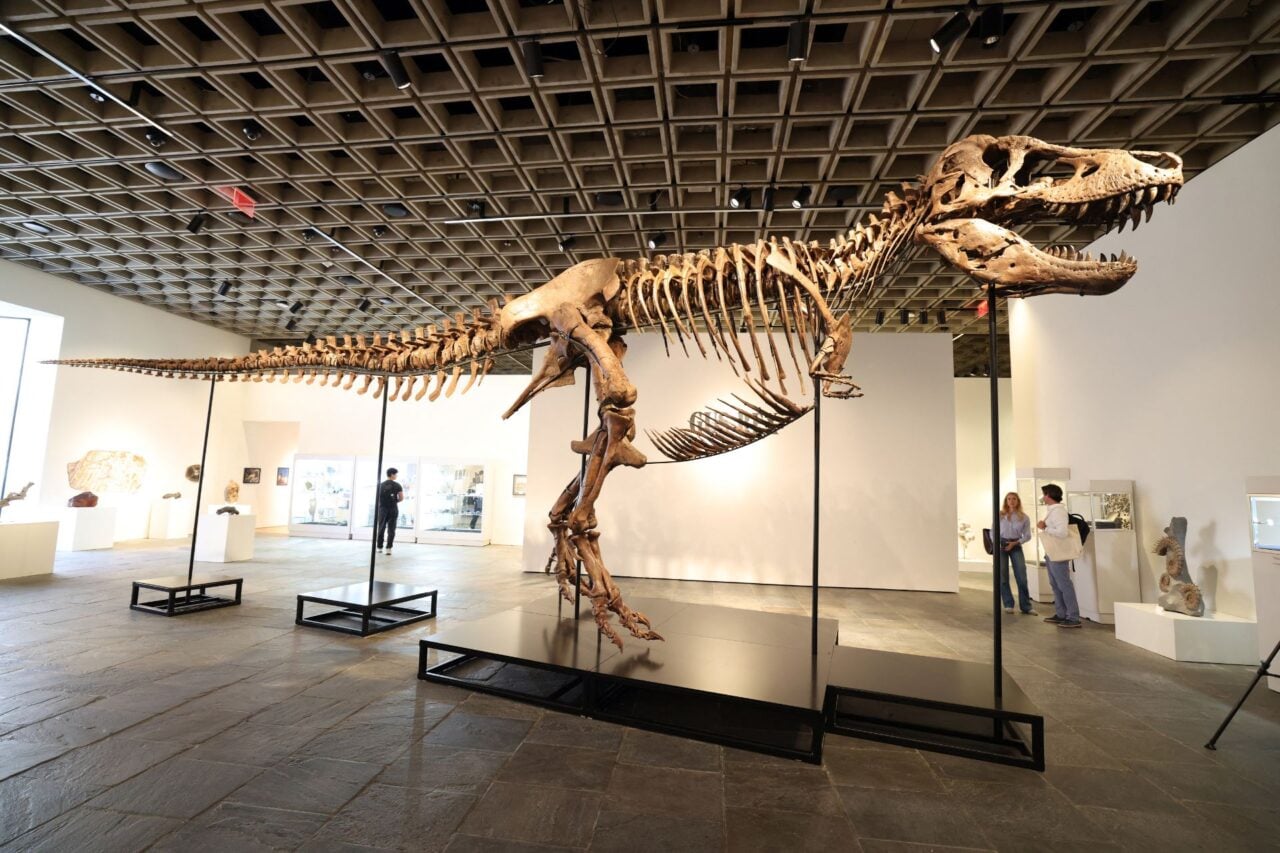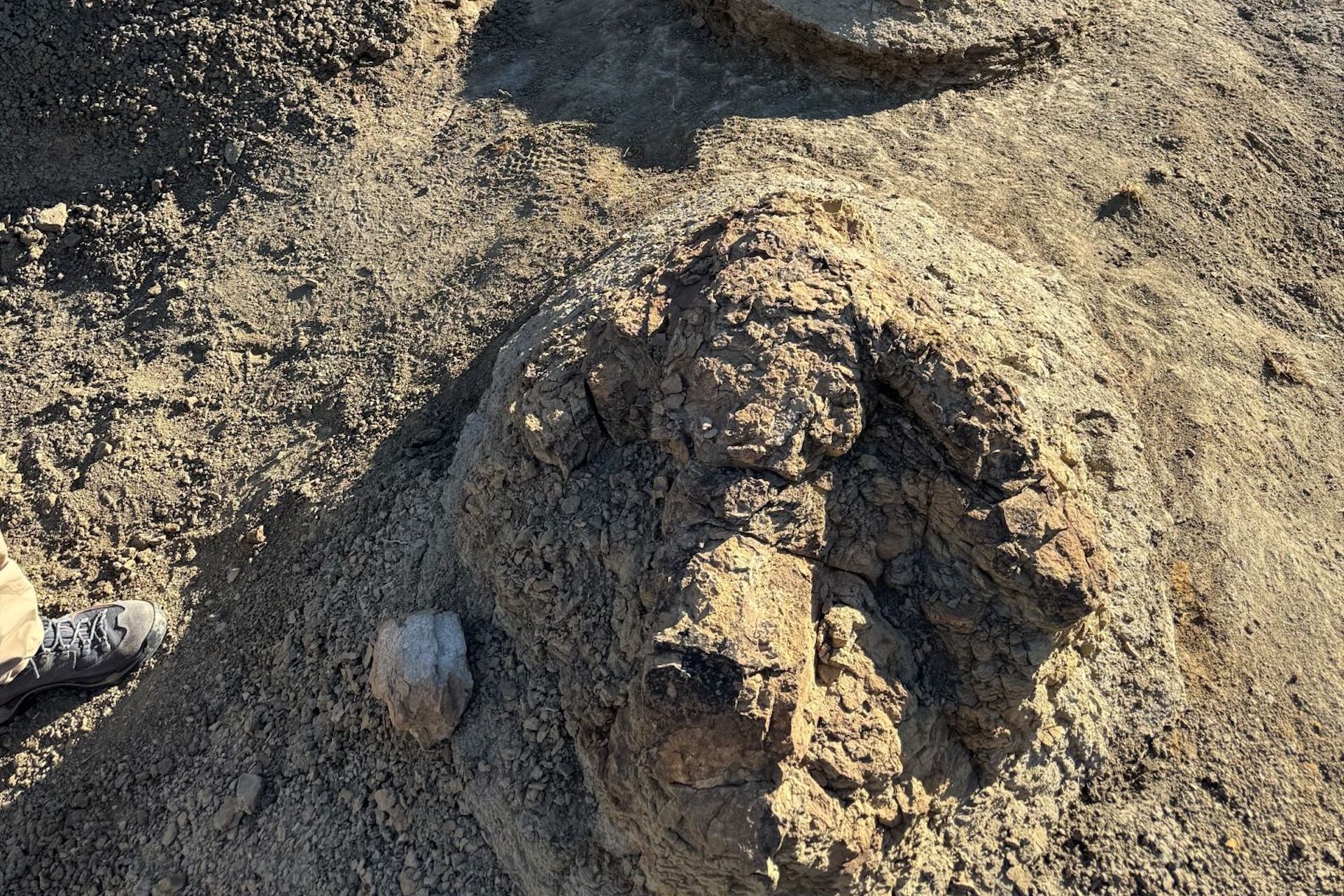
Few dinosaurs are as instantly recognizable as Tyrannosaurus rex, and its fossil remains have been found across western North America. While the bones and teeth of this iconic predator are relatively well known, evidence of how it actually moved across the ancient landscape is far rarer. Now, the discovery of a series of giant footprints offers scientists a rare glimpse into the movement of one of the most famous dinosaurs ever to walk the Earth.
A team of paleontologists have uncovered four three-toed footprints left behind by an adult T. rex in the Hell Creek Formation of southwestern North Dakota. While isolated footprints from the apex predator have been found before, the recent discovery marks the first known trackway of a fully grown T. rex.
The findings, published in the Journal of Vertebrate Paleontology, provide new insight into the behavior of the famous dinosaur as it moseyed its way across an ancient path millions of years ago.
1, 2 step
The trackway was first discovered in 2025 on federal land near the town of Marmath, North Dakota. A team of scientists from the Denver Museum of Nature & Science and Liverpool John Moores University in England identified the footprints as belonging to T. rex due to their massive size and narrow shape of the toes.
“Bones tell us an enormous amount about these animals, but footprints capture a moment of behavior,” Tyler Lyson, senior curator of vertebrate paleontology at the Denver Museum of Nature & Science and co-author of the new study, said in a statement. “With a trackway, we can actually follow an animal as it moved across the landscape. That is incredibly rare for T. rex.”
The researchers imaged each footprint using a high-resolution 3D surface scanner, allowing them to examine the tracks in detail. The entire trackway measures 23-feet long (7 meters), and includes two left and two right footprints. Each of the footprints is about 3 feet (0.91 meters) long, with a stride of about 13 feet (3.96 meters).
The trackway dates back to about 66.5 million years ago, according to the study.
Casual stroll
Based on its path, this particular dinosaur was not in a hurry. The researchers estimate that the T. rex was walking at a pace of approximately 3.5 to 4.5 miles per hour (5.6 to 7.2 kilometers per hour). That’s comparable to a brisk walking speed for a human.
The team of paleontologists is planning to excavate three of the four footprints later this year and transport them to the Denver Museum of Nature & Science by helicopter.
“As a teacher, I’m always telling my students that science starts with curiosity, passion and careful observation,” Kent M. Hups, a teacher at Northglenn High School who discovered the site and co-author of the paper, said. ”I never imagined that could lead me to a discovery like this.”