Pluto remains one of the great generational divides of our time; you either grew up learning about the nine planets of the solar system, or you had an eight-planet childhood like a loser (jk). Although it’s been 20 years since Pluto was overthrown as the ninth planet, the debate over its status still strikes a nerve among dedicated fans of the adorable world.
This week, the debate over Pluto’s official status is once again making the rounds in the news after NASA administrator Jared Isaacman revealed where he stands on the issue. During a hearing before the U.S. Senate Committee on Appropriations, Isaacman shared his thoughts on Pluto, saying that he is “very much in the camp of ‘make Pluto a planet again.'”
The NASA chief’s remarks reignited the long-held debate over whether astronomers should rethink their decision of demoting Pluto to a dwarf planet, an opinion that some people just can’t seem to let go of.
Planetary downgrade
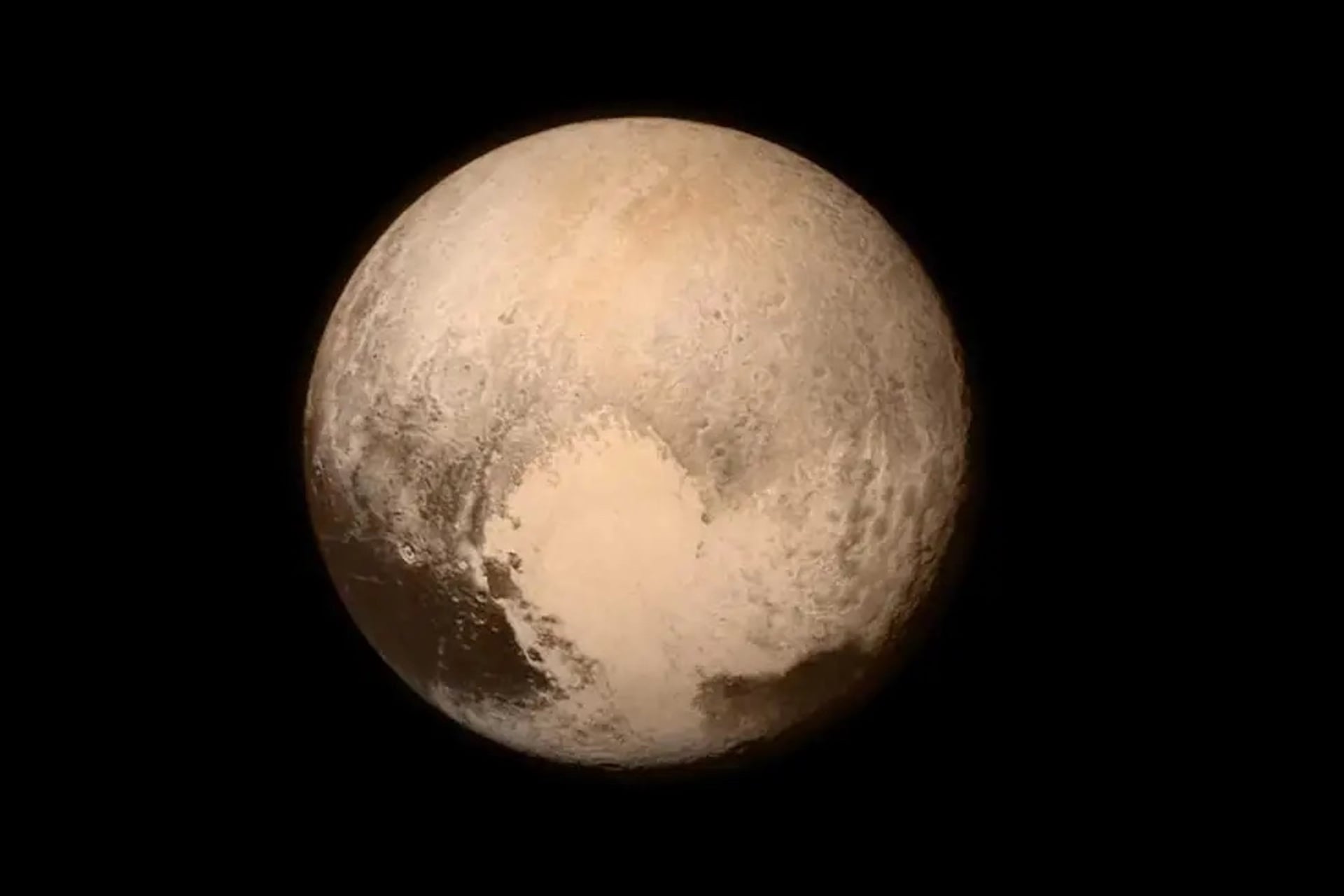
Beyond its planetary classification, Pluto is a complex and mysterious world with valleys, glaciers, mountains, plains, and craters. It lies about 3.6 billion miles away from the Sun, and its frigid temperatures can reach -387 degrees Fahrenheit (-232 degrees Celsius), according to NASA.
Astronomer Clyde W. Tombaugh discovered Pluto in 1930 using imagery captured by Lowell Observatory in Arizona. After its discovery, Pluto became known as the ninth planet of the solar system.
Pluto was still much smaller than its solar system neighbors, measuring at about 1,400 miles wide (2,253 kilometers). That’s about half the width of the United States. It wasn’t until the discovery of similar objects beyond the orbit of Neptune that Pluto’s classification came into question.
The Kuiper Belt is a doughnut-shaped region of icy bodies that extends far beyond Neptune’s orbit, containing left-over remnants from the early construction of the solar system. As scientists learned more about the Kuiper Belt in the 1990s, they found other small, icy worlds that resembled Pluto. This list includes Eris, Haumea, Makemake, Quaoar, and Orcus, among other dwarf planets.
In 2006, the International Astronomical Union (IAU) agreed on a new, more specific definition of a planet, dictating that it must orbit the Sun, be roughly spherical in shape, and have to clear its orbit of debris.
Unfortunately for Pluto, it is located in the trans-Neptunian region (a part of the solar system beyond Neptune), where it shares its orbital neighborhood with many other Kuiper Belt objects of similar size. Pluto doesn’t gravitationally dominate and clear this region, so it failed the IAU’s third criterion for planetary status. As a result, the IAU demoted Pluto to a dwarf planet.
Sorry, Pluto
Although the decision was purely scientific, it left a long-lasting emotional impact on some of those who grew up learning about the nine planets of the solar system.
There is an understandable attachment to Pluto as an underdog, a tiny world cast out into the farther regions of our star system and left behind. Pluto is also famous for having a giant, heart-shaped feature north of the equator, which makes the fan connection to the adorable, tiny world a little harder to deny.
Since its demotion, the debate over Pluto’s status has persisted. Although the IAU still maintains Pluto’s classification as a dwarf planet, there are counterarguments to reclaim its planetary status based on its complex geology, thin atmosphere, and geophysical characteristics.
Isaacman also hinted at research that could support reinstating Pluto as a planet. “We are doing some papers right now on, I think, a position that we would love to escalate through the scientific community to revisit this discussion,” he said during the hearing.
The decision is still up to the IAU, but Pluto’s case may have just reopened with the help of the NASA chief.