Recently, I walked the convention floor of Anime Central, the self-proclaimed largest anime, manga, and Japanese popular culture convention in my stomping grounds of Chicago. While I typically don’t stick around for the full weekend since I’m usually there for work, I always make it a point to see what hidden gems I can find from manga and home video distributors like the incomparable Discotek Media.
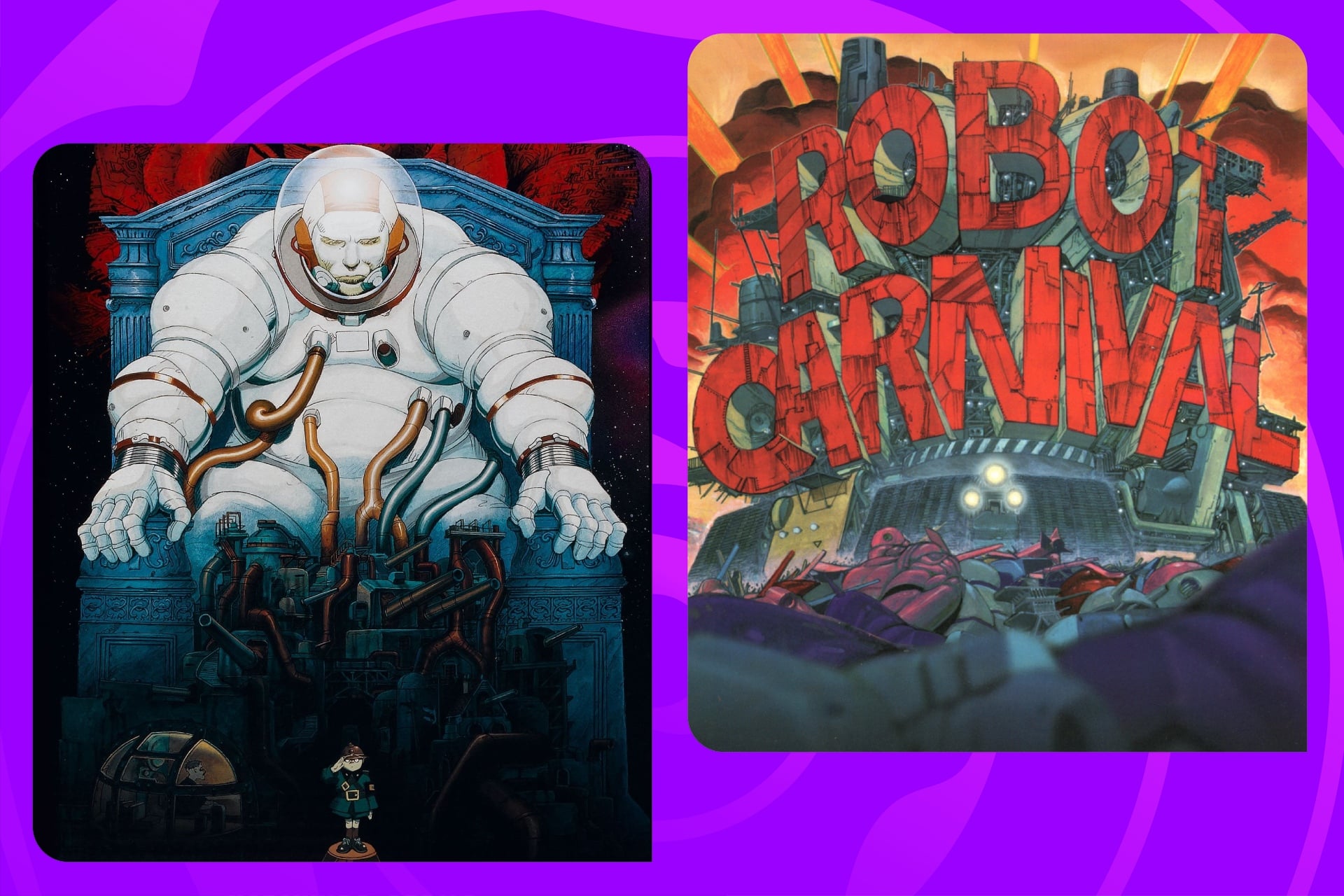
Even though I didn’t fetch the Nana live-action Blu-rays I’d sacrifice my firstborn child for, on the off chance they didn’t sell out (they did), I for sure rubbernecked at the equally tempting copies of Memories and Robot Carnival—two of the greatest anime anthology collections of all time. Their presence not only tempted my baller-on-a-budget ass to make next month’s rent a problem, but they also refueled my desire to see what a renaissance of the format would look like today.
Before you ask, yes, Memories and Robot Carnival have me deep in my “old thing good” bag more than I’d care to admit. Hell, I’ve referenced them whenever I write about anthologies that have nothing to do with them. How could I not? To me, they’re pure forms of creation I hold in high esteem as the metric to measure any that follows. Admittedly, leaving it at “they don’t make anime the way they used to” doesn’t fully capture my longing for anime anthologies.
My problem isn’t that they’re more than my rubric for anthologies that came after them; it’s that it’s so rare for any anime anthologies to come out at all. And by proxy, so are original works, where established and up-and-coming creators get together to make kaleidoscopic visions nowadays as a launching pad for what’s next, instead of playing in a sandbox whose corners have been thoroughly explored or adapting other works.
Let’s start with Memories. Released in 1995, Memories saw legendary creatives like Masao Maruyama (Pluto) work together with Katsuhiro Otomo (Akira), Satoshi Kon (Perfect Blue), Yoko Kanno (composer for Cowboy Bebop, Macross Plus, and Ghost in the Shell: Stand Alone Complex), Tensai Okamura (Darker Than Black), and Kōji Morimoto (founder of Studio4°C).
Likewise, the older Robot Carnival saw a similar showcase of visionary animators. In contrast to Memories, which was comprised of three vividly imaginative short stories, the 1987 anime anthology told nine stories. Alongside Otomo and Morimoto, Robot Carnival‘s anime heavy hitters included key animators Hidetoshi Omori (Mobile Suit Gundam: Char’s Counterattack), Yasuomi Uematsu (Mezzo Forte), Hiroyuki Kitazume (Bubblegum Crisis), Mao Lamdo (Cyborg 009), Hiroyuki Kitakubo (Golden Boy), Takashi Nakamura (Nausicaä of the Valley of the Wind), and Atsuko Fukushima (Ashita no Joe).
Naturally, these lists of names are enough to make anyone’s eyes dilate if they know ball with anime. But what makes them even more remarkable is that, beyond assembling all the best to ever do it in anime, it also served as a gateway for these creatives. Chief among them is that it served as one of Kon’s first major screenwriting gigs, as Otomo’s return to making short stories after Akira, as the establishment of Studio4°C’s titular aesthetic on a big stage before they hit it big, and as a testing ground before Okamura made Darker than Black. And that’s really fucking cool to think about how an anime anthology encompassed all that.
Of course, that’s not to say that anime anthologies as we know them are a relic of the past. Projects like Star Wars: Visions, Love, Death + Robots, and Secret Level have kept that energy alive, showcasing what studios around the world can do when allowed to run as far as their artistic abilities can take them. And what they have to show for it, whether that’s expanding the small confines of a galaxy far, far away, recontextualizing classic games, or presenting incredible speculative fiction short stories, is remarkable in its own right. They do a valiant job keeping their flames alive.
Despite being the worst streamer for animation—a sentiment that gets truer with each passing day—I also have to give props to Prime Video for Tatsuki Fujimoto 17-26, one of the latest examples of this high I’ve been chasing. It saw the cooperative efforts of studios P.A. Works, Zexcs, Lapin Track, Studio Kafka, 100studio, and Studio Graph77 adapt eight short stories from the Chainsaw Man creator before he became a household name with Fire Punch.
Even the miracle of Tatsuki Fujimoto 17-26 existing as a time capsule of one of manga’s great auteurs barely scratches at the itch I have for the return of anime anthologies. A lot of that has to do with the fact that those shorts were adaptations of stories I’d already lived with, with studios working within the contours of a single mind. And as close as it gets to restoring that feeling, Tatsuki Fujimoto 17-26 effectively felt like a damp cloth to wet my cracked lips. To push this metaphor further, Immortan Joe was right about not becoming addicted to water lest you curse its absence, because reviewing it only made me hunger to see a coalition of studios crack open the hydrant and make original, breathtaking anime anthologies like the days of old.
That’s not to say that it hasn’t happened recently. In fact, my recent droplet of reprieve came in Adult Swim’s The Elephant, which brought together Cartoon Network legends Pendleton Ward (Adventure Time), Rebecca Sugar (Steven Universe), Patrick McHale (Over the Garden Wall), and Ian Jones-Quartey (OK K.O.! Let’s Be Heroes) to make an animated version of the exquisite corpse game, creating an animated tale without knowing what the others were cooking up. But even that was described by the creators as a wild bit of creative freedom that they were lucky to be part of in today’s world.
And beyond The Elephant, I’ve made peace with getting a kick out of spinning the block on anime filler to fill the hole anthologies once housed. Back in the day, filler wasn’t Gen-Z shorthand for an episode that was filibustering with boring non-canon detours from the source material to rage-bait them. Filler, in its truest sense, was a phenomenon where animators could break from the manga to cook up original stories whenever an anime would stray from its source material (or its creator got sick), and there’s some really great filler out there that elevates the source material in ways the manga never did.
Sadly, the era of 26-50-episode anime that led to filler seasons is gone, along with the space for animators to stretch their creativity, add imaginative flair, and make a name for themselves by helming those episodes. Which brings me back to my desire for anime anthologies to fill the void that filler once served, as anime has modernized from a niche hobby to a mainstream hit.
But as a lifelong anime fan who gets giddy seeing how the sausage is made—gawking at Dan Da Dan key animation posts, tracing an auteur’s early quirks as they seep into their magnum opus, and reading archival interviews where artists reveal their inspirations—I can’t help but daydream about what it’d look like if Science Saru, MAPPA, Trigger, Bones, and my other favorite studios and creatives got together like the old days of animation to make a brand new anthology.
In my waking dreams, I imagine a modern-day anthology that’d stand shoulder to shoulder with Memories and Robot Carnival (so I’d stop nostalgically waxing poetic about them). But for now, that dream will remain just that. Still, you can’t fault me for holding out hope that it will become a reality in my lifetime.
Want more io9 news? Check out the best movies and TV shows to stream this month and all the upcoming sci-fi, fantasy, and horror books that should be on your radar.