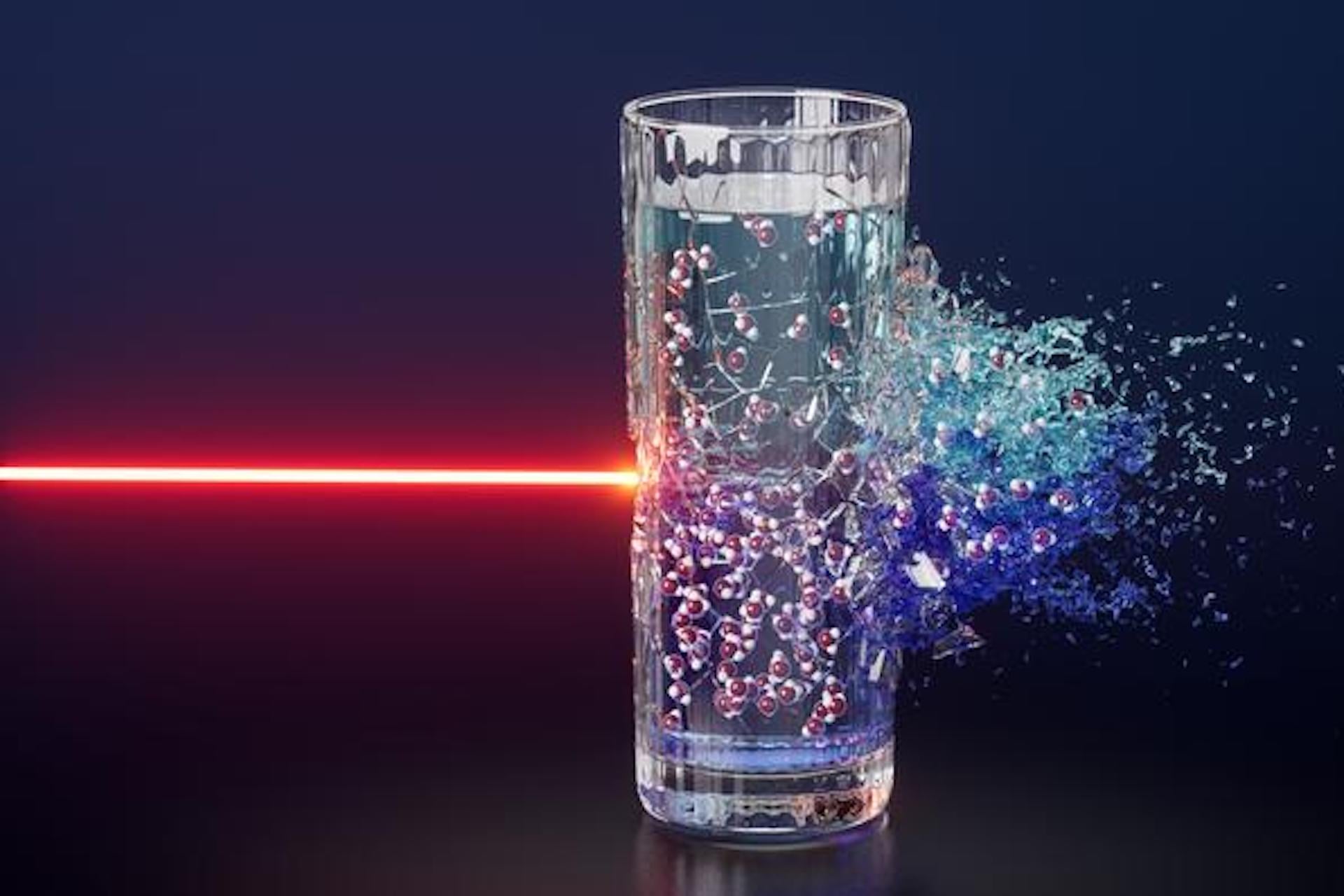
Around 70% of Earth’s surface is covered in water, a uniquely anomalous substance that often behaves differently compared to other liquids. Now, a new scientific finding may help explain what makes water so strange, catching a rare glimpse of it before it freezes and turns to ice.
You may not have thought about it much, but water is incredibly weird. Water’s properties, such as its density, viscosity, and heat capacity, respond to temperatures and pressure in ways that seemingly defy the laws of nature. While other liquids become increasingly dense as they are cooled down, water is denser as a liquid than as a solid. That’s why ice cubes float in a glass of water.
To help explain water’s odd behavior, a team of researchers from Stockholm University used X-ray lasers to probe water when it’s deeply supercooled. The team’s findings, published last week in Science, reveal evidence of a critical point tied to two distinct liquid states at extremely low temperatures.
Cold as ice
Normally, all matter shrinks when it is cooled, resulting in an increase in density. Water, on the other hand, is at its densest at 39 degrees Fahrenheit (4 degrees Celsius). If you chill water below that temperature, it starts to expand again. Water’s expansion rate even starts to speed up the colder it gets.
“For decades there has been speculations and different theories to explain these remarkable properties and one theory has been the existence of a critical point,” Anders Nilsson, professor of chemical physics at Stockholm University and co-author of the new study, said in a statement. “Now we have found that such a point exists.”
The researchers behind the new study used ultra-fast X-ray laser pulses, allowing them to observe water at incredibly short timescales. “What was special was that we were able to X-ray unimaginably fast before the ice froze and could observe how the liquid-liquid transition vanishes and a new critical state emerges,” Nilsson said.
When 2 become 1
By probing water quickly enough to capture its structure before it crystallizes into ice, the researchers found that water can exist as two distinct liquid phases with different molecular bonding structures under low temperatures and high pressure. The two forms of water then become indistinguishable as a single phase at the critical point.
Water’s molecular dynamics slow significantly as it nears the critical point, according to the study. “It looks almost that you cannot escape the critical point if you entered it, almost like a Black Hole”, Robin Tyburski, researcher in chemical physics at Stockholm University and co-author of the study, said in a statement.
The critical point could help explain water’s strange properties. As water approaches this point, it becomes unstable and shifts between the two liquid states on a microscopic level. These fluctuations are what give water its unique abilities.
“There has been an intense debate about the origin of the strange properties of water,” Nilsson said. “Researchers studying the physics of water can now settle on the model that water has a critical point in the supercooled regime.”
“The next stage is to find the implications of these findings on waters importance in physical, chemical, biological, geological and climate related processes,” he added.