Scientists believe nearly all massive stars destined to explode as supernovae exist in binary or multi-star systems. Despite this, no one had ever detected a binary pair of supernovae—until now, perhaps.
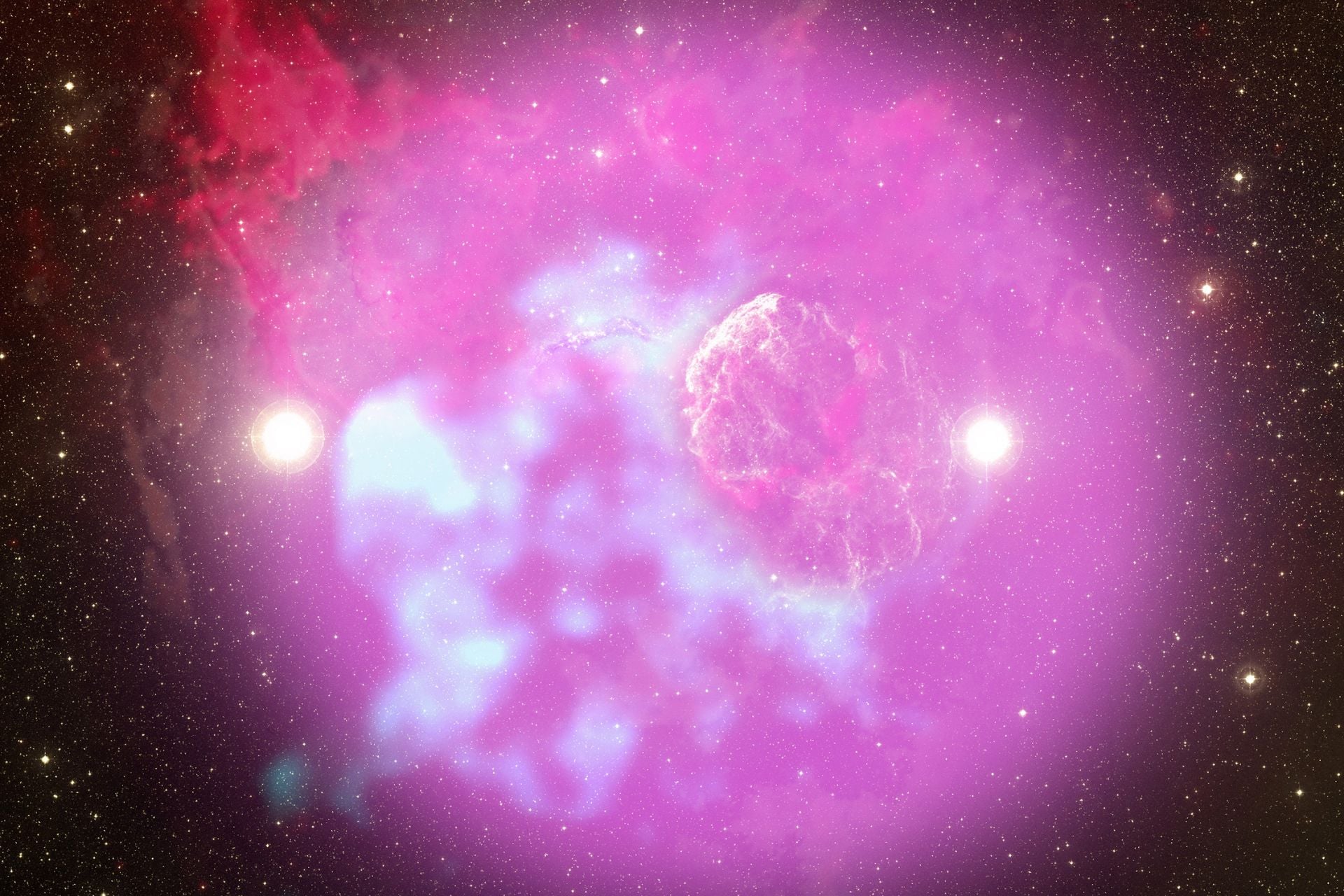
According to new research, one of the best-studied supernova remnants in our galaxy—IC 443, also known as the Jellyfish Nebula—may have been hiding a sibling this whole time. The findings, published today in the journal Nature Communications, describe supernova remnant G189.6+3.3, which has long been obscured by the glare of IC 443. Using 16 years of observations from NASA’s Fermi Large Area Telescope combined with X-ray and multiwavelength data, the researchers uncovered G189.6+3.3 and determined that it and IC 443 are likely the ghosts of a binary star system.
“Although we are as conservative as possible and we use the word ‘candidate’ because we can’t be 100% sure, it is very unlikely that this is a chance alignment,” lead author Miltiadis Michailidis, a postdoctoral scholar of physics at Stanford University, told Gizmodo. Based on multiple lines of evidence, he and his colleagues believe it is “very likely” that they have made the first detection of supernova remnants that originated from a stellar binary.
Confirming the nature of G189.6+3.3
IC 443 is a bright supernova remnant in the constellation Gemini, located about 6,000 light-years from Earth. It lies in a complex environment that includes the S249 H II region—a vast cloud of ionized hydrogen gas—and several neighboring astronomical structures.
Scientists have extensively studied IC 443 and its surroundings, but the remnant’s brightness and its crowded cosmic neighborhood have made it difficult to separate overlapping sources of radiation. In 1994, the ROSAT All-Sky Survey imaged the region in X-rays for the first time, revealing another possible supernova remnant, dubbed G189.6+3.3.
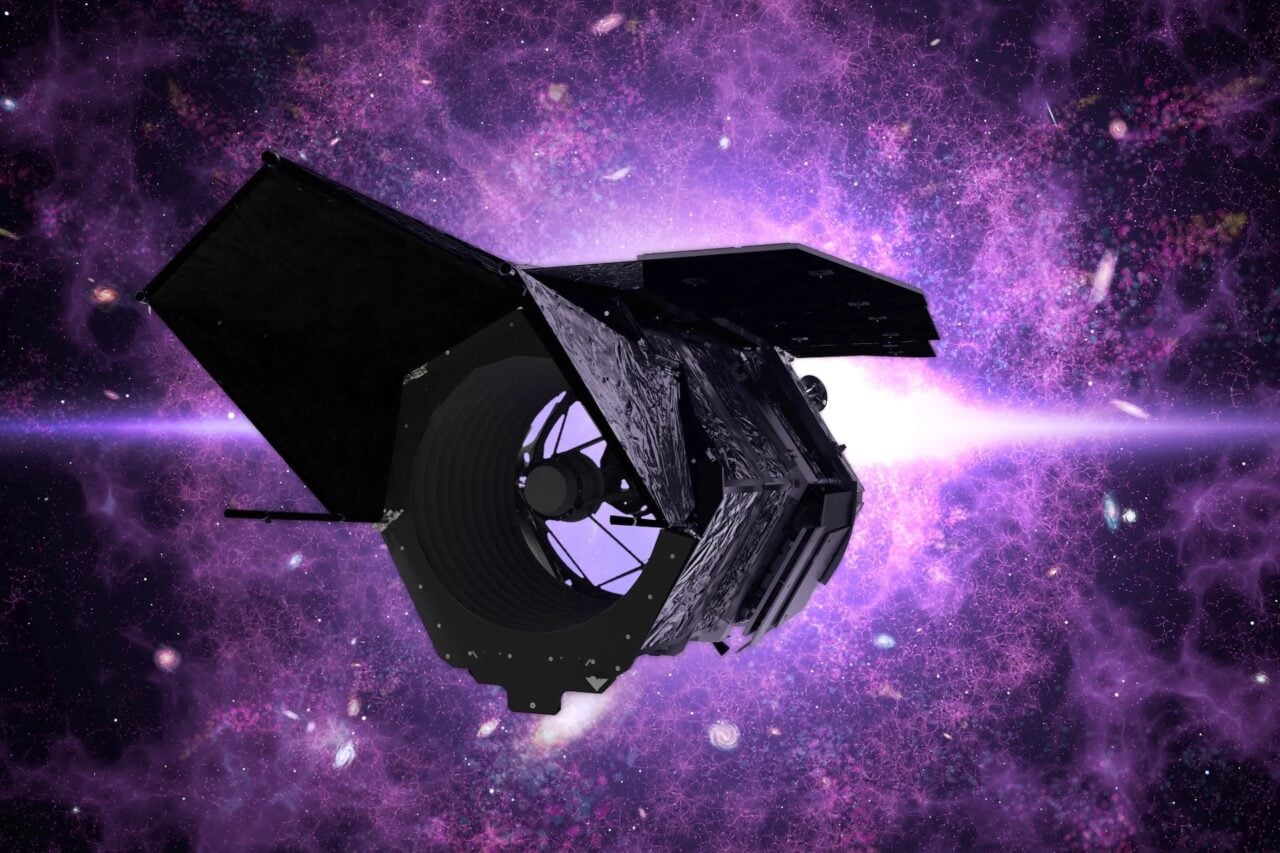
Now equipped with more than a decade of gamma-ray observations from the Fermi Large Area Telescope, Michailidis and his colleagues have taken a closer look at G189.6+3.3. This telescope has been orbiting Earth since 2008, scanning the entire sky for gamma rays every three hours.
“It is not a brand new telescope, but what this telescope does is stack data,” Michailidis explained. Years of continuous observations have provided researchers with much stronger statistics, helping them better distinguish individual gamma ray sources and separate faint signals from background noise.
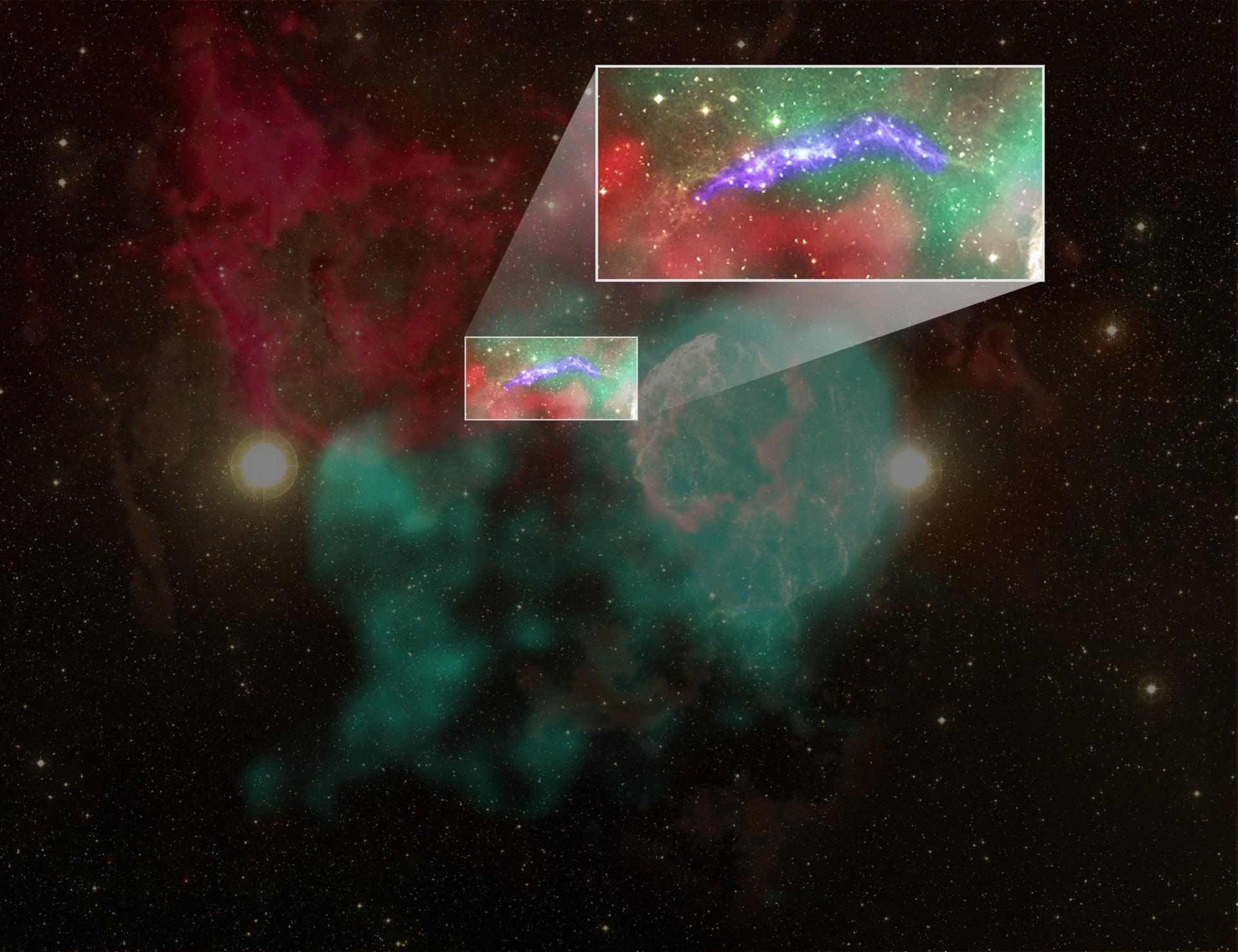
His team used this data to isolate the gamma ray emissions from IC 443 and investigate what lies behind this nebula, confirming that G189.6+3.3 is independently emitting gamma rays. But to determine whether it is indeed a supernova remnant, the researchers needed to test whether it could accelerate particles.
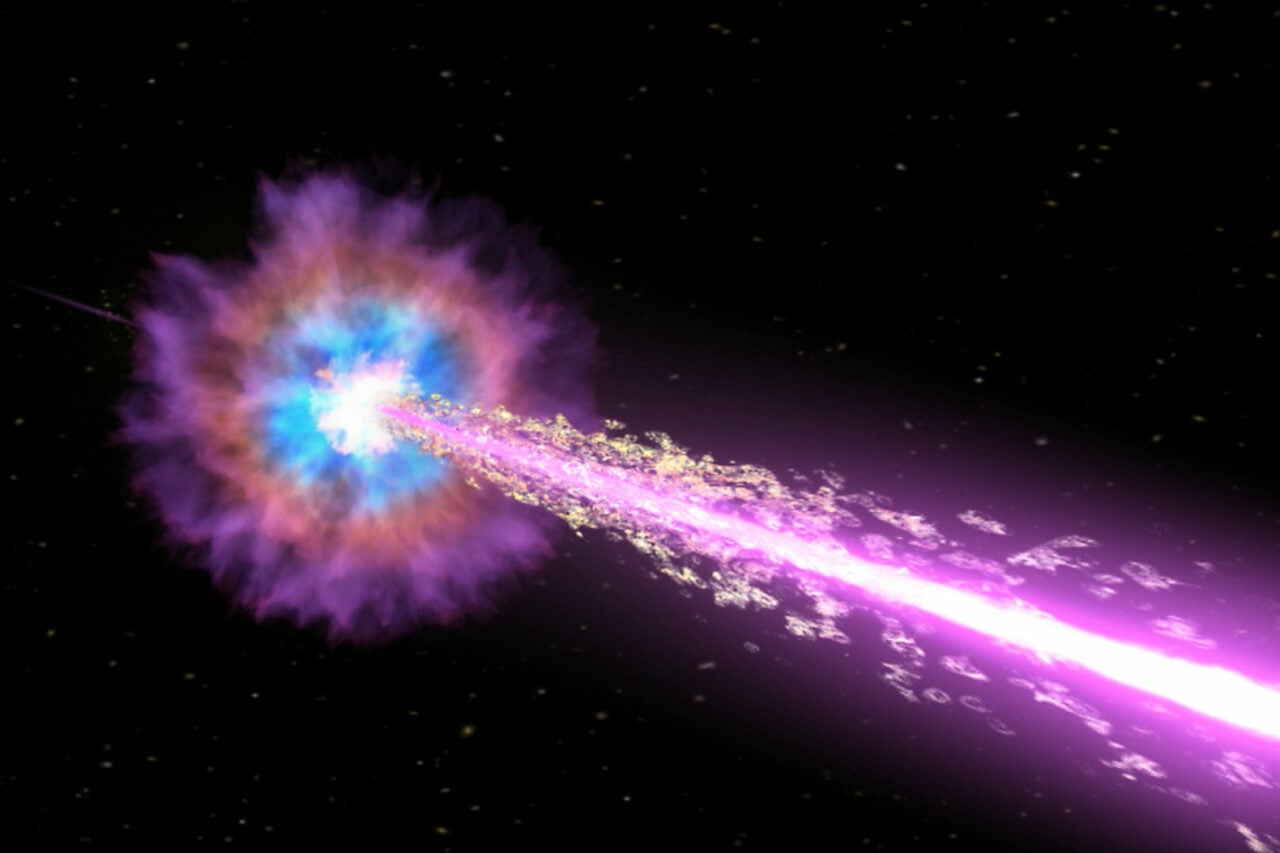
Imagine a drop of water falling onto the still surface of a lake, causing ripples to emanate outward from the point of contact. “For a supernova remnant, it’s exactly the same thing,” Michailidis explained. The explosion creates a shock wave that propagates through space away from the center of the blast. Because these waves are rippling outward at such high speeds, they’re able to accelerate particles.
By analyzing its gamma-ray emissions, the researchers showed that G189.6+3.3 accelerates protons and electrons to enormous energies, confirming that it is a supernova remnant. This was an important discovery in its own right, but when Michailidis and his colleagues performed a spectral analysis, things got even more interesting.
Ghosts of a binary star system
That spectral analysis revealed something never seen before in a supernova remnant: different regions of G189.6+3.3 were producing gamma rays from different types of high-energy particles. The gamma rays linked to protons came from a shock-heated ultraviolet filament where the remnant collides with a giant cloud of gas—the same cloud interacting with IC 443.
This suggests the two remnants are in the same vicinity and are located at roughly the same distance from Earth, leading the researchers to believe that they originated from stars that once comprised a binary system.
However, it’s also possible that these two remnants were individual stars that just happened to be aligned in space when they died. Michailidis and his colleagues ran a statistical analysis to explore that possibility but found that the odds of a chance alignment were one in 1,000. It is therefore much more likely that IC 443 and G189.6+3.3 are the remnants of a binary star system.
The first detection of a candidate binary supernova system isn’t just significant for its novelty. The researchers believe their findings have major implications for the field of astrophysics. For example, they could help scientists solidify constraints on the death stages of massive binary stars, such as how much time passes between each supernova or what causes massive binaries to survive or become disrupted following one or both explosions.
“Now that we have the first system—the first observable system—that we can actually use to make measurements, calculations, and set constraints, we can go through a list of things that we can do from now on that were simply not possible before,” Michailidis said.