If you use Avast’s VPN, you have probably noticed (or you will in the next few days) that the app now calls itself Avast Premium VPN, and you may have wondered what it did with SecureLine. Don’t worry, it’s the same thing: since October 8 that is simply the new name of the product and the app, your account, the servers and the price are exactly where you left them so there is nothing for you to do.
The new name makes more sense once you know about Avast One, which is the bigger change at Avast this year. Instead of a separate app for each product, there is now a single platform with everything inside it: you install it, the free antivirus is right there, and the VPN sits in the same sidebar next to tools like Cleanup or AntiTrack. Each of those works like a brick that you pay for only if you want it, so someone who just needs a VPN buys the VPN and isn’t charged for a pile of services they will never open (we go through the whole thing in our Avast antivirus review).
See what’s inside Avast Premium VPN
What I find even more interesting is everything Avast did to the VPN itself over the summer, because it has been a while since we saw a provider ship this many features in such a short time.
What Avast Added in August
The first one is Double VPN which sends your traffic through two servers instead of one so that the second server never sees your real IP address. It isn’t new in the industry, you’ll find it at all the big names like Proton VPN or NordVPN but that is sort of the point: Avast didn’t have it before and with this update it is getting really close to what those two offer.
The one we spent the most time with is IP Rotation and it’s worth explaining because it is rare, even among the big VPNs. Normally, when you connect to a VPN server, you are given one IP address and you keep it until you disconnect which means every site you visit during that session sees the same address. With IP rotation switched on, Avast replaces that address with another one from the same country at regular intervals (every 30 seconds by default) and it does this without cutting the connection so whatever you are watching or downloading just keeps going. On paper you could argue it doesn’t change much, since Avast’s policy says it keeps no record of what you do online anyway (no log VPN) but the sites you visit still see your address and one that keeps moving is harder for them to follow, so I see it as an extra layer of security.
Avast also talked on its blog about a new Pause button which turns the VPN off for a set time and then turns it back on by itself. It’s practical in some cases, typically when your bank’s site or a streaming app refuses to load with a VPN, and a few other VPNs have had something similar for a while. One small warning with this kind of feature: because it reconnects on its own, you tend to forget the VPN is back on, so if a site starts acting up a bit later, that is the first thing to check.
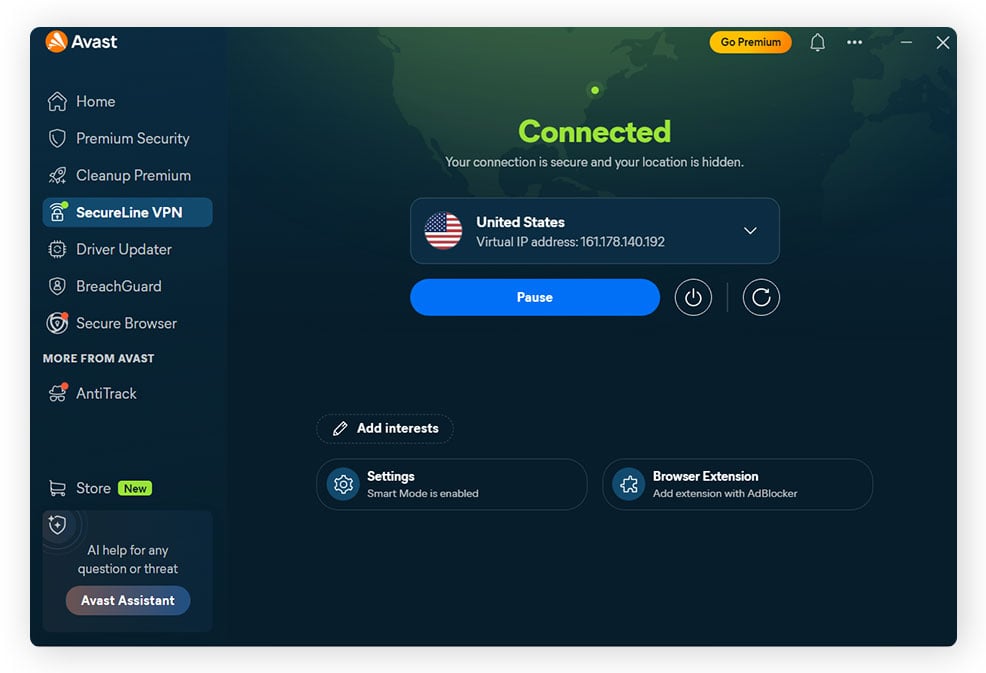
What Our Updated Review Found
We retested the whole thing in August and the result has very little to do with the Avast VPN we remembered a few years back, which covered only 34 countries, blocked torrenting and lost Netflix every few months. The current version covers 103 countries, has dedicated P2P servers and runs WireGuard next to Avast’s own Mimic protocol.
What struck us most was the speed on nearby servers: from our 190 Mbps line in Belgrade, connecting through London cost us 1.9% of our download speed which is so little that you would never notice it in daily use. Netflix opened in the eight regions we tried, on regular servers and without any fiddling, our leak tests came back clean, and Mimic even got us connected from Shenzhen in July, which very few VPNs can still do. Faraway servers like Tokyo are noticeably slower, and Avast still sits just outside the top three of our ranking, but the gap with NordVPN and the others is nothing like what it used to be.
As for the price of the VPN, it didn’t change with the name: it starts at $3.99 a month on the two-year plan for 10 devices, it also comes inside Avast Ultimate with the antivirus we reviewed this summer, and there is a 60-day free trial if you’d rather see all this for yourself before paying.