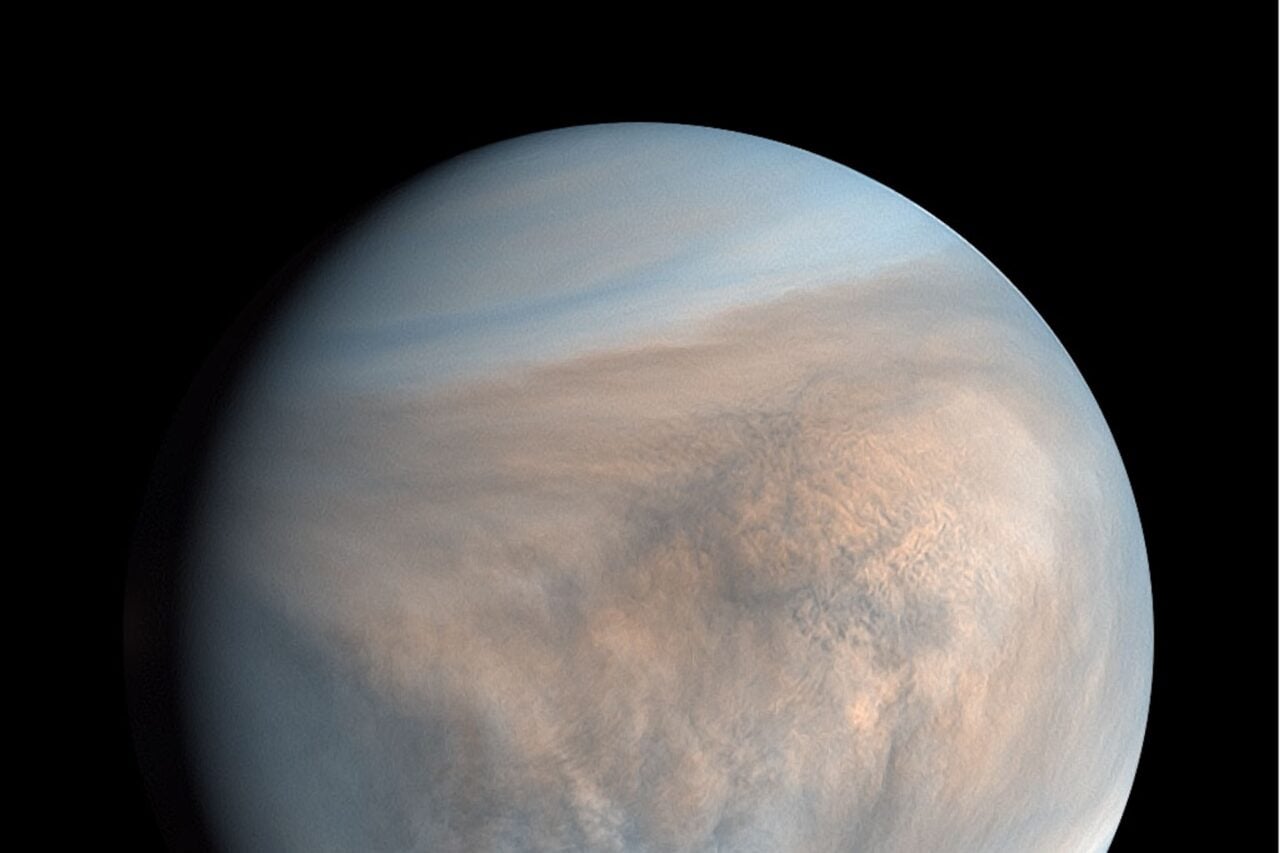
Venus is often called Earth’s twin. The two planets are remarkably similar in size, mass, and composition, and both formed in the same region of the solar system. Yet despite these similarities, Venus has one striking difference: it has no moon. The absence of a natural satellite has puzzled scientists for decades. Now, a new paper explores a surprising possibility: Venus may not have always been moonless, but its moon could have met a violent end.
To find out what might have happened if Venus had a moon of its own, a team of scientists ran simulations of the planet with a hypothetical satellite companion. In almost all scenarios, the Venusian moon’s fate was sealed as it was consumed by the planet.
The findings, available on the preprint website arXiv, could help scientists learn more about the planet’s potentially habitable past.
Moon on the menu
Earth’s Moon likely came to be in the aftermath of a giant impact that struck the planet, leaving the shattered material in an orbiting ring that eventually coalesced into a proto-moon. Based on what scientists know about the early solar system, it is unlikely that Venus would have avoided a similar, moon-forming collision billions of years ago.
And yet, Venus is one of two solar system planets without a moon. The other planet is Mercury, which is too small and too close to the Sun for its gravity to hold onto an orbiting satellite. The reason why Venus lacks a moon of its own, however, remains a mystery.
The scientists behind the new study, led by Stephen Kane at the University of California, Riverside, created a simulation to model the gravitational tug between Venus, its hypothetical moon, and the Sun over billions of years. They factored in a wide range of possibilities for how fast Venus was spinning and how massive its moon may have been to examine different scenarios.
The models revealed a moon about half the mass of Earth’s natural satellite could have survived in Venus’ orbit for 1.7 billion years. If the moon were twice as massive as our own, it would have survived for only 30 million years around Venus due to a stronger tidal effect.
Sealed fate
Despite the different variabilities, the outcome for a Venusian moon remained the same.
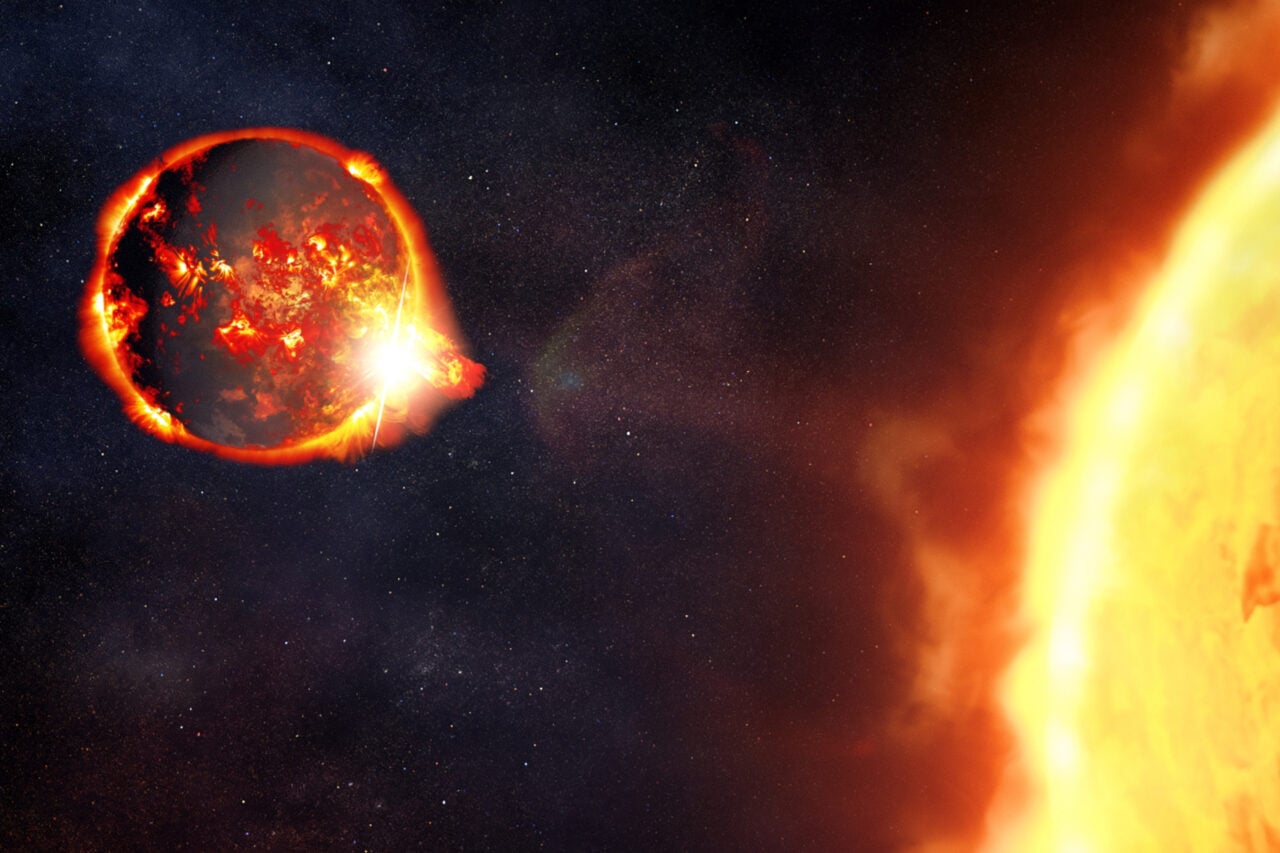
Following its formation, the moon would have drifted outwards until it reached a boundary known as the Roche limit, which is the point at which the tidal effects of a larger body start to overcome a smaller object. At that point, Venus’ gravity would have torn the moon apart, and the remaining debris would have been swallowed up by the planet’s atmosphere.
With nothing left of Venus’ potential long-lost moon, it is pretty difficult to be able to gather evidence to support this theory. If Venus did have a moon at some point, however, it may have played a part in the planet’s possible habitability billions of years ago.
Scientists believe Venus may have had a shallow liquid-water ocean and habitable surface temperatures for up to 2 billion years of its early history, according to findings by NASA. Venus may have formed from ingredients similar to Earth’s, but it later followed a very different evolutionary path, becoming the hellish planet we know today.
The two planets, Earth and Venus, may have had more in common at some point, even the presence of an orbiting companion.