I’m still reeling
from the whirlwind of She-Ra and the Princesses
of Power’s final season. But even in a season full of excitement and
warfare, what sticks with me about the show isn’t the big, dramatic setpieces.
It’s how well the show understands what it means to grow.
 The character arc
that sticks out to me the most might be Shadow Weaver (Lorraine Toussaint). The most striking thing
about Shadow Weaver is that she doesn’t change, not really. Even at the final
moment, when she sacrifices herself to protect Catra (AJ Michalka) and Adora (Aimee Carrero), when she says the
one kind thing Catra has waited her entire life to hear, it’s not exactly
redemption. Shadow Weaver is positioning herself in the role she, in one way or
another, has sought her entire life. Powerful, important, a force to be
reckoned with. Unlike her surrogate daughters, she doesn’t live long enough to
really answer for her mistakes. As showrunner Noelle Stevenson herself has pointed out in interviews, one sacrifice doesn’t a hero make.
Shadow Weaver’s
journey from villain to mostly villain isn’t the first lesson the show wants to
teach about character growth, but it’s one of the most important. To understand
how people grow, you have to understand that some people won’t. Redemption is hard-earned,
and it’s not a journey everyone’s willing to take. Some people are villainous
in mundane, casual ways, and they’ll stay that way forever.
That point is
important because redemption arcs—stories where villainous characters who have
done wrong turn to the side of good—can be an uncomfortable subject for some
people. In a lot of stories, redemption is a lazy way out, a way to put a neat
satisfying bow on a story that hasn’t earned it. It can also be a way of
weakening a story by making it feel emotionally dishonest, by offering
redemption to characters whose crimes seem too large to atone for, whose evils
would realistically not be easily forgiven by those around them. It’s not fair
to expect stories, even kids’ stories, to be simplistic morality tales—it’s
okay and interesting to sympathize and engage with “bad people” in
fiction. But we want stories to communicate something true, emotionally if not literally. Bad redemption stories don’t
resonate with our sense of what’s true about people.
Shadow Weaver’s
complex half-redemption feels like a gesture toward that dissatisfaction
redemption stories often create, an admission that growth is extremely
complicated. It’s an admission that opens the path for She-Ra to fully enjoy the slow, messy redemption of Catra.
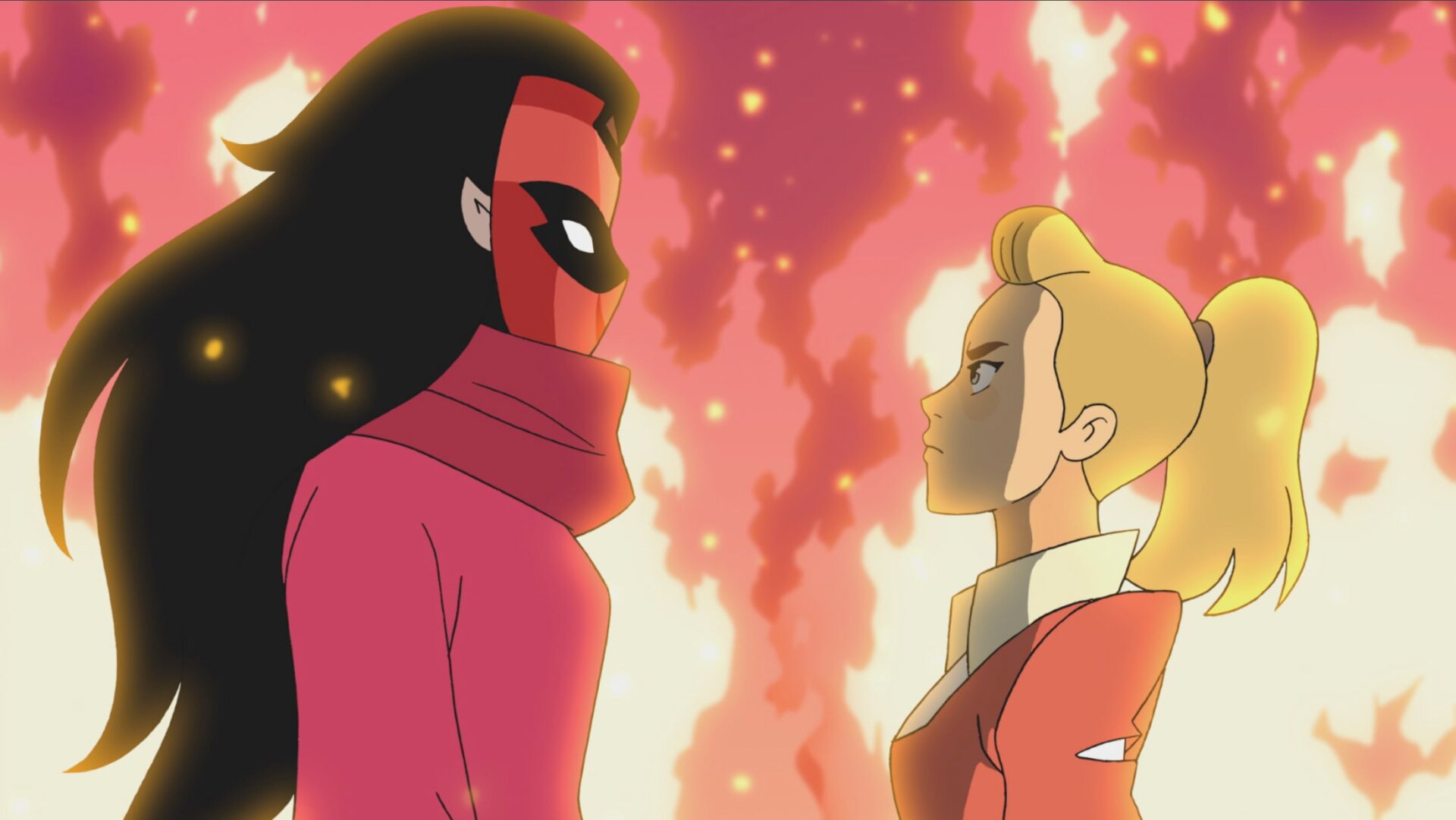
Maybe redemption is
the wrong word. For Catra, it feels more like maturation. Catra begins the
story lonely, under the yoke of a terrible mother figure and suddenly bereft of
the only person who she thinks has ever cared about her. Her story is one of coping
with trauma, terribly, until, finally, at her very last opportunity, she
decides to try to do it right. All of the awful things she does in between
those two moments—losing Adora in season one and trying to save her in season
five—are an attempt to mollify her own sense of rejection, to justify her own
suffering. When I’m in charge, Catra seems to think, no one will be able to
hurt me again. This will all, somehow, have been worth it. Her serious of
villainous successes and near-misses throughout most of the series serve, in
her story, largely as mounting evidence that no amount of victory in the world
can undo her hurt. That takes a different kind of work; reconciliation,
compassion, love.
What I love about
Catra’s storyline in She-Ra, and the way
it culminates in the last season, is how hard the show works to make you
understand, if not sympathize, with Catra’s point of view. Stevenson and her
writing team have a deft understanding of trauma and the way it manifests in
the lives of their characters, in the way Adora and Catra both are, in
fundamental ways, shaped by the same terrible experiences, and how that shared
history bonds them and also makes it incredibly difficult for them to finally,
really connect.
Catra, for a long time, absolutely sucks. She almost kills
people she loves. She alienates the few people actually on her side. At one
point, she nearly eradicates reality out of spite. None of that is easy to
sympathize with. But despite the fantastical circumstances and the big, ugly
gestures they allow (most of us will never have the chance to send our ex
through a maelstrom of collapsing space-time), Catra’s behavior is grounded in
the mundane reality of the traumatic experiences she went through.
Catra’s grounding is
important, I think, because good redemption stories are always about the
perspective in which they’re told. Fundamentally, stories about characters
undergoing moral struggle—trying to figure out and do the right thing, the
healthy thing—are stories we tell about ourselves. When we connect to those
stories, it’s about us seeing the successes and failures of the characters in
our own moral struggles. Characters like Shadow Weaver and Catra resonate
because they tell us about ourselves.
Shadow Weaver is ultimately just a
metaphor: the bad, abusive mentor who lives on in your memories and in that
ugly voice in the back of your head, whispering awful untrue things. And Catra
is a personal dramatization of the struggle to try to make more and better out
of what we’ve been given. She-Ra gets
its character growth right because it understands that, ultimately, one of
those things deserves to be honored and saved. And for the other, maybe the
best fate is to just end.
For more, make sure you’re following us on our Instagram @io9dotcom.