
A cloud upload takes minutes on most home connections, because upload speed is a small share of download speed, and that limit applies to every service. After testing 20+ cloud services, I timed eight of them in October, moving one 500 MB archive up to the cloud and back down.
pCloud was the fastest cloud storage overall, finishing the round trip one second ahead of Dropbox and Google Drive, while Dropbox recorded the quickest single upload. Internxt led the services that encrypt every file on the device. The spread was small, though: all eight finished their uploads within 40 seconds of each other.
Fastest Cloud Storage for 2026
- pCloud: Fastest combined upload and download, at 3 minutes 56 seconds
- Internxt: Fastest service with zero-knowledge encryption on every plan
- NordLocker: Best balance of speed and protected share links
- Dropbox: Fastest single upload, plus block-level sync for edited files
- Google Drive: Best for fast collaboration in Docs and Sheets
Cloud Storage Speed Comparison
Our test file was a 500 MB archive of music and video, sent through each service’s Windows desktop app from Europe and then downloaded to an empty folder. Our connection tested at 187.95 Mbps down and 19.69 Mbps up, so the fastest possible upload of that file was about 3 minutes 23 seconds. TeraBox was tested through its browser version.
| Service | Upload | Download | Total | Upload speed used |
| pCloud | 3:32 | 0:24 | 3:56 | 96% |
| Dropbox | 3:31 | 0:26 | 3:57 | 96% |
| Google Drive | 3:33 | 0:24 | 3:57 | 95% |
| Internxt | 3:34 | 0:24 | 3:58 | 95% |
| NordLocker | 3:48 | 0:27 | 4:15 | 89% |
| MEGA | 4:00 | 0:25 | 4:25 | 85% |
| TeraBox | 4:05 | 0:34 | 4:39 | 83% |
| Sync.com | 4:11 | 0:29 | 4:40 | 81% |
The top four used at least 95% of our upload speed, close to the limit for this connection.
Our Top 5 for Speed
1. pCloud: Fastest Combined Upload and Download
Pros
- Lowest combined transfer time in our tests
- Unlimited file sizes
- US or EU data region at signup
- Speed limits adjustable in the app
- Streams music and video from the cloud
Cons
- Paid encryption add-on
- 14-day refund window
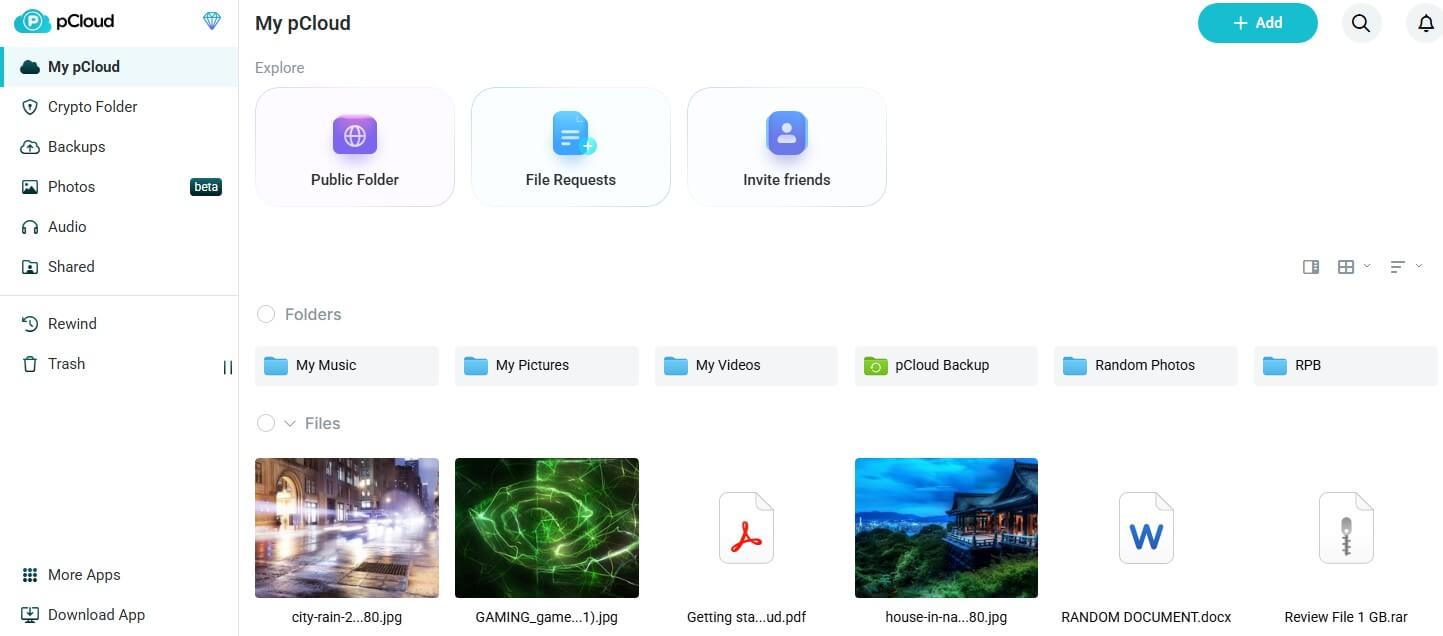
pCloud uploaded our archive in 3 minutes 32 seconds and downloaded it in 24 seconds, the lowest combined time we recorded. That was with its US data region from Europe. New accounts choose between US and EU storage at signup, and the closer region usually speeds up transfers. Large files aren’t a problem: pCloud sets no file size limit, and its apps play music and video straight from the cloud.
Paid plans start at about $50 a year for 500 GB, and the 2 TB plan costs just under $500 as a one-time lifetime payment. Zero-knowledge encryption isn’t part of the base price. It comes as a separate add-on, which Internxt includes on every plan. Our pCloud review covers the plans in detail, and pCloud also ranks among our recommendations for storing videos in the cloud.
2. Internxt: Fastest Encrypted Cloud Storage
Pros
- Encryption without a speed penalty
- Post-quantum protection on every plan
- Lifetime plans on every tier
- Security tools bundled with paid plans
- Open-source code
Cons
- Charges in euros
- Short trash period on cheaper plans
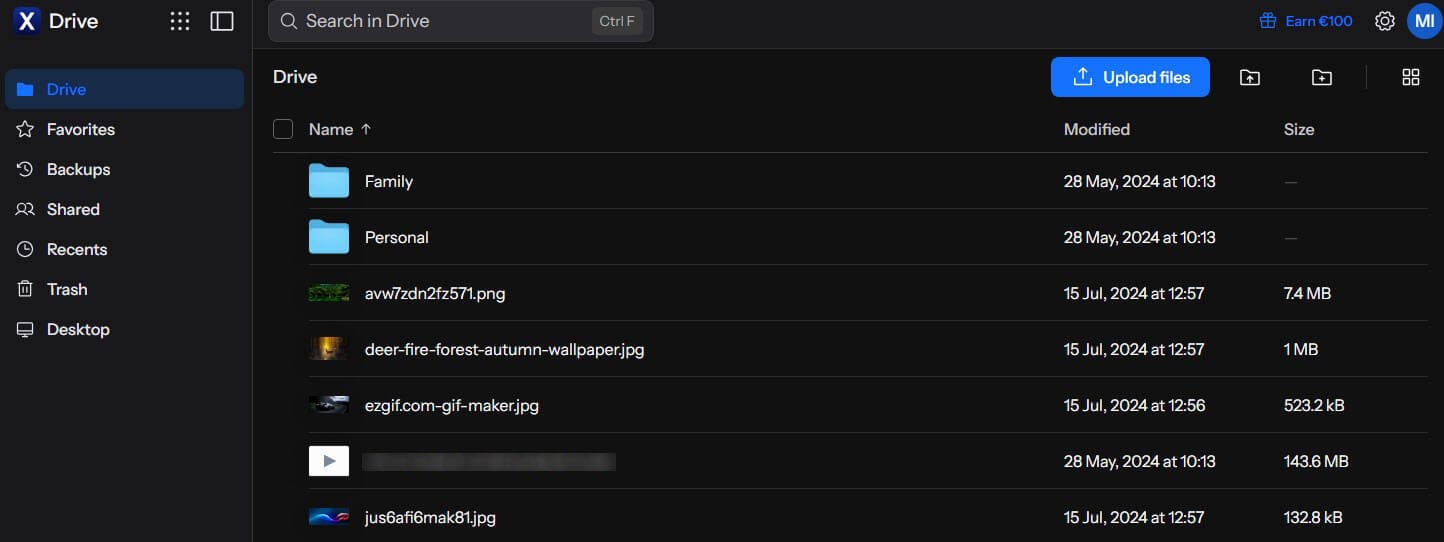
Internxt encrypts every file on your device before upload, and it still finished our upload in 3 minutes 34 seconds, with a 24-second download. NordLocker, MEGA, and Sync.com also encrypt files end to end, and each of them was slower by 14 seconds or more. Its encryption pairs AES-256 with Kyber-512, a post-quantum algorithm, and the code is open source.
Lifetime plans cover 1 TB to 5 TB, and the Premium 3 TB plan costs about €435 once, close to $500 at current exchange rates. Its paid tiers bundle extra security software as well. Billing is in euros, even for US customers, and the Essential plan keeps deleted files for only a week. Our Internxt review covers each plan, and our ranking of encrypted cloud storage compares it with other private services.
3. NordLocker: Best Balance of Speed and Link Security
Pros
- Files encrypted before they leave the PC
- Time-limited share links
- Easy downloads for recipients
- Budget-friendly first year
Cons
- Uploads lag behind full connection speed
- Permanent deletion, no recycle bin
- Steep renewal price
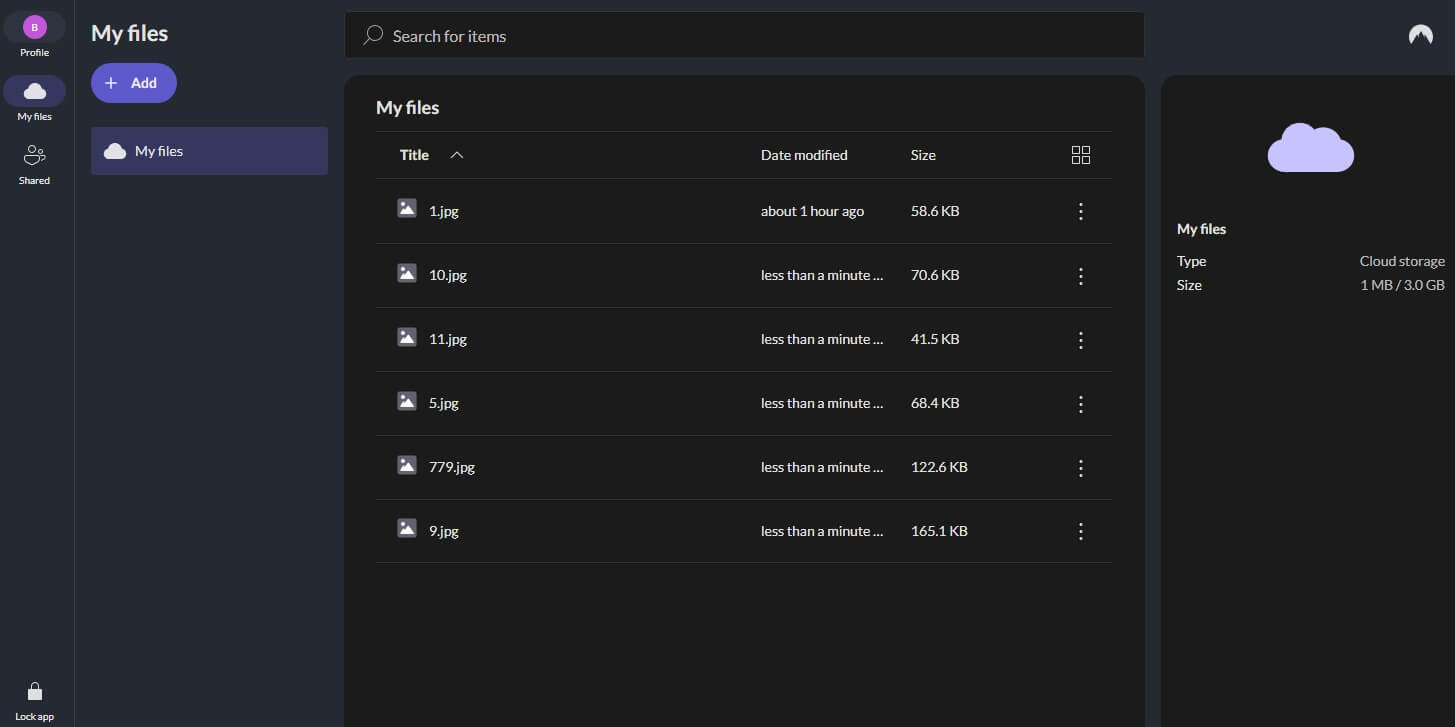
NordLocker uploaded our archive in 3 minutes 48 seconds and downloaded it in 27 seconds, using 89% of our upload speed. Dropbox and Google Drive moved the file faster, but neither encrypts files end to end on personal plans, and NordLocker does. Its share links expire and can include a security code generated by NordLocker, and recipients can download without an account.
Pricing jumps after year one: about $84 for the first 12 months of 2 TB, then about $180 a year. The weakness we found had nothing to do with speed: when we deleted the test file, it was gone at once, because NordLocker has no trash. Keep a second copy of important files. NordLocker also appears in our most secure cloud storage ranking.
4. Dropbox: Fastest Single Upload in Our Tests
Pros
- Quickest upload we recorded
- Block-level sync
- LAN sync between computers on one network
- Large-file sending with Dropbox Transfer
- Wide range of app integrations
Cons
- Small free tier
- Password links only on Standard and up
- No end-to-end encryption on personal plans
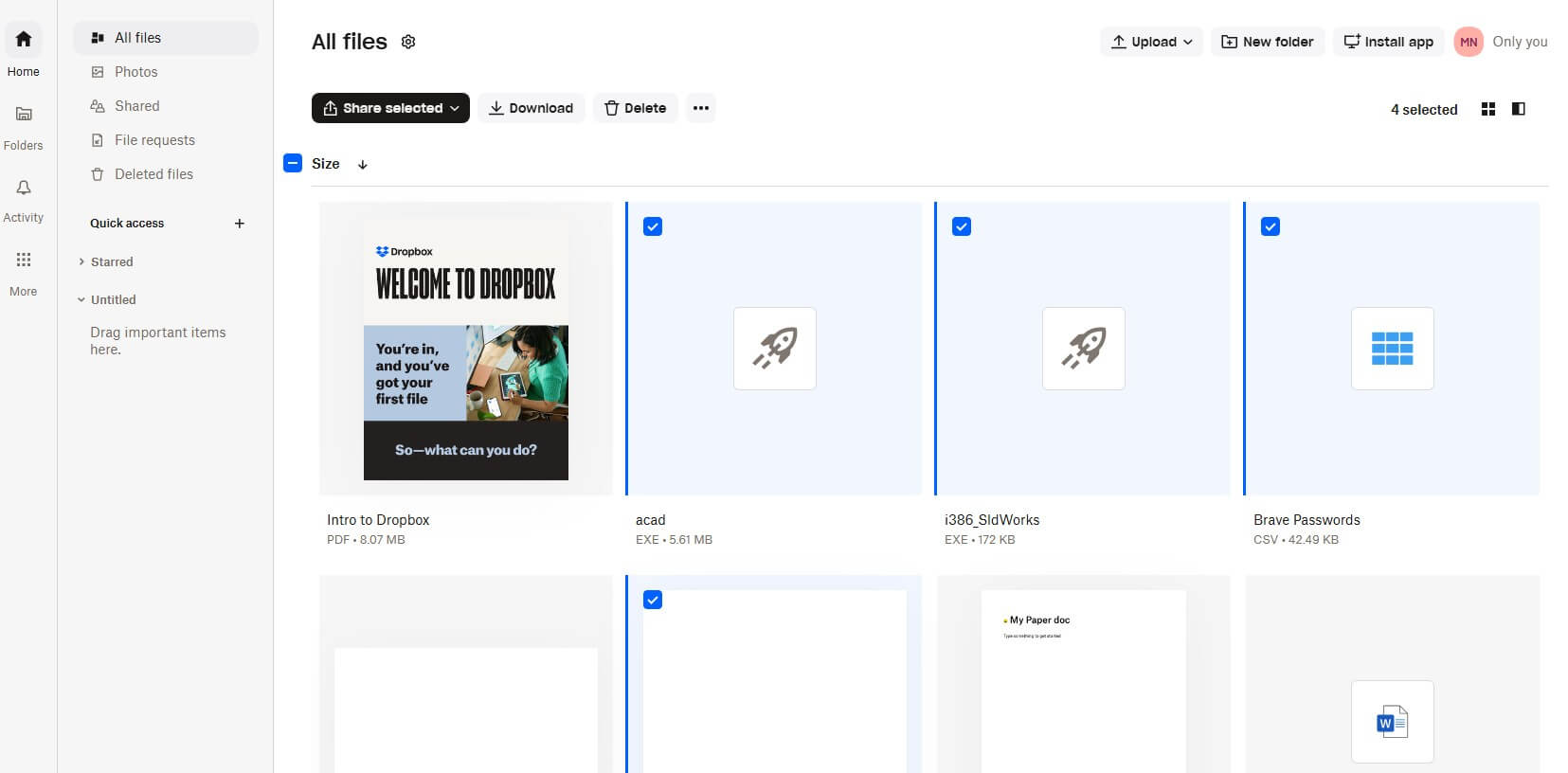
No service uploaded our archive faster than Dropbox, at 3 minutes 31 seconds; its download took 26 seconds. Its biggest speed advantage shows up after the first upload. Block-level sync sends only the changed parts of an edited file, and LAN sync copies files between computers on the same network without going through the internet. The personal Plus plan costs about $120 a year for 2 TB.
It includes Dropbox Transfer for sending files up to 50 GB. Link passwords and expiry dates require the Standard plan, at about $15 per user a month on yearly billing. The free plan offers only 2 GB, and personal plans don’t encrypt files end to end. Users who share sensitive files often are better served by NordLocker or Internxt.
5. Google Drive: Best for Shared Workspaces
Pros
- Near-full upload speed
- Docs and Sheets edited in place
- Generous free tier
- Storage tiers for every need
Cons
- Daily upload limit for very large transfers
- No zero-knowledge option for personal accounts
- Gmail and Google Photos share the same quota
Google Drive for desktop came within 10 seconds of our connection’s upload limit, finishing in 3 minutes 33 seconds. Documents in Docs, Sheets, and Slides open and save in the browser, so editing shared files doesn’t wait for a download. Google One’s 2 TB plan costs about $100 a year, and the free plan has 15 GB shared with Gmail and Google Photos.
Google caps each account at 750 GB of uploads per day, a limit that affects only very large backups. Files stay readable to Google, which rules Drive out for confidential documents. Our guide to free cloud storage compares its 15 GB with other free plans.
Slower Services in Our Speed Test
Three services fell behind the top five, though none was slow enough to cause problems with everyday files:
- MEGA: uploaded in 4 minutes and downloaded in 25 seconds. Free accounts also have a transfer quota that limits how much can be downloaded in a given period.
- TeraBox: uploaded in 4 minutes 5 seconds through the browser, and its 34-second download was the slowest we recorded. Free users can download one file at a time, and faster downloads are reserved for paid plans.
- Sync.com: its upload finished at 4 minutes 11 seconds, and the download took 29 seconds, using 81% of our upload speed. Its end-to-end encryption and unlimited plan are better matched to large private archives than to frequent big transfers.
Why Cloud Uploads Take Longer Than Downloads
Most home internet plans offer far more download speed than upload speed. Our results show it: the archive took about 24 seconds to download and over 3 minutes 30 seconds to upload on every service. No cloud storage service can upload faster than the connection allows. A faster home upload plan shortens every cloud transfer, whichever service stores the files.
How to Speed Up Cloud Uploads
- Use the desktop app: desktop sync apps upload in the background and resume after interruptions, and they handle large batches better than a browser tab.
- Check the app’s speed limits: Dropbox, pCloud, and Google Drive for desktop let users cap upload speed in their settings. Remove the cap before a large upload.
- Choose the nearest data region: pCloud lets new accounts choose US or EU storage at signup.
- Pause other uploads: backups, video calls, and other devices share the same upload speed.
- Use a wired connection: an Ethernet cable avoids the speed drops that Wi-Fi can cause in larger homes.
Is Free Cloud Storage as Fast as Paid?
Yes, on most services. All our tests used free accounts, and pCloud, Internxt, NordLocker, Dropbox, and Google Drive transferred at the same speed as their paid plans. Paying adds storage and features, such as longer file history and protected links.
The exceptions are TeraBox, which keeps high-speed downloads for paying users, and MEGA, whose free accounts have a download quota. The fastest free plan in our tests was pCloud’s, which offers up to 10 GB.
Conclusion
On a home connection, pCloud, Dropbox, Google Drive, and Internxt are effectively tied, with uploads close to our connection’s limit. pCloud ranks first for the lowest total time, unlimited file sizes, and lifetime plans. Internxt is the fastest choice with end-to-end encryption on every plan, and NordLocker trades some speed for protected share links.
Dropbox makes the most sense for files that change often, thanks to block-level and LAN sync, and Google Drive for teams working in Docs. Sync.com is a reasonable choice for large private archives that rarely change. Our main ranking of the best cloud storage services covers price and features in more depth.
Frequently Asked Questions
Which cloud storage has the fastest upload speed?
Dropbox, pCloud, and Google Drive have the fastest uploads, using nearly all of a home connection's upload speed. Sync.com and MEGA upload more slowly on the same connection.
Which cloud storage is fastest for syncing files?
Dropbox is the fastest for syncing edited files. Its block-level sync uploads just the modified sections of a file, while most cloud storage services upload the whole file again.
What is the fastest free cloud storage?
pCloud is the fastest free cloud storage, with free accounts that transfer at the same speed as paid plans and up to 10 GB of space. Dropbox and Google Drive are close behind.
Why are cloud uploads so slow?
Cloud uploads are slow because most home internet plans have much less upload speed than download speed. A file that downloads in seconds can take several minutes to upload.
Does encryption slow down cloud storage?
No, not by much. Internxt applies end-to-end encryption on the device and still uploads at nearly the full speed of a home connection, though Sync.com is noticeably slower.
Is cloud storage faster than an external hard drive?
No. An external SSD copies files at hundreds of megabytes per second, while a typical home connection uploads only a few megabytes per second to the cloud.