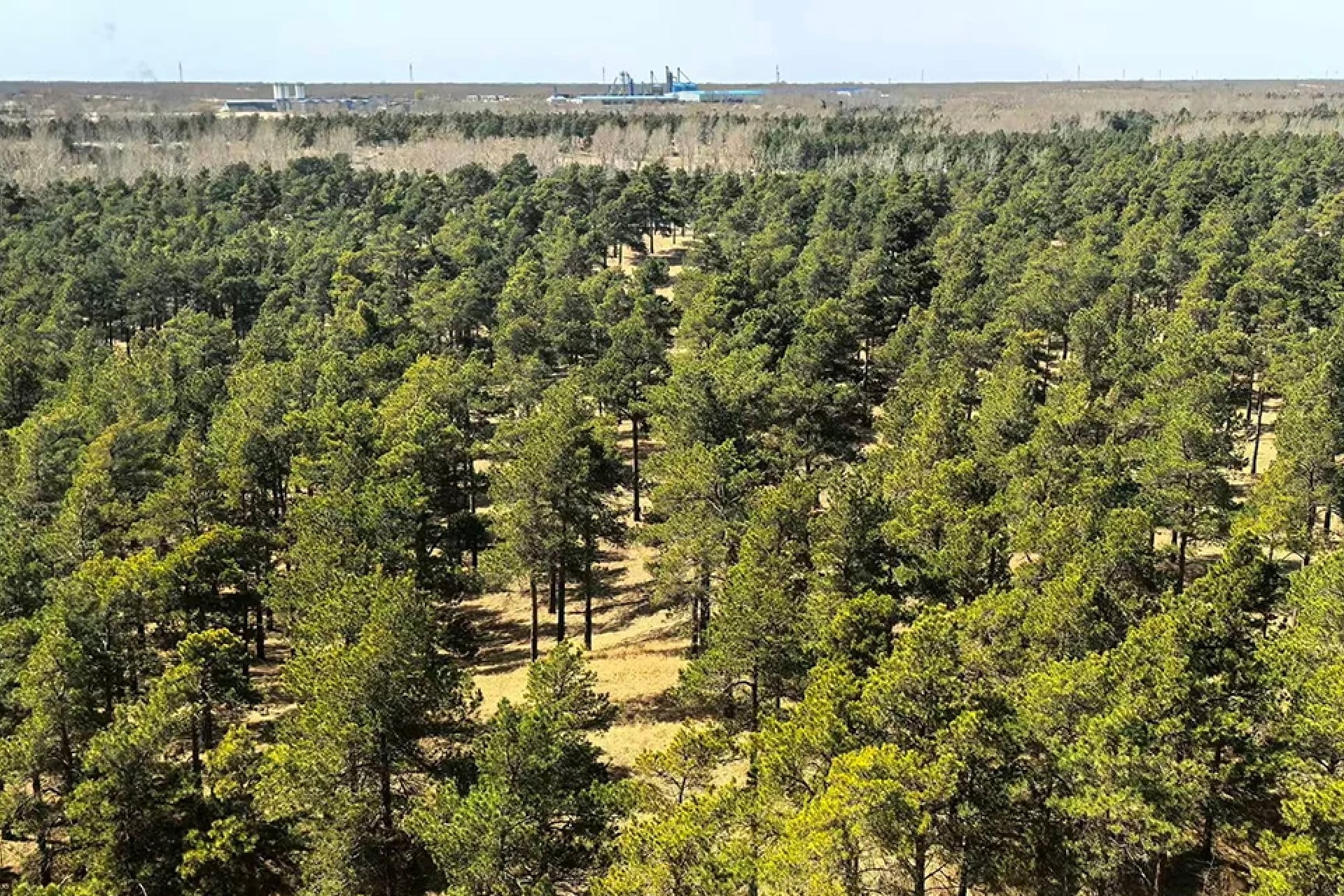
Scientists have described it as a “biological void” or a “hyperarid environment.” Across China, locals know it as the “Sea of Death.” But—after five decades of ecological engineering—the edges of northwestern China’s 130,000 square-mile (337,000 square-kilometer) Taklamakan Desert is now slowly transforming into forests that absorb greenhouse gases.
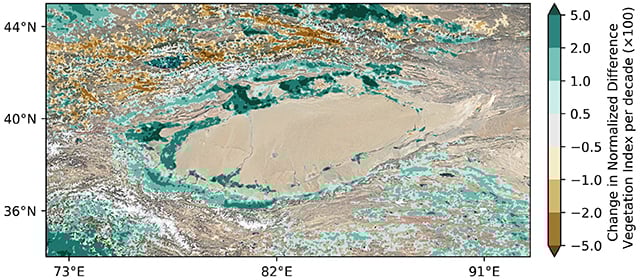
New research led by atmospheric physicist King-Fai Li at the University of California, Riverside, has corroborated the Chinese government’s success in turning parts of this gigantic and reportedly 25 million-year-old desert wasteland into an effective carbon sink. Li, along with colleagues at universities in Beijing, Houston, and California, assembled years of data from NASA’s Orbiting Carbon Observatory (OCO) and its orbital MODIS imagers to track carbon dioxide concentrations and the progressing greenness around Taklamakan.
“This is not like a rainforest in the Amazon or Congo,” Li noted in a press statement. “Some afforested regions are only shrublands like Southern California’s chaparral.”
“But the fact that they are drawing down CO2 at all, and doing it consistently,” he added, “is something positive we can measure and verify from space.”
China’s 72-year plan
The Chinese government has had cascading incentives to continue planting hardy shrubs and trees across the Taklamakan, the world’s second-largest “mobile desert” or sand sea, ever since the project began in 1978.
China’s first goal was to stem the expansion of this vast desert itself by building a bulwark of forest that could be easily and naturally irrigated by high-elevation runoff—like the seasonal snowmelt from the surrounding Kunlun Mountains to the south. As secondary benefits, the nation hoped to improve its agricultural conditions and ease political unrest from minority ethnic groups, including local Uyghur communities. In recent years, state-funded workers have also planted along the Taklamakan’s 340-mile (550-kilometer) Tarim Desert Highway—part of China’s Three-North Shelterbelt forest growth program, which extends into 2050.
That said, China has also pursued this program to increase its northern forest cover from 5.05% to 14.95% as an explicit contribution to the United Nations Strategic Plan for Forests. And it appears to be working.
Li and his colleagues studied both seasonal and multiyear trends to determine if there has been a true reduction in regional carbon dioxide (CO2), based on NASA satellite sensor data tracking CO2 levels, vegetation cover, and weather behavior.
Each year during the July to September wet season, the researchers found, the increasing vegetation consistently sucked up atmospheric CO2 by approximately three parts per million (ppm) compared to Taklamakan’s hyperarid dry-season rates. To put this in context, if the entire Taklamakan desert were successfully blanketed in woodlands, it would be able to absorb roughly 60 million tons—a lot, but admittedly only a minute fraction of the estimated 40 billion tons of carbon emitted globally per year.
“We’re not going to solve the climate crisis by planting trees in deserts alone,” Li noted. “But understanding where and how much CO2 can be drawn down, and under what conditions, is essential.”
According to UC Riverside, China’s afforestation project has also helped impede wind erosion, cutting down on the frequency and severity of sandstorms and protecting local farms as well.
A model for ‘the most extreme arid landscapes’
Li and his team suggest that the Taklamakan Desert could serve as “a model for climate change mitigation through nature-based solutions” in “even the most extreme arid landscapes,” as they wrote in the journal Proceedings of the National Academy of Sciences (PNAS).
One critical factor, according to Li, is successful long-term planning. A similar United Nations project to green the Sahara Desert failed—the multibillion-dollar “Great Green Wall” failed largely due to “limited political support, lack of money, weak organizational structures, and not enough consideration for the environment,” according to Voice of America.
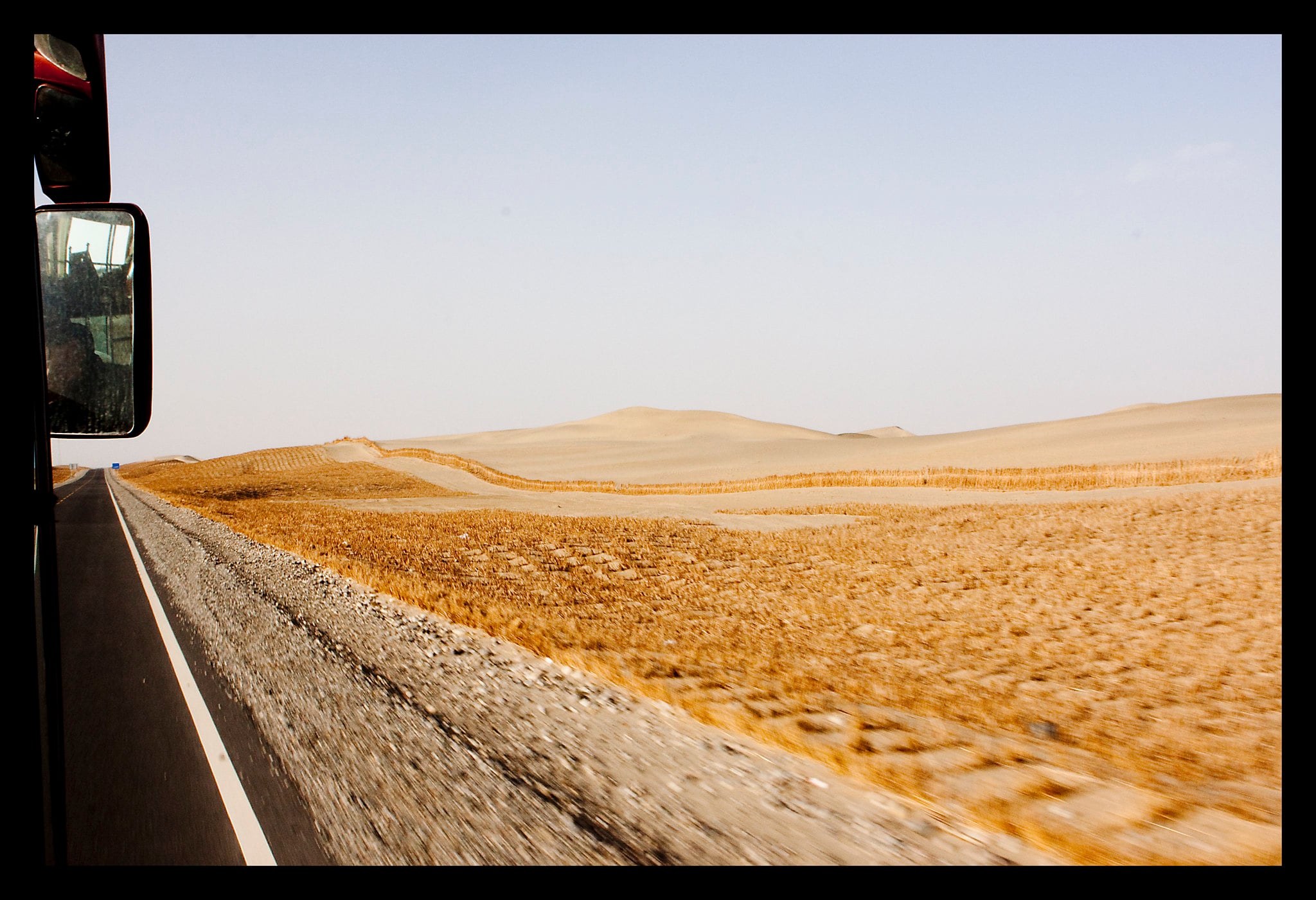
But China’s efforts to beat back Taklamakan’s vast and deadly sand sea, according to Li, have shown that even Earth’s most barren wastelands can be marshaled in the battle to fight climate change.
“Even deserts are not hopeless,” Li said. “With the right planning and patience, it is possible to bring life back to the land, and, in so doing, help us breathe a little easier.”