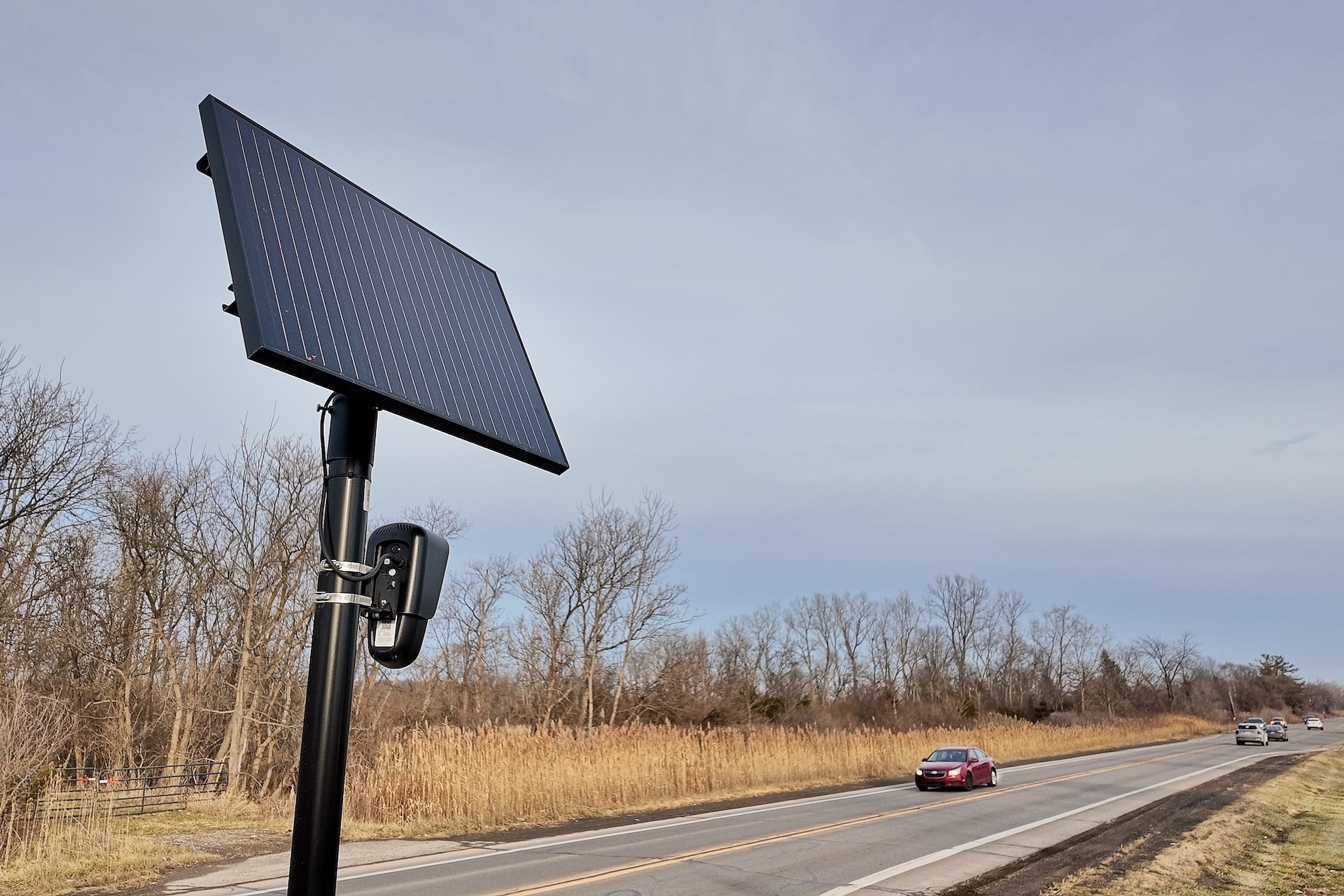
A Savannah, Georgia, police officer lost her job after giving her Flock login to her husband, an Immigration and Customs Enforcement (ICE) agent who used it to run hundreds of license plate searches on people his agency wanted to find. Former Savannah Police Department (SPD) officer Amber Harpe handed her username and password to Tyler Harpe because he had no Flock account through the Department of Homeland Security, according to internal records obtained by local news outlet WJCL. Savannah police don’t share their Flock data with ICE.
The case is a clear example of one of Flock critics’ longstanding fears: federal immigration agents getting into local camera networks without any formal agreement. It also extends a long run of stories about police misusing Flock’s automated license plate readers (ALPRs), and Georgia has supplied more than its share of those incidents. In recent months, police employees in Savannah, Milton, Augusta, and Coweta County have been fired, arrested, and even sued over how they used the system.
‘Every Name That I Ever Ran Was an ICE Target’
Initially, an internal audit flagged unusually heavy search activity on Amber Harpe’s account between January and July. Auditors counted 983 search entries covering 97 plates from Georgia, New Jersey, Maryland, Florida, South Carolina, and North Carolina. South Carolina dominated, accounting for 788 of those searches, and investigators found that most of the registered owners of the vehicles associated with searches in the South Carolina group were Hispanic, according to WJCL.
In a July 27th interview, Harpe told investigators she didn’t recognize many of the names and that her husband had run most of the searches.
Tyler Harpe gave his side in an August 3rd interview, according to audio WJCL obtained. “I asked her if I could have her Flock login, and she asked what I was going to be using it for,” he said. “And I told her that once we had already developed target packages for people that were, had arrest warrants, it would be easier while we’re out on the street to be able to locate them.”
“Every name that I ever ran was an ICE target,” he told investigators.
When an investigator expressed surprise that ICE didn’t have its own Flock access, Amber Harpe said, “No one really wants to work with them, sir.” Records WJCL obtained show the department shares its Flock data with more than 1,700 agencies, but ICE isn’t on the list.
Not a Crime, but a Firing Offense
It’s important to note that investigators didn’t find that Amber Harpe broke Georgia’s ALPR law. The statute counts federal agencies as law enforcement agencies and says, “Law enforcement agencies may exchange or share captured license plate data with other law enforcement agencies for law enforcement purposes.”
Harpe was fired instead under a department policy against letting unauthorized people into city or police software. SPD Interim Major Max Nowinsky cited the state law when he recommended only a one-day suspension.
Harpe accepted responsibility but argued that firing her was excessive. “The violation occurred because I gave my husband, who is a certified law enforcement officer with the Department of Homeland Security, access to my Flock account,” she wrote in her appeal. “Every search he conducted was for law enforcement use only and not for personal gain.”
Assistant Police Chief Robert Gavin denied the appeal in August, and her termination took effect last month.
Harpe was one of six Savannah police employees fired in August after audits that included Flock’s Audit Assist tool. The Georgia Bureau of Investigation later arrested four of the others, who were accused of searching for personal reasons. Harpe wasn’t charged.
ICE has confirmed it is investigating its agent’s involvement, according to WTOC. In a joint statement to WJCL, the mayor’s office and police department said:
“Unauthorized access to police technology by anyone is a breach of Savannah Police Department policy and public trust. In this case, SPD determined that department policy was violated and terminated the employee. An outside law enforcement agency’s investigative purpose does not, by itself, authorize access to SPD’s system.”
Flock has generally pointed to its audit logs as the answer to misuse. “It is because of Flock’s built-in, permanent audit logs that these officers are held accountable,” CEO Garrett Langley said of past misuse cases in a previous company blog post. In the same post, Flock said publicly reported cases are rare across its more than 6,000 agency customers.
Georgia Is at the Heart of the Flock Debate
Savannah’s case is far from the only Flock controversy of the past year. Last month, five Indianapolis officers were charged with misusing Flock cameras, including one alleged case of stalking. Earlier this month, a Colorado woman sued Flock after a Flock hit led police to hand her a summons for a package theft she didn’t commit. Additionally, U.S. District Judge Sara E. Hill in Oklahoma threw out evidence from a deputy’s warrantless plate reader search. “This is a type of indiscriminate mass surveillance,” Hill wrote.
Federal immigration enforcement agents have also been part of the story for more than a year. In May 2025, 404 Media reported that local police were running Flock lookups for ICE, which had no contract with the company. Fears that local Flock data could aid the Trump administration’s immigration crackdown have since become a major driver of the backlash against the company, and such worries have pushed a number of cities to deactivate their cameras or cancel their contracts, according to NPR.
Georgia in particular has seen a string of Flock misuse cases in recent months. In the Atlanta suburb of Milton, Detective Randy Dula, the city’s 2025 Officer of the Year, was reportedly fired in August over his use of Flock. In Augusta, the Richmond County Sheriff’s Office arrested and fired a deputy this month over alleged personal Flock searches, making him at least the seventh employee there arrested over alleged plate reader misuse since June. And in Coweta County, a man sued Flock and the county earlier this month, alleging deputies tracked his car while he was suing the sheriff.
Useful to Cops, but the Backlash Keeps Growing
Tyler Harpe made a pitch for the technology while explaining himself to investigators. “I’m hoping that, you know, nothing too bad comes out on this as far as it just being a policy violation. But, I mean, the tool actually helped our agency, like, get people off the street,” he said.
Plenty of police departments see Flock the same way, but a steady stream of misuse cases has left many communities unwilling to trust police with the extra power it provides. The backlash has been enormous. Secure Justice, an Oakland advocacy group, has logged 446 actions by cities, counties, and other local bodies to terminate, suspend, or not renew Flock contracts, according to its tracker. Those include 138 actions in August and 141 last month.
These issues have also led to activity in Congress, where Democrats and Republicans alike have introduced bills to rein in Flock and other license plate readers.