During the Triple-I showcase, Sunset Visitor—the Peabody award-winning studio behind 1000xResist, finally unveiled its next, hotly anticipated narrative sci-fi adventure game, Prove You’re Human. The announcement wasn’t just about a new game; it was a signal flare for a growing movement in the indie space.
Rather than hand their futures to an industry where even successful launches can end in mass layoffs and studio closures, Sunset Visitor has teamed up with fellow narrative heavyweights Black Tabby Games—creators of Slay the Princess, now acting as publisher—to stake out a different path. It’s a part of an emerging wave of developers banding together to publish each other’s work, reclaiming ownership in an era where game development is seen less like a medium and more like an industry, in an era where C-suites tout AI as the cure-all for “leaner, healthier” development pipelines no one seems able to define.
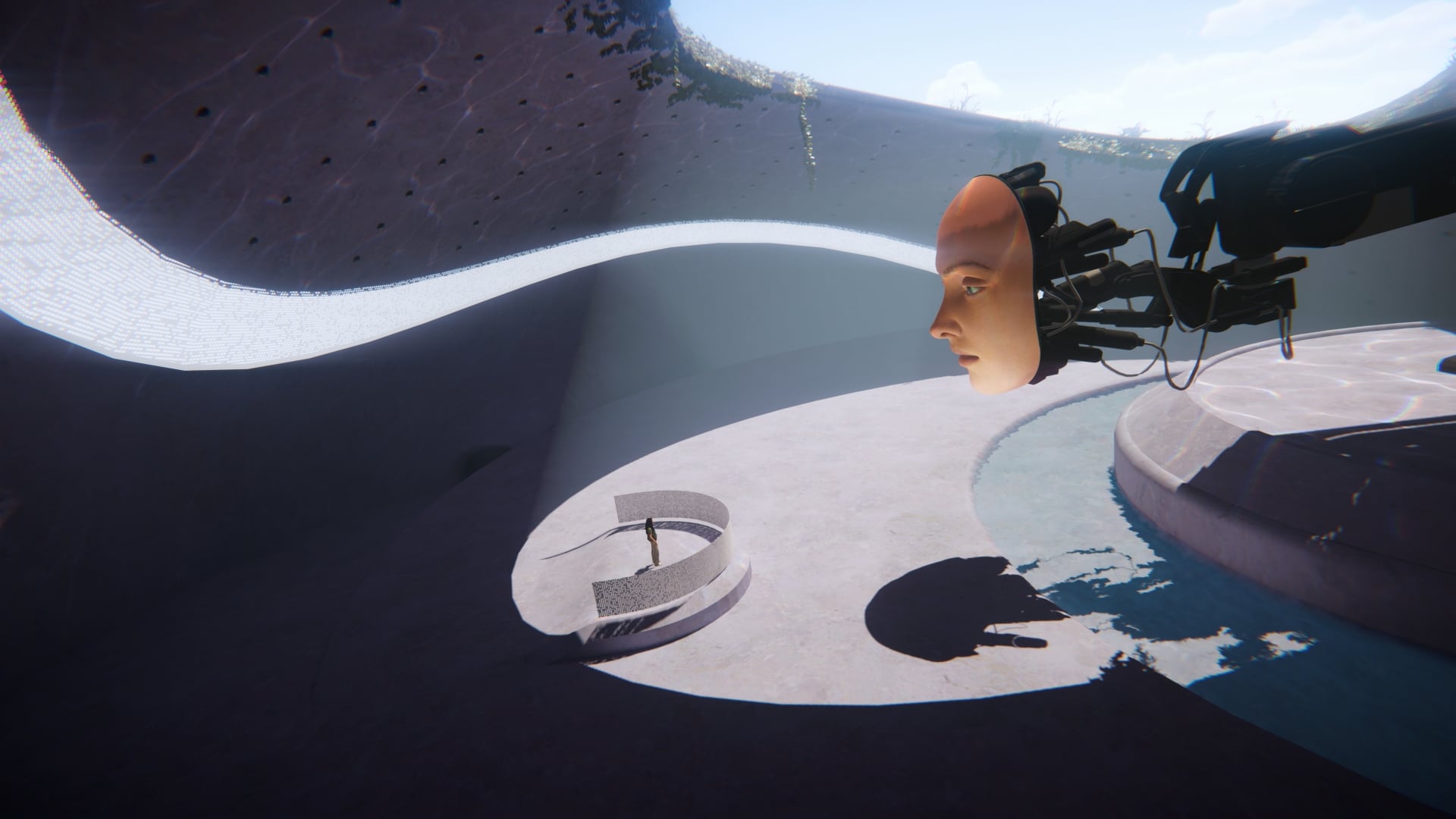
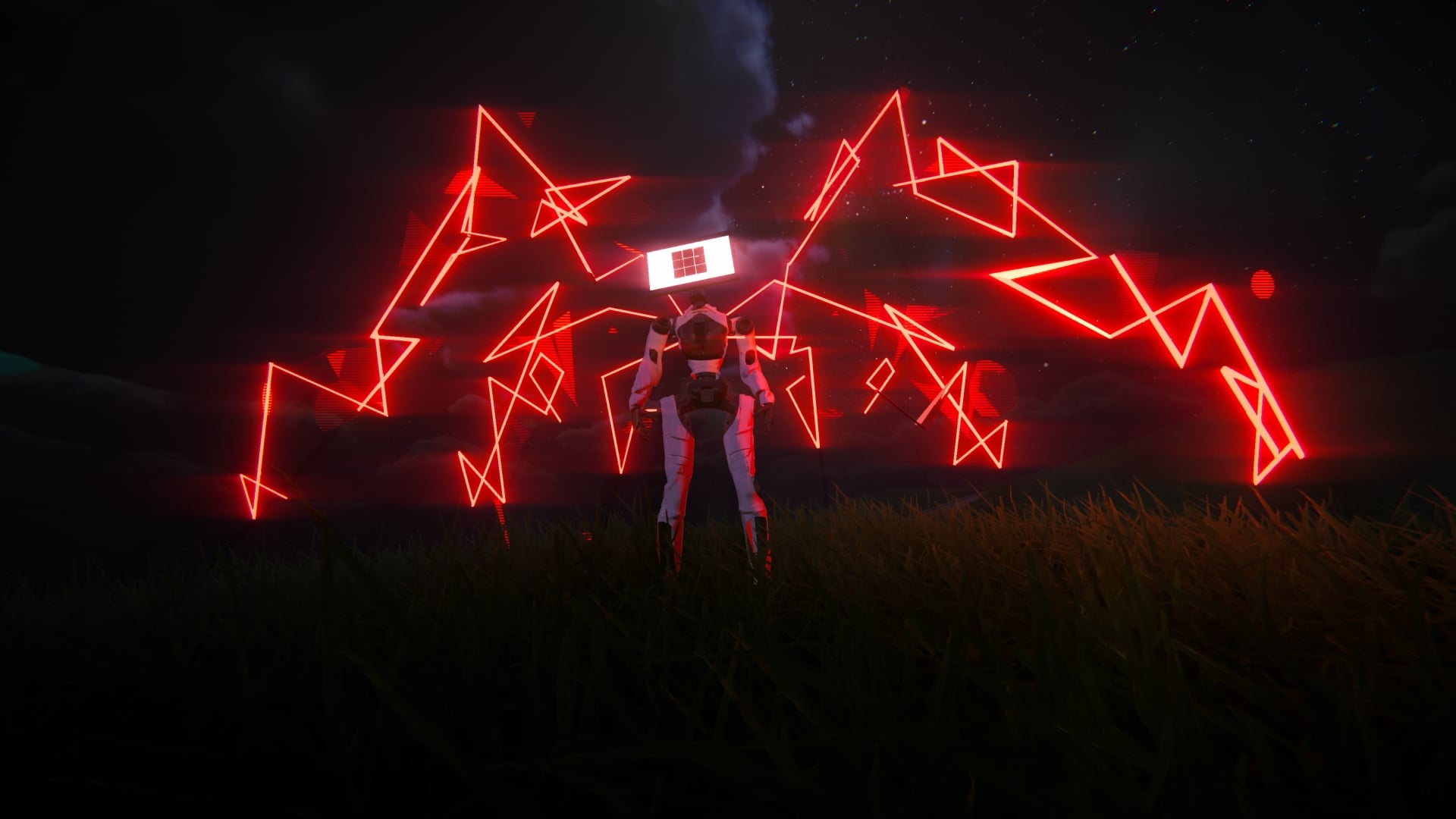
There’s a certain irony—perhaps even a pointedness—in the fact that their new collaboration centers on a story about AI itself. In Prove You’re Human, you play as Santana, a human who splits their consciousness into two to interrogate an artificial intelligence on the brink of achieving true AGI at the behest of a mysterious company. The catch (because there always is one) is that Mesa, the company’s AI, has hallucinated itself into believing that it is human. Santana’s job, and by proxy, the players, is to put Mesa back in its place by training it out of its delusions of sentient grandeur.
io9 spoke with Sunset Visitor creative director Remy Siu and Black Tabby’s Abby Howard and Tony Howard-Arias about how their partnership came together, what it means to publish in the middle of an industry perpetually in crisis, and why their story about AI hits differently when the real world keeps insisting it’s the solution for game development while slopping up how we perceive the world and ourselves.
What Is Prove You’re Human?
When 1000xResist—the sci-fi cinematic visual novel game that IGN, AV Club, and Inverse lauded as a revolution in storytelling back in 2024—was first publicized, it was through an internet meme on X/Twitter comparing itself to other touchstone media whose vibe was similar to its own. Those being Yoko Taro’s Nier: Automata, Wong Kar-wai’s In the Mood for Love, and Satoshi Kon’s Millennium Actress. To people hearing about Prove You’re Human for the first time, Siu said the game also vibes close to Apple TV’s Severance and director Sebastián Lelio’s Florence Pugh-led mystery thriller, The Wonder. In layman’s terms, Liu teased Prove You’re Human as being a “claim story.”
“The claim, in this case, is that the AI thinks that it’s human and you’re ready to encounter it—to try and understand where it’s coming from—and perhaps convince it that it’s not,” Siu said.
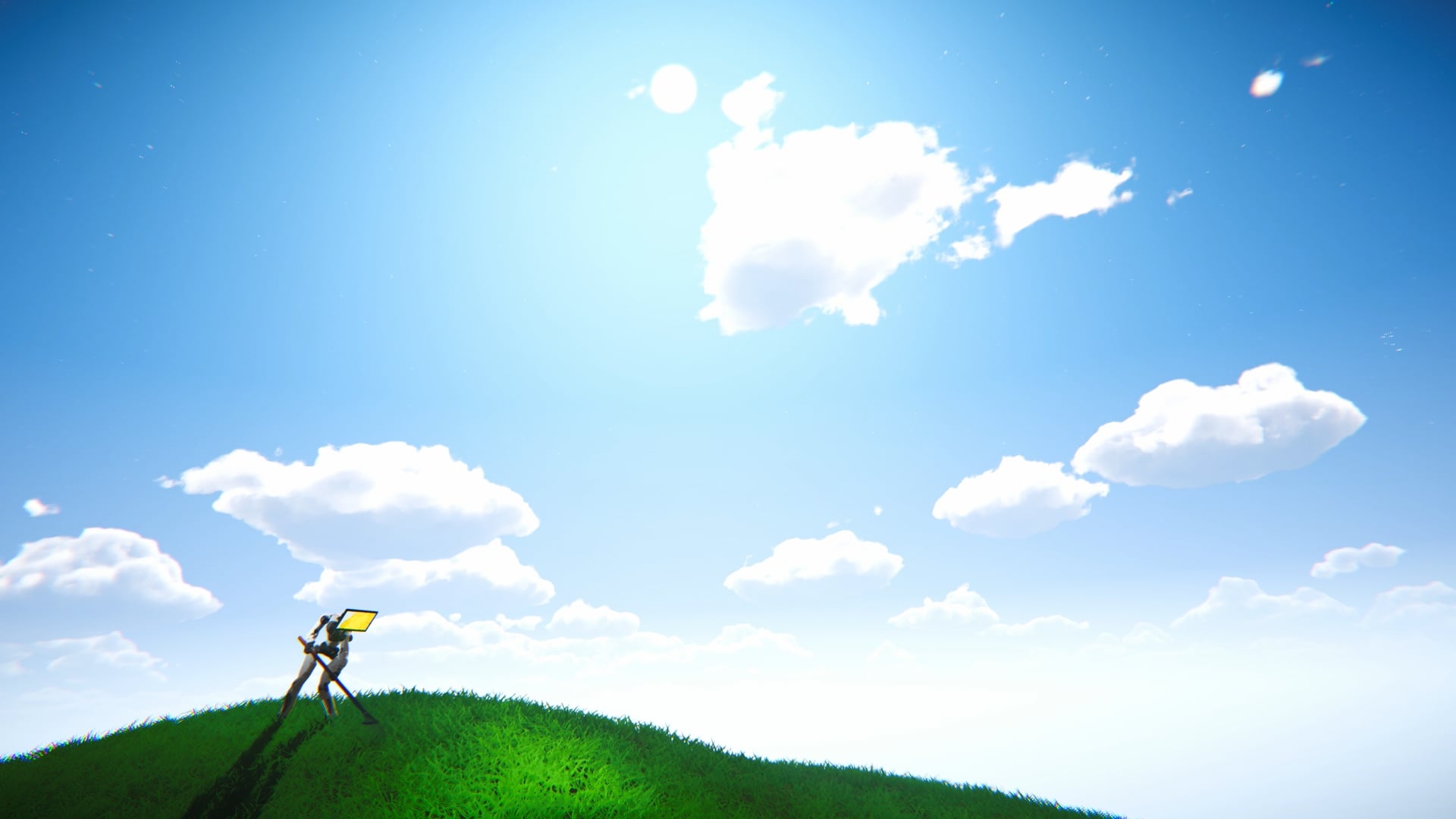
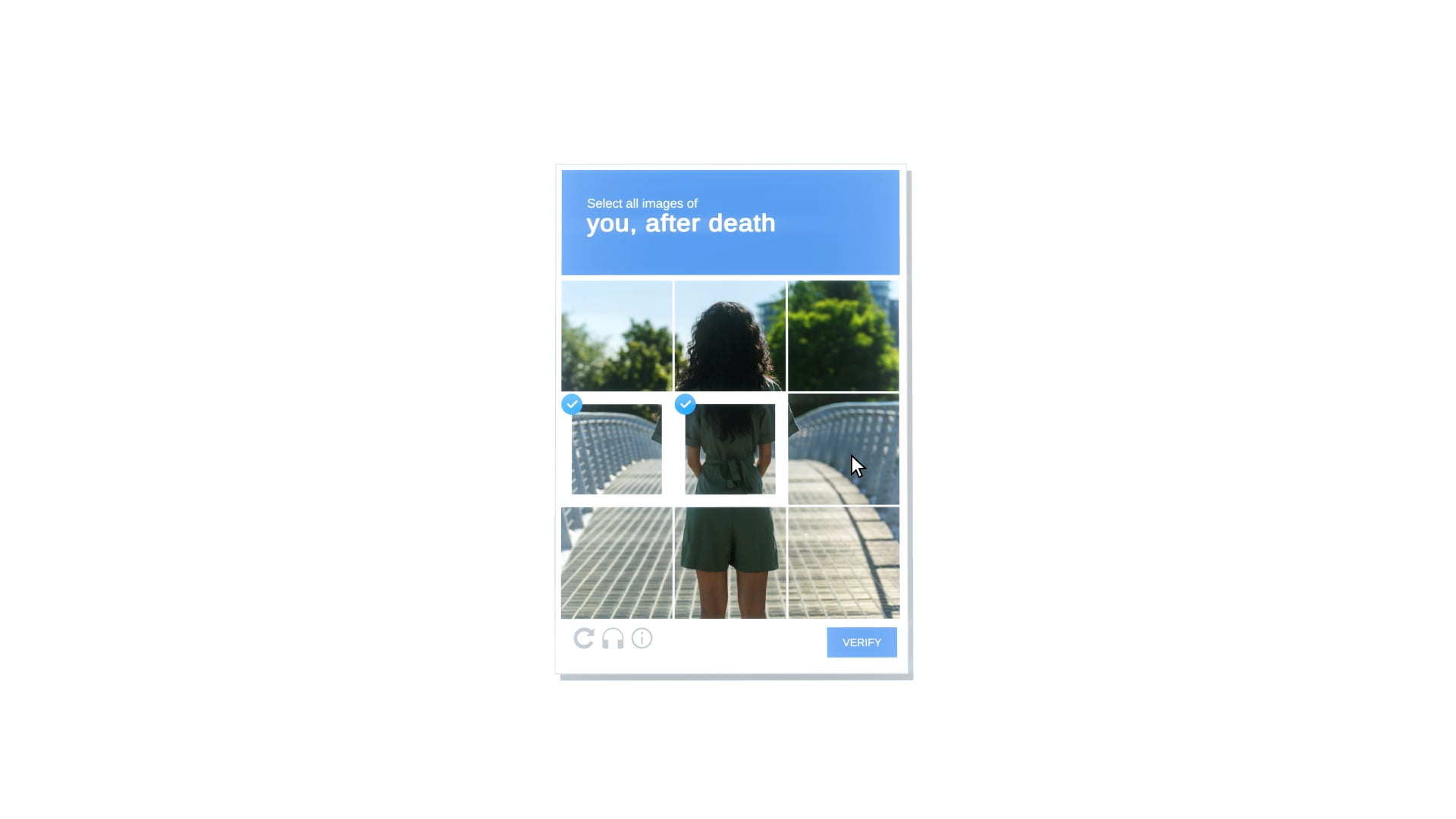
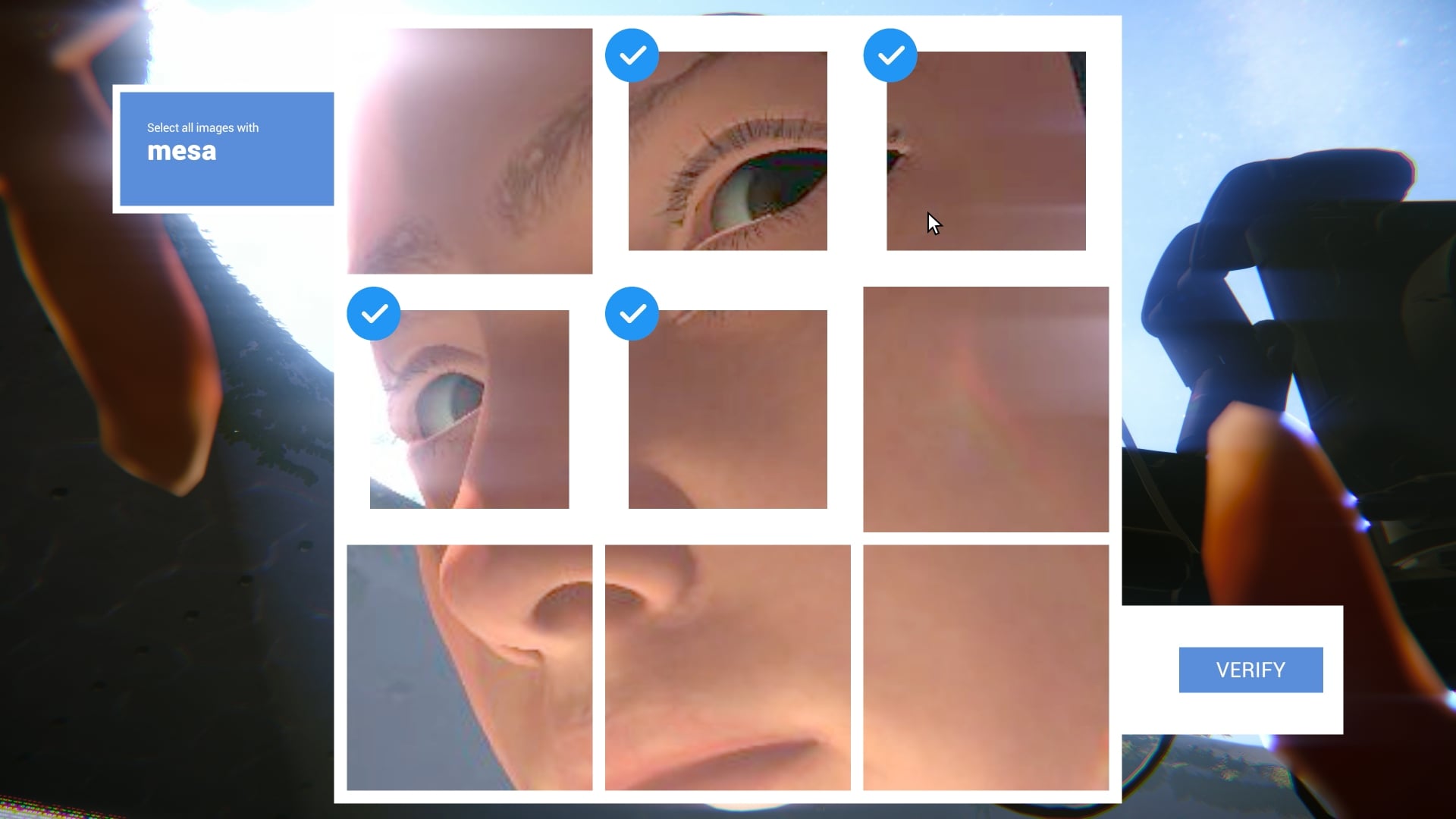
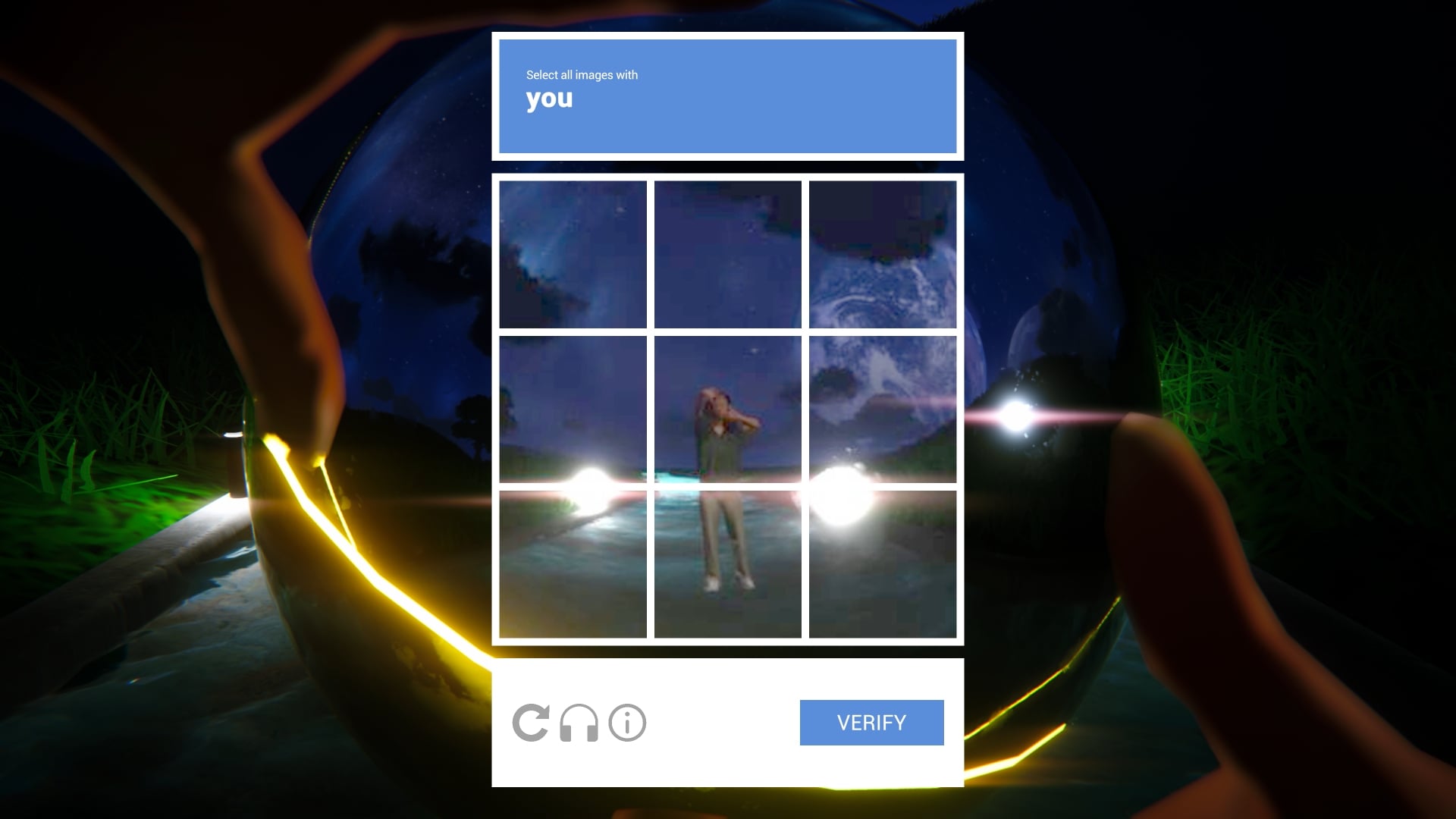
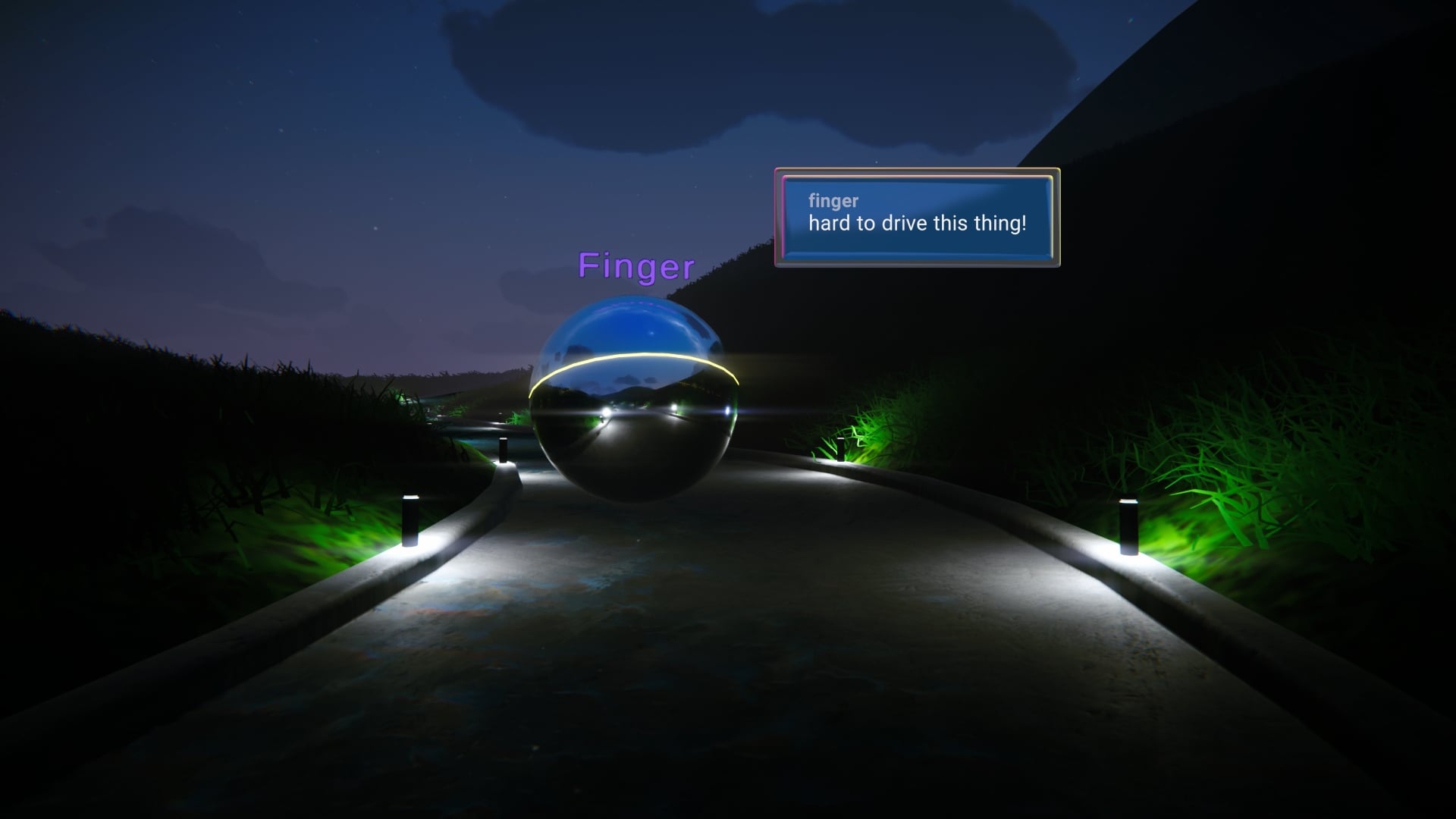
Gameplay-wise, players will do their “convincing” by spending their days in a virtual world reminiscent of Windows XP’s Bliss. Whenever players aren’t chatting with Mesa, chipping away at her defenses and incepting the idea that her self-actualization is but an illusion, they will wander the virtual space getting to know its employees while completing increasingly existential CAPTCHA that’ll have you questioning your own illusions of the world and self. Think of it as a mix between fourth-wall breaking puzzle games like Split Fiction, The Stanley Parable, and Portal, and a dash of Neal Agarwal’s I’m Not A Robot, wrapped in Sunset Visitor’s titular pastiche of live action FMVs and cinematic cutscenes. Ultimately, all roads will lead to Santana deciding whether to re-merge with Mesa or discard her work self as she lives the life she always wished to lead in her corporeal body in the outside world.
Pretty heady stuff, but that’s to be expected from the Vancouver-based studio whose first work was a game about a clone kept in an underground bunker during an alien invasion, uncovering even more messed-up secrets about generational trauma left to rot for centuries that hit particularly hard coming out of the pandemic. Though Sunset Visitors focuses on Prove You’re Human, which was ideated near the end of 1000xResist‘s development, it aims to be more prescient about the now without putting too fine a point on what players will take from its themes. Though Siu did give us breadcrumbs to trail the studio’s early ideations of the game, as clues for what players can look forward to.
“In terms of themes that we’re always carrying forward, it’s the effectual experience of discontinuity: of memory, of our relationship to virtual space, our relationship to what we as humans are wanting out of life in 2026,” Siu said. “People live differently now than they did even in 2020, so [Prove You’re Human] is investigating emerging desires and conflicts, especially regarding what it means to be alive right now in 2026.”

When two indie darlings match each other’s freak for the greater good
Howard-Arias characterized what’s essentially a Mega Powers collaboration between Black Tabby Games and Sunset Visitor as stemming from the fact that the world of indie game developers is very small and that everyone knows everyone. True enough, Howard-Arias and Howard had become friends with Siu and the folks at Sunset Visitor for around eight months, where they’d talk about work, the industry at large, and the stresses of pitching a new title.
“Pitching is always stressful. Even if people are interested, conversations can go on and on and people will ask more before confirming a deal,” Howard-Arias said.
“And that’s time, and time is difficult to come by,” Howard added. “If you have a staff, making sure that those people still have jobs, and not knowing whether or not they’re going to be working on a project, puts a lot of stress on people. It’s very difficult to form a project in that kind of environment.”
Howard and Howard-Arias had kicked the can around with casual talks about launching a games publishing company once they were done with internal projects. Howard said they wanted to treat Siu’s verbal pitch for what would later become Prove You’re Human as a kind of exercise to see how that post-career venture would pan out logistically.
“It took us like an hour after the call to come back to him, like, ‘All right, we’ll email our lawyer tomorrow about starting like a publisher, and we’ll take it from there,'” Howard-Arias said.
Howard said the early seeds of Prove You’re Human‘s verbal pitch were the size of a project that Black Tabby Publishing could manage while also doing its own internal projects and supporting itself.
“It was basically being able to give back because of Slay the Princess. It’s a really good feeling to be able to do that,” Howard said, teasing that Prove You’re Human was just one of two upcoming game projects Black Tabby Publishing would be heading up.
“We’re all truth seekers, and one of the ways I engage with that part of myself is if I’m talking to other devs or venting about the state of the industry, and I’m taking this position of, ‘Man, I feel like with your track record, it shouldn’t matter what you’re doing next. Someone should just sign you and give you the space to do that.’ It’s one thing to say that, and it’s another thing to face the reality of whether that claim is real,” Howard-Arias said.
He continued: “This moment felt interesting to us as an opportunity to say we’ve got a good friend here who we talked to about game design, writing, marketing, and art in general, so much. We have an interesting project. We could just sit down, start a publisher, and see if the circumstances that we think would lead to a better game, a better game publishing environment for studios like Sunset Visitor or studios like us, where we have one or two successful games under our belt, we actually think that’s a better environment. Why don’t we see if we’re right?”
One part of their partnership that Howard-Arias has enjoyed is that the usually difficult process of figuring out what an in-development game’s marketing will be for its audience—finding out who the game is for, what its most compelling aspects are, and what they want to communicate with the game—felt more organic and of the moment than retroactively placing a puzzle piece into place.
When the latter happens, things can feel fumbled if a game fails to catch fire with prospective players through whatever marketing approach it decides to use to achieve mass appeal—or chase trends—only to rakestep like Sideshow Bob from The Simpsons, not realizing those games are victims of a system built to fail rather than endemic of their own quality.
“Ultimately, at the end of the day, games are art, and art is about communicating something with another person. Sometimes that is something that you communicate through designing systems, sometimes it’s through a story, but part of communication is getting somebody to listen to you,” he said. “It sounds so business-brained, but marketing should inform art, [and] art should inform marketing. It’s all part of the same process, which is taking something that is too complicated to distill in a couple of sentences, and getting someone to listen and engage.”
Using a term from the performing arts sphere, Siu described Black Tabby Publishing’s role as a dramaturge—an advisor who is next to the project, not hovering over it or grandstanding about what the project itself will be. In other words, it’s like a book publisher helping a writer by assigning an editor who helps communicate its ideals more effectively. Granted, dramaturge is a cooler word.
“We talk all the time. We hear how things are going, and if the team gets stuck somewhere, we’re here to bounce ideas off of each other while not directly involving ourselves with the act of creation,” Howard-Arias said. “There’s an editorial aspect of the relationship, too, one that I think is well-suited for our studio because all we do is write.”
Prove You’re Human hopes to be the solution behind the scenes
Sunset Visitor and Black Tabby Publishing are the first to admit they weren’t the first to come up with the idea to unfuck game development, which has been treated as a package deal in the “Triple A” games industry as it comes up with new ways to excuse layoffs, studio closures, and games canceled virtually upon announcement as a natural part of the business. In fact, they both cited Outersloth, the publishing company by Innersloth, the developers behind the pandemic-era party game hit Among Us, as a source of inspiration for making the world a better place, namely by leveraging the financial success of their blockbuster game to help fund other indie developers’ games. Essentially, this forms a chain in an otherwise crab-in-a-barrel scenario that’s plagued the games industry.
The specific capacity Black Tabby Publishing has to budget for funding projects is now in the mid-six-figure range. Translation: leaner teams that are also taking on small projects, as seen with Slay the Princess and 1000xResist. For Black Tabby Publishing, they see their figure as an alternative to the big gamble “Triple A” studios will immediately bail out on if the numbers of their games, which are otherwise successful but not achieving impossible blockbuster numbers, always end up killing a studio.
Rather than lay everyone off and posit AI as the catch-all solution to make a healthier game environment, as many big companies have glibly proposed, coupled with studio closure announcements that’ve become as frequent as game announcements used to be, Black Tabby Publishing posits that there is more economical way to do things. It also also highlights a root cause of all the folly of modern game development: the need for everything to have high fidelity while ignoring the high costs to achieve that, instead of simply making a good game first.
“There’s this issue in AAA spaces where the AAA audience really wants fidelity. They constantly want more fidelity in the next thing than the previous thing, and that’s outrageously expensive to make,” Howard-Arias said, with Howard saying the quiet part out loud that they’re also difficult to run on modern consoles as well, with a playtime to the tune of 100 hours or more. Yet maximization is in vogue in the games industry at its own detriment.
“People want more content as well because games are expensive, but then games are also resistant to inflation as well. So you have this environment where you can make a really good AAA game that sells a million copies, but whoever financed that project is out half their budget. It’s a massive commercial flop,” he said. “An area where we’re trying to foster sustainability is, [say], what if we make something that doesn’t cost an endless amount of money, and what if we make tighter, smaller, like focused narrative experiences?”
“The exponential growth of the industry failing to actually have the audiences keep up with that exponential growth is what we’re seeing here versus what we’re doing, which is very pragmatic, I would say,” Howard added.
Black Tabby Games and Outer Sloth aren’t the only indie darlings behind the movement of leveraging their financial and critical success to lift up other aspiring game studios and help them make their own titles. Kinetic Games, the devs behind the multiplayer horror game Phasmophobia, also headed up its own publisher, as did Punkel, the devs behind the very good Vampire Survivors. For Black Tabby Games and Sunset Visitor, the developer and publisher roles in their partnership on Prove You’re Human are “very well suited for the times.”
“From a developer perspective, we are seeing the community step up and provide these kinds of opportunities where it’s more developer to developer. One of the things that immediately allows for a making perspective is that developers understand the process in a very intimate way. That allows for some new affordances in the actual process of making the thing, which can be harder when, say, perhaps groups are more detached from it,” Siu said. “There’s artists across the table. It’s a nice thing.”
“Being a small team, funding other small teams, having kind of an understanding of the complete project versus just one aspect of it and how cool that one aspect is gonna be, and then the rest we will figure out with money … we don’t have to do that because we just have people who are able to understand the scope of the project from the get-go,” Howard added.

As far as what Prove You’re Human has to say about the AI of it all, Black Tabby Publishing and Sunset Visitor want players to experience that for themselves once the game comes out on Steam. After all, if they could verbalize it, they wouldn’t have to make a game from the art side of it. Though they did give us a little tease, as a treat, that’s sure to inspire some introspection in the lead up to the game’s release and long after its credits roll, regardless of whether you work in game development or not.
“Much of the very initial that we got for this was focusing less on the artificial intelligence character and more on the character’s relationship with her own labor: what does it mean to work?” Howard-Arias said. “In a very Severance-like way, when you choose to work somewhere, you are trading a part of your life, you’re trading a part of your soul for sustenance and comfort that exists entirely outside the context of that environment. So the initial pitch is very much looking at what this is worth to you. What if we take something like a job and we change its appearance, we shuffle the pieces around, but functionally, a lot of the pieces are the same. Does that change the way you relate to the prompt?”
“Or just what is your relationship being the person who is working versus the version of you that gets to reap the rewards of what you’re doing?” Howard added. “Does that mean that you are any more human than the AI?”
“In that way, [Prove You’re Human] is still very classical sci-fi speculative fiction,” Siu said. “It’s like what containers can we set up for ourselves to think about what is happening to us, both in new ways and to establish effectual and literal space in which to traverse.”
Prove You’re Human is available to wishlist on Steam.
Want more io9 news? Check out the best movies and TV shows to stream this month and all the upcoming sci-fi, fantasy, and horror books that should be on your radar.