In recent years, CAR T-cell therapy has become a revolutionary, if risky, treatment for some late-stage cancers. Yet CAR T may also have another life as a near-miraculous intervention for certain immune-related diseases. It now appears to have treated not one, not two, but three separate autoimmune conditions in a 47-year-old woman.
Doctors in Germany detailed the remarkable case in a report published today in the journal Med. They used CAR T to effectively reset the woman’s immune system, sending her many conditions into a sustained remission that has lasted over a year so far. Though more study is needed, they’re hopeful that CAR T could become a reliable treatment for these sorts of complex ailments.
“She is doing fine, back in her daily routine, with no therapy directed towards the three diseases since CAR T,” report author Fabian Müller, a hematologist and oncologist at the University Hospital of Erlangen, told Gizmodo.
A game changer
CAR stands for chimeric antigen receptor. The basic concept of the immunotherapy is to take a person’s T cells—immune cells trained to attack a specific target—and reprogram them to have these customized receptors on their surface. Once there, the receptors allow them to attack antigens they wouldn’t have before, including the ones found on some cancer cells.
CAR T has been a game-changer for the treatment of once-incurable cancers, but some researchers have been working to expand the therapy’s potential beyond cancer alone. The therapy is typically used to target blood cancers caused by malignant B cells. As luck would have it, some autoimmune disorders are also caused by antibodies produced by dysfunctional B cells—cells that could possibly be eradicated through CAR T as well.
There’s early evidence that CAR T-cell therapy can send conditions like lupus into a prolonged remission, possibly even for good. In 2022, researchers at the University Hospital of Erlangen described five lupus patients who no longer needed any treatment up to 17 months after CAR T. Some of those same researchers are now involved in this current case.
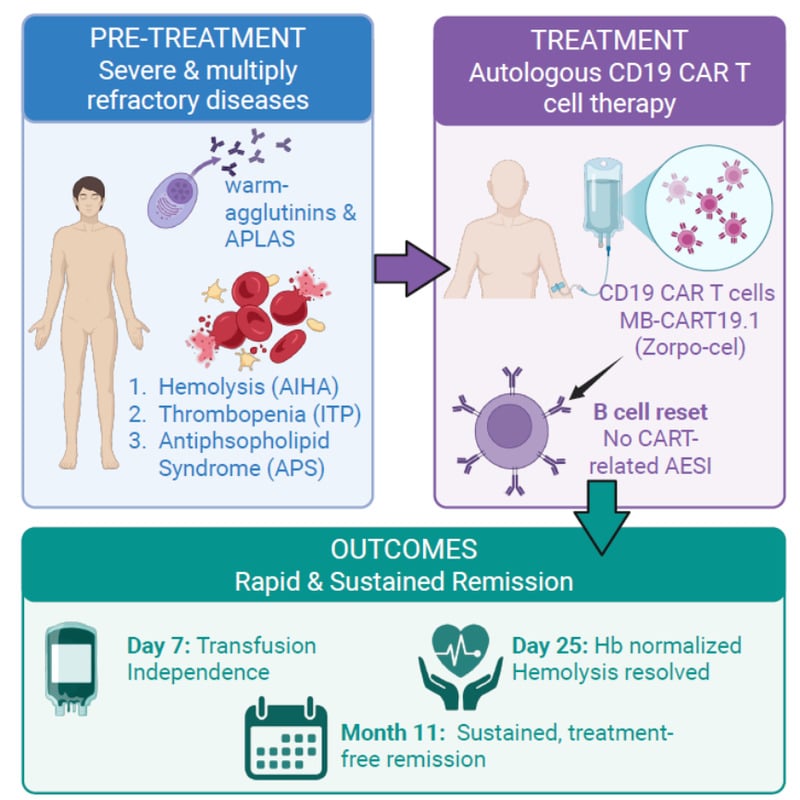
According to the report, the woman was first diagnosed in 2014 with a severe form of autoimmune hemolytic anemia (AIHA), a rare condition where antibodies bind to and kill off red blood cells. She also developed antiphospholipid antibody syndrome (APLAS), a condition where the immune system attacks phospholipids, raising the risk of dangerous clots, and immune thrombocytopenia (ITP), a condition where the immune system destroys platelets.
By 2025, nine different treatments had failed to do much for the woman’s AIHA, including daily blood transfusions, and the condition had become life-threatening. With no other recourse, the doctors offered her the chance to undergo CAR T-cell therapy, specifically a type targeting the CD19 antigen.
As hoped, the therapy depleted the woman’s existing supply of B cells, and with them, the autoantibodies driving her AIHA, APLAS, and ITP. Both her AIHA and APLAS went into clear remission, with her hemoglobin levels returning to normal within 25 days (an indication her red blood cells were no longer being killed off). She still showed some signs of ITP, but even that had greatly improved compared to before. When her body began to produce a steady supply of B cells again months later, they were largely naïve, meaning the treatment had basically reset her immune system.
Though the woman has some evidence of liver and bone marrow damage, the doctors say it may be more related to the after-effects of her many past failed interventions than to the CAR T therapy. As of now, 14 months later, she is no longer on any treatments for her autoimmune disorders.
The future of CAR T
There remains much work to improve the safety, cost, and viability of CAR T for a wider range of cancers. And similarly, there are still hurdles left to overcome before CAR T could become a commonly used option for autoimmune disorders, the doctors note.
The therapy is expensive and requires resources not easily available at many hospitals. It can also cause severe side effects, including a potentially fatal immune reaction known as cytokine release syndrome (the woman showed no signs of that in this case, thankfully). And it will still be important to track the health of autoimmune patients treated with CAR T to establish its long-term effectiveness.
But for the most severe cases of B cell-driven autoimmune disease, particularly cases that haven’t responded to other treatments, CAR T-cell therapy could very well become a new standard of care, the doctors hope.