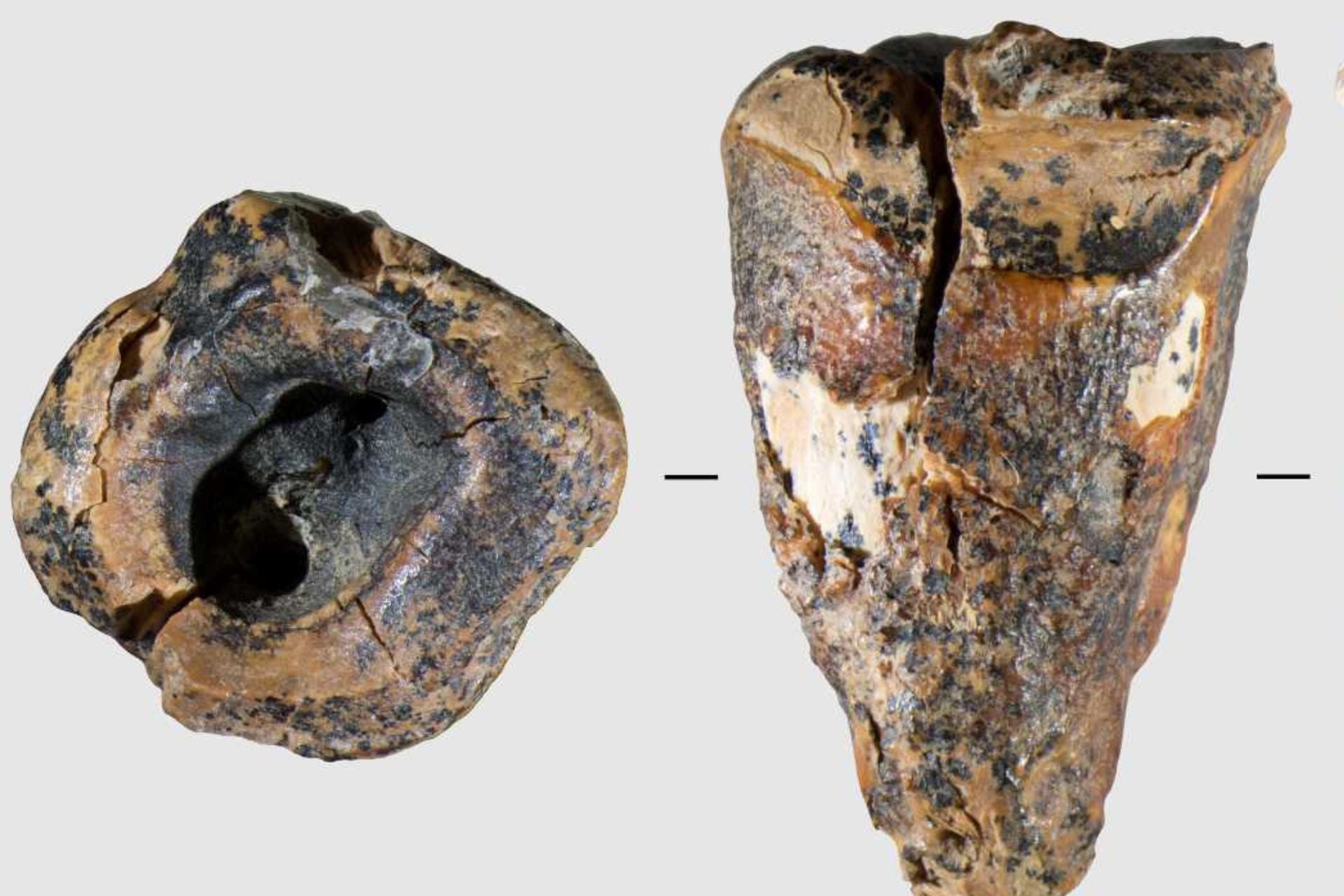
No one enjoys getting a cavity filled, but it could be worse. Imagine your dentist’s office is inside a cave where the best available tool is a sharp stone point for manually drilling into your teeth. You can forget about Novocaine—that won’t exist for another 60,000 years or so. Oh, and by the way, your dentist is a Neanderthal.
This isn’t just some weird dentistry-related thought experiment. Neanderthal dentists were a real thing, according to a study published today in PLOS One. After analyzing the unusual features of a 59,000-year-old molar discovered inside a cave in western Siberia, the researchers found that they were created by an ancient cavity treatment.
Previous research has shown that Neanderthals likely used toothpicks to clean their teeth as well as medicinal plants, but the study’s authors believe this molar—called Chagyrskaya 64—presents the earliest evidence of invasive cavity treatment in human history. It’s also the first documented evidence of this behavior outside of Homo sapiens.
“The outdated stereotype of cognitively inferior Neanderthals has been crumbling for years, replaced by evidence of their symbolic art, personal ornaments, and ritual burials,” co-author Ksenia Kolobova, an archaeologist in the Siberian Branch of the Russian Academy of Sciences, told Gizmodo in an email. “This discovery adds a fundamentally new category: invasive medical treatment.”
Uncovering signs of drilling
Chagyrskaya 64 exhibits damage never before observed in odontological findings from any Neanderthal group, according to the researchers. A large cavity extends across nearly the entire chewing surface of the crown, and the shape of the cavity did not match the normal morphology of the pulp chamber—the hollow space at the center of a tooth that contains dental pulp.
When Kolobova and her colleagues took a closer look at this cavity, they noticed that its interior walls preserved parallel, linear scratch marks and V-shaped grooves with corrugated bases. These markings could not have been produced by natural wear, cavity formation, or decomposition, but they are diagnostic traces of a rotating stone tool. The researchers were able to recreate the markings using a stone perforator on modern human teeth, confirming that they most likely resulted from a dental procedure.
“The polished edges of the cavity prove the drilling happened during life and the individual continued chewing afterward,” Kolobova said.
She and her colleagues believe the Neanderthal this tooth belonged to suffered from severe cavities, as a micro-CT scan revealed extensive demineralization around the cavity and along a groove likely made by a toothpick. Thus, the procedure was likely motivated by an instinctive urge to eliminate the source of pain.
Penny Spikins, an archaeologist and professor at the University of York in the U.K. who was not involved in the study, agrees with the authors’ assessment. “This is quite an evocative find,” she told Gizmodo in an email. “It draws attention to the medical skill that Neanderthals had developed to be able to treat injuries or illnesses which might otherwise have been debilitating or even life-threatening.”
“It also gives us some insight into their emotional relationships—that these people both had a case a desire to alleviate someone else’s pain and a willingness to do that in a way that’s both emotionally and technically challenging,” Spikins added.
The Neanderthal intellect revealed
Whether this individual performed the procedure on themselves or received treatment from another remains an open question, but the researchers suspect they likely had help from someone. The molar’s position at the back of the mouth would have made it difficult to reach with his own hands, and it would have been an immense challenge to maintain the necessary control and precision while enduring intense pain.
Regardless of who performed the procedure, the fact that it took place offers fresh insight into the Neanderthal mind. “Medicine is not symbolic, it requires causal reasoning, the understanding that a specific lesion inside the body is the source of suffering and that mechanically removing it can bring relief,” Kolobova explained.
“This reveals an analytical, interventional aspect of Neanderthal intelligence that goes beyond expressive culture,” she added. “The procedure also demonstrates advanced volitional control, enduring intense pain for a calculated long-term benefit, and, if someone else performed the drilling, a deliberate act of caregiving grounded in shared understanding.”
Still, several questions remain unanswered. How much did the Neanderthals actually understand about pain relief? Could there be overlooked examples of dental drilling in other Neanderthal populations? And how did they share medical knowledge? Was it a shared cultural practice passed from generation to generation or isolated innovations shared between individuals?
Kolobova and her colleagues hope to investigate these questions in future studies. The next step, she said, is to determine whether the drilled cavity was filled with any organic material after the procedure. This could reveal whether Neanderthals used antiseptic resins or plant-based analgesics to prevent infection and relieve pain.