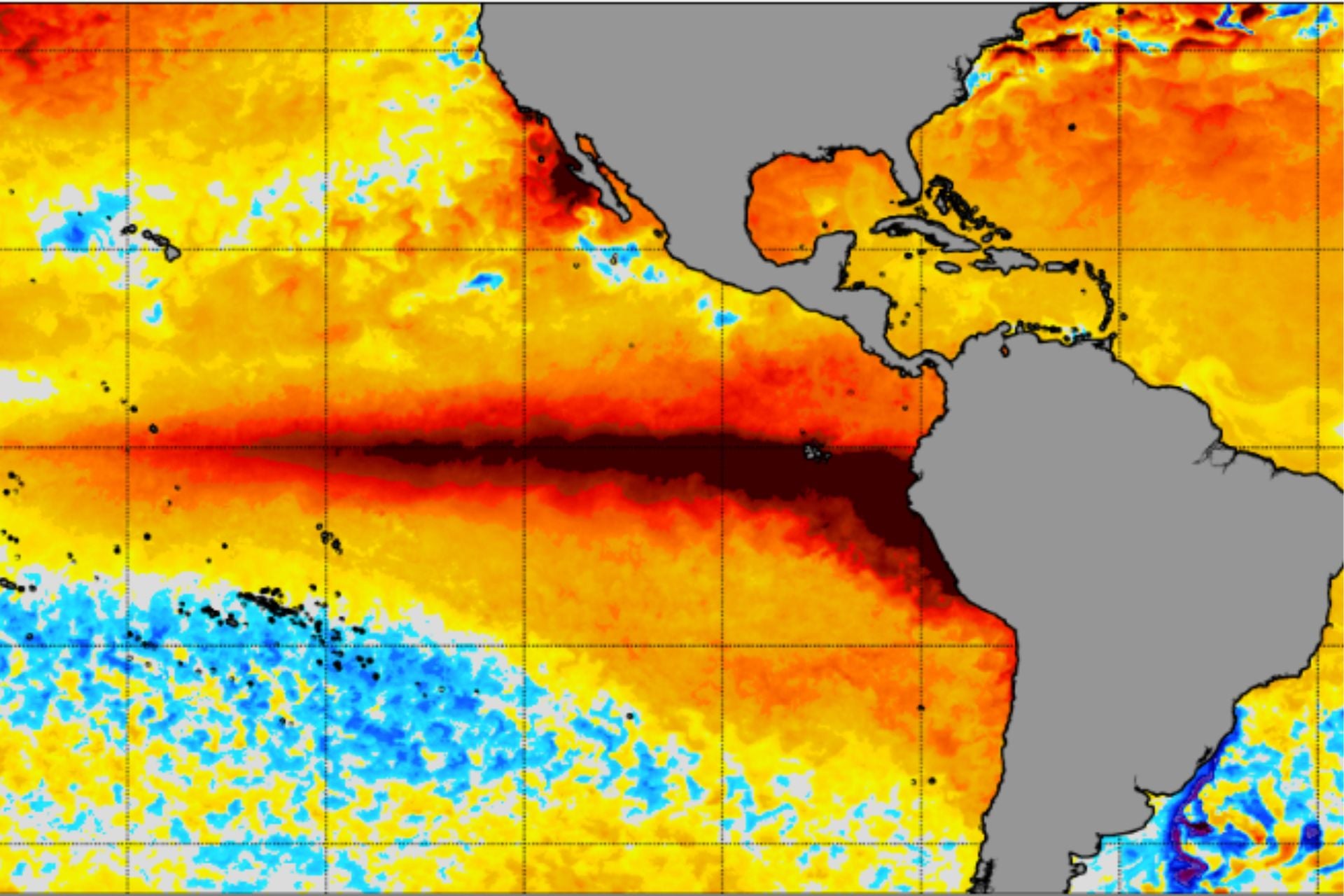
We’re still months away from the expected peak of this “super” El Niño, and the waters of the tropical Pacific Ocean have been record-warm for weeks. The latest model projections suggest they could remain that way for months to come, stretching El Niño’s impact well into 2027.
In mid-September, daily sea surface temperatures in the Niño 3.4 region—a key area of the tropical Pacific that serves as the benchmark for El Niño and La Niña—were 5.49 degrees Fahrenheit (3.05 degrees Celsius) above average. The anomaly exceeded the record-setting peak temperature measured during the very strong El Niño of 2015-2016. That event didn’t peak until November 2015, so the fact that this year’s El Niño has already broken its record is nothing short of remarkable.
Even more remarkable is the fact that this El Niño is still rapidly strengthening. The most recent seasonal El Niño forecast from the European Centre for Medium-Range Weather Forecasts (ECMWF) shows this event peaking around 7.2 degrees F (4 degrees C) in December.
Model projections suggest sea surface temperatures could remain at record-breaking levels for six straight months, a sign that this El Niño’s weather influence will likely persist longer into 2027 than usual, according to meteorologist Ben Noll.
“I think the pace of decline will accelerate by May, but given just how large the anomalies are, the event may not fully conclude until summer,” he wrote in an X thread on Tuesday.
New ECMWF seasonal guidance shows *six straight months* of record-breaking El Niño conditions, with a peak above 4°C in December.
This event is showing signs of potentially lingering longer into 2027, with El Niño's influence on the weather continuing through spring. pic.twitter.com/9vjcBB4ERh
— Ben Noll (@BenNollWeather) October 6, 2026
An enduring El Niño
Episodes of El Niño typically last nine to 12 months, but the longest in the modern record hung on for 18 months, according to NOAA. El Niño shifts weather patterns across the globe and boosts Earth’s average temperature, so the longer it persists, the longer its impacts will, too.
Climate scientists expect this event to pack a serious punch. Although every El Niño unfolds differently, stronger events are more likely to produce expected impacts. Those impacts vary regionally across the planet. For example, some parts of the world—such as Australia, Indonesia, and parts of Southern Asia—tend to experience severe drought, while others get drenched by record rainfall, like the southern United States and parts of western South America.
In a nutshell, El Niño tilts the odds toward extreme, anomalous weather that can have severe consequences for human lives, ecosystems, and the global economy. The financial toll of El Niño can persist for years after it subsides, racking up trillions of dollars in global income losses. With this event projected to be exceptionally strong and long-lasting, experts warn it could cost the global economy at least $7.2 trillion over the following five years.
Due to the lagging effect El Niño has on global temperatures, scientists are growing increasingly confident that 2027 will become the hottest year on record. The farther this event pushes into next year, the more pronounced its temperature boost will be. That means 2027 might not just surpass the record set in 2024 but absolutely shatter it.
The true outcome of this El Niño remains to be seen. Again, we’re still months away from its expected peak, but the data increasingly points to an exceptionally strong, long-lasting, and influential event that will be unlike any observed before.