Wireless underwater communication is just hard. A vacationing friend (or maybe even your own experience) has perhaps already shown you, for example, that the ocean just totally absorbs a Bluetooth wireless signal due to water’s 2.4 GHz resonance frequency.
Scientists and military contractors have been tinkering for decades on innovations that might bridge this communications lag, testing out optical laser pulses, radio-frequency schemes, magnetic induction relays, and anything really to get faster than sonar’s sluggish speed of sound. But, last month, engineers with the University of Florida (UF) published what they promise is a cost-effective breakthrough: a magnetoelectric antenna capable of efficiently transmitting and receiving very low and low-frequency (VLF/LF) electromagnetic signals underwater.
“Our design benchmark was to keep power consumption very low, ideally lower than a standard stereo camera system, while maintaining robust communication performance,” one of the project’s leaders, UF computer scientist Md Jahidul Islam, explained in a press statement.
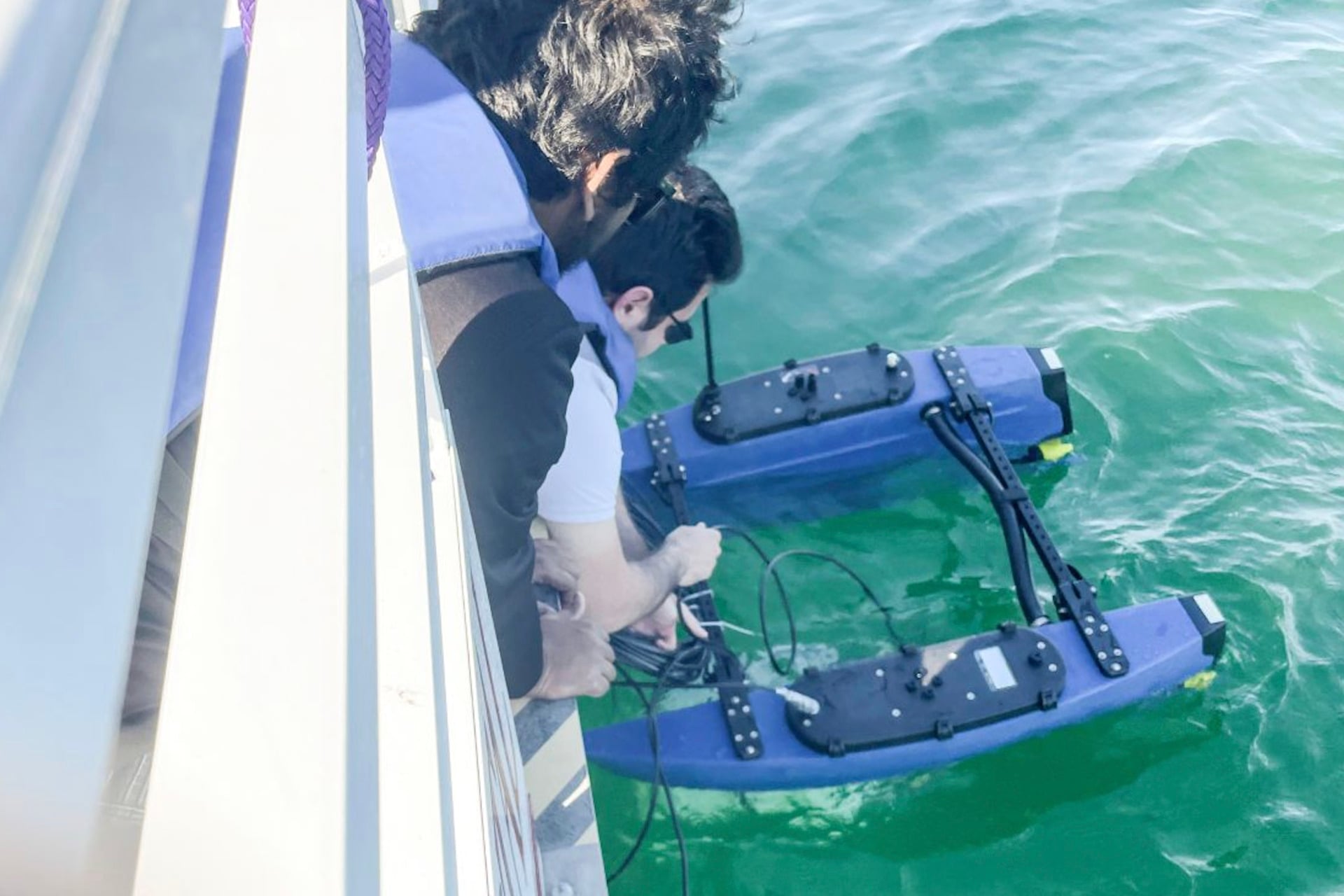
“Our compact, energy-efficient BlueME system achieves that balance, operating around 10 watts of power at maximum capacity,” according to Islam, whose ocean experiments confirmed that these antennas can communicate quickly across 2,296 feet (700 meters) on their frugal energy budget.
Robocall of the sea
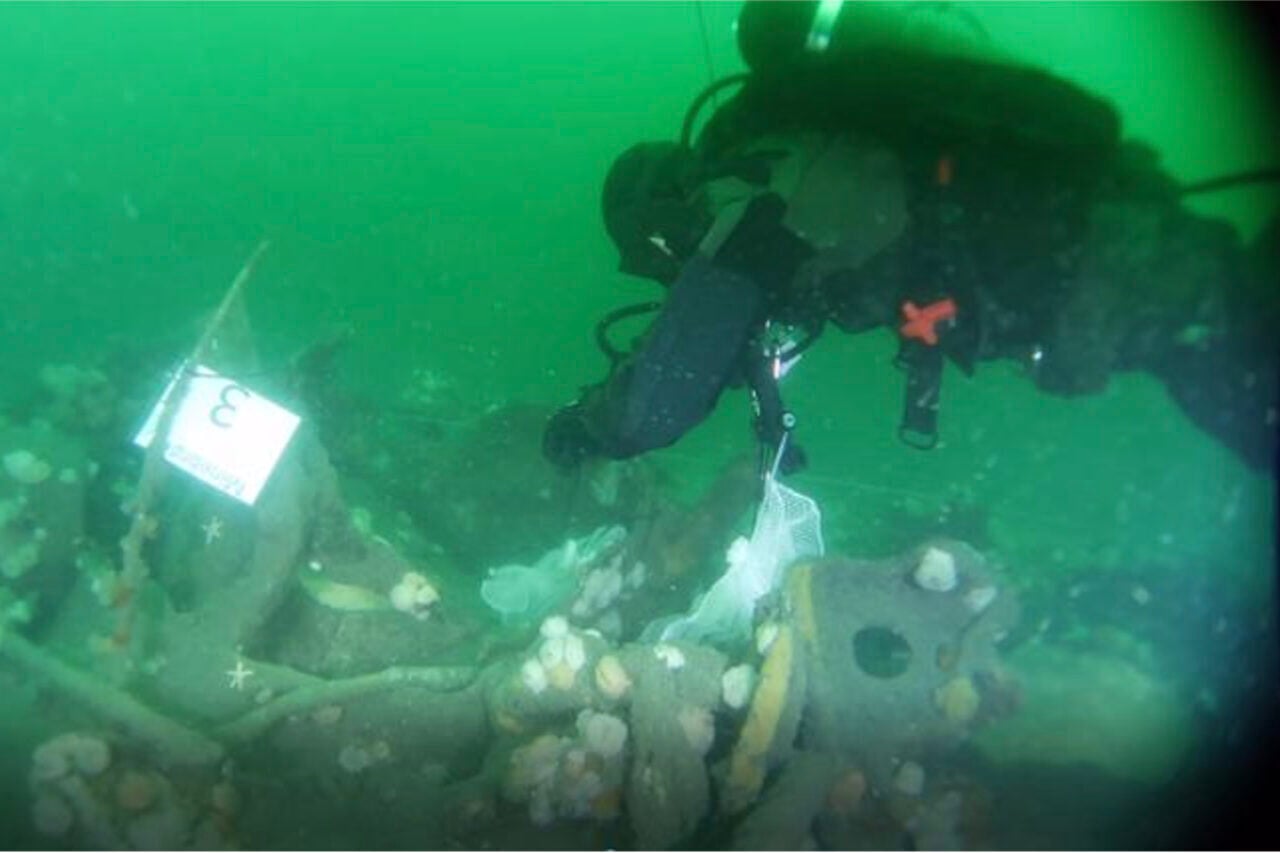
Islam and his colleagues, including a fellow assistant professor with UF’s Department of Electrical and Computer Engineering, Adam Khalifa, tested their underwater communication system with a small school (or maybe a pod) of autonomous marine robots. Their hope is that this research might one day assist remote marine environmental monitoring, naval operations, and offshore infrastructure inspections (i.e., non-dystopian, undersea drone swarms).
“Underwater multi-robot coordination remains extremely difficult because communication bandwidth and range are so limited,” Islam said. “Today, many underwater robots can only exchange sparse status signals or rely on surfacing periodically to transmit mission data. That significantly limits real-time autonomy and coordination.”
Governments have sometimes used VLF systems to communicate with submarines from outside the water—but those systems have had to be prohibitively large to handle the massive wavelengths of these very low-frequency signals, which can extend up to 62 miles (100 km) long. Islam and his team’s much more compact magnetoelectric antenna works around that limitation with piezoelectric materials that resonate at specific VLF frequencies regardless of the antenna’s size. (The concept is relatively new, but not entirely.)
The researchers tested their BlueME system of underwater robot-to-robot communication antennas in freshwater trials inside Gainesville, Florida’s Lake Wahlberg and in saltwater trials out in the open ocean.
“Ocean trials demonstrate that the system operates effectively under challenging conditions, such as turbidity, obstacles, and multipath interference, which are factors that typically degrade acoustic and optical methods,” the researchers noted in their new study, published last month in the IEEE Journal of Oceanic Engineering.
“Advances in compact underwater communication could fundamentally change how autonomous marine systems collaborate and operate in complex ocean environments,” Islam opined. “We are talking about the very early days of a very powerful product.”
A medical technology inspiration
Islam’s colleague Khalifa came to the project through his own engineering research, working to design small, safe, and unobtrusive wireless medical devices intended to be injected instead of surgically implanted. Wireless devices like this struggle to communicate through patients too, given that the human body is mostly water.
“I’ve spent years designing miniature wireless implants and studying efficient power transfer in highly conductive environments,” Khalifa said in UF’s press statement.
“At one point, it clicked that many of the same physical challenges inside the human body also exist underwater,” he added. “Our body is effectively made of lightly salted water. That realization opened the door to thinking about ocean communication in a completely different way.”
The researchers are confident enough in the unique innovations of their hardware that they have filed a provisional patent with the goal of refining the technology for use with more autonomous underwater vehicles.
“We demonstrated these results with very limited initial resources,” Khalifa noted. “With dedicated development and larger-scale deployment, the possibilities become much broader.”