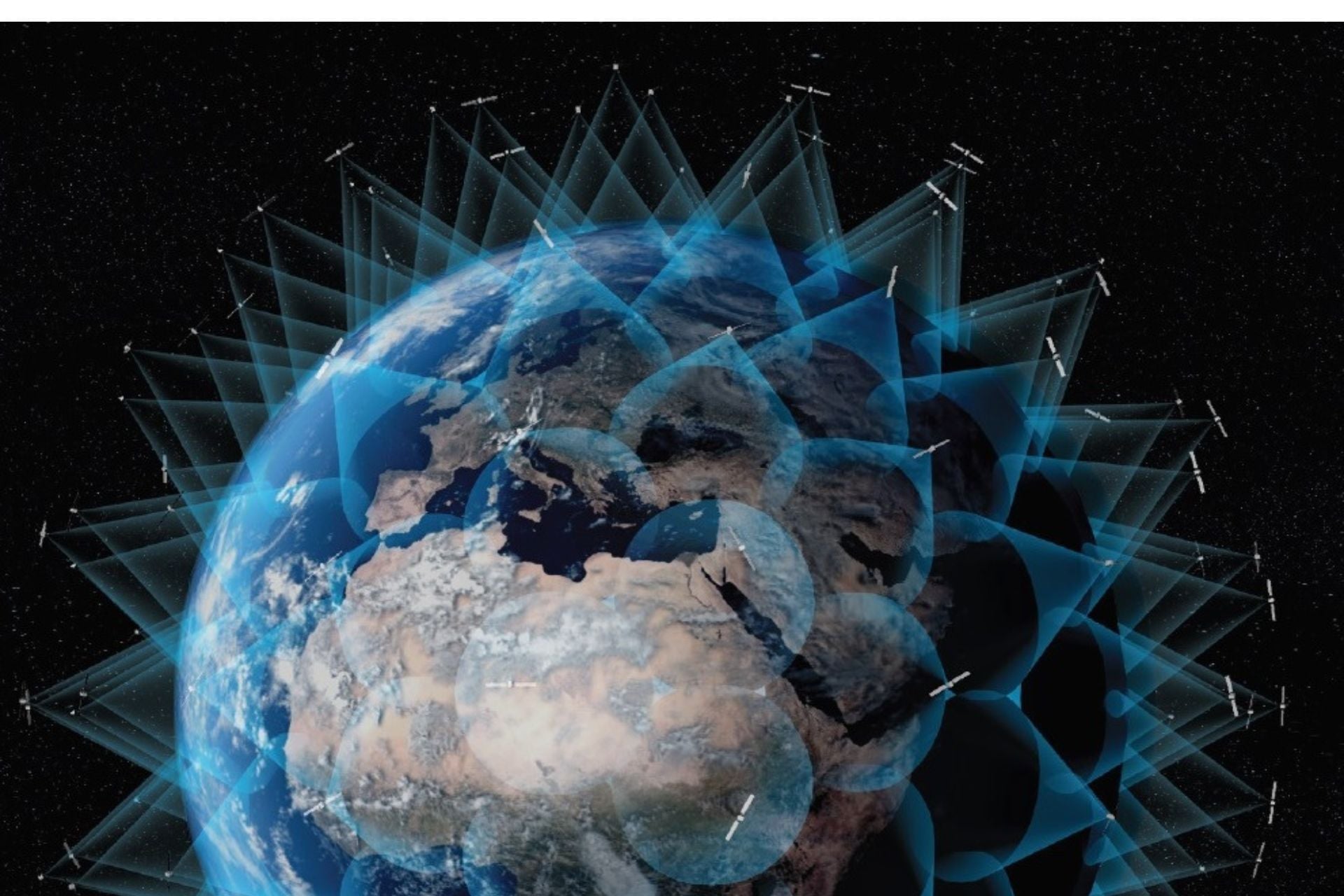
Companies are launching more satellites into space than ever before, and the industry’s biggest players have no intention of slowing down. SpaceX, the owner-operator of the world’s largest satellite constellation, recently applied for permission to launch 1 million Starlinks—on top of the 10,000 already in orbit.
Scientists have scrutinized Starlink and other megaconstellations for dangerously overcrowding Earth’s orbit and interfering with astronomical observations, but a new study suggests they could be messing with the climate, too. The findings, published May 14 in the journal Earth’s Future, show that air pollution—particularly black carbon, or soot—associated with megaconstellation deployment will account for nearly half of the climate impact from space sector pollution by the end of the decade.
Project lead Eloise Marais, a professor of atmospheric chemistry and air quality at University College London, likened space-industry pollution to an “untested geoengineering experiment with many unintended consequences.” That’s because black carbon particles released in atmospheric layers about 6 to 7 miles (10 to 12 kilometers) above Earth’s surface block incoming sunlight and cool the lower layers of the atmosphere.
“The amount of black carbon released currently by rocket launches is far less than the geoengineering ideas, but this may change with unregulated growth,” Marais told Gizmodo in an email.
Rapidly growing impact
Satellite deployment is a major driver of the commercial launch boom. The 29th annual State of the Satellite Industry report, published by the Satellite Industry Association last week, found that commercial satellite industry revenue accounted for 71% of the world’s space business in 2025. It also pointed to staggering growth, with 296 launches having deployed a record number of 4,434 satellites into Earth orbit. That’s a 65% increase from 2024.
As the industry explodes, there is a critical need to better assess its growing environmental impact. That’s why Marais and her colleagues sought to project its emissions out through 2029. They did so using data from a global inventory of air pollution from megaconstellation deployment, calculating the growth rates between 2020 and 2022. They then implemented this data into a 3D atmospheric chemistry model to determine how megaconstellations will impact the ozone layer and climate by the end of the decade.
The analysis revealed that in 2020, megaconstellations contributed about 35% to the total climate impact of the space sector, but that figure is expected to climb to 42% by 2029.
“Ideally we [would] have more years of data to improve the reliability of the prediction,” Marais said. “But the study progressed for an additional two years, typical of the rate at which research progresses. So, we were able to evaluate our predictions against two years of actual data for 2023-2024.”
This indicates that their impact estimate for 2029 was conservative, as the increased number of megaconstellation launches and amount of propellant burned actually exceeded the growth rates for 2020 to 2022.
How satellite pollution affects the climate
Marais and her colleagues looked at various air pollutants emitted by rocket launches and the re-entry burn-up of discarded rocket bodies, satellites, and other forms of space junk. They found that black carbon from kerosene-fueled rocket launches had the biggest environmental impact, lingering in the atmosphere for much longer than soot emitted by ground-based sources. As such, the cooling effect of launch-generated black carbon is about 500 times greater, but it’s still minimal compared to global temperature rise driven by greenhouse gas pollution.
Nevertheless, soot from megaconstellation deployment could cause problems, according to the researchers. To combat the climate crisis, engineers have proposed a geoengineering solution called stratospheric aerosol injection, which would spray reflective particles (like black carbon) into the stratosphere to counteract the greenhouse effect. But scientists warn the strategy carries severe, planetary-scale risks.
“These unintended consequences are a dominant reason why we haven’t adopted stratospheric aerosol injection geoengineering to scale,” Marais said.
Her team also investigated whether megaconstellation pollution could deplete the ozone layer, which protects Earth’s surface from UV radiation. The impact they estimated was small because most rockets launching megaconstellations do not emit strong ozone-depleting chlorine compounds, but this may change, as some satellite companies plan to use chlorine-emitting propellants, Marais explained.
While this study provides a starting point, “there’s a lot that needs to be done to observe and measure pollution and environmental impacts from rockets,” she said. Her team is building an online tracker for launch and re-entry emissions and designing techniques to observe rocket launch pollution using satellite instruments that observe land rather than the air.
“We hope policymakers will see the warning signs offered by us and other related studies to design regulation that prevents harm to the environment, so that future generations aren’t left with the burden to repair the damage,” Marais said.