For all we’re learning about the distant cosmos, there’s still much we don’t understand about things much closer to us, like the Sun. It’s difficult to investigate something as big and hot as the Sun up close, so astronomers have to use other means, like tapping into the hidden sound waves from deep inside the star.
When astronomers compiled 40 years’ worth of helioseismic data—information on the waves propagating inside the Sun—they found a previously unknown pattern of solar magnetic activity bunching up into a shallow layer just below the surface. In a new paper published today in Monthly Notices of the Royal Astronomical Society, researchers describe how this internal “biorhythm” points to changes in solar activity that weren’t observable via traditional methods.
“We discovered that the relationship between internal solar oscillations and surface activity has evolved over the past few cycles,” Sarbani Basu, a study co-author and an astronomer at Yale University, said in a statement. “This trend cannot be explained simply by weaker magnetic fields.”
From down under
According to the paper, the two previous solar cycles deviated slightly from previous ones. Cycle 24 (2008 to 2019) was significantly weaker. Meanwhile, solar cycle 25, which we’re currently in, was initially predicted to be “below average” by experts but ended up overshooting expectations in terms of the number of sunspots and radio activity.
These predictions come from observations of sunspots and magnetic fields on the surface of the Sun, according to NASA. While that enables experts to make fairly good estimates of solar activity, these factors are admittedly indirect estimates of all the unmeasurable stuff going on under the Sun’s surface.
Sounds of the Sun
Analyzing helioseismic data of p-mode oscillations—sound waves whose frequencies shift in response to solar magnetic activity—reveals a missing pattern that might fill in the gaps. In the study, the team plotted the Sun’s oscillations across solar cycles 22 to 25, which correspond to the years between 1987 and 2025. The oscillations were grouped along frequency bands.
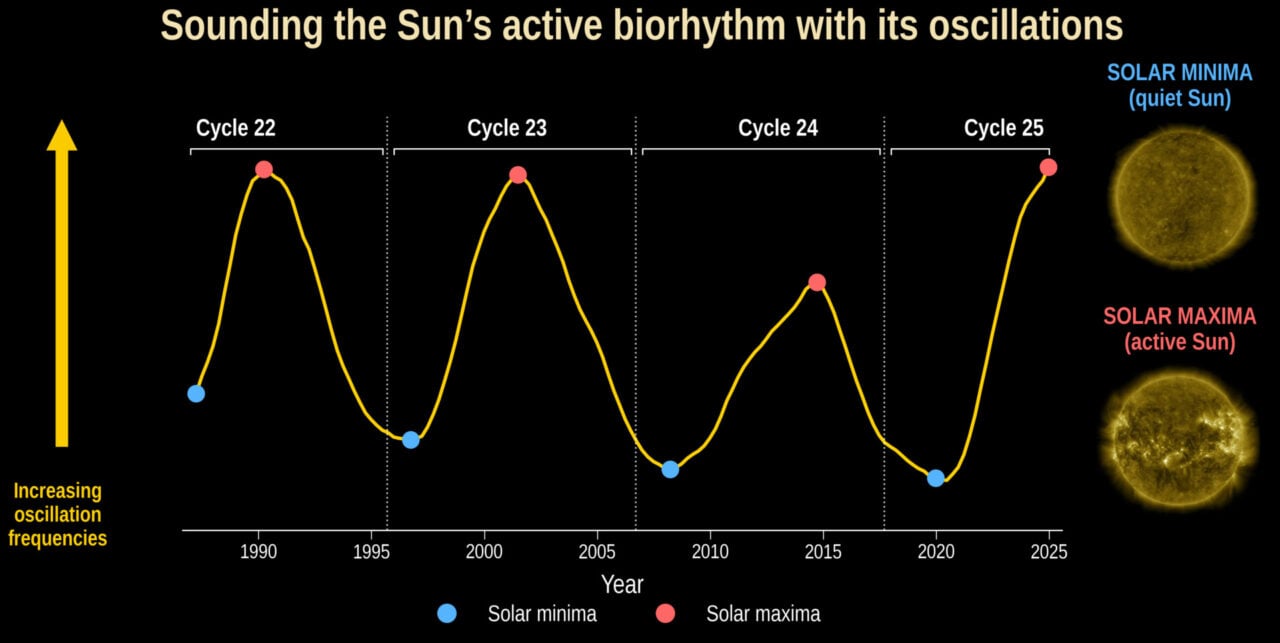
As a result, the team discovered a gradual change in below-surface solar activity spanning multiple cycles, which overall indicated that the Sun was going through a long-term change from beneath its surface. These signatures were particularly strong for solar cycle 25, which traditional surface indicators inaccurately predicted would be weaker than usual.
Maybe, or maybe not
The findings indicate a “structural reorganization of how the Sun’s magnetic activity is stored beneath the surface,” Basu said. These changes appear to be confined within 621 miles (1,000 kilometers) below the Sun’s surface, noted the paper.
“The Sun has its own ‘active biorhythm,’ creating rising and falling magnetic activity that shapes space weather,” Bill Chaplin, the study’s lead author and an astronomer at the University of Birmingham in the U.K., explained in a statement from the Royal Astronomical Society. “Crucially, magnetic activity is becoming more tightly confined near the surface with each cycle.”
But the team said it still needs to “explore” what this really means. In the foreseeable future, the researchers will stay tuned (literally) into the Sun for the remainder of cycle 25, which will likely end around 2030. If this inner pattern continues into cycle 26, it’ll give astronomers a better idea of what this all really means.