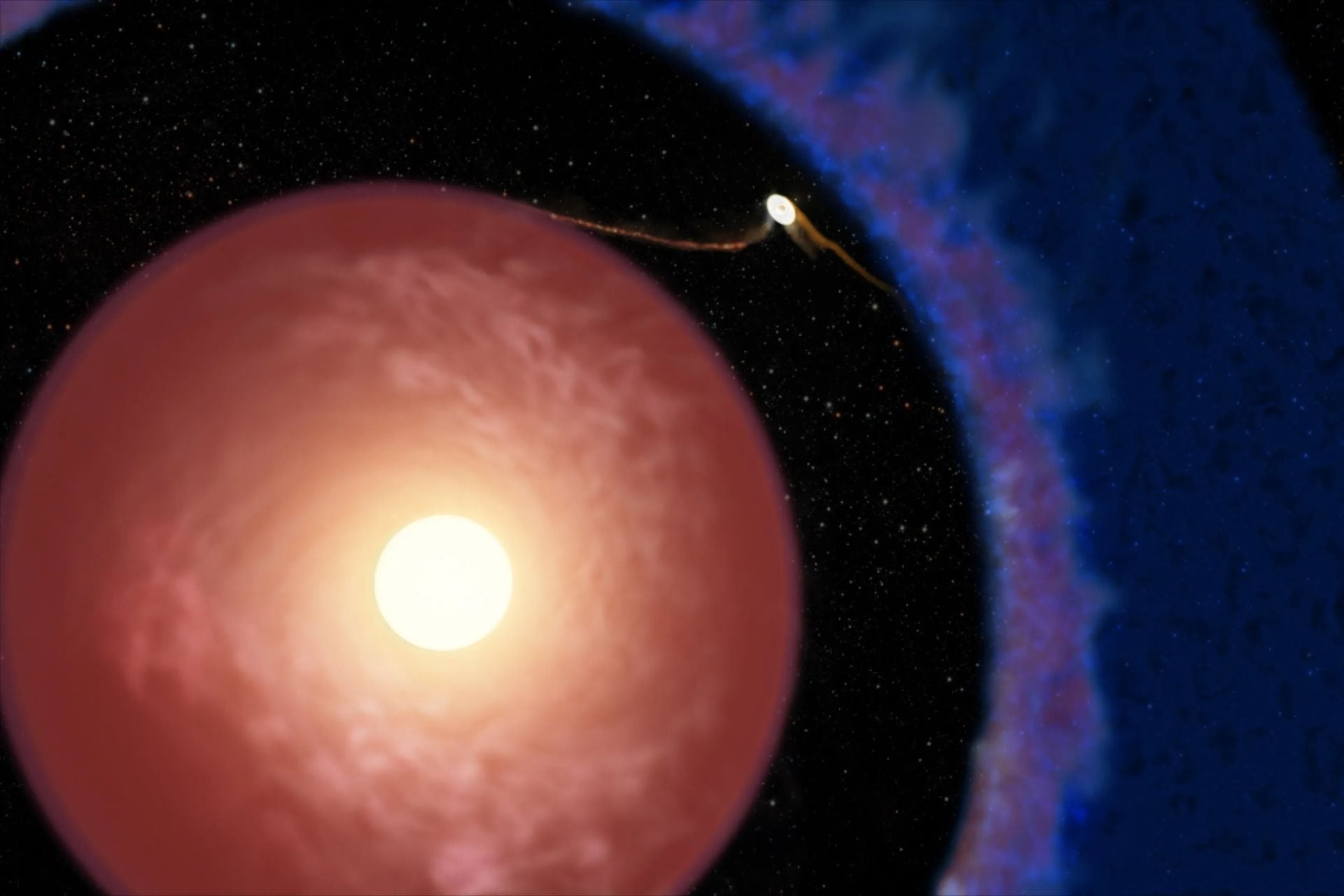
For a decade, astronomers have debated whether a planet is taking shape in the dusty disk surrounding Elias 2-24, a young star located about 450 light years from Earth. The first clue was a gap in the disk spotted by the ALMA observatory in Chile, followed by the European Southern Observatory’s detection of a faint point of light sitting in that gap.
There was a problem, however. According to planet formation models, it takes about 5 million years for a Jupiter-sized planet to form at Jupiter’s distance from the Sun. The farther a planet is from its star, the longer it takes to grow. But this glowing dot was roughly 11 times farther from Elias 2-24 than Jupiter is from the Sun, and it was already behaving like a forming planet.
A study published Wednesday in The Astrophysical Journal Letters finally confirmed that this dot is, in fact, a Jupiter-sized planet, and it’s turning current models of planet formation upside down. Elias 2-24 b, as the planet is now called, is the youngest ever discovered at less than a million years old. It’s still growing inside a natal disk of dust and gas, but it is much farther along than theory suggests it should be.
“Our planet-formation models already struggled to explain the previous record holders for the youngest known planet—a four-way tie between two planets orbiting the star PDS 70 and two planets orbiting the star WISPIT 2—which are all more than 5 million years old,” co-author Lucas Cieza, a professor at the Instituto de Estudios Astrofísicos in Chile, said in a statement. “Elias 2-24 b shows us that even our best planet-formation models are still missing some important processes.”
A puzzling planet
Cieza was part of a team of researchers led by Andrea Bernardi, a doctoral candidate at the Universidad Diego Portales in Chile, that analyzed archival observations of seven stars—including Elias 2-24—from the coronagraph at the W. M. Keck Observatory in Hawaii. They found the mysterious point of light in observations gathered between 2018 and 2020 and stitched them together to study its motion over time.
This revealed that the dot behaved more like a forming planet than an imaging defect or a background star. The researchers know it must be very young because previous studies have found evidence that its host star is less than a million years old. One estimated that Elias 2-24 is just 400,000 years old, while another suggested that it could be even younger at approximately 200,000 years old. This star also has a particularly high accretion rate, so it’s still growing.
The authors of this new study therefore believe Elias 2-24 b is less than a million years old too, but to model its size, they assumed an age of one million years. They determined that this planet could be two to 14 times larger than Jupiter, but because the planet is shrouded in a thick cloud of gas and dust and is still growing, it’s exact mass remains uncertain.
Still, the idea that a planet located so far from its host star could grow so quickly is highly intriguing. Elias 2-24 b will now serve as a natural laboratory for researchers to study the earliest stages of planet formation and refine their models.
“This planet is a rare gem, as it is currently undergoing a stage of its evolution for which theoretical models still struggle to reliably predict its mass, entropy, and, consequently, its expected luminosity,” co-author Alice Zurlo, a professor at Universidad Diego Portales, said in a statement. “This system will therefore provide key insights once we are able to further constrain its dynamical mass, helping us refine and recalibrate evolutionary models for young planets.”
The hunt for more infant planets begins
Because planets are born in the haze of material that surrounds young stars, it’s extremely difficult to study an exoplanet’s newborn stage. The fact that astronomers found Elias 2-24 b at all is astounding, and the discovery speaks to the value of combining observations from multiple telescopes.
“We usually hear about telescopes working separately, but this confirmation was possible only by using multiple telescopes together,” Bernardi said. “Elias 2-24 b is at the limit of what current telescopes can detect, but with new instruments like NASA’s Nancy Grace Roman Space Telescope, such detections should become easier.”
Roman launched in late August and achieved first light on Thursday. It is equipped with the most powerful coronagraph ever flown in space. This instrument blocks light from a bright object, like a star, so that the telescope can better see a faint object, like a planet. The Roman coronagraph can detect planets 100 million times fainter than their stars, or 100 to 1,000 times better than existing space-based coronagraphs.
This could allow astronomers to find many more infant planets like Elias 2-24 b. “This is just the beginning of a new era of discovery,” Cieza said. “It’s incredible that with modern technology, we are actually able to see planet formation in action, and Roman will take planet hunting to the next level.”