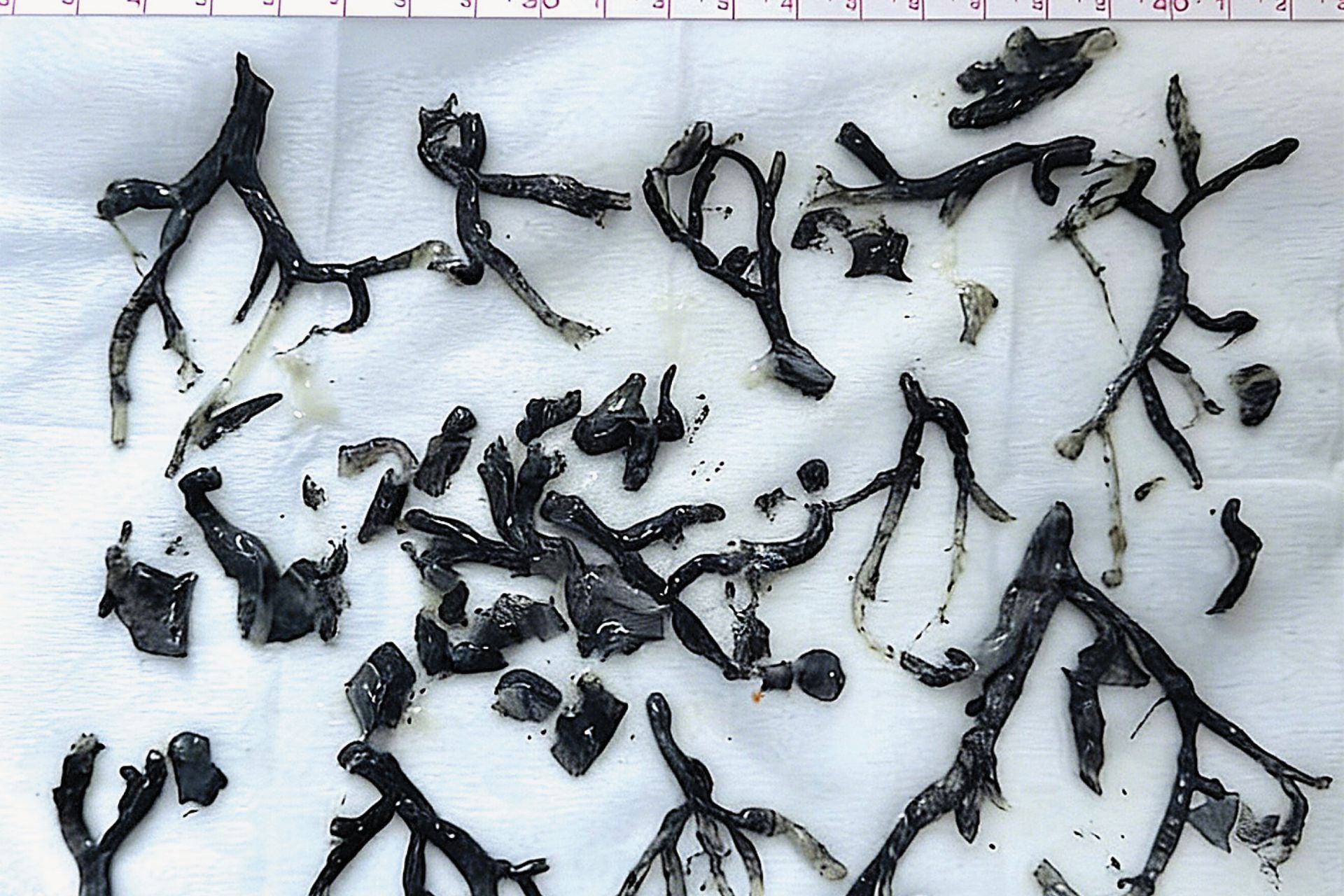
Editor’s note 5/1/2026: The New England Journal of Medicine retracted this case report after the authors reported use of AI image manipulation that was not disclosed at the time the manuscript was submitted. In the retraction note, the authors said they used “an artificial intelligence (AI) tool to move the ruler to the top of the image.” Neither the journal nor the authors have indicated that the clinical findings described in the case report are inaccurate. The NEJM’s editorial policies permit the use of AI tech in preparing materials for publication but say the use must be disclosed.
A case report out this month starkly illustrates the damage forest fires can do to our lungs.
Doctors in China treated a man who breathed in thick smoke from a forest fire. After the man’s respiratory function began to decline, doctors examined his airways and discovered they were filled with rubbery, blackened mucus caused by the smoke inhalation. Thankfully, they successfully removed the gunk, and the man eventually recovered from his injuries.
Bronchial casts
According to the report, the man went to an emergency room because he had difficulty breathing. For several hours prior to the visit, he had been exposed to thick smoke from a forest fire.
He managed to avoid getting burned, but his oxygen levels had fallen dangerously low. As his condition worsened, doctors intubated him and placed him on mechanical ventilation. The ventilation wasn’t working as well as expected, however, prompting doctors to closely examine his lungs and airways with a flexible tube and camera (a bronchoscopy). And it was then that they spotted something known as a bronchial cast, also known as plastic bronchitis.
Bronchial casts are caused by the build-up of mucus, lymph fluid, and other materials in the airways. This build-up leads to rubbery and thick plugs, or casts, that fill out and block the airways, which can cause serious, even life-threatening breathing issues. The doctors determined that the man’s casts were the direct result of “inhalation of particulate matter from forest-fire smoke,” accounting for their soot-tinged appearance.
Casts can sometimes be coughed out, but severe cases necessitate immediate treatment. The doctors removed the casts using a cryoprobe. Three days after, the man was taken off intubation, and he was treated for pneumonia. And after a week in the hospital, he was discharged.
“At follow-up 2 weeks later, the patient’s breathing had returned to normal,” the doctors wrote in their report, published over the weekend in the New England Journal of Medicine.
The sneaky effects of climate change
This case offers more than a memorable image—it illustrates the less obvious harms of climate change. The report is part of a series in this month’s issue of the NEJM, spotlighting some of the health effects that could be exacerbated by climate change.
Increasingly hotter and drier conditions in many parts of the world, the U.S. included, have contributed to more extreme wildfires over the past several decades. These trends are only expected to worsen in the years to come without a significant reduction of greenhouse emissions. So while these sorts of inhalation injuries might be rare, they could be more common in our near future.