Ah, Pompeii. It’s become a cliché for unwitting, inescapable doom, the fragility of life in
the shadow of uncaring nature. And in Pompeii,
opening today, Paul W. S. Anderson turns this tale of an ill-fated city into an accidental comedy
that happens to have a volcano in it to absolutely no one’s surprise.
The thumbnail sketch, which draws from
so many well-worn tropes it’s essentially made itself spoiler-proof,
attempts to turn a “Gladiator Epic and Disaster Movie” Venn
Diagram into a circle. Milo has spent his life as a gladiator,
waiting to avenge himself against the Roman general who murdered his
people. When he’s brought to Pompeii, he has a fateful meeting with
Cassia, daughter of Pompeii’s most powerful family. (Will they fall
in love?)
At the arena, he meets Bridgageous, a hardened fighter who
doesn’t like our hero. (Will they find grudging respect for each
other that grows into devoted brotherhood just in time for
Bridgageous to sacrifice himself for the white guy?) Cassia’s under
pressure because of a threat to her rich and influential family, who
spend the movie unable to leverage either wealth or power. (Will she
have to marry to save her family, or get a chance at freedom?) Milo’s
determination to avenge his family is rekindled when the Roman
general appears in Pompeii to handle Imperial business. (Will he be
pure evil, or an evil-cowardice alloy?)
And meanwhile, the camera
passes dutifully over the crater of Vesuvius as the pressure builds.
(Will it expl – yes, okay, yes, it completely will.)
Some of this, of course, is comfort
food. A piercing study of class issues and the increasing
globalization of the Roman Empire would probably be less popcorn-fun
than a gladiator flick where supporting characters will always be
able to stagger to their feet after terrible injuries to deliver one
last cutting remark before going to that great ludus in the sky.
But
as usual with Paul W. S. Anderson,
the setup is ripe for camp delight. Unfortunately, his intermittent but insistent self-seriousness leaches
away most of the potential fun. He managed a
solid B-movie in Alien vs. Predator,
where a steadfast Sanaa Lathan was so good at fighting
xenomorphs that the Predators were impressed, but that was exception
rather than the rule. With Pompeii,
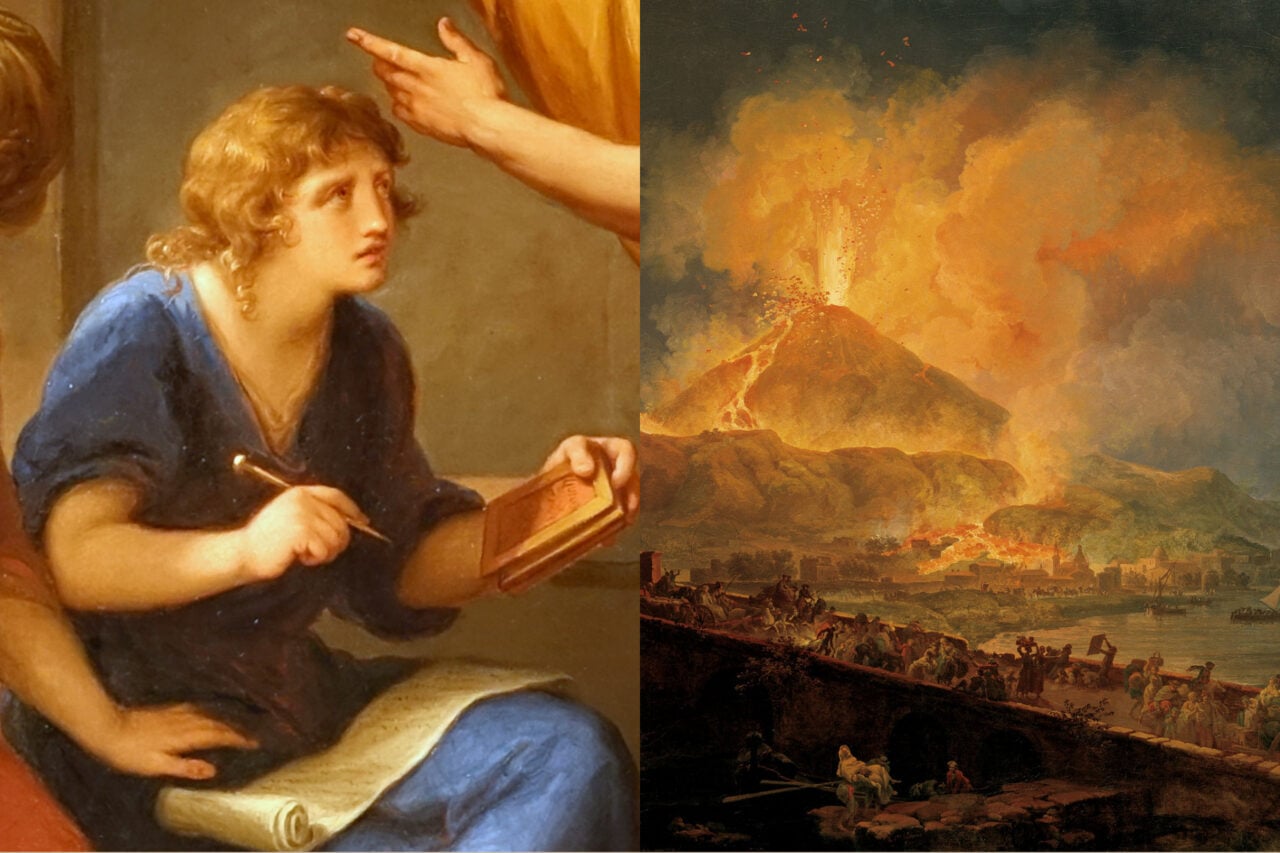
from the first moments that we pan across ash-draped corpses between
quotes by Pliny the Younger, it’s clear that he wants us to
appreciate the drama.
It’s
almost too bad, since Pompeii
has everything it needs to be a camp satire of gladiator flicks, down
to the debauched noble drawling “You dragged me from a perfectly
adequate brothel for this?” before he sees Milo fight for
the first time, the sort of guy the movie knows you want to get
eaten, drowned, or swallowed by a chasm. Sadly, the movie manages to
get in its own way just enough to keep things stilted.
As Milo, Kit Harington, who must have
been looking for a role in the sweet spot of “I already know how
to stage fight, so this will save time in sword camp” and “I’d
like to look angry instead of constantly petulant and half-smothered
by my fur collar, and also maybe be a horse-tamer,” does what he can with a paper-thin leading
role, and makes a decent case for himself being a Colin Farrell-level movie brooder after he’s killed off in season 18 of Game of
Thrones. Emily Browning ably pulls off Cassia, a young woman who’s
assertive and good in a crisis while skirting the dreaded shortcut of
“feisty.” She also, conveniently, loves and owns several horses.
(If a handful of tweens don’t stagger
out of this movie deciding they want to train stunt horses, this movie was made for nothing.)
Their chemistry doesn’t quite sell the
city-wide tragedy it needs to, but at least they pitch
their performances so that you know they’re in the same movie. Not
everyone does!
Sometimes, honestly, that’s an
improvement: Adewale Akinnuoye-Agbaje, whose intensity and
self-awareness are both more than this movie really deserves, steals
his scenes by giving every line his full weight while maintaining an
air of mild bemusement that those are, in fact, his lines. Jared
Harris and Carrie-Anne Moss are, one assumes, lifted from their
screentest for Rome, where
they would have played the only decent parents on the entire show and
were thus summarily cut from the season. And Kiefer Sutherland, who
admittedly could do little else with what he was given, leans into
every muttering threat and scenery-chewing outburst. (Not only is he
the man who killed Milo’s family, he’s also the man out to marry
Cassia – what are the chances? – and at one point he actually
grabs her by the arm and snarls, “I’ll break
you!”, which is right underneath “Tie her to the train
tracks” in the Movie Bad Guy Cue Handbook.)
To a degree, this might all be
forgiven—it’s a bit lackluster and scattershot even for a gladiator
B-movie, but Pompeii’s also a
disaster flick, to which characters are merely toys you get to melt
or drown later. A painstaking Pompeii being buried by a
staggeringly-rendered volcano could have made this movie the most
gripping dramatization of the disaster since Forever Knight
had that episode where the Roman
general’s daughter made him a vampire.
It’s worth noting that apparently
Anderson researched for several years to make the film as
historically accurate as possible, from the streets of Pompeii to the
masked chorus at the arena. And admittedly, there might be a little
thrill for history buffs watching the extras of Pompeii crossing
streets using the elevated pedestrian stones. But for all its
background and its significant budget (the largest Anderson’s ever
had), there’s no sense of visual impact to carry the movie along.
Overhead shots of the city have all the grandeur of Google Maps, and
the movie cuts so often to the roiling volcano that the audience
burst out laughing during a very dramatically-loaded look toward
Cassia’s villa, way too close to the shadow of Vesuvius. And when
disaster strikes, the obvious attempts to show the pathos of a city
vanishing (waves engulfing the lighthouse) are undermined by moments
of Milo and Cassia breathlessly gazing at one another as extras
around them are struck in the head by direct-hit flaming rocks, which
is exactly as hilarious as it sounds.
If Pompeii had
given in just a little to moments like this, it might have been in I,
Frankenstein situation, in which
the self-seriousness creates a parabola of sublime comedy on which
the movie gently coasts to an angel-gargoyle stop. Instead, Pompeii
has a sense of being dutifully
lost—determined to ignore its camp potential in favor of its most
predictable and least engaging aspects, giving us a movie that’s the
cinema equivalent of reciting some Latin phonetically.