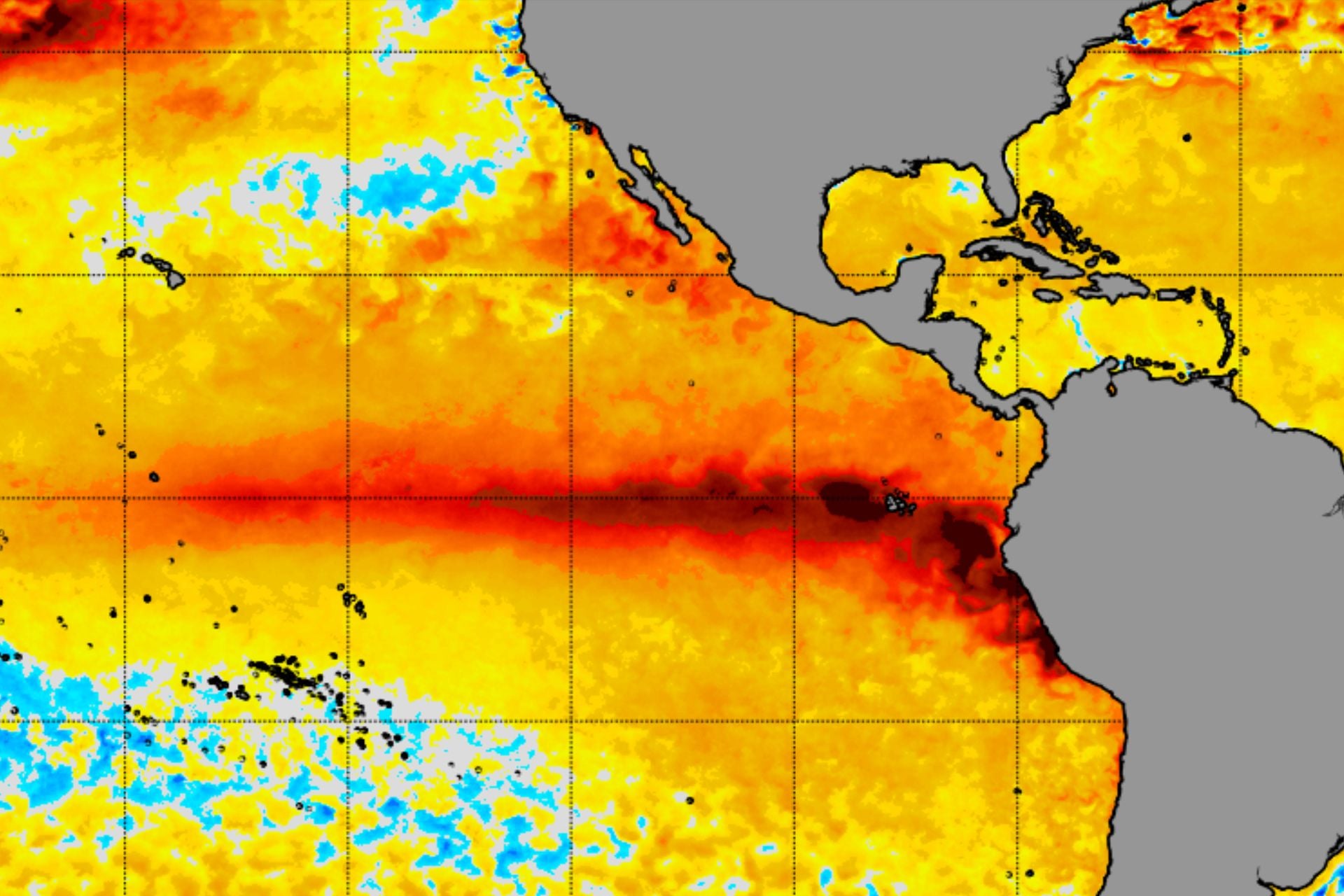
Every time I think the El Niño forecast can’t possibly get worse, the models prove me wrong. The latest outlook from the European Centre for Medium-Range Weather Forecasts (ECMWF) shows this event peaking around 7.2 degrees Fahrenheit (4 degrees Celsius) in December, blowing the previous record out of the water.
We’re still several months out from that peak, and the closer we get, the more confident the models will become. It’s certainly possible that sea surface temperatures in the tropical Pacific could rise even higher. Current temperatures are already hotter than any days logged during the 1997/1998 super El Niño event, according to climatologist Zeke Hausfather. Subsurface temperatures in the tropical Pacific have also never been higher, “so there’s a lot more gas in the tank for this El Niño,” meteorologist Jeff Berardelli said on Monday.
The worst-case scenario currently projected by the ECMWF shows sea surface temperatures rising a whopping 8.1 degrees F (4.5 degrees C) above average. Even if they don’t reach that extreme, the peak anomaly only has to climb above 5.4 degrees F (3 degrees C) to surpass the record set during the 2015/2016 super El Niño.
We’re already halfway there. In its latest El Niño update, the National Oceanic and Atmospheric Administration (NOAA) reported an average temperature departure of 2.7 degrees F (1.5 degrees C) in the Niño 3.4 region, a key area of the Pacific that scientists monitor for signs of El Niño and La Niña.
Breaking: El Niño strength forecasts have just taken another step higher.
The new ECMWF outlook shows the event peaking near +4.0˚C in December — obliterating the previous record.
This will have sweeping implications on global climate patterns from late this year into 2027. pic.twitter.com/YvbctXluCL
— Ben Noll (@BenNollWeather) August 5, 2026
UN preparing for global food shortages
El Niño is the warm phase of the El Niño-Southern Oscillation (ENSO), the largest and most influential year-to-year climate variation on the planet. During El Niño, sea surface temperatures in the central and eastern equatorial Pacific Ocean rise above average, which significantly boosts Earth’s average temperature and drives major shifts in weather patterns across the globe.
The bigger the temperature anomaly, the more impactful El Niño is likely to be. Based on the expected strength of this year’s event, experts are expressing concern about a significant uptick in extreme weather, record-shattering global temperatures, and food shortages.
An analysis published Wednesday by the United Nations’ World Food Programme shows that the strengthening El Niño is on track to significantly worsen food insecurity in some of the world’s most vulnerable countries. The record-strong El Niño that occurred between 2015 and 2016 impacted the food security of 60 million to 100 million people, and WFP’s preliminary analysis shows that the 2026-2027 El Niño could push at least 49 million more people into acute food insecurity by the end of 2027.
“El Niño is a massive threat to the food security of millions who are already vulnerable,” Carl Skau, WFP’s acting executive director, said in a statement. “The sooner we help families to prepare for these climate shocks, the greater our ability to save lives and protect livelihoods.”
It’s important to remember that this is a developing event and its true fallout remains to be seen. What’s more, “the models have never been verified in this territory,” Hausfather wrote in a blog post in July. Seasonal forecast systems have clearly demonstrated their ability to predict ordinary El Niño events, but no ensemble has ever forecast—and then verified against—an event exceeding 5.4 degrees F (3 degrees C), because one has never happened.
With global temperatures higher than ever before thanks to climate change, it’s no surprise that El Niño is entering uncharted territory. As this potentially unprecedented event unfolds against the backdrop of long-term anthropogenic warming, we’ll likely get a glimpse of what our climate will look like permanently in the not-so-distant future.