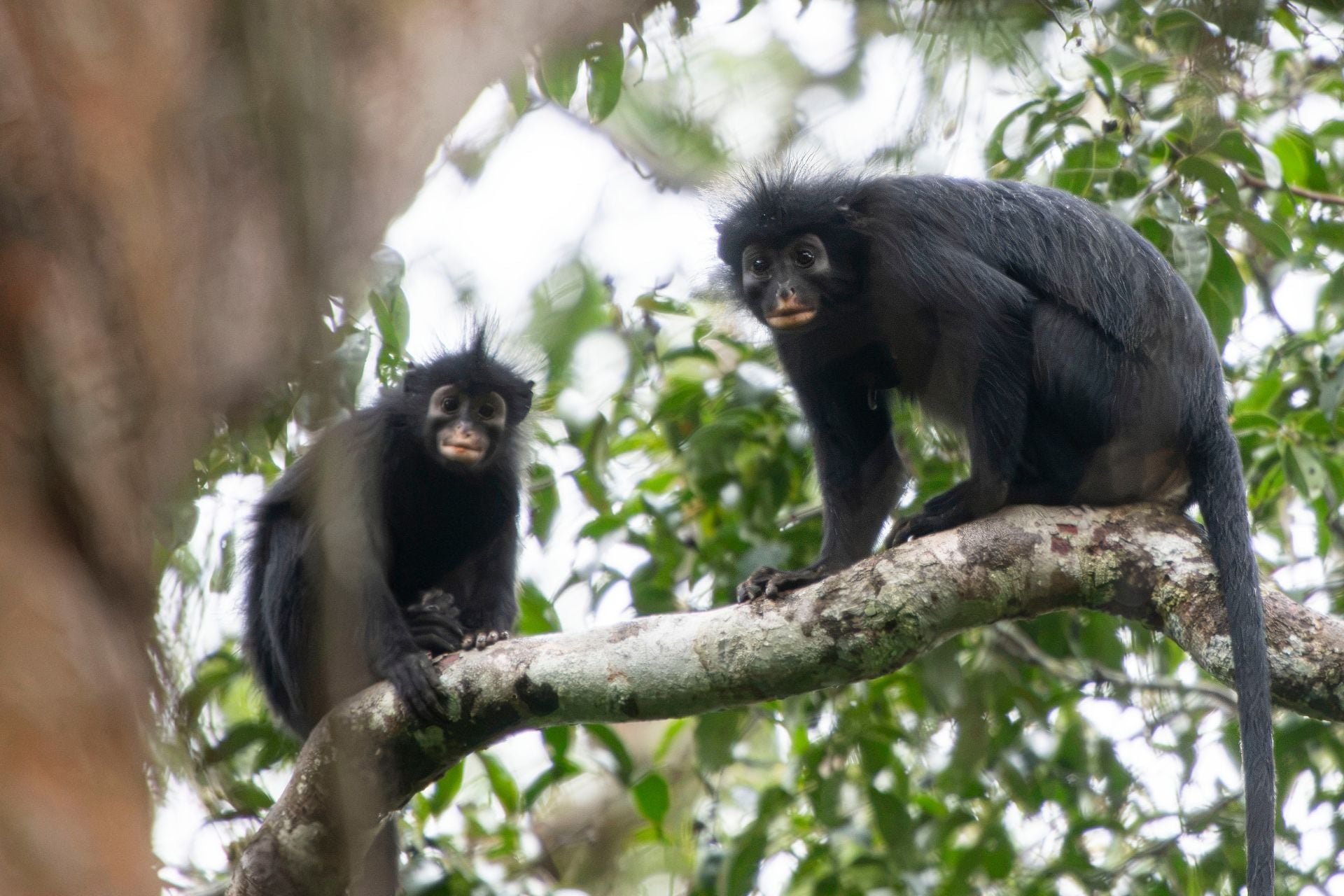
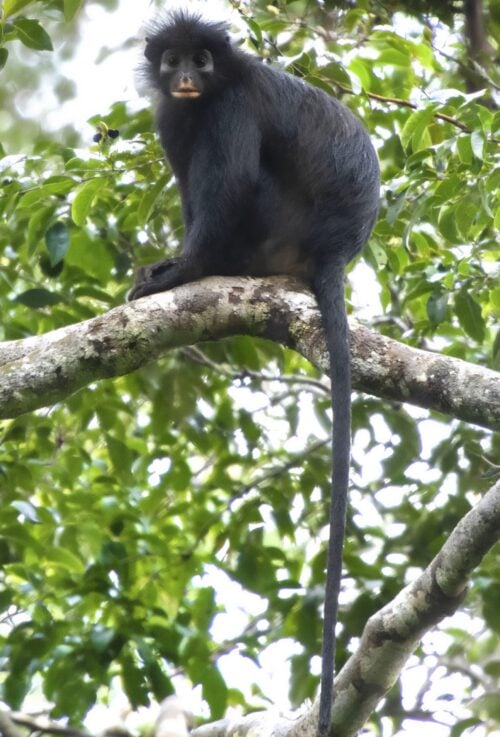
In 2008, a team of researchers working in the Congo Basin snapped a blurry picture of a funny-looking monkey. While it resembled monkeys of the genus Colobus, its small size, glossy black fur, dramatic facial features, and white rear-end markings set it apart from any known species. Then, it disappeared.
Without additional observations, scientists gave up on trying to identify this peculiar primate and turned their attention to other species. It wasn’t until 2018 that researchers working near the location of the 2008 sighting spotted the monkey again. This time, they got much clearer photos.
“We were able to tell that it was something unusual,” Junior Amboko, a field conservationist from the Democratic Republic of the Congo and a PhD student at Florida Atlantic University, told Gizmodo. At the time, he was overseeing field researchers in Lomami National Park, located in the heart of the Congo Basin.
The photos revealed that the monkey did not have thumbs, confirming that it belonged to the genus Colobus, but its bizarre features—particularly the pinkish-orange patch around its mouth and nose—were a clear sign to Amboko that it belonged to an unknown species or subspecies. In 2020, he launched the first official study of this mysterious monkey. The findings, published today in the Public Library of Science (PLOS) One, confirm that it is, indeed, a newly discovered species of Colobus, now officially named Colobus congoensis.
Monkey mystery solved
The break in the case came in 2021, when Amboko and his colleagues obtained specimens of C. congoensis that were confiscated from hunters inside the National Park. Prior to this, the researchers relied on recovered fecal samples for genetic analysis, but tissue samples yield far better information.
This lucky find allowed them to extract DNA from the new species and compare it to all known Colobus genomes. “When we got the genetics and we shared it with the team, we were like, ‘Oh my gosh, it has such a deep divergence,'” senior author Kate Detwiler, an associate professor of anthropology at Florida Atlantic University, told Gizmodo.
Based on comparisons of mitochondrial DNA and fossil evidence, the researchers estimate that C. congoensis split from its closest known relative, C. satanas (the black colobus), between 4.3 million and 5.8 million years ago, marking one of the oldest known evolutionary splits within the Colobus lineage. Today, these two closely related species occupy distinctly different ranges, living about 750 miles (1,200 kilometers) apart from each other.
Analyses of C. congoensis anatomy, behavior, and vocalizations provided further evidence that it is a distinct species, solving a mystery that had puzzled researchers for nearly two decades. However, many questions remain unanswered about these elusive monkeys.
A new species at risk
To better understand the distribution and behavior of C. congoensis, the researchers spoke with locals across 52 villages in the Lomami National Park’s buffer zone. To their surprise, residents in only eight villages recognized the species.
Even those that knew C. congoensis could barely describe it, Amboko said. One community referred to the species as “Likweli,” while another called it “kasaba nkoni,” the latter meaning “the branch shaker.” Locals generally reported that the species is quiet and cryptic with a localized distribution. Indeed, between 2018 and 2022, researchers recorded 114 sightings across an estimated range of just 660 square miles (1,700 square km)—an unusually small range for Colobus monkeys.
Based on its elusive nature, Amboko and his colleagues believe C. congoensis has a small range and population size, though confirming this will require more research. Still, growing hunting pressure and ongoing habitat loss could pose a threat to what appears to be a relatively vulnerable species. The researchers therefore propose that C. congoensis be classified as endangered on the International Union for Conservation of Nature (IUCN) Red List.
Defining the species’ range, population size, and conservation status will help provide a clearer picture of C. congoensis, but Amboko, Detwiler, and their colleagues have other questions, too. Amboko plans to investigate what part of the canopy these monkeys primarily occupy, while Detwiler is particularly interested in their reproductive biology.
The team has received funding for additional fieldwork, so they could find answers to these questions soon. For now, they will relish the experience of adding another primate species to the scientific record. This discovery highlights the incredible biodiversity of the Congo Basin, and Amboko hopes it will inspire more researchers to work in this natural laboratory.