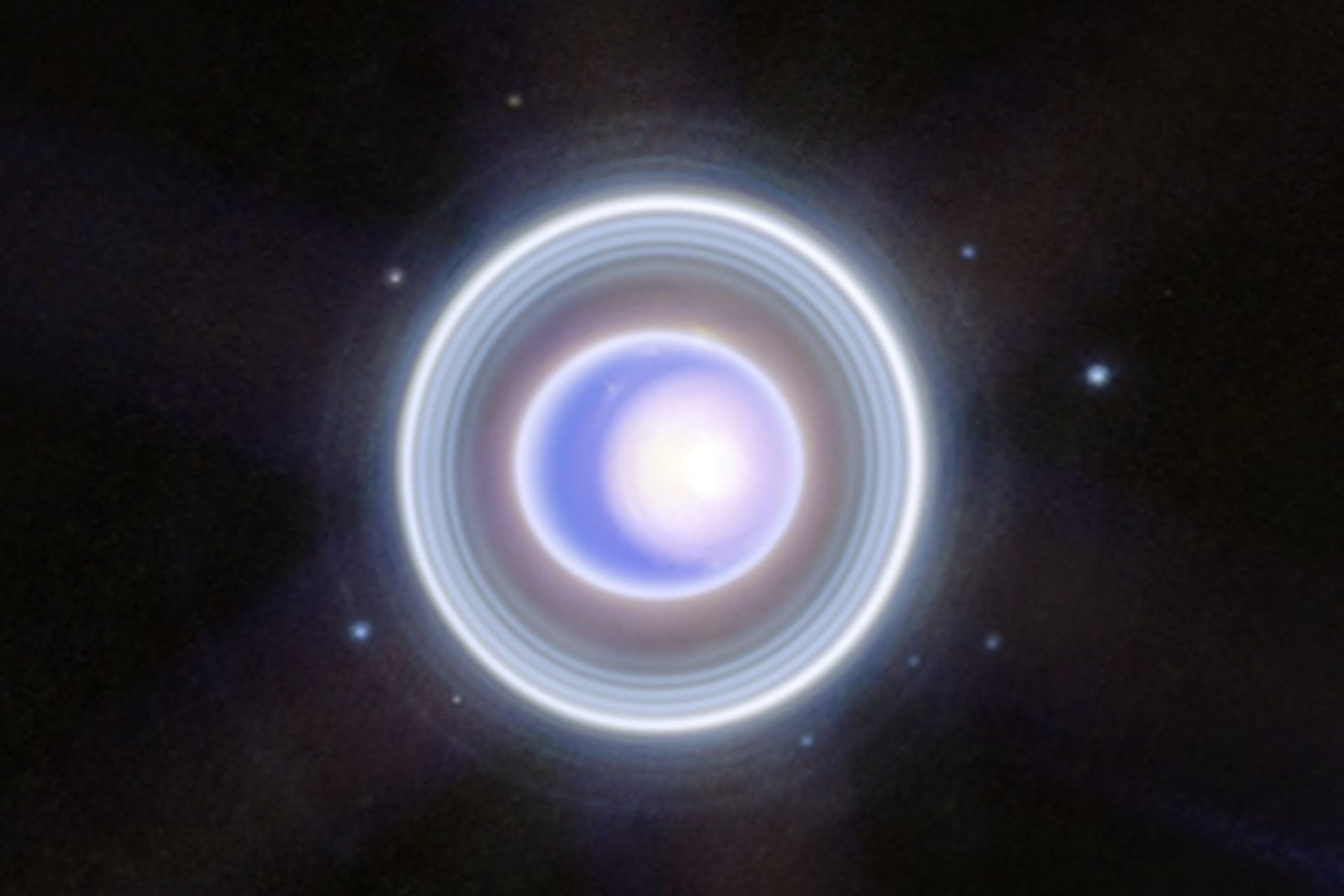
The cold, icy world of Uranus is framed by a pair of rings that orbit the planet at twice the distance of its main ring system. Each ring tells a different story — the outermost ring appears blue, while the inner ring has a reddish hue. For years, astronomers have wondered why the rings are so different and how each of them came to be. By decoding the light from these rings, we may finally have a clue to their unique origin stories.
A team of astronomers used the W. M. Keck Observatory in Hawaii to probe the composition of Uranus’ outer rings and uncover their history. The findings, published in the Journal of Geophysical Research: Planets, point to two very different formation processes. While one ring is made of tiny grains of ice, the other likely formed from a history of violent collisions and impacts.
A pair like no other
The first nine rings of Uranus were discovered in 1977 by a group of astronomers observing the planet’s atmosphere. Nearly 10 years later, the Voyager 2 mission spotted two other inner rings, as well as 10 moons.
More recently, the Hubble space telescope photographed a pair of distant rings in 2004. Scientists hadn’t noticed the outer rings in previous observations because they are extremely faint and much farther from the planet than they had expected.
The outer rings are so far away that they are referred to as Uranus’ second ring system. The μ ring is blue like Saturn’s E ring, an indication of extremely small particles, while the ν ring is reddish like other dusty rings typically found in the solar system.
The difference in color hinted at fundamental differences in the size of the particles that make up the rings, as well as their composition. Uranus’ outer rings, however, are faint and narrow, making them difficult to observe. So far, data on the planet’s ring system has been extremely scarce.
Same, but different
To uncover each of their unique composition in detail, the team behind the new study analyzed how sunlight reflects off Uranus’ outer rings. “By decoding the light from these rings, we can trace both their particle size distribution and composition, which sheds light on their origins, offering new insight into how the Uranian system and planets like it formed and evolved,” Imke de Pater, professor at the University of California, Berkeley and lead author of the study, said in a statement.
The team combined observations by the Keck Observatory with data from the Webb and Hubble space telescopes to put together a complete spectrum of the rings taken at different wavelengths. The μ ring closely matches the spectral signature of water ice, suggesting that it’s made up of tiny icy grains that were flung from Uranus’ small moon, Mab, through a series of impacts. The ν ring, on the other hand, is composed of rocky material mixed with around 10% to 15% of carbon-rich organic compounds that are commonly found in the outer solar system.
“The ν ring material is sourced from micrometeorite impacts on and collisions between unseen rocky bodies rich in organic materials, which must orbit between some of the known moons,” de Pater explained.
At this point, the results fuel more mysteries surrounding Uranus. The composition of the μ ring confirms that the moon Mab is made up of mostly water ice, unlike the rest of Uranus’ inner moons that have a rocky composition. “One interesting question is why the parent bodies sourcing these rings are so different in composition,” de Pater said.
The scientists behind the study also noticed hints that the µ ring’s brightness changes over time, but they’re not sure what causes those changes. They suggest that a future mission to Uranus designed to capture closeup images of the peculiar planet can help resolve some of these mysteries surrounding its chaotic world of rings and moons.