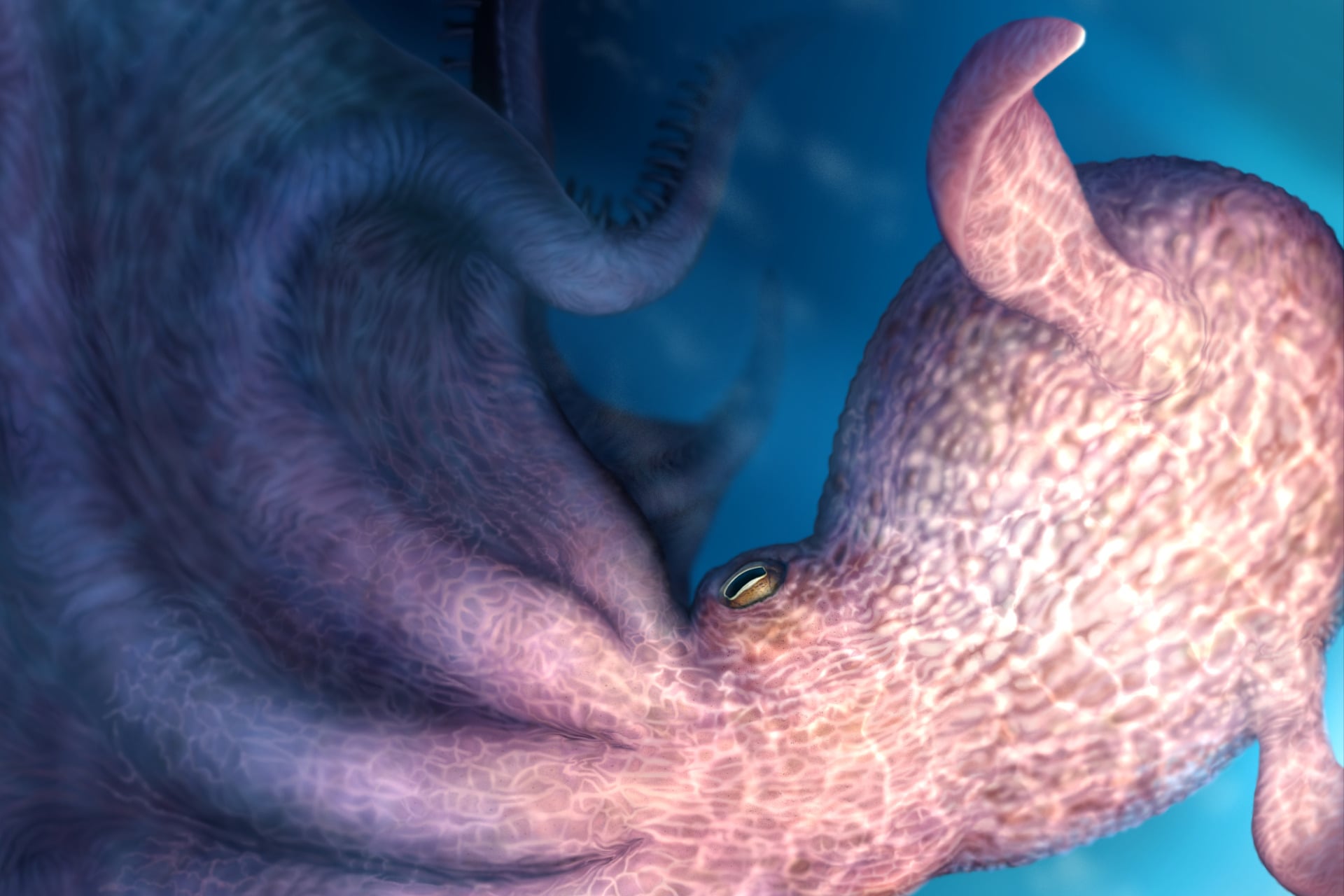
Hundreds of millions of years ago, life tended to grow huge, like the giant griffinflies. Octopuses weren’t exempt from this rule, as demonstrated by a new study that found strong evidence for a colossal, “kraken-like” octopus from around a hundred million years ago.
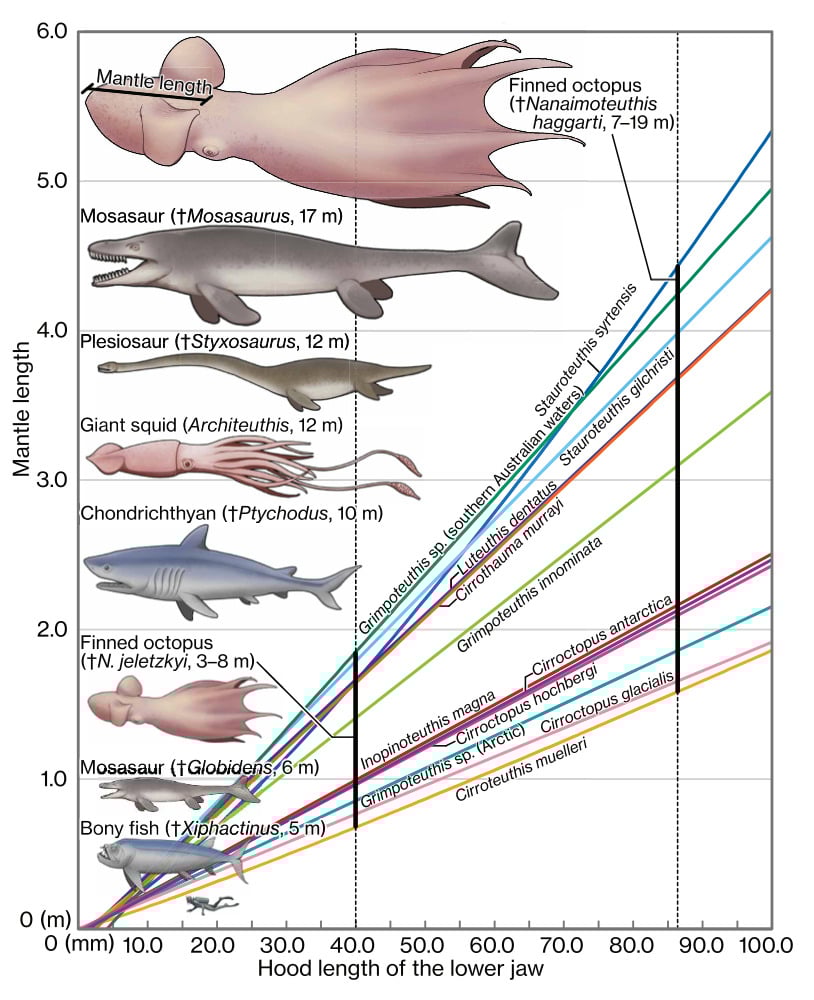
In a Science paper published today, scientists led by Shin Ikegami of Hokkaido University in Japan report identifying two species, Nanaimoteuthis jeletzkyi and N. haggarti, which were likely predatory, giant, finned octopuses ranging from 23 to 62 feet (7 to 19 meters). The 15 large fossil jaws displayed signs of wear that most likely came from crushing hard skeletons, refuting the general consensus that ancient marine ecosystems were dominated by vertebrate apex predators, such as mosasaurs.
‘Aliens’ on Earth
Kraken-size or no, octopuses were already infamous to researchers for their odd genetic makeup, with some even calling them “aliens.” Unlike their peer invertebrates, octopus genes invested less in developing hard shells and more in enhanced swimming abilities, eyesight, and intelligence.
This “exceptional evolutionary pathway” gave octopuses an upper hand (or tentacle?) in cementing their place as mid-level carnivores in marine ecosystems typically dominated by vertebrate predators, according to the study.
While scientists were aware of gigantic fossils potentially belonging to octopus ancestors, they struggled to pinpoint the ancient octopuses’ exact location in the food chain. This was because, as octopuses—even ancient ones—were likely soft-bodied. As a consequence, not many of these giant creatures were preserved over hundreds of millions of years.
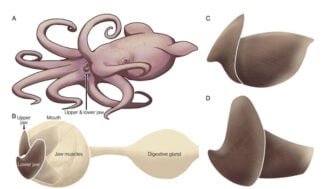
The only parts left over were chitinous jaws and a remnant of a primitive shell. As a result, it was near impossible to find direct evidence that would alert scientists to their presence, such as stomach content.
Intelligent krakens
For the new study, the team decided to take a different approach. The researchers revisited 27 large-sized fossil jaws, assumed to be related to ancient octopuses, collected from Cretaceous (145 to 66 million years ago) sediments in Japan and Vancouver Island. They focused on distinctive wear features on the jaws, such as chips, scratches, and polish that weren’t caused by erosion over time or human collection for scientific research.
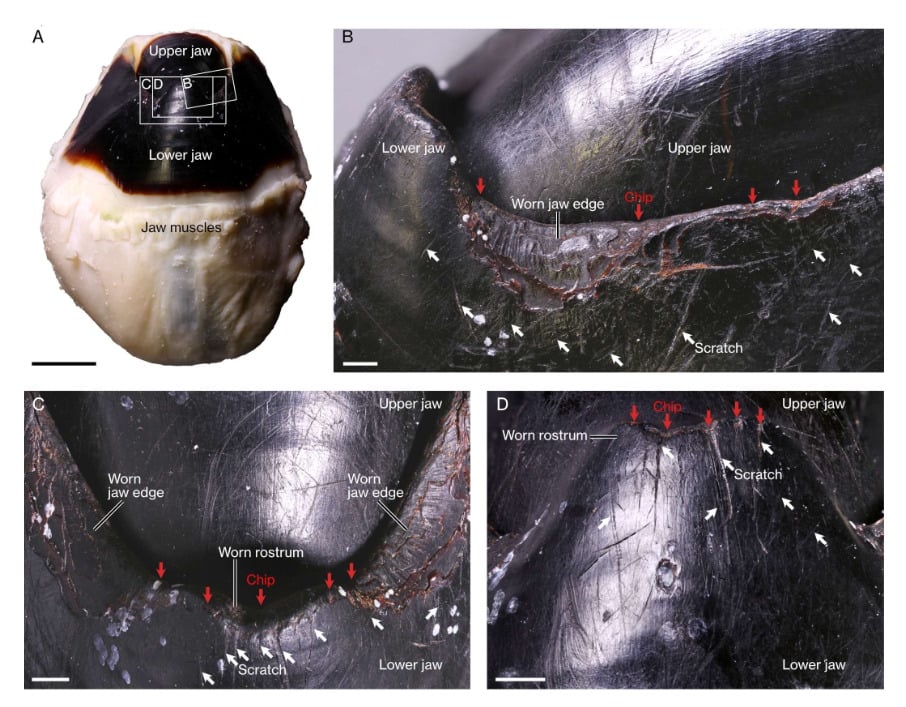
Overall, they found that the wear patterns were consistent with those seen in modern octopuses and cuttlefish, which indicated to the team this was “reliable evidence of durophagy [eating behavior of animals that consume hard-shelled prey and], in a broader sense, carnivory in fossil cephalopods.” Notably, these patterns were absent in skeletons from smaller, presumably younger individuals, as well as fossil squid jaws.
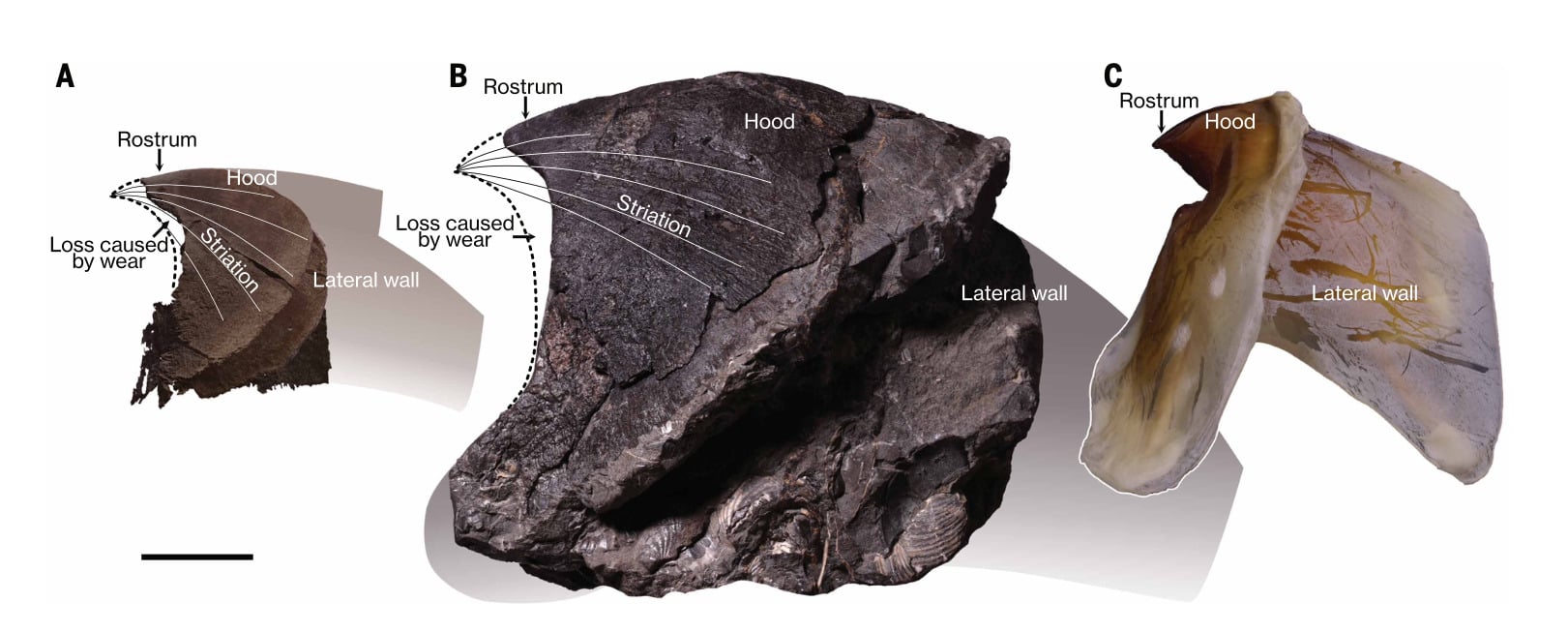
The long scratches distributed on wide areas of their jaw reflect the dynamic use of the entire jaw for dismantling prey,” the team wrote in the paper. In addition, the “asymmetric loss of the jaw edges suggests lateralized behavior, which has been linked to a highly developed brain and cognition.”
So these kraken-sized octopuses weren’t randomly chewing on things but were cognizant of how best to crush their prey and break it up for digestion. They then passed on to their descendants, the modern octopus, this brutal intelligence. That’s hardcore.