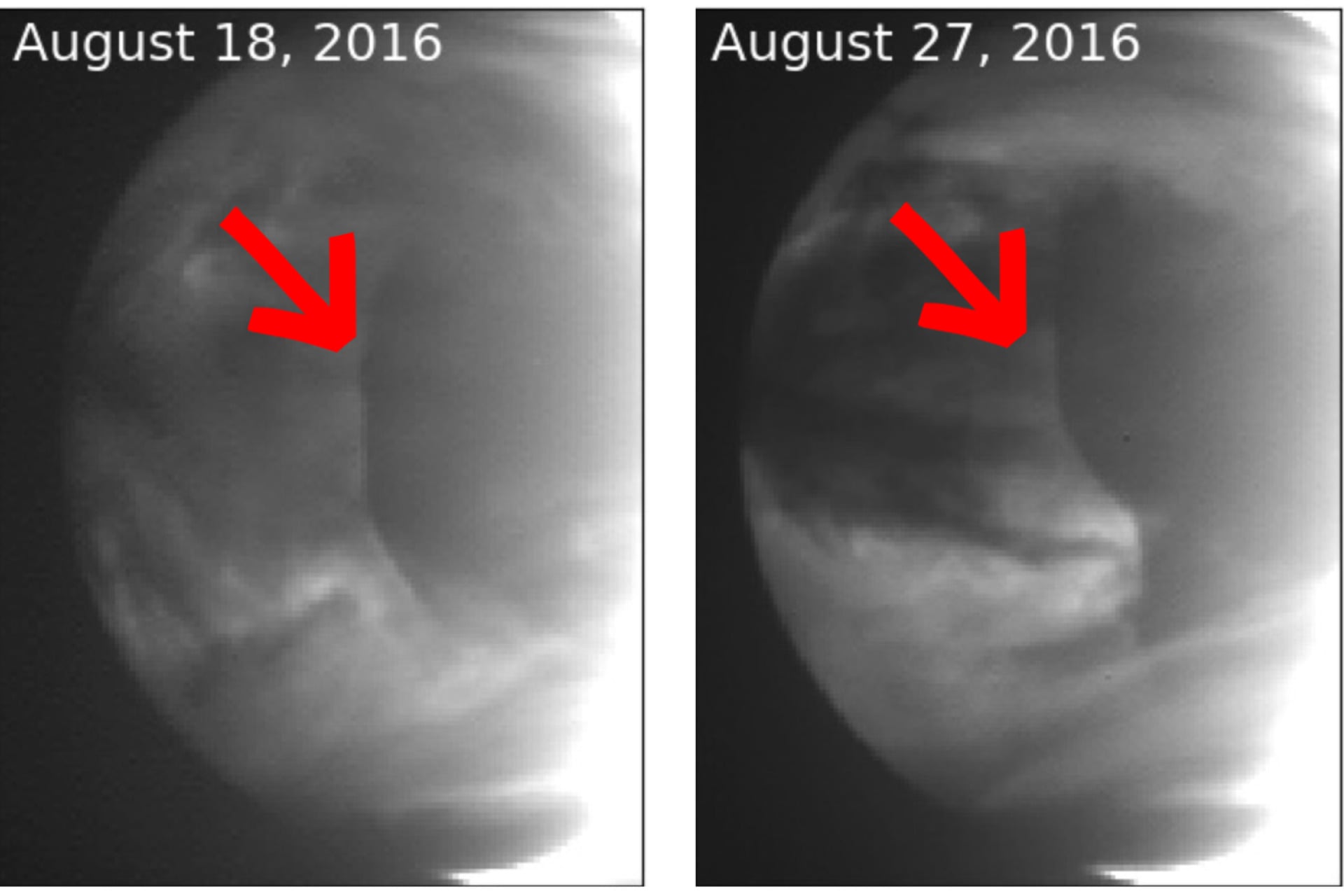
In 2016, a Japanese Venus orbiter repeatedly spotted colossal waves of acidic clouds sweeping the planet’s atmosphere. For roughly a decade, astronomers weren’t able to reconcile their observations with existing models. But an unexpected connection finally offers an answer.
In a recent Journal of Geophysical Research: Planets study, an international research team describes how a large “hydraulic jump” forces sulfuric acid vapor higher into the atmosphere, where it bunches up into a massive, acidic cloud. These fronts can grow up to around 3,728 miles (6,000 kilometers) and persist for an extended period of time. As a result, the team believes this hydraulic jump also maintains planet-wide atmospheric phenomena on Venus, such as its unusually fast winds.
“Thanks to this research, we’re now able to show that this cloud disruption is caused by the largest known hydraulic jump in the solar system,” Takeshi Imamura, the study’s first author and a planetary scientist at the University of Tokyo in Japan, said in a statement.
Similar, but not really
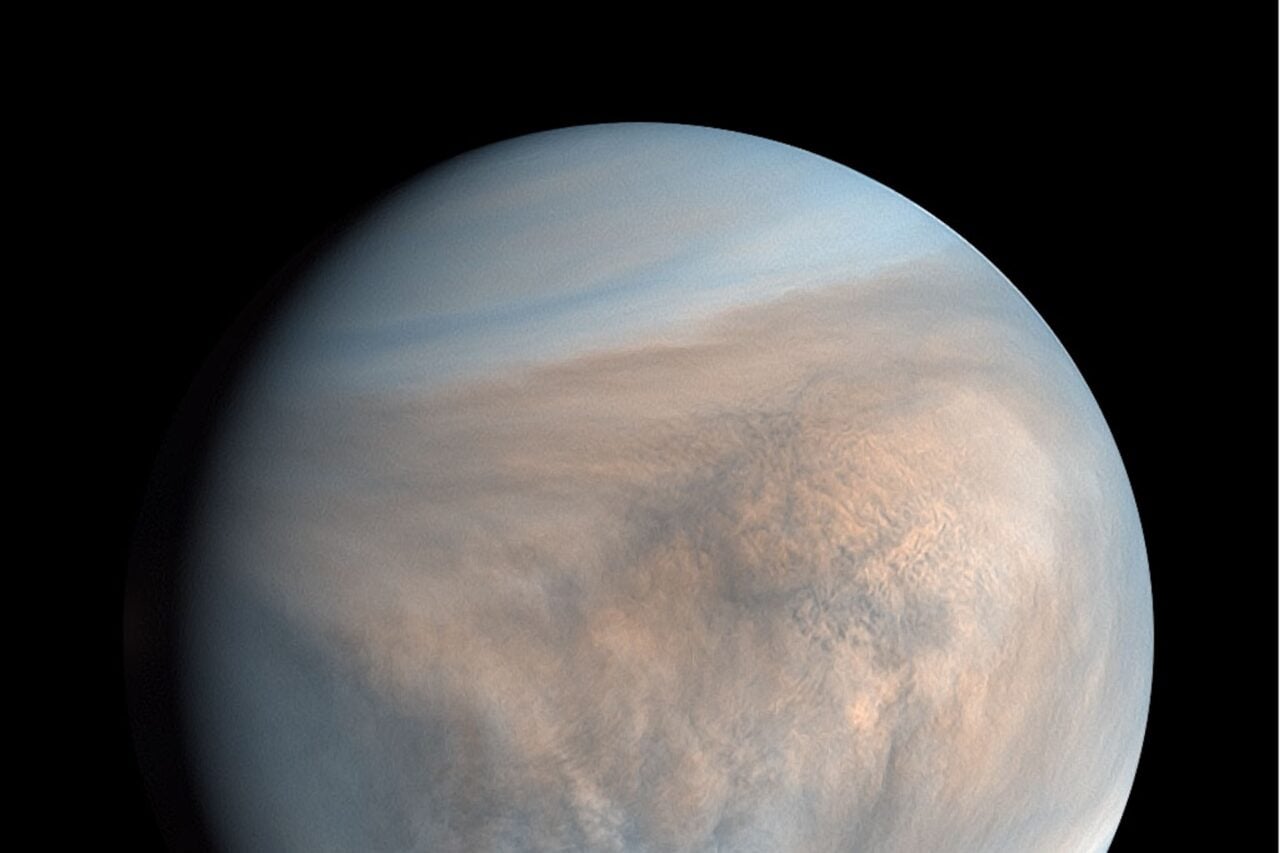
In terms of size, mass, density, and volume, Venus bears an uncanny resemblance to Earth. But the similarities end there. Notably, Venus’ dense atmosphere and extreme temperatures make the planet exceptionally difficult to study, even with orbiters like Akatsuki observing safely from its orbital perch.
Of course, that hasn’t deterred researchers from making use of every opportunity available to extract useful data from Venus. For instance, because Venus has such a thick cloud cover, it’s an “excellent” target for studying atmospheric patterns that wouldn’t be as apparent where clouds are more sparse, like Earth, according to the statement.
A cloudy sandwich
According to the study, the Venusian atmosphere can be divided into three layers of sulfuric acid clouds. Massive winds called “superrotation” circulate these clouds around the planet at blinding speeds, around 60 times faster than Venus’s own rotation. These gusts also regulate the planet’s radiative energy budget and atmospheric chemistry and dynamics, added the paper. For obvious reasons, the upper clouds were easier for Venus probes—and therefore scientists—to investigate, but the lower and middle layers proved difficult to study, Imamura explained.
There was only so much atmospheric models could explain, as Imamura discovered in 2016, when Akatsuki brought back the first images of repeated, sweeping cloud waves propagating around Venus’s atmosphere. “We identified the phenomena, but for years we couldn’t understand it,” Imamura said.
Previous investigations by ESA’s Venus Express between 2006 and 2022 also confirmed similar observations. What’s more, a literature review indicated that this cloud feature has been recurrent on Venus since at least 1983—meaning that, for whatever reason, astronomers didn’t or couldn’t identify the cause behind this phenomenon.
The cosmic kitchen sink
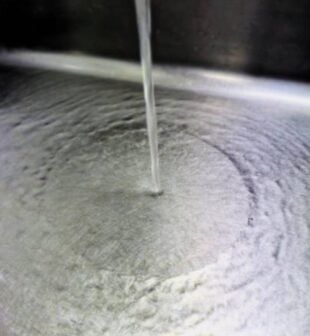
Imamura and colleagues tested the hypothesis that a gigantic hydraulic jump is causing this cloud wave. Hydraulic jumps are surprisingly mundane phenomena, even on Earth. In fact, you can observe one right at your kitchen sink. Let the water run, and you’ll see that, as the water pillar hits the sink, it forms a smooth inner circle of shallow, fast water, with ripples of deeper, slower water at the fringes of the circle.
Something similar occurs on Venus when an eastward atmospheric wave in the lower-to-middle cloud region becomes unstable. This “shock,” as the team puts it in the paper, forces air to rise sharply along a front. That sudden movement carries sulfuric acid vapor higher and higher until it eventually condenses into clouds that encircle the entire planet. The team’s numerical simulation also suggested that similar processes help maintain the superrotation of Venus’s atmosphere.
Beyond our planet’s twin
Aside from resolving a decades-long mystery, the findings could inform planning for future space missions—not just to Venus, the team said. For instance, recent research confirmed that superrotation occurs on Mars, the Sun, and even Earth’s atmosphere. This will be critical as humanity seeks to expand its presence in space, as accounting for weather conditions is vital for protecting astronauts and spacecraft. The research may be based on simulations, but every detail counts when we’re exploring the unknown.
“Our next step will be to test this discovery within a more inclusive climate model that includes other atmospheric processes,” Imamura said. “Under some circumstances, Mars’ atmosphere may also have the right conditions for a hydraulic jump.”