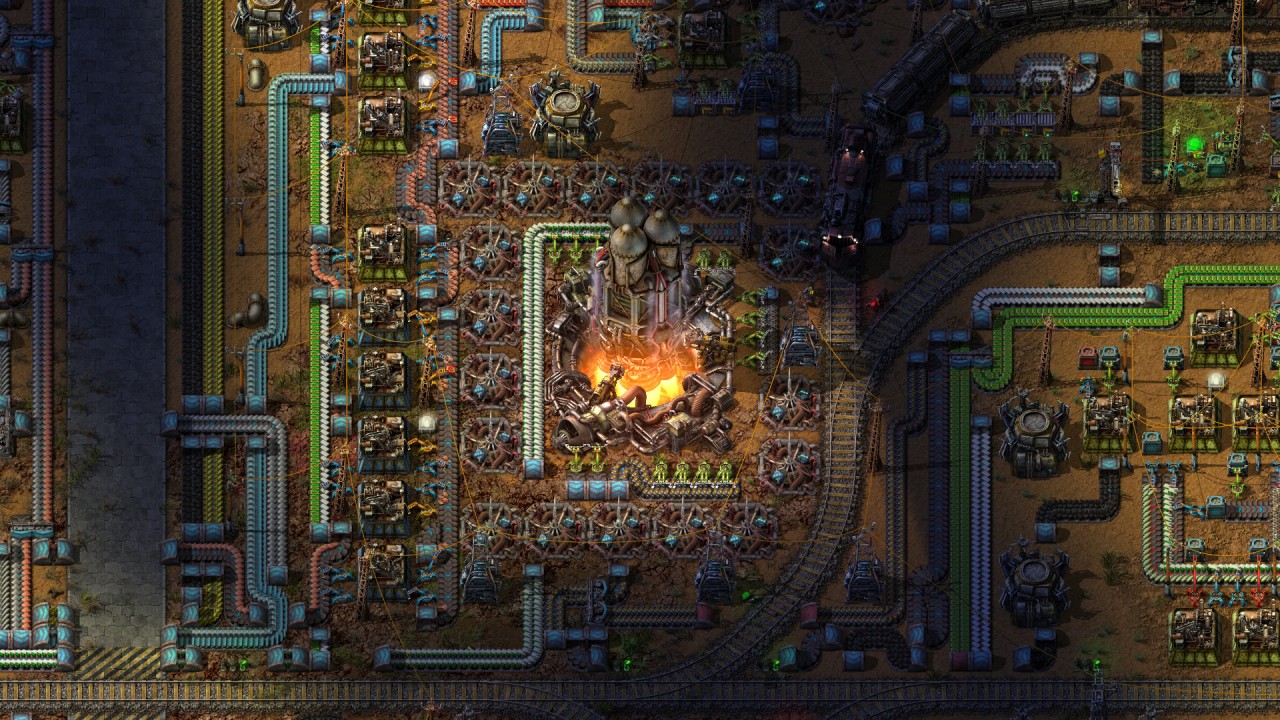
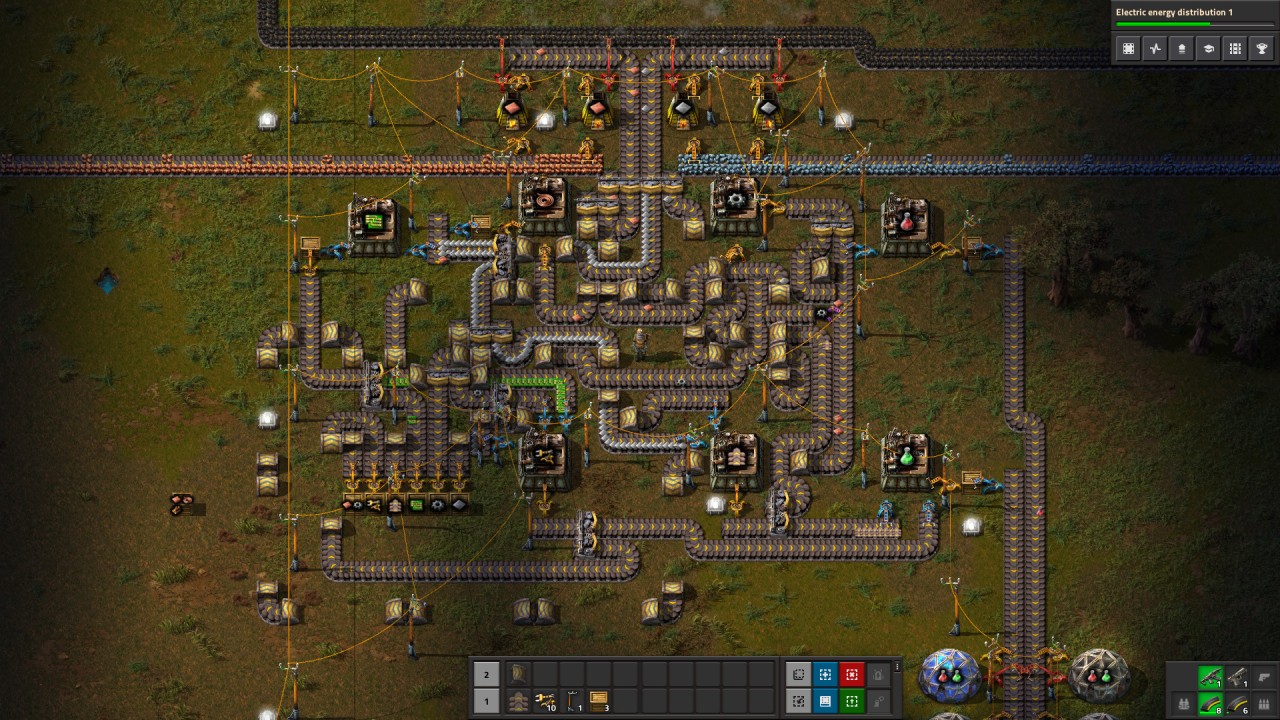
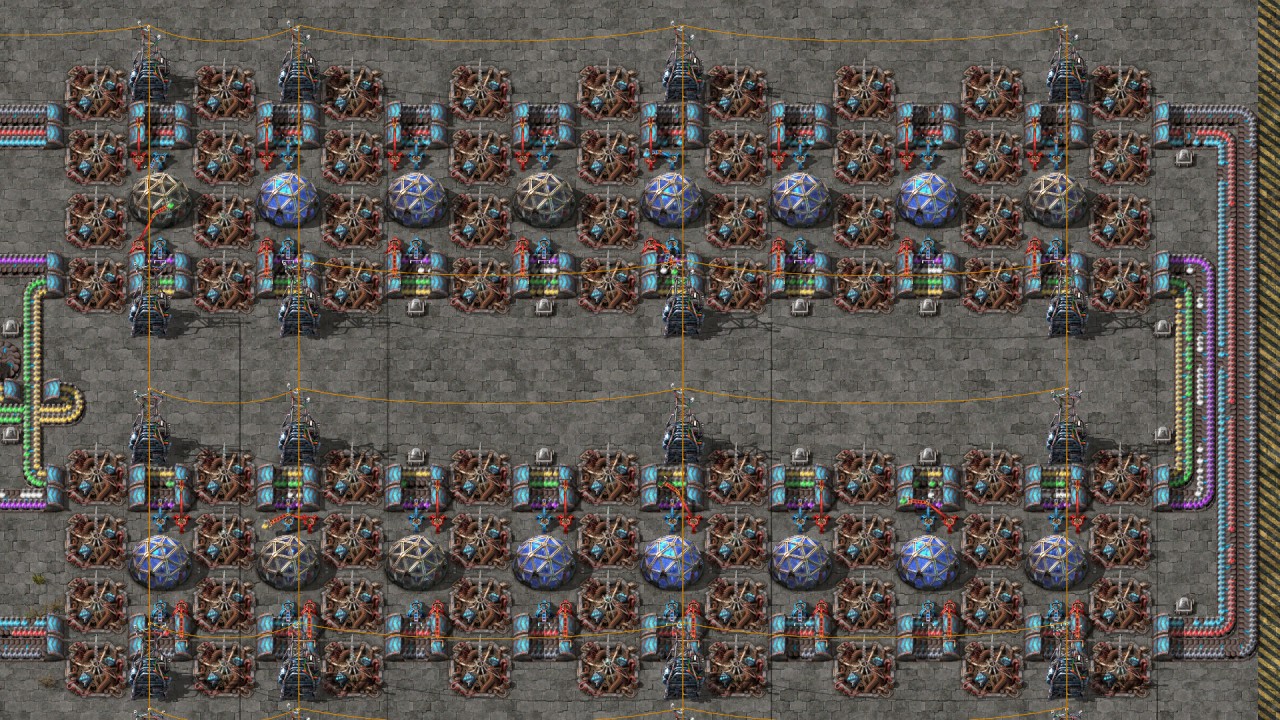
Factorio is a builder game about designing, automating, and maintaining factories in an infinite 2D world. Early play starts with chopping trees, mining ore, and hand-crafting parts, then shifts to a network of miners, belts, inserters, furnaces, assemblers, refineries, power, and rail. Materials flow through machines, new technologies unlock recipes, and layouts evolve as throughput increases.
The loop stays visible at all times: raw inputs enter, intermediate items branch into sub-assemblies, and finished goods leave on schedule. Bottlenecks are obvious, because a starved belt, a stalled inserter, or an empty chest shows exactly where attention is needed.
Clarity is the appeal. Every splitter, junction, and balancer explains itself through motion, and a single change ripples across the line. Blueprint tools capture working patterns so a smelter block, an oil kit, or a four-lane rail can be stamped into place and extended later.
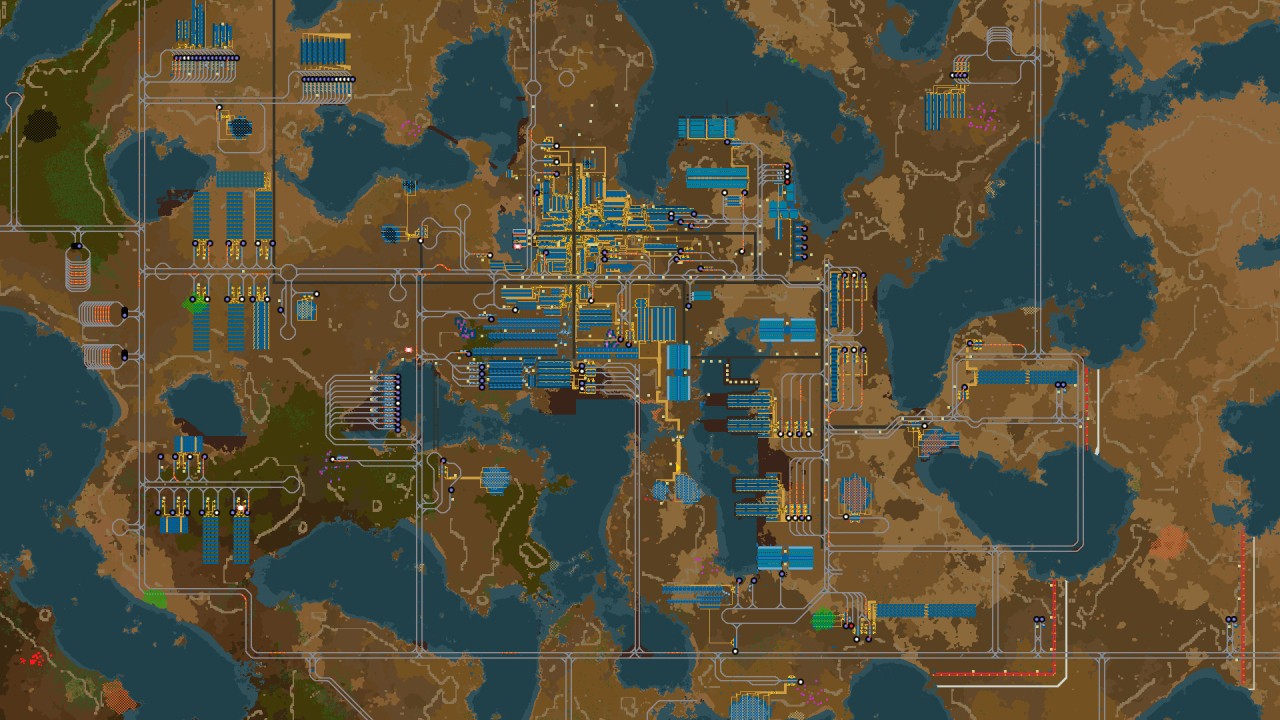
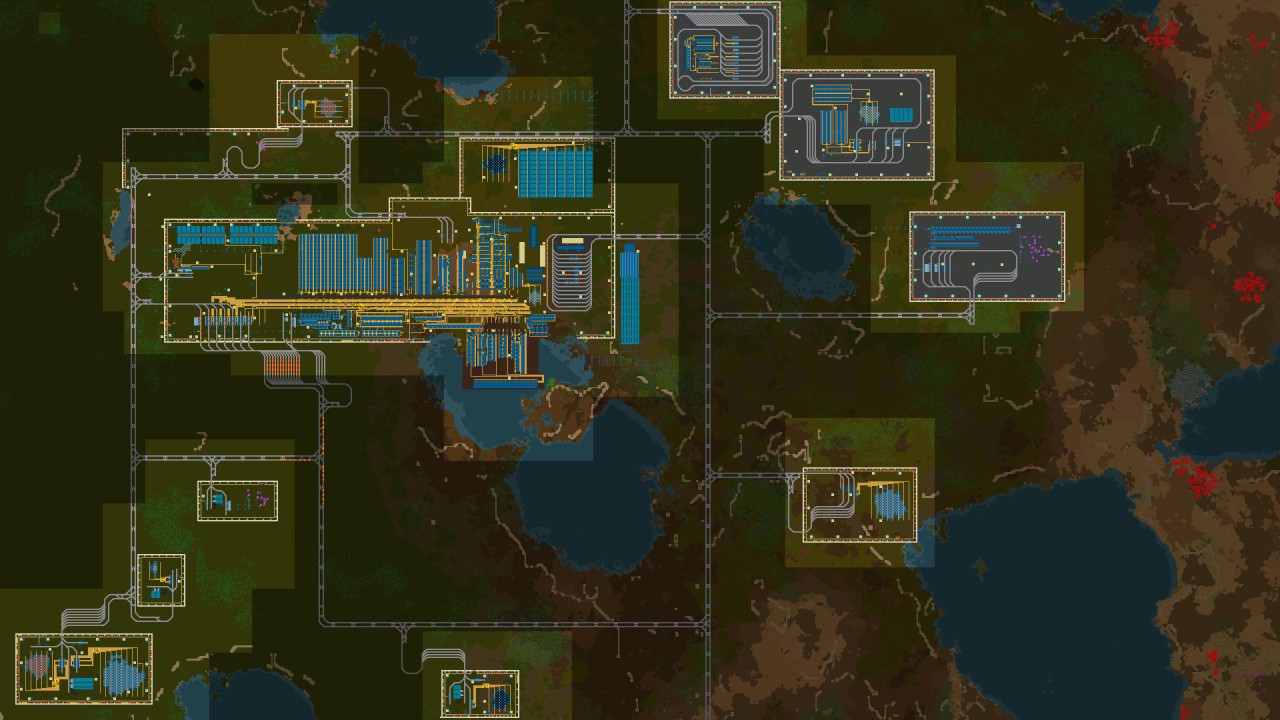
Map view and zoom levels make audits simple from any distance, while power and production graphs reveal whether the system is short on fuel, miners, or machines. The result is a factory that feels alive, because every machine depends on the next and momentum never arrives for free.
Why Should I Download Factorio?
Download Factorio if clean cause-and-effect design in game is satisfying for you. Small pieces snap together into lines that run without micromanagement. A miner feeds a belt, a furnace smelts plates, labs consume science packs, and research pushes the base forward.
When flow stalls, ratios, belt priorities, and inserter speeds provide levers to smooth things out, improvements are felt instantly across the chain. Oil refining and cracking deepen planning without hiding the logic; fixes are concrete and permanent. Defense matters, but production remains the center of the game, and the strongest strategy is usually the one that keeps materials moving.
Scaling is the long test. Early lines that felt roomy become cramped once modules and higher tier machines arrive, so layouts get rebuilt to shorten paths and concentrate power. Blueprints and deconstruction planners reduce busywork during upgrades, and ghost placement lets construction bots handle repetition. Throughput becomes a discipline: bus design, lane balancing, and splitter filters keep items where they belong. The signal is always the same—if something slows, the map will show where the plan needs another belt, another wagon, or a more efficient layout.
Long-term variety comes from flexible tools instead of gimmicks. The Map Editor can establish constraints, objectives, and scripted events. Lua mod support ranges from light helpers to full overhauls that introduce new materials, intermediates, and research tiers. Co-op Multiplayer lets a team split roles and build in parallel—power, smelting, oil, rail, defense, research—under the same clock. The rhythm stays readable and steady: design, test, refine, defend, expand.
Is Factorio Free?
Factorio is a paid game with a straightforward model. After purchase, the complete experience is available without free-to-play tiers or paywalls around the core loop. Progress is earned by designing better lines, not by buying advantages.
From a small starter bus, the build grows into a dense system of production blocks, trains, and logistics, and each upgrade reuses skills learned earlier. Solo play suits quiet iteration, while cooperative sessions highlight division of labor and long-range planning. The reward is seeing a plan run itself because the design is sound, not because a menu unlocked a shortcut.
Blueprint books organize proven solutions so smelting columns, refineries, power plants, and rail junctions can be repeated across the map. Trains move bulk freight once distances grow, and logistic bots cover fine distribution inside the base. Graphs help plan expansions before shortages hit, and alerts point to broken lines or empty chests. The loop rewards tidy thinking: look, measure, adjust, repeat until the factory sustains itself and the next frontier becomes the new project.
What Operating Systems Are Compatible with Factorio?
Factorio is compatible with Windows, macOS, and Linux. Saves travel cleanly between platforms, so a factory started on one machine can continue on another without friction. Multiplayer, Lua modding, and the Map Editor are available across supported operating systems, keeping blueprint books, bus designs, rail networks, and megabase projects consistent regardless of desktop setup. Choose the OS that fits the workflow; the factory plays the same.
Performance scales with hardware, and the design encourages efficiency. Chunk-based simulation, tuned update rates, and disciplined blueprinting help large builds stay responsive even when trains, bots, beacons, and solar fields fill the screen. Stability under load is a quiet strength, because a project that begins as a handful of belts can end as a continent of production without losing the thread.
What Are the Alternatives to Factorio?
Satisfactory views the same fantasy from the first-person perspective. Conveyor belts, power grids, and production chains are still core; however, exploration and vertical construction convert layouts. The issue of terrain, height, and the three-dimensional space varies the way the lines are bent and the way they intersect. Some vehicles and drones transport goods over distance, hypertubes, and jump pads that involve the player in transport. It is more discovery-based and scenic build, but throughput is still a puzzle, and clever design still prevails.
The Planet Crafter is a combination of factory thinking and survival pacing, and a horizon of environmental change. Oxygen, pressure, heat, and biomass become progress bars to a world, which begins hostile and becomes habitable with an increased production. Power networks, mining, and craft are not new but are to be diverted by the storms, digging, and discoveries such as lakes being formed in what was once desert. What comes out is a slower, more atmospheric cycle in which logistics serves as a driver to goals of terraforming, and the base placement is factored into the plan.
Shapez 2 brings to attention the focus on pure flow. This environment is abstract, and the problem is routing, splitting, merging, and painting scale-sized shapes. Ratios get decisions made, belt geometry is a design language, and solutions may be elegant when a layout drops out of harmony. Combat and exploration are not present, maintaining the focus on the puzzle, a good friend to the larger simulation that Factorio has. In situations when the brain desires the spirit of making, this purified, refined technique provides the sensation of cracking a factory in its purest form.