A man in New York has filed a lawsuit alleging that JetBlue uses personal data it collects from customers to set the price of tickets, a practice known as surveillance pricing. The proposed class action comes after a tweet from the airline went viral, suggesting that customers could get a lower price by clearing their browser cache and cookies, as well as booking flights in an incognito window.
The lawsuit was brought on Wednesday by Andrew Phillips, identified as a New Yorker who bought a JetBlue ticket in December 2025 for a flight from New York to Florida. The lawsuit, filed in the Eastern District of New York, argues that Phillips provided a lot of personal information to the airline and was “unaware that he was being tracked for the purpose of setting pricing.”
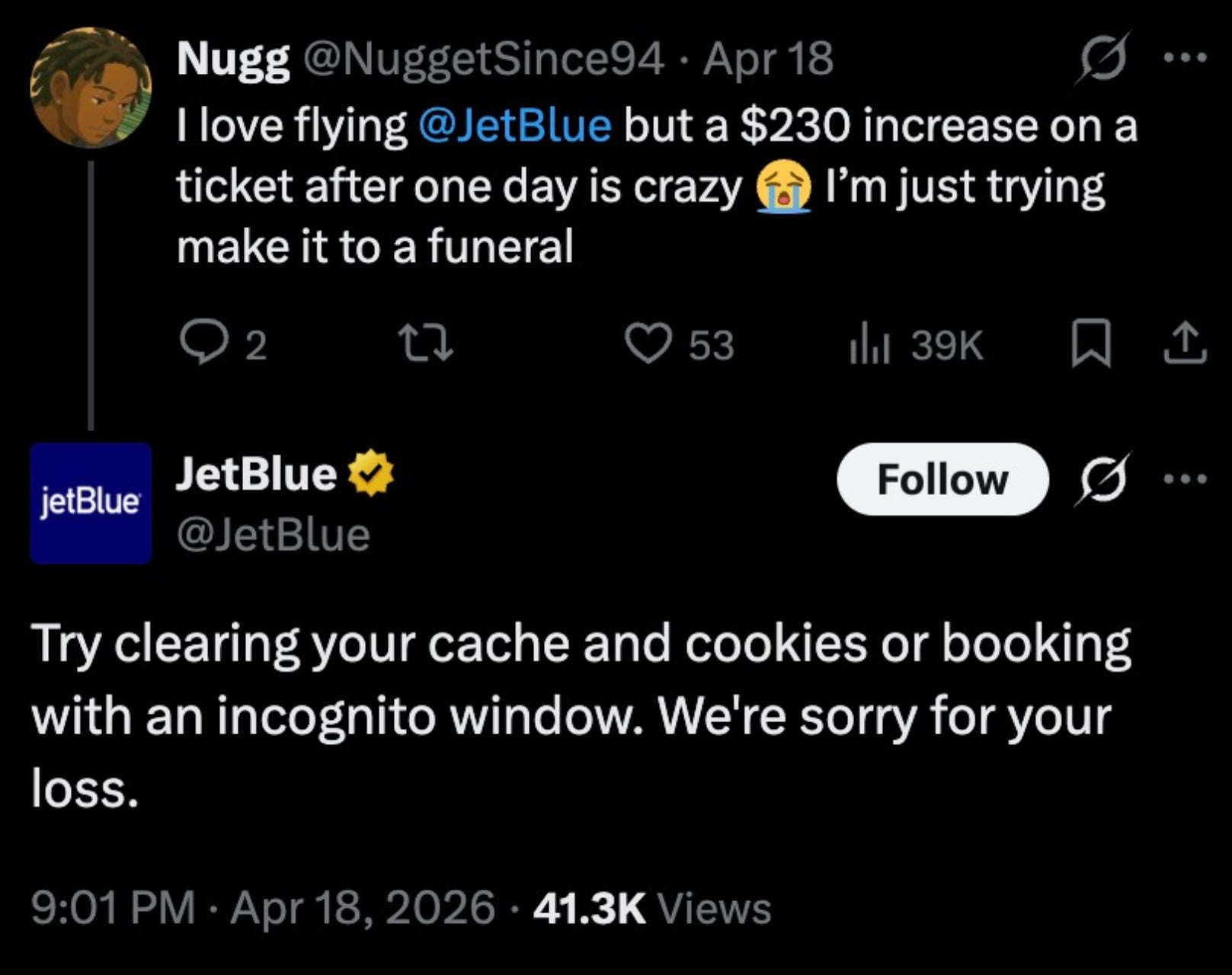
The lawsuit includes a screenshot of a tweet sent by JetBlue on April 18, in which an X user complained that they saw a $230 price increase after just one day. The tweet also said that the customer was trying to attend a funeral.
“Try clearing your cache and cookies or booking with an incognito window,” the JetBlue account responded. “We’re sorry for your loss.” The tweet from JetBlue has since been deleted.
Reached for comment on Thursday, JetBlue denied that it engages in surveillance pricing.
“JetBlue does not use personal information or web browsing history to set individual pricing. Fares are determined by demand and seat availability, and all customers have access to the same fares on jetblue.com and our mobile app,” a spokesperson for JetBlue told Gizmodo over email.
The airline also tried to explain the tweet that seemed to set everything off.
“The recent social media reply was simply a mistake from an individual customer service crewmember. The steps the crewmember suggested would not have changed the airfares available for purchase,” the airline told Gizmodo.
That explanation gave a little more insight into what happened than the comment JetBlue provided earlier this week. On Monday, JetBlue told Gizmodo, “The reply from our JetBlue crewmember on social media was incorrect, and we apologize for the error,” but didn’t respond to follow-up questions.
The airline has previously said that air fares are set based on “real-time availability and is managed through our reservation system.” It claims the price fluctuates “as seats are purchased or as inventory is adjusted based on demand.”
Airlines have long changed prices based on demand, and the availability of online tracking data has made that even easier during the 21st century. But the rise of AI and various third-party tracking services has caused both consumers and regulators some concern over how various data is being used to individualize prices. Hyper-targeting based on things like location, browsing history, and income level is an area where it’s unclear how much price customization is happening.
Last year, Delta told shareholders on an earnings call that it would soon be using AI to determine the prices of domestic fares, but the airline tried to walk that comment back after some bad press. Negative publicity has been a recurring theme, as companies struggle to implement dynamic pricing for goods when customers hate the idea of being charged more for circumstances beyond their control.
Wendy’s rather famously had to deny it had any interest in doing surge pricing back in 2024 after just a couple of days. People really don’t like the idea of walking into a business and the price changing wildly from day to day or even hour to hour.
Price discrimination based on things like race and sex is already illegal, but consumer protection laws haven’t really caught up to the realities of surveillance pricing in the 2020s. Maryland recently became the first state to pass a law banning surveillance pricing in grocery stores, but Gizmodo spoke with experts who say the legislation has enormous loopholes.
The lawsuit filed against JetBlue on Wednesday cites the companies that the airline works with sharing personal data, including FullStory, a behavioral analytics and data collection platform, and PROS Holdings, which “uses an algorithm to set pricing in real time based on ‘buyer behavior,'” according to the filing.
The suit argues that “Had Plaintiff Phillips known about the surreptitious collection and tracking of his [personally identifiable information], he would not have used a different airline or booked travel a third party travel website.” But there’s no evidence that JetBlue does anything that other airlines refuse to do.
Democrats in both the House and Senate have introduced legislation to ban surveillance pricing at the federal level, but that’s unlikely to pass as long as Republicans are in the majority in both chambers. Sen. Ruben Gallego, a Democrat from Arizona, has sponsored one of the bills.
“Is Jet Blue openly admitting to raising someone’s price hundreds of dollars because they know they have to go to a funeral? Grief shouldn’t come with surge pricing. We need to pass my bill to make surveillance pricing illegal,” Gallego wrote earlier this week after a screenshot of JetBlue’s tweet went viral.
President Joe Biden’s administration launched an investigation into surveillance pricing in 2024 with FTC chair Lina Khan at the helm, but President Donald Trump killed that study in 2025.