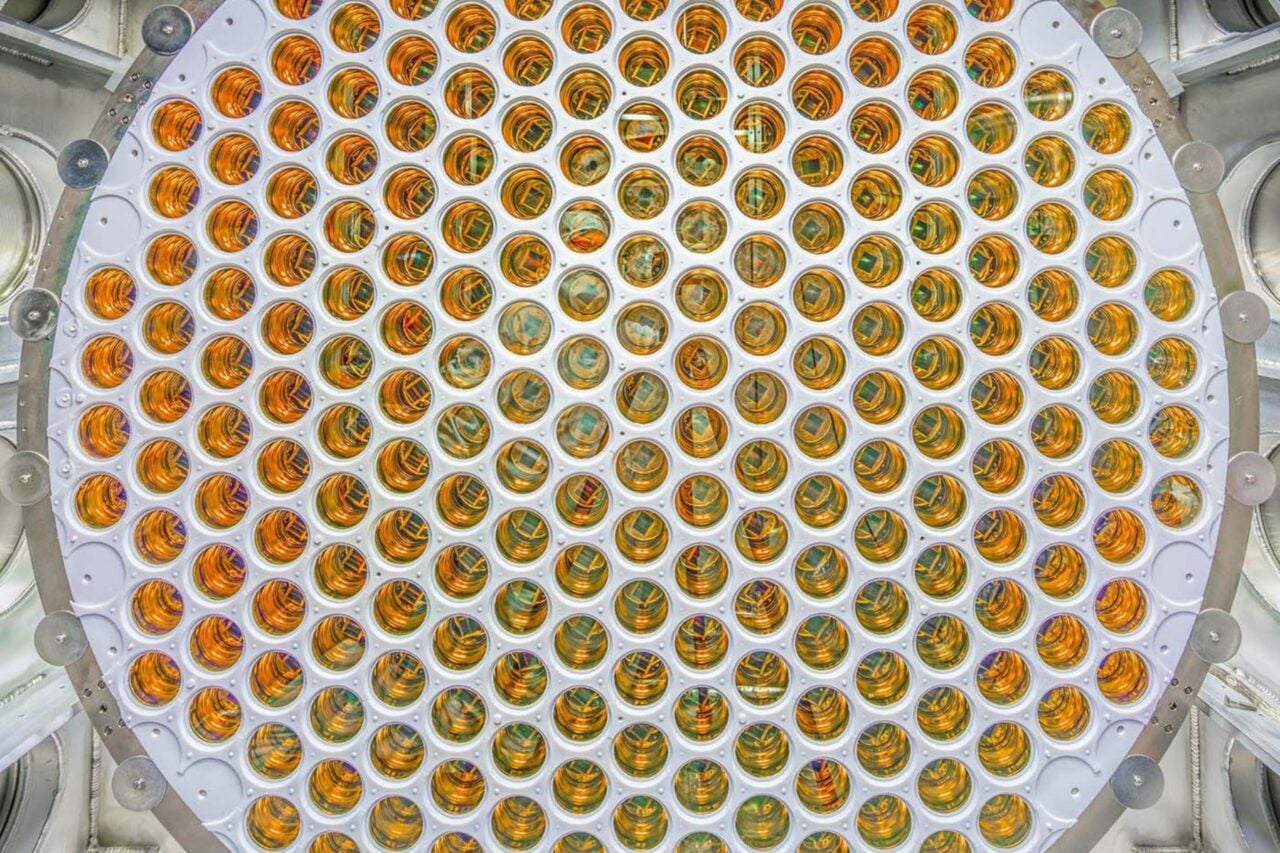
WIMPs (weakly interacting massive particles) are one of the most serious contenders for dark matter—the “missing” mass supposedly constituting 85% of our universe. Given its elusiveness, dark matter tests the patience and creativity of physicists. But the latest results from LUX-ZEPLIN (LZ), the South Dakota-based detector, may have brought scientists a small step closer to catching WIMPs in action.
In a recent Physical Review Letters paper, scientists analyzed 280 days’ worth of data from LUX-ZEPLIN, reporting the tightest ever upper limit on the interaction strength of WIMPs. The result—a near fivefold improvement—demonstrates how physicists are increasingly getting better at circumventing the problem that dark matter is, well, dark; the elusive stuff evades any detection method that depends on materials interacting with visible light or other types of radiation.
There’s ample evidence to suggest that dark matter does in fact exist, including numerous astrophysical observations hinting at some invisible matter exerting gravitational force on objects we can see. Physicists, as a result, tend to use materials that we can see, such as liquid forms of heavyweight elements like xenon, and simply wait for some unknown particle to interact with it. That strategy—waiting for particles to interact with heavy elements—is a well-tested approach for detecting WIMPs, hypothetical particles that interact with gravity but on a scale so tiny that only the most sensitive detectors might catch a glimpse.
The LUX-ZEPLIN experiment, located one mile underground in a decommissioned South Dakota gold mine, employs nearly 15,000 pounds (7 tons) of liquid xenon. The chemical element’s high atomic mass and density make it potentially easier for scientists to detect any unknown particles that may pass through the detector. Also, liquid xenon is transparent, preventing any unwanted noise—usually arising from radioactive matter around the detector—from spoiling an experiment.
“If you think of the search for dark matter like looking for buried treasure, we’ve dug almost five times deeper than anyone else has in the past,” said Scott Kravitz, a physicist at the University of Texas at Austin and deputy coordinator for LZ, in a press release. “That’s something you don’t do with a million shovels—you do it by inventing a new tool.”
“These results firmly establish that LZ is the world’s most sensitive search for dark matter heavier than 10 GeV, that’s about 10 times heavier than a proton,” explained Scott Haselschwardt, a physicist at the University of Michigan and LZ physics coordinator, in an email to Gizmodo. “To put our result in perspective: we have ruled out dark matter that would interact only once in a single kilogram of xenon every four millennia!”
The latest experiment also represents the first time the LZ team applied a technique called “salting,” in which false WIMP signals were added in advance. This helped the researchers—who, of course, would love to find dark matter—avoid bias and stay skeptical of potentially promising signals.
“There’s a human tendency to want to see patterns in data, so it’s really important when you enter this new regime that no bias wanders in,” said Haselschwardt in the same release. “If you make a discovery, you want to get it right.”
The next steps for the LZ experiment are to continue pressing against the upper limit for WIMPs and utilize the detector’s cutting-edge technology to probe other interesting and rare physics processes, explained Amy Cottle, a physicist at University College London also involved with LZ, in the statement.
“LZ is the most sensitive search for WIMP dark matter to date, but we still have another two years of data to collect,” Haselschwardt wrote to Gizmodo. “This means that a discovery of dark matter in LZ could come anytime now. We are truly looking for dark matter where no one has ever looked before and that is extremely exciting!”
Editor’s note (07/08/2025): This story was edited after publication to reflect Scott Haselschwardt’s comments to Gizmodo, as well as to better clarify the details of LUX-ZEPLIN’s results.