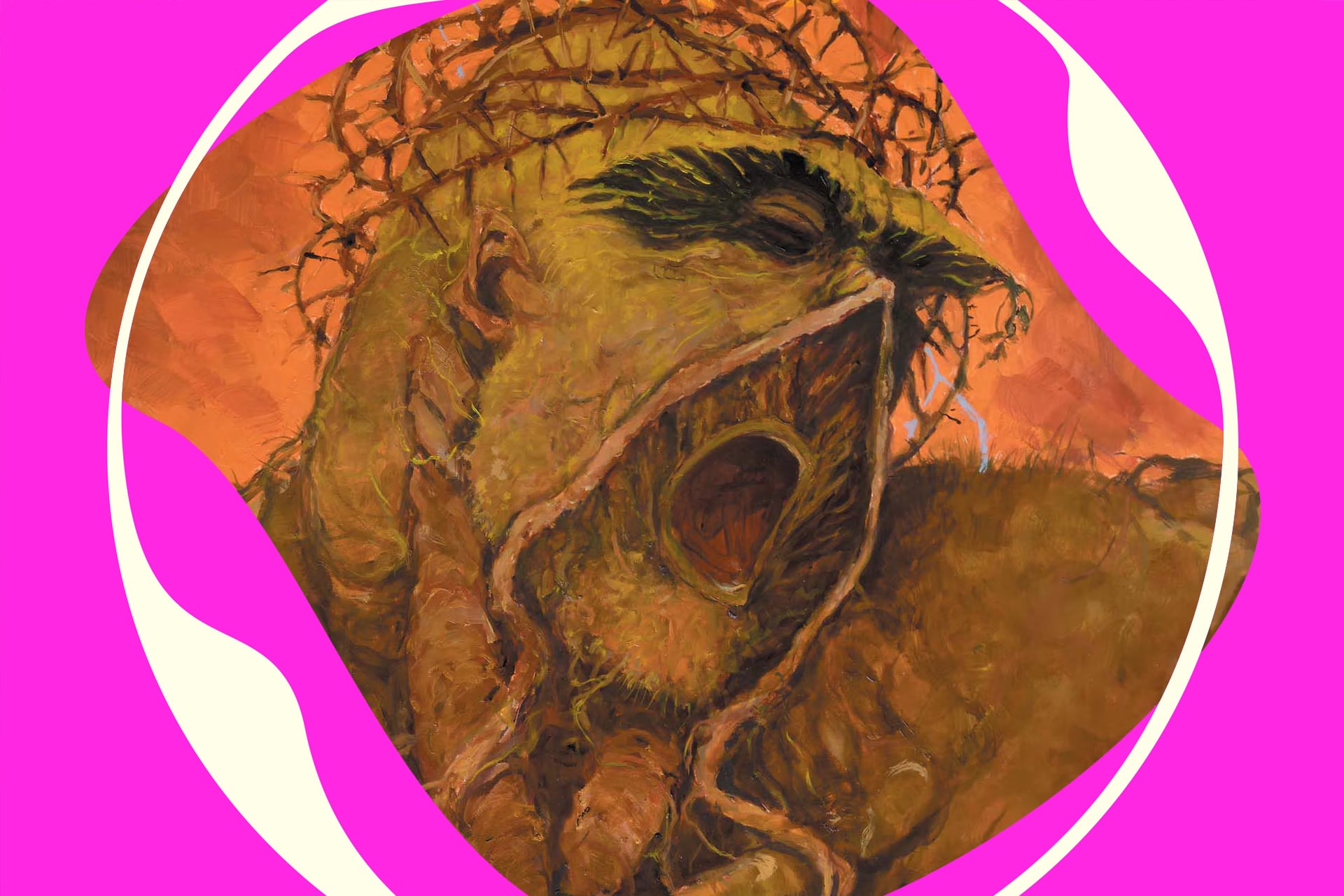
Rick Veitch got the phone call just as he was settling down for bed that night. It was 1989, and Veitch had been at work on the capstone storyline of his ambitious run on DC Comics’ Swamp Thing. The story was a doozy, the sort of thing that might have stood up against the most memorable issues of Alan Moore’s landmark run on the title. Over the course of the previous year, Veitch’s shambling, muck-monster antihero had traveled backward through time, encountering historical figures great and small. Now, in the climactic finale to close out Veitch’s tenure, Swamp Thing was about to play a role in the crucifixion of Jesus Christ Himself.
Astonishingly, the story had made it through editorial review: a plot had been written, the pencil art (by artist Michael Zulli) for the first issue of the story had been drawn, and the cover of Swamp Thing #88, a stunning scene of a pained Swamp Thing turned into a crucifix, had already been created. But now, at the last moment, the inevitable call came down from on high: the issue would be pulled, the story would be axed, and no more would be said about the encounter between Swamp Thing and the Son of Man.
For the next three decades, Veitch’s final Swamp Thing issues became the stuff of legend: often mentioned in rumors and industry gossip, argued about in the pages of fanzines and message boards, and, on at least one occasion, coming close to belated publication before getting yanked back into oblivion once again.
Until now. This month, DC is releasing Swamp Thing 1989, the first issue of a four-issue miniseries that will at last see the completion of the most infamous (and, depending on your point of view, blasphemous) DC storyline ever nearly made. On the occasion of this near-Easter miracle, io9 spoke with Veitch, artists Tom Mandrake, Vince Locke, and Trish Mulvihill, and others involved with the making (and unmaking) of the book to reflect on Swamp Thing’s long road to Calvary.
Taking Root
Rick Veitch was an unlikely pick to wind up at DC Comics. A veteran of the 1970s underground scene, his notable works before landing at the publisher included such non-Comics Code-approved titles as 1971’s horror-comedy Two Fisted Zombies and a Heavy Metal adaptation of the Steven Spielberg flop 1941, transformed into a dadaist acid trip (Spielberg wrote an admiring introduction to the paperback).
But in 1984, Veitch’s art school buddies Stephen Bissette and John Tottleben told him about a new writer named Alan Moore who had just taken over the Swamp Thing book they were already drawing. For Veitch, it was an almost religious epiphany.
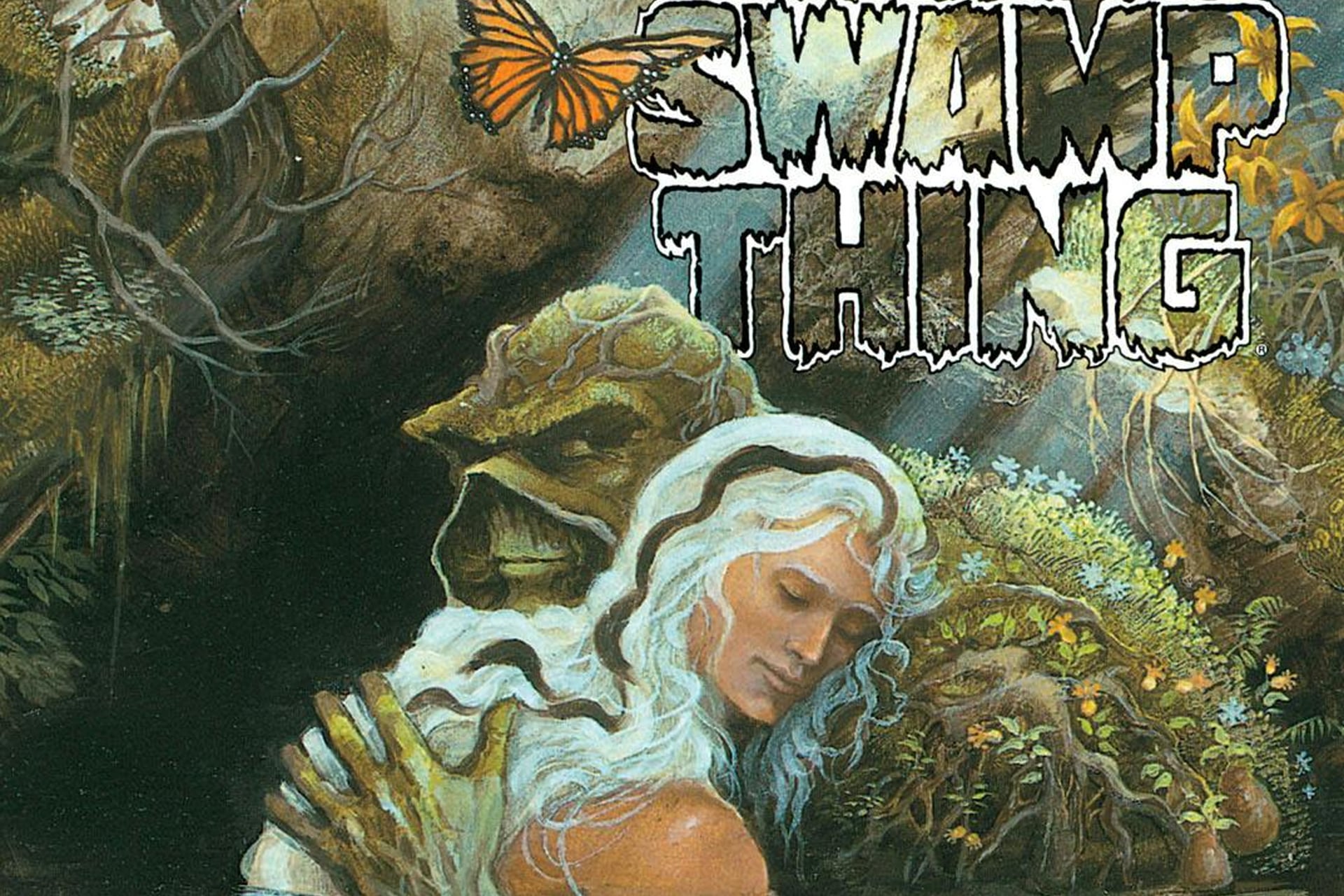
At Bissette and Tottleben’s request, Veitch began ghosting parts of Swamp Thing from their earliest issues. “I got to work on those early Alan Moore scripts right from the beginning,” Veitch says. “I think in [seminal early Moore story] ‘The Anatomy Lesson,’ that whole opening sequence where they’ve got Swamp Thing in a tank, I drew all the machinery. So I got drawn back into DC at that point, started drawing some fill-in issues, and then became penciler when Steve and John left.”
The result of their collaboration was a memorably offbeat science fiction epic, in which the plant-based hero travels across the galaxy, encountering icons like Adam Strange of Rann and the hawk people of Thanagar. But if a Swamp Thing space opera took readers off guard, it could hardly prepare them for what came next: after four years of taking Swamp Thing to the top of the critical lists, Moore was calling it quits—and he wanted Veitch to take his place.
Bearing Mixed Fruit
To begin with, Veitch knew that Moore wasn’t going to be an easy act to follow. “He and I would make jokes about it: how I was committing career suicide,” Veitch remembers. “But I was the right person to do it because I was intimately involved with Swamp Thing since Tom Yates had been drawing it back in 1981. I was really invested in the characters of Abby, and Alec [Holland, Swamp Thing’s human quasi-alter ego]/Swamp Thing. I understood that it was a love story, and I could see these different paths of storytelling that I wanted to take, using DC characters.”
Veitch, who shared Moore’s love of the DC Universe, wanted to continue peppering his work with guest spots from the company’s all-stars like Batman and Superman. But, he says, “I think it was a problem for DC.”
The problem was this: the mid-’80s were a cultural high-water mark for Ronald Reagan, Jerry Falwell, and the Moral Majority. National media panics over the corrupting influence of role-playing games and rock and roll had become brief but hot scandals. For years, an internal debate had raged in comics over whether their small-time industry was especially at risk.
It was with this in mind that DC, in 1987, announced that it would be adopting an MPAA-style rating system for its books to mark off mature titles. The policy had been crafted without input from freelance writers and artists, and the resulting controversy led four of the company’s top creators—Alan Moore, Frank Miller, Howard Chaykin, and Marv Wolfman—to announce they would contribute no further work to the publisher while the policy remained in place. DC soon compromised with a less stringent labeling system for mature titles, and three of the four creators (with the exception of Moore) dropped their boycott. But for Veitch and Swamp Thing, the fallout still remained.
“I was already trying to explore ideas that I would use in [Veitch’s creator-owned title] Brat Pack,” Veitch says. “Amped up sex, amped up violence, and [exploring] the general kinkiness of superheroes. I mean, superheroes are kind of like kink for kids! So I was pushing the envelope in my scripts. I had Superman appear a couple of times, and both times I heard from DC, ‘Hey, you got to tone it down. You’ve got to focus on his heroism and his courage, not the fact that he’s a giant superpowered fascist.’”
According to Veitch, one early red flag emerged shortly after he took over as writer of Swamp Thing. “[DC] brought me down [to New York] and wined and dined me and took me to a Broadway play, and I got to meet with [DC President and Publisher] Jenette [Kahn]. This was right at the time when [DC] had tried to institute [their] standards and practices. They were trying to put the brakes on the violence and the sexuality that had been such a success with Dark Knight and Watchmen.”
A year into Veitch’s run on the title, it was clear that something would have to give. “I think Jenette Kahn realized that the whole thing had blown up in her face. She wasn’t willing at that point to just get rid of [DC’s content standards], but she was telling people like me that it was not going to be a problem.” Thus, a time travel story was designed as both a solution to Swamp Thing’s ties to the mainstream DC universe and a capstone to a run that Veitch had already decided was coming to an end. And that, as it turned out, is where the trouble really happened.
Ungodly Acts
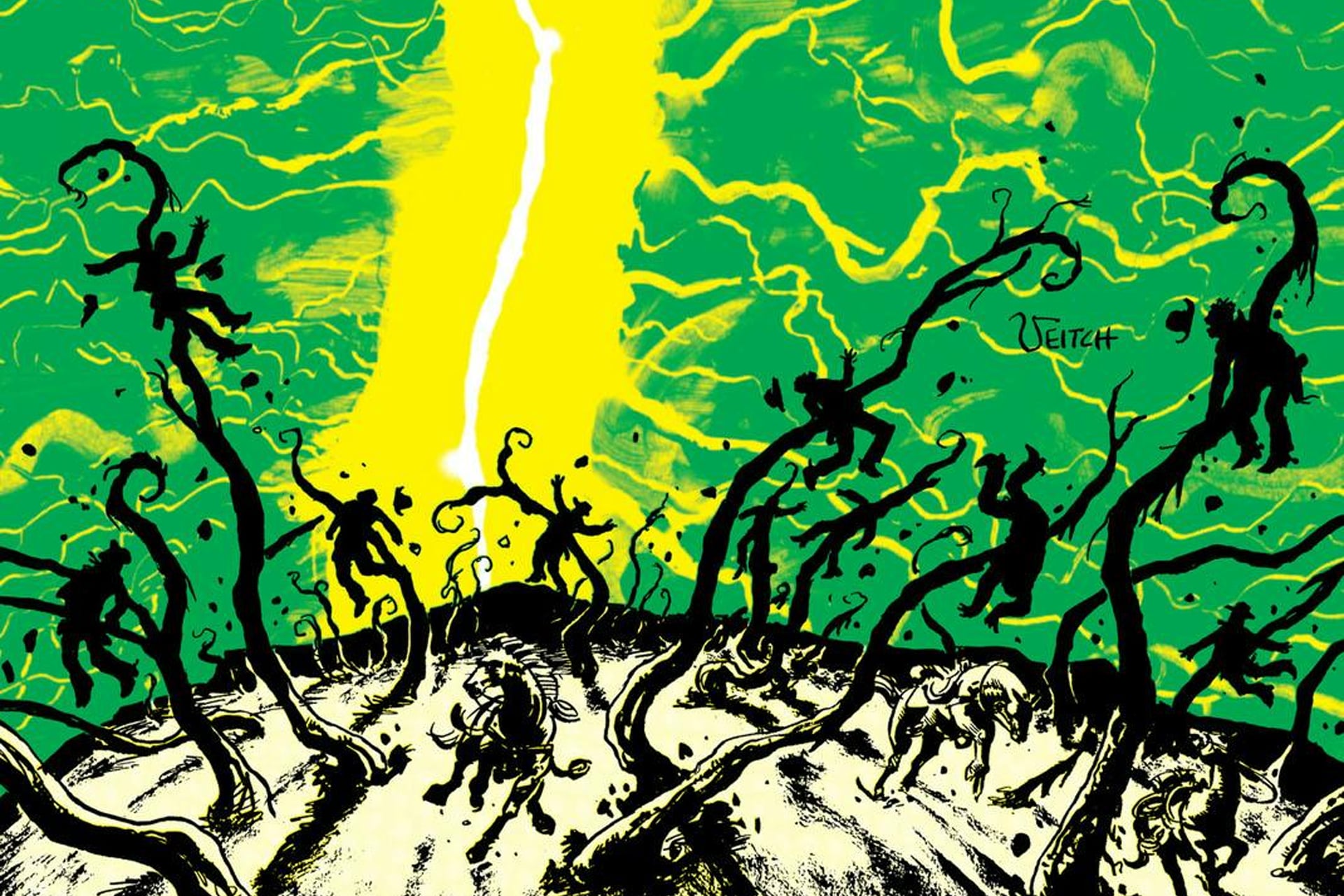
The story as Veitch wrote it went like this: Swamp Thing, unmoored from time and space, would move backward through the timestream, encountering historical figures along the way. The title’s issue #88 was to be the climax, in which Swamp Thing would find himself in the Garden of Gethsemane, where he would meet Jesus Christ just before his arrest and execution—and be drawn into a conspiracy involving an unholy magician and a cadre of religious assassins. This would begin a five-issue arc to close out Veitch’s run on the title, during which Swamp Thing would, at one point, be present on the spot of the crucifixion itself. The cover of issue #88, drawn by Veitch, showed the body of Swamp Thing, crowned in thorns and stained with the blood of the savior, carved into the holy cross itself.
Impressively (and perhaps improbably) Veitch’s proposal was approved: Berger signed off, and (Veitch thought) so had executive editor Dick Giordano, publisher Paul Levitz, and president Jenette Kahn. “Everything was good. Everybody went with the outline,” Veitch says. “I wrote the script [for issue #88] in two parts. Everybody approved that. I think the real problem happened when I turned in the cover.
“And I like to blame Bissette for this, because I originally drew the cover with Swamp Thing kind of looking like this”—here Veitch leans forward in his chair with a mild expression on his face—”and I was showing him the pencils to Steve, and he was like, ‘No, you’ve got to have Swamp Thing leaning back like this‘”—and here he mimes a gruesome expression. “And I did that, and it totally came together. But I got a feeling—and I had nothing to back it up—that when it went through production at DC, it set off the red flags that got the bad response going.”
So that was when the phone call from Berger came in, and Veitch got the news: his Swamp Thing story, not unlike his divine co-star, had been condemned to death. “I got a phone call late at night from Karen. She was absolutely off her shit—she was really angry. I thought she was angry at me, and misinterpreted it. She wanted me to write a new script in a couple of days. But I immediately knew I had to resign, and I resigned on that phone call.”
Veitch concedes that the rejection didn’t entirely come out of left field. In 1988, the release of Martin Scorsese’s The Last Temptation of Christ and the Iranian fatwa against the life of author Salman Rushdie had sparked renewed fears of religious controversy. “We were taking a chance, and I knew it,” Veitch says. “But the hard thing was that I didn’t get any information [about DC’s decision]. [Berger] wouldn’t tell me. I was offering, “I’ll change it, I’ll fix this, we’ll do this, we’ll do that.” But it was just like, ‘No, no, no.’ Which was DC’s response to me over the next couple of weeks as we tried to negotiate something. I just got stonewalled completely.”
The rest of the saga played out in embarrassingly public fashion. In short order, Veitch’s would-be successors as writer, Neil Gaiman and Jamie Delano, quit the book in solidarity. In the eventual issue #88 (which had nothing at all to do with Veitch’s original plans), Berger used the letter column to publish a quasi-apologetic explanation for what had happened, writing, “Neither he [Veitch] nor I expected the ending to be like this, but now that it’s all over, we can only be philosophical about the whole affair.” Veitch, meanwhile, published a long article in the Comics Buyer’s Guide under the headline, “What would have happened in Swamp Thing #89-92,” spelling out at length his axed plans for the book. The great Swamp Thing/Jesus team-up was dead, and there would be no Easter miracle. Or so it seemed for the next 37 years.
Second Coming
Over the course of the next three decades, Veitch’s squelched Swamp Thing story became the stuff of comic book legend. A write-up of the saga in a 1993 issue of Wizard Magazine helped make it one of the tantalizing could-have-been stories of the comics canon, alongside Alan Moore’s unused “Twilight of the Superheroes” pitch or the final arc of Miracleman. Few expected that it would ever become anything more.
At times, it seemed as though the book was haunted by a kind of comic book curse. In 2019, after years of internal lobbying at DC by editor Scott Dunbier and senior VP Bob Wayne, among others, the book was rumored to finally see the light of day—only to be nixed once again when a Fox News story about the Jesus-themed comic book Second Coming made the Swamp Thing plotline once again too hot to handle.
But in 2024, Swamp Thing’s resurrection began. The impetus came from editor Alex Galer, whose long association with DC’s collected editions, as well as the monthly Swamp Thing title, sparked an abiding interest in bringing Veitch’s story black from the dead. “Alex Galer was the one who really made this happen,” Veitch says. “He took it upon himself to push this thing through. He was able to convince DC to restart the thing as a special project. But Alex is the real hero here.”
Veitch, understandably, was skeptical at first: after so many false starts, his feeling was, “Charlie Brown isn’t going to kick the football again,” he says. But Galer’s enthusiasm was persuasive, and before long, Veitch found himself throwing himself into a new script to an old plot as if it were old times.
“It wasn’t difficult at all because the plot points have been rattling around in my brain all these years,” Veitch says. “I’m driving in the car, and Abby and Alec are in the back seat giving me dialogue. So when it comes time to actually sit and type, it’s all there already. I’ve just got to get it down.”
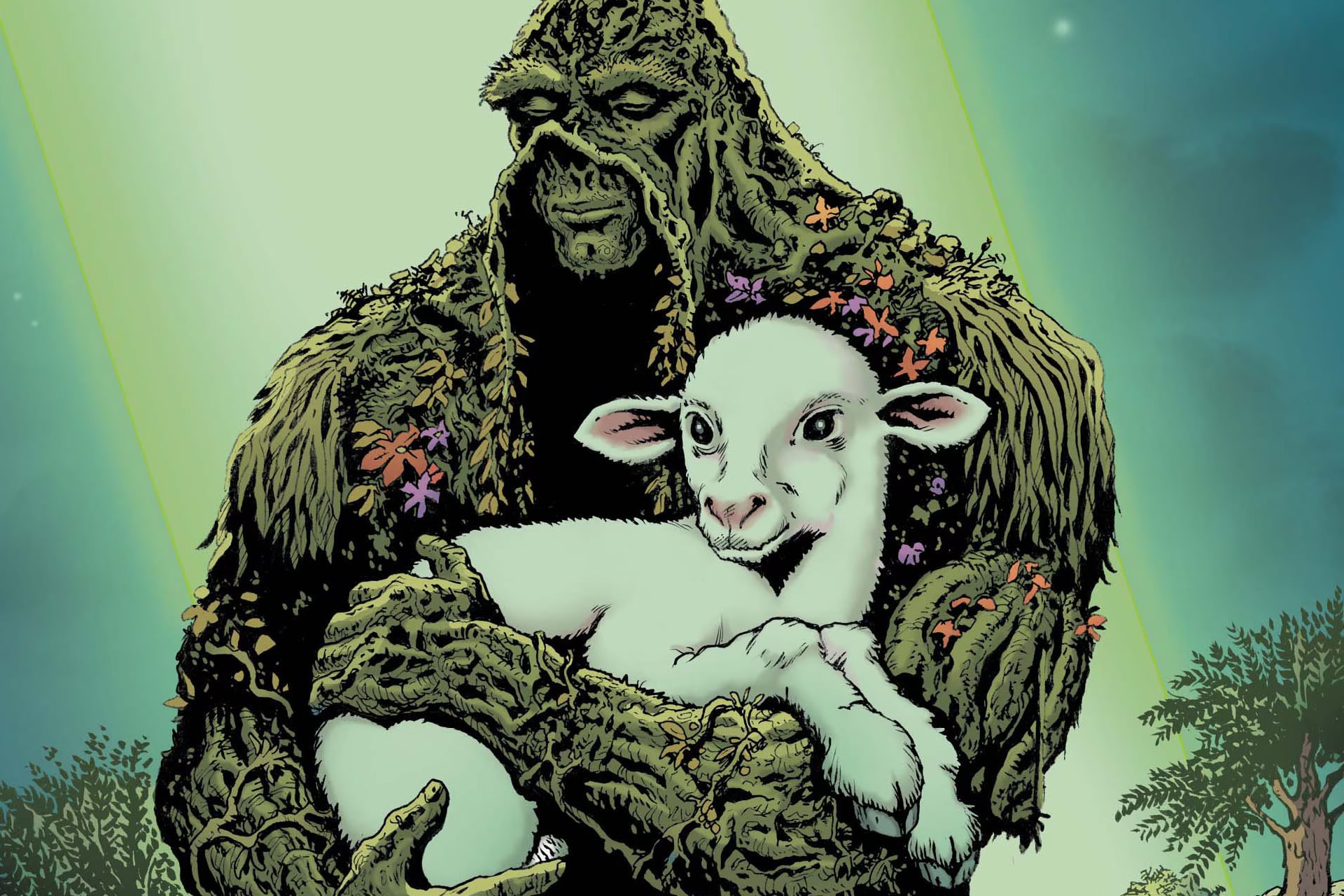
The words are new, but the story Veitch is telling had been with him for decades. In that time, he says, its meaning for him has only grown more profound. “As I have thought about it over the years, I think I was trying to bring together [my beliefs in] pantheism and spirituality. Modern Christianity seems to have cut nature away from itself, and I think that’s a mistake. And to tie Swamp Thing—who embodies nature, and the Green, and pantheism itself—to a figure like Jesus, it’s explosive.”
“I was brought up Catholic, and the whole organized religion thing just seemed kind of dumb to me,” Veitch continues. “And having taken the mushroom a few times in my youth, and having done regular dream work since my early 20s, I felt that I was connecting to something deeper and something real that kind of powers us all. I think Jack Kirby got it right with the Source. It really is a Source to all of us.”
So the story was ready to take form, but what about the art? The story’s artist in 1989 was to have been Michael Zulli, with his pencils inked by the ubiquitous Alfredo Alcala. But Alcala passed away a quarter century ago, and in 2024, Zulli suffered a recurrence of the cancer he had been battling for the past decade, passing away in July of that year. Zulli’s pencils for the first issue of the story were complete, but the rest of the series had yet to be drawn. What was to be done?
DC turned to Zulli’s frequent collaborator Vince Locke—a choice made at the personal recommendation of Zulli’s widow, Karen. Locke was honored by the choice to have one more chance (albeit posthumously) to work with his old friend. But about the infamous story itself, he knew almost nothing until he received a crash course from Galer and Veitch: “Welcome to the greatest clusterfuck in comics history,” Veitch told him.
Running his brush over Zulli’s lightbox pencils became, for Locke, a deeply emotional experience. “It would get to me sometimes,” Locke says. “Because as you’re working, you’re thinking, ‘He was drawing this while he was sick, and he passed away trying to get it done.’ [So I was] trying to live up the expectations of the fans, matching what they were hoping for. I think my main concern was making sure that when I was done, you would still see Michael’s hand in there. So I get emotional sometimes.”
To draw the remaining four issues of the series, DC turned to another veteran of the era, artist Tom Mandrake, who penciled a number of Swamp Thing issues during the ’80s and ’90s. For Mandrake, that past experience posed its own special kind of challenge.
“It was daunting for a couple of reasons,” Mandrake says. “One, because [the story] has this huge reputation. And second, I sort of felt my own ghosts standing behind me, working on something that I had done in the ’80s and ’90s. I sort of felt like I was putting pressure on myself to try and work like I did then.”
Mandrake likewise felt pressure to live up to the reputation of inker Alfredo Alcala, whose thick and extremely distinctive style had helped define a decade of Swamp Thing comics. “We did very much want to make it look like it belonged in that era of 1980s Swamp Thing,” he says. “And of course, Alfredo Alcala was the look of the book at the time. And I tried to…I don’t want to say ink like Alfredo, but I tried to give it some of that flavor.”
Indeed, that effort to replicate the look and feel of a late ‘80s comic was one of the mission statements that Galer brought to the project as editor. “It’s going to be on newsprint. It’s going to have ads from the time period,” Locke says. “Alex’s thought was he wanted people to pick up the books and have it blend in [with the older Veitch Swamp Thing comics]. So it looks like it’s from that time.”
Colorist Trish Mulvihill had the daunting task of taking the place of the legendary Tatjana Wood (who passed away at age 99 this past February). “Since this was going to be a continuation of the arc, we wanted the transition between the earlier issues and our new ones to look as seamless as possible,” Mulvihill says. “I didn’t feel daunted, but knew I would have to be constantly mindful of making choices she would have, even if they differed from my instincts. The best way to honor Tatjana was to faithfully study and follow the palettes she used.”
That meant studiously following the guidelines Galer laid down: “An extremely limited palette. No grads allowed. That got a bit frustrating at times, but it makes a colorist get extra creative. I could not allow myself to have an ego with this project. It was all about creating harmony with Tatjana’s work.”
So now, after 37 years in the tomb, Rick Veitch’s final Swamp Thing arc will rise at last. And the creators who reincarnated it are cautious but hopeful. “The years that I spent thinking about it really helped me zero in on the point I wanted to make,” Veitch says. “I was able to take the Swamp Thing that I worked on, and John and Steve and Alan worked on, and Tom Yates and Marty Pasco did, and even Bernie [Wrightson] and Len [Wein]; and tie up that whole story as a single unit.”
“I think it’s more important now [than it was in 1989],” Veitch continues. “Maybe things like this happen for a reason, and maybe it’s because now is the time when we bring nature and the spirit together again, and people’s minds can think creatively, and people can choose if there’s something there for them… I think Jesus would love nature, and understood it in a way that you and I don’t.”
The first issue of Swamp Thing 1989 releases on April 29.
Want more io9 news? Check out the best movies and TV shows to stream this month and all the upcoming sci-fi, fantasy, and horror books that should be on your radar.