FET is a free timetabling application designed to generate class schedules automatically for educational institutions. Whether you run a small primary school or a large university with thousands of students and hundreds of rooms, FET can build a working timetable that satisfies your constraints, often in a matter of minutes. Developed by Liviu Lalescu and licensed under the GNU Affero General Public License, FET has been quietly solving one of the most tedious problems in education administration for years: the puzzle of fitting teachers, students, subjects, rooms, and time slots together without conflicts.
What makes FET stand out from manual scheduling approaches is its algorithm. You feed in your data, including teachers, student groups, subjects, rooms, and any rules or preferences you need to enforce, and FET generates a complete timetable automatically. Complicated schedules that might take an administrator days or weeks to arrange by hand can typically be solved in five to twenty minutes. Simpler setups may take only seconds. The software runs on Windows, macOS, and GNU/Linux, and since it stores everything in a flexible XML format, your data stays portable and easy to edit even outside the application.
Why Should I Download FET?
The core reason to download FET is that it eliminates the gruelling manual work of building a school timetable. Anyone who has tried to create a conflict-free schedule by hand knows how quickly the complexity spirals out of control. Every teacher has availability restrictions. Students belong to overlapping groups. Certain rooms only suit certain subjects. FET handles all of this through a system of time and space constraints that you define, and then it finds a solution that respects every rule you have set.
The constraint system is where FET really earns its reputation. On the time side, you can specify teacher availability, maximum days per week, gaps between classes, consecutive teaching limits, break periods, and minimum resting hours. For students, similar constraints apply, including maximum hours per day, early start preferences, and gap limits. You can also lock specific activities to preferred time slots, require certain classes to run on the same day, prevent overlaps between activity groups, and set minimum spacing between related sessions. Space constraints are equally detailed. You can assign home rooms to teachers or student groups, restrict individual activities to specific rooms, limit room changes per day, and enforce minimum gaps between building changes. FET supports up to 1,000 working days per week, 1,440 hours per day, 30,000 student subgroups, 500,000 activities, and 30,000 rooms, so the scale is not a concern for even the largest institutions.
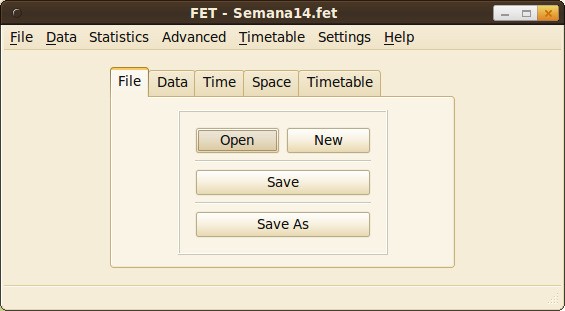
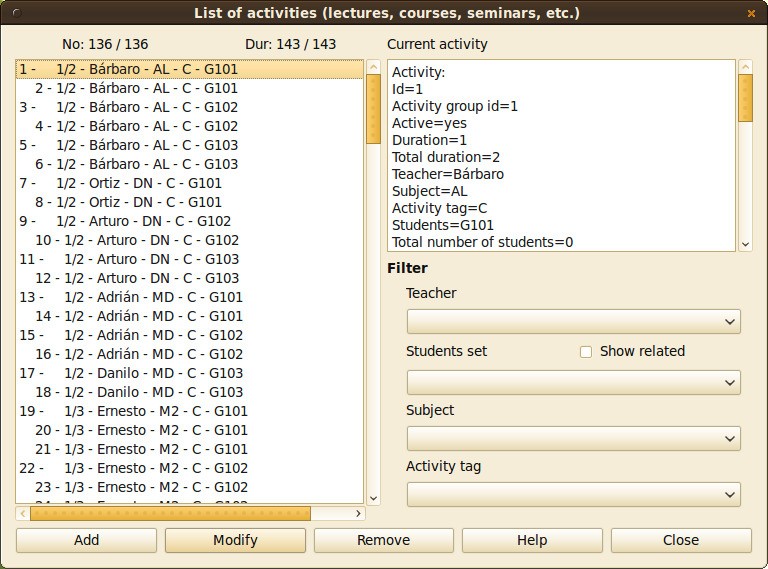
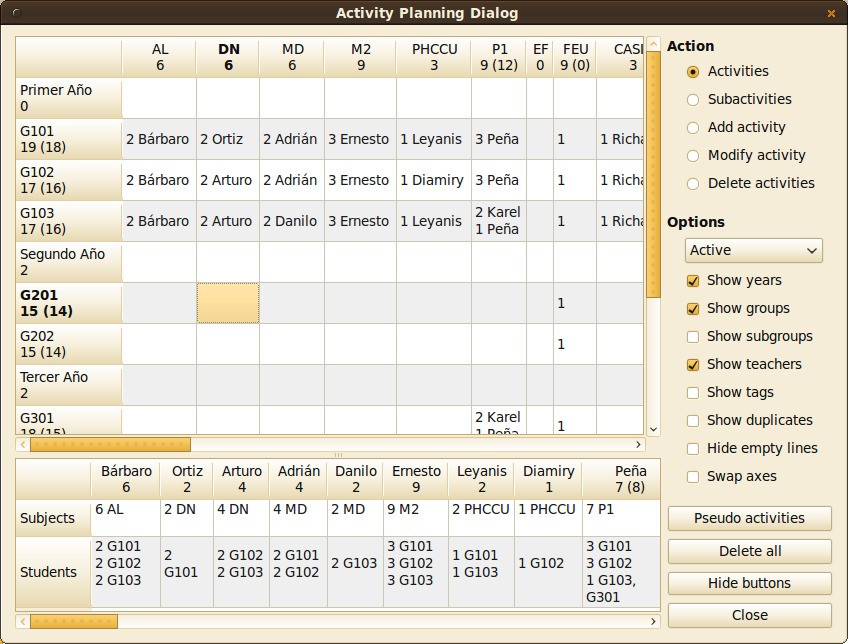
Beyond automatic generation, FET also supports semi-automatic and fully manual scheduling for administrators who want to lock in certain slots before letting the algorithm fill in the rest. The finished timetable exports to HTML, XML, and CSV formats, making it easy to publish online or import into other systems. Data entry is handled through the application's interface, but you can also import from CSV files or edit the XML input directly with any text editor, which is useful for bulk data entry or integration with existing school databases.
Is FET Free?
FET is completely free. There are no paid tiers, no premium features, and no subscription costs. The software is distributed under the GNU Affero General Public License version 3, which means anyone can download, use, copy, modify, and redistribute it without restriction. The full source code is publicly available, so schools and universities with technical staff can inspect, customize, or extend the software to fit their specific needs.
The developer does accept donations to support ongoing work, but donating is optional and does not unlock any additional functionality. Every feature FET offers is available to everyone at no cost, from the smallest single-school setup to the largest multi-campus deployment.
What Operating Systems Are Compatible with FET?
FET runs on Windows, macOS, and GNU/Linux. For Windows users, the recommended download is the 64-bit executable for Windows 10 or later, which includes everything needed to run the application without a separate installation process. Older Windows versions (7 and 8.1) are supported through an alternative build using Qt 5.15, and a 32-bit Windows build is also available. On macOS, a contributed build is maintained by a community member and available through the FET website. GNU/Linux users can grab a precompiled 64-bit binary or compile from source, and distribution-specific packages are available for various Linux distributions through their respective repositories.
FET is built using Qt, the cross-platform C++ framework, which means it can technically run on any platform Qt supports. The source code is provided as a tar.xz archive for anyone who wants to compile it themselves. The application is lightweight and portable, requiring no formal installation on Windows. You simply download the executable and run it.
What Are the Alternatives to FET?
Moodle is a free, open-source learning management system used by schools, universities, and organizations worldwide. While FET focuses narrowly on timetable generation, Moodle provides a full online learning environment with course management, gradebooks, quizzes, forums, and assignment submission. It does not generate timetables automatically, but it handles the broader challenge of organizing and delivering educational content online. Moodle runs as a web application on a server and supports a vast plugin ecosystem that extends its functionality in almost any direction. If your scheduling needs are paired with a need for online course delivery and student interaction, Moodle covers the learning management side of the equation.
RosarioSIS is a free, open-source student information system designed primarily for K-12 schools, though it adapts to other educational settings. It covers student records, grades, scheduling, attendance tracking, discipline, billing, and food service management in a single web application. RosarioSIS includes built-in Moodle integration for schools that want to connect their administrative and learning management systems. While it has a scheduling module, it is more of a record-keeping and administration platform than a dedicated timetable generator. For schools that need a central hub for all student data alongside basic scheduling, RosarioSIS fills that role well.
UniTime is the closest direct alternative to FET in terms of purpose. Developed originally as a collaborative project between universities in North America and Europe, UniTime is a distributed scheduling system specifically built for higher education. It handles course timetabling, exam scheduling, event management, and student sectioning (assigning students to individual class sections). UniTime uses constraint-based solving similar to FET, but it adds multi-user coordination, allowing multiple departmental schedule managers to work on the same timetable simultaneously. The software is free and open source under the Apereo Foundation, and it can integrate with existing student information systems. For universities that need collaborative scheduling across departments with exam and event management built in, UniTime is purpose-built for that workflow.