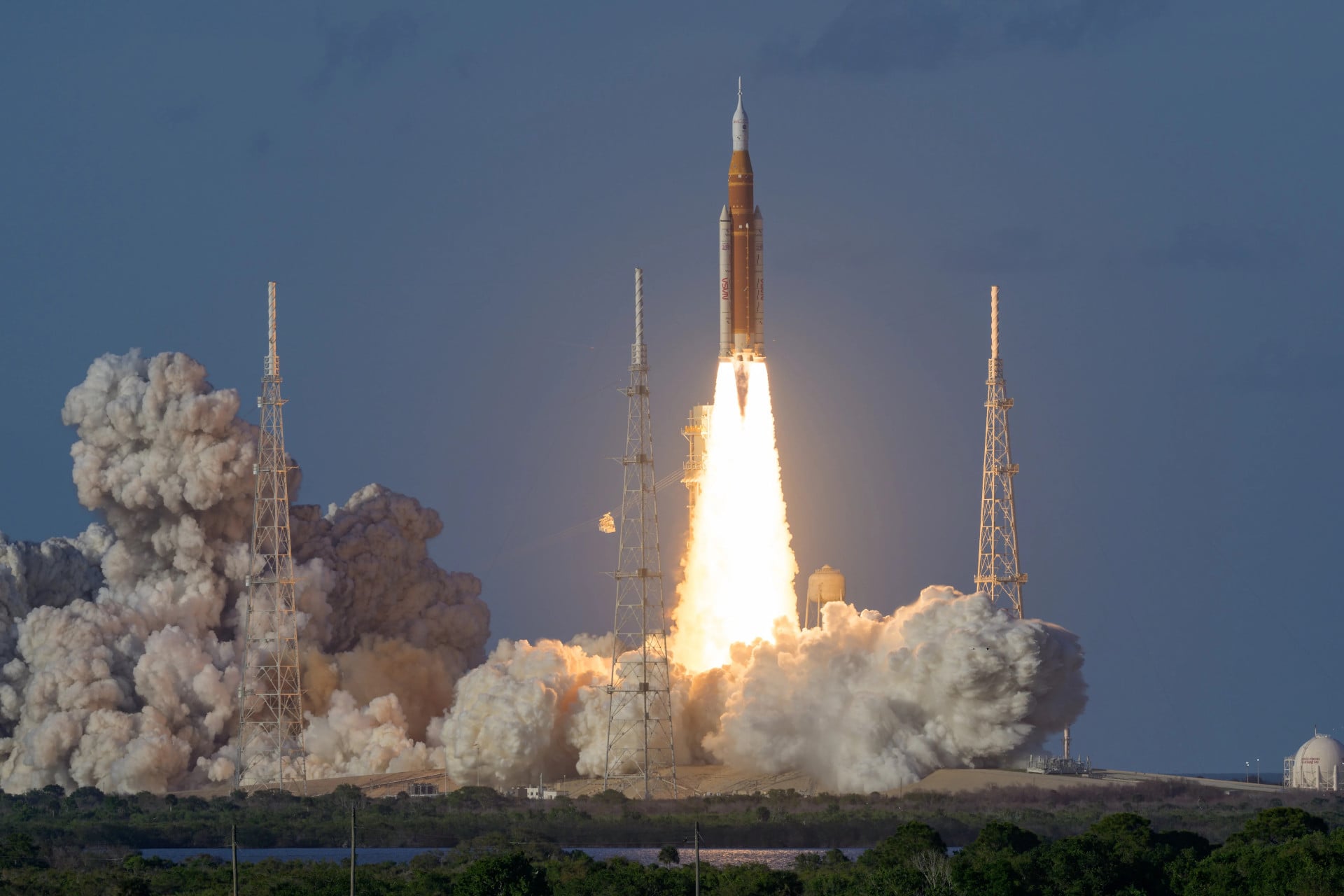
Artemis 2 returned to Earth on Friday, splashing down off the coast of San Diego, California. This historic mission sent four astronauts around the lunar far side, allowing them to observe parts of the surface humans had never laid eyes on before. Gizmodo followed the mission from launch to splashdown, and you can find all of our daily updates right here.
NASA’s Space Launch System (SLS) rocket launched at 6:35 p.m. ET on Wednesday, April 1, sending NASA’s Reid Wiseman, Victor Glover, Christina Koch, and the Canadian Space Agency’s Jeremy Hansen to low-Earth orbit aboard the Orion spacecraft. At the end of Flight Day 2, Orion successfully executed a translunar injection burn and set course to the Moon.
Artemis 2 is the first spaceflight to send humans beyond low-Earth orbit in 54 years, and this time, they ventured deeper into space than ever before. On Monday, April 6, the mission surpassed the record previously set by the Apollo 13 crew in 1970 of the farthest humans have ever traveled from Earth. Now that the Artemis 2 crew is safely back on Earth, NASA is busy analyzing all the data they gathered and preparing for the next mission under its Moon program: Artemis 3.
Splashdown!

Orion slowed to just 20 mph before splashing down in the Pacific Ocean off the coast of San Diego, California, at 8:07 p.m. ET. The Artemis 2 crew has officially returned to Earth and completed their 694,481 mile journey around the Moon and back again.
Next, recovery teams from NASA and the U.S. military will extract the crew from the capsule and fly them by helicopter to the USS John P. Murtha. Once aboard the ship, the astronauts will undergo post‑mission medical evaluations before returning to shore where awaiting aircraft will take them to NASA’s Johnson Space Center in Houston, Texas.
Drogues Release, Main Parachutes Deploy

At 8:05 p.m. ET, Orion reached an altitude of 6,000 feet. The drogue parachutes released and the three main chutes deployed, slowing the capsule’s velocity to less than 136 mph.
Drogue Parachutes Deployed

At 8:04 p.m. ET, Orion reached an altitude of 22,000 feet and the drogue parachutes deployed. These will slow and stabilize the capsule as it nears splashdown.
Orion Has Reached Earth’s Atmosphere
At 7:54 p.m. ET, Orion reached an altitude of 400,000 feet above Earth’s surface, traveling more than 30 times faster than the speed of sound. NASA expects the crew to experienced nearly 4 Gs of force upon reentry, according to the planned entry profile.
Plasma is building around the capsule, which will cause mission control to lose contact with the crew during a planned six-minute communications blackout in about 20 seconds. The next several minutes will be the most harrowing of the 10-day mission.
Crew Module Completes Raise Burn
At 7:38 p.m. ET, the crew module performed an 18-second raise burn to set the proper entry angle and align the heat shield for atmospheric interface. This was a critical step. If the angle is too shallow, the capsule could skip off the atmosphere and bounce back into space. If it’s too steep, the heat shield could be overwhelmed, causing the spacecraft to burn up during descent.
Orion’s Crew Capsule Separates From Service Module
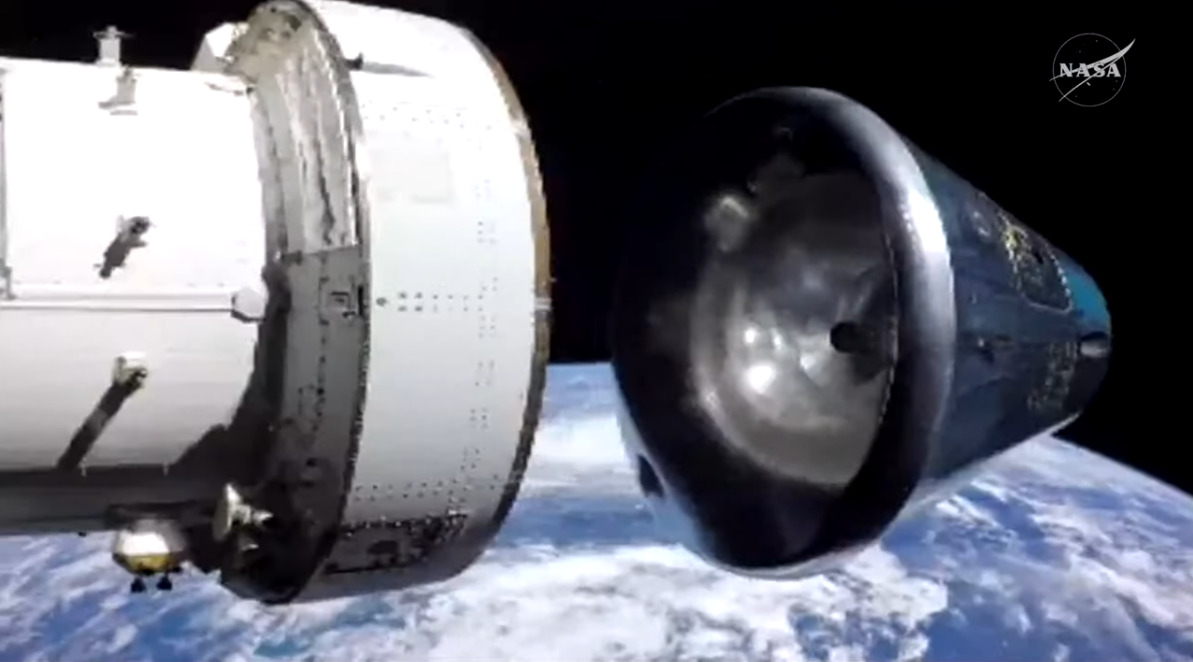
At 7:34 p.m. ET, Orion’s crew capsule separated from the service module. This exposed the capsules heat shield, which will protect it and the crew from the extreme temperatures of reentry. NASA expects the exterior of the capsule to encounter maximum temperatures of about 3,000 degrees Fahrenheit.
Orion Closing In

We’re about 30 minutes away from crew capsule and service module separation. The cameras on Orion’s solar array wings are giving us some incredible views of Earth looming not too far in the distance!
How the Artemis 2 Reentry Profile Differs From Artemis 1

For the uncrewed Artemis 1 mission, NASA used a skip reentry. Essentially, Orion dipped into the upper atmosphere and used it, along with the lift of the capsule, to skip back out of the atmosphere. It then reentered for a final descent under parachutes and splashdown. You can think of it like skipping a rock across a pond.
The rationale behind this approach was to improve landing accuracy, reduce the g-forces astronauts would experience on future crewed missions, and split up the heating between two separate entries. But due to issues with the Artemis 1 heat shield, NASA has modified the reentry profile for Artemis 2.
This time, the reentry will still use aerodynamic lift to protect the crew, but the “skip” will be less defined. This faster, more direct reentry should prevent the heat shield issues NASA saw after Artemis 1, but according to Spaceflight Now, it will also reduce the distance the Orion capsule can fly to avoid bad weather in the planned splashdown zone. Fortunately, the forecast is looking good.
What’s more, this profile will result in higher sustained heating during descent, but NASA engineers believe this will actually maintain permeability in the heat shield’s outer char layer, Spaceflight Now reports.
Orion Sights Its Target
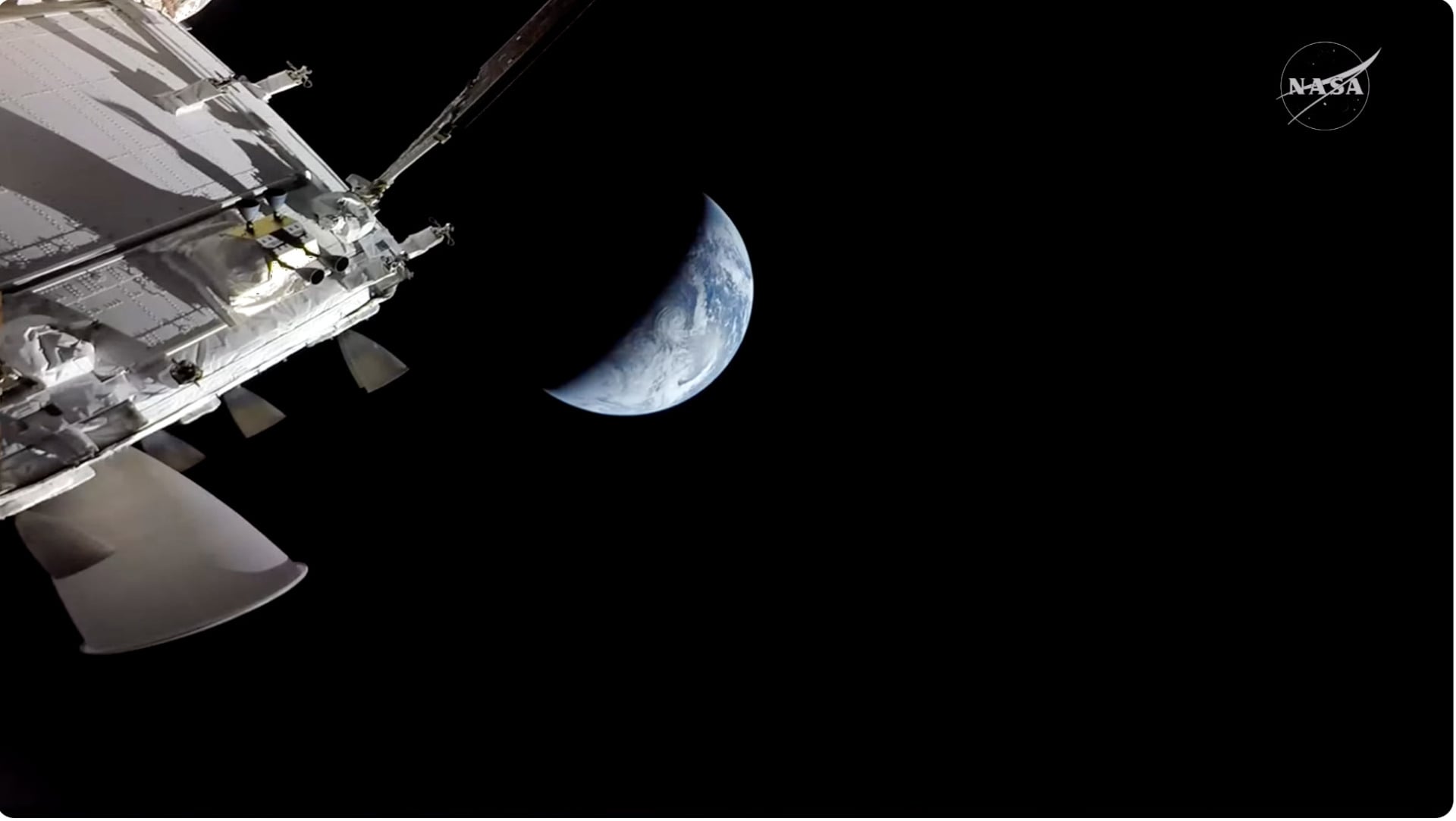
As Orion approaches Earth, we’re getting some stunning views of our planet captured by one of the cameras mounted on the spacecraft’s solar array wings. As of 3:30 p.m. ET, Artemis 2 was about 39,000 miles from home.
Return Trajectory Correction Burn Complete
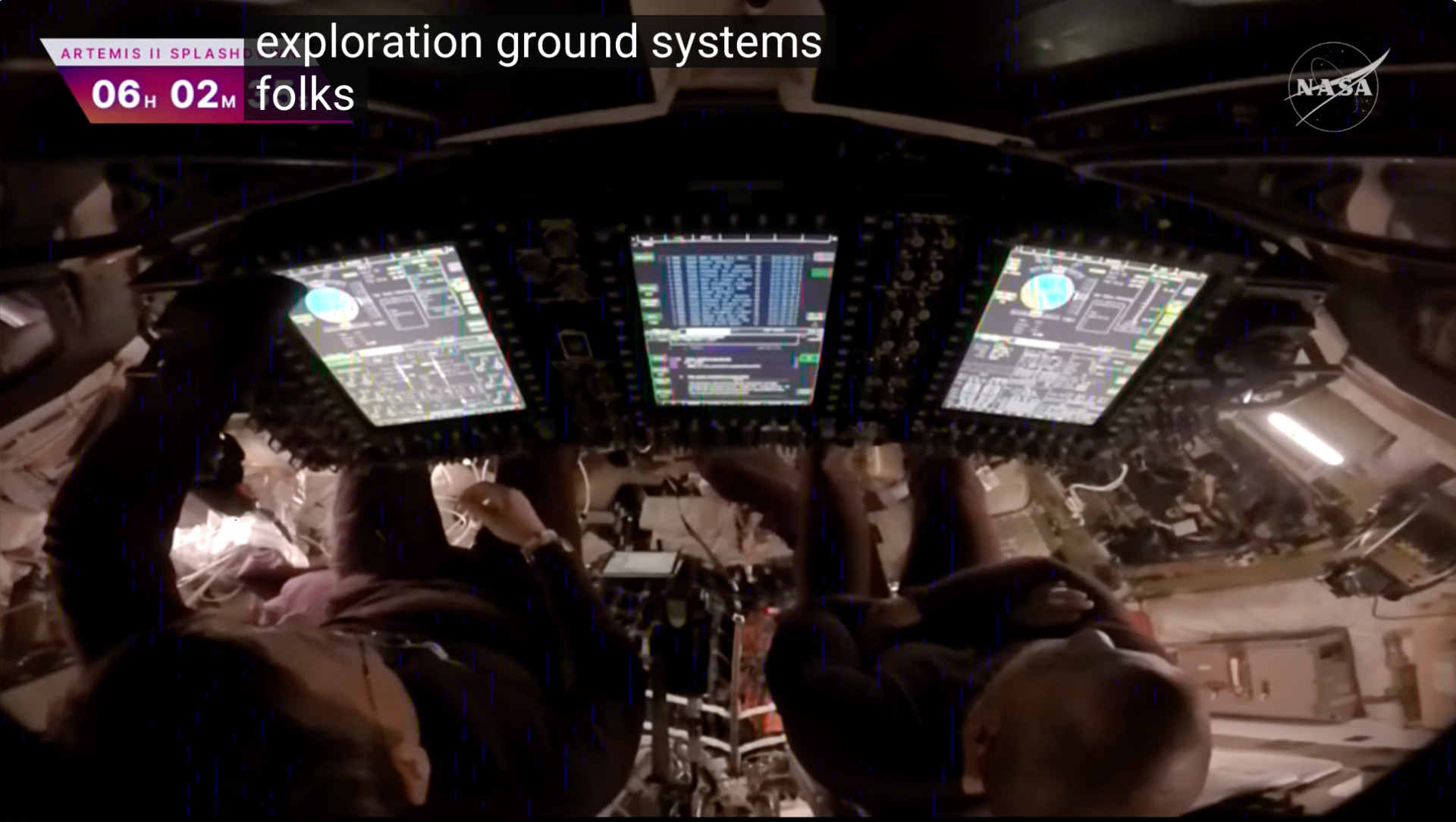
Orion has completed the return trajectory correction burn that will keep the spacecraft on track for reentry and splashdown in the Pacific Ocean at approximately 8:07 p.m. ET today. The spacecraft fired its thrusters for 8 seconds to increase its velocity by 4.2 feet per second.
For the Last Time—Good Morning, Artemis 2!

The crew woke for their last day in space to the songs “Run to the Water” by Live, selected by the crew, and “Free” by Zac Brown Band. At the time of the wakeup call, they were 61,326 miles from Earth.
Here’s NASA’s updated splashdown timeline. Just keep in mind that these times are estimated and subject to change.
- 7:33 p.m.: Orion’s crew module separates from the service module, exposing its heat shield.
- 7:37 p.m.: Orion performs an 18 second crew module raise burn beginning to set the proper entry angle and align the heat shield for atmospheric interface.
- 7:53 p.m.: Orion reaches the upper atmosphere at 400,000 feet above the surface, traveling nearly 35 times the speed of sound. The planned six-minute communications blackout begins as plasma builds around the capsule.
- 8:03 p.m.: Drogue parachutes deploy at an altitude of roughly 22,000 feet, slowing and stabilizing the capsule.
- 8:04 p.m.: Drogue parachutes release and the three main chutes deploy, slowing Orion to less than 136 mph.
- Within two hours of splashdown, the recovery team will extract crew and fly them to the USS Murtha. Once aboard, the astronauts will undergo post‑mission medical evaluations before returning to shore to board a flight to NASA’s Johnson Space Center in Houston.
In the above image, NASA astronaut and Artemis 2 pilot Victor Glover is assisted by U.S. Navy personnel as he exits a mockup of the Orion spacecraft in the Pacific Ocean during training Feb. 25, while his crewmates look on.
The Four Phases of Artemis 2’s Return
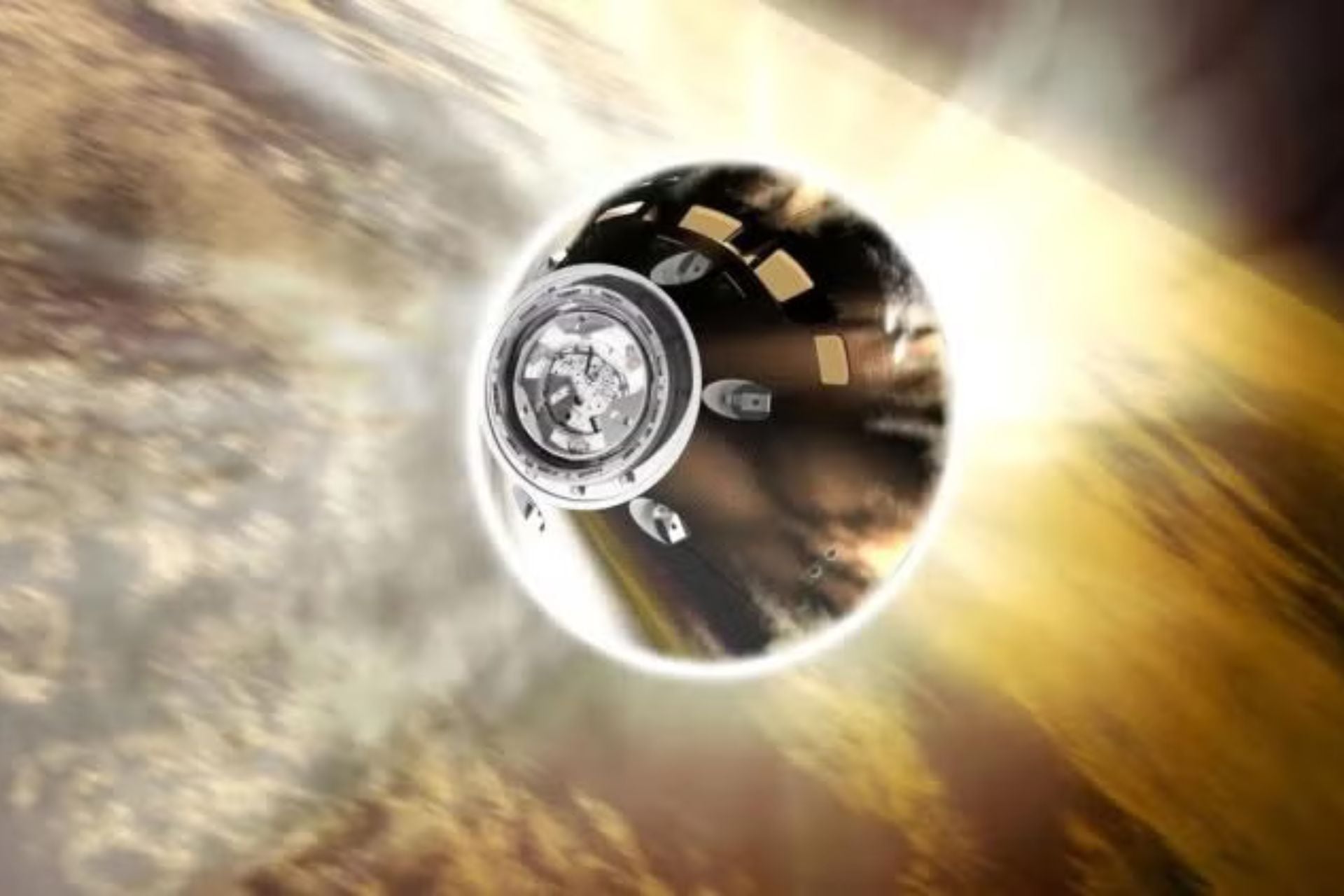
Atmospheric reentry is no joke. The Orion spacecraft will be exposed to extreme temperatures and forces as it falls back to Earth. Fortunately, capsule’s heat shield and the astronauts’ spacesuits should keep them safe, and NASA has worked out a procedure designed to make sure everything goes smoothly.
The four phases to watch for today will be the service module jettison, the moment of reentry, the plasma phase, and parachute deployment. You can learn more about each of these crucial steps here.
It’s Splashdown Day

Good morning, Artemis 2 fans! It’s the final day of the mission. The Orion spacecraft is picking up speed at it hurtles back to Earth, targeting a splashdown off the coast of San Diego, California, at 8:07 p.m. ET today.
At 10:53 p.m. ET on Thursday, Orion ignited its thrusters for 9 seconds, producing an acceleration in velocity of 5.3 feet-per-second and pushing the Artemis 2 crew toward Earth. The crew is now more than halfway home.
Roughly 2 hours before the burn, Mission Control unexpectedly lost transmission of communications and telemetry from the spacecraft to the ground, though flight controllers did manage to reestablish two-way communications.
Orion is scheduled to perform another return trajectory correction burn at about 1:53 p.m. ET today ahead of reentry procedures. Yesterday, the crew was busy preparing the cabin for reentry, stowing away items that need to be secured.
Flight Day 10 feels bittersweet. If you’ve been following along since launch day like I have, you’ve probably grown quite fond of these four intrepid space explorers and their Integrity spacecraft. I’ll be trying not to bite my nails as they reenter the atmosphere at a blazing 25,000 mph today. To watch their epic return, head to our watch page.
A Couple Surprises for the Crew
Mission Control surprised the Artemis 2 astronauts with a couple small gifts hidden inside Orion’s cabin. After looking around with some guidance from the CAPCOM, the astronauts said they had found some “pretty cool socks” and some sort of beverage, though they did not specify what the drinks were. Christina Koch said she and her crewmates were enjoying some “coffee shop time,” so perhaps it was a little caffeine boost to help them get through a long day of reentry preparations.
Rise and Shine, Artemis 2!
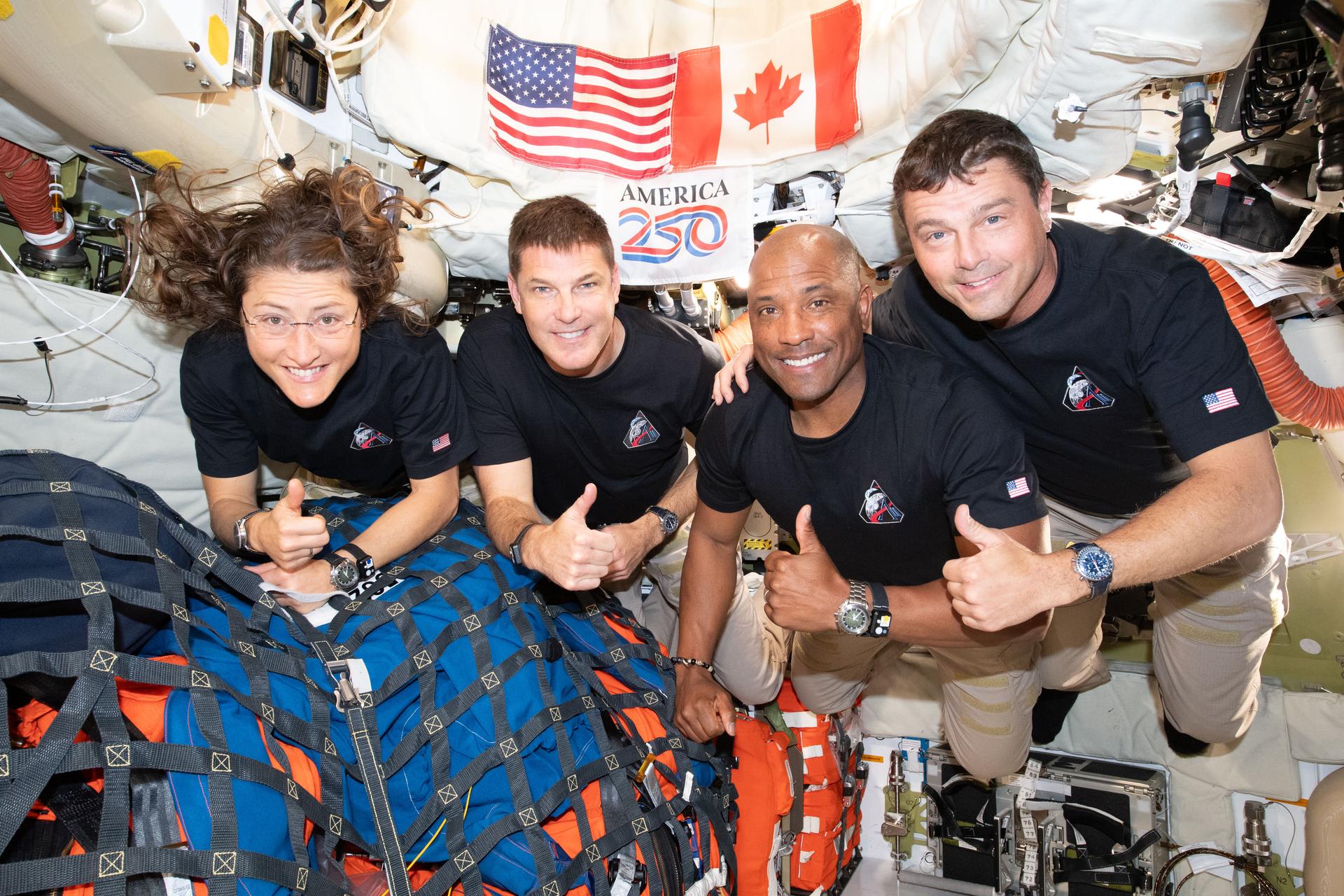
The Artemis 2 crew woke to the sounds of “Lonesome Drifter” by Charley Crocket as they approached Earth at a distance of 147,337 miles this morning.
Today, Mission Specialists Christina Koch and Jeremy Hansen will stow equipment, remove cargo and locker netting, and install and adjust crew seats to ensure all items are secured before reentry on Friday. The crew will also review the latest weather briefing, recovery force status, and entry timeline while working through post-landing operations.
Orion’s return trajectory correction burn is scheduled to take place at 9:53 p.m. ET. This maneuver will further refine the spacecraft’s trajectory to ensure it remains aligned for atmospheric reentry. During the burn, Hansen will review the procedure steps and monitor Orio’s guidance, navigation, and propulsion systems.
What to Expect During Reentry and Splashdown
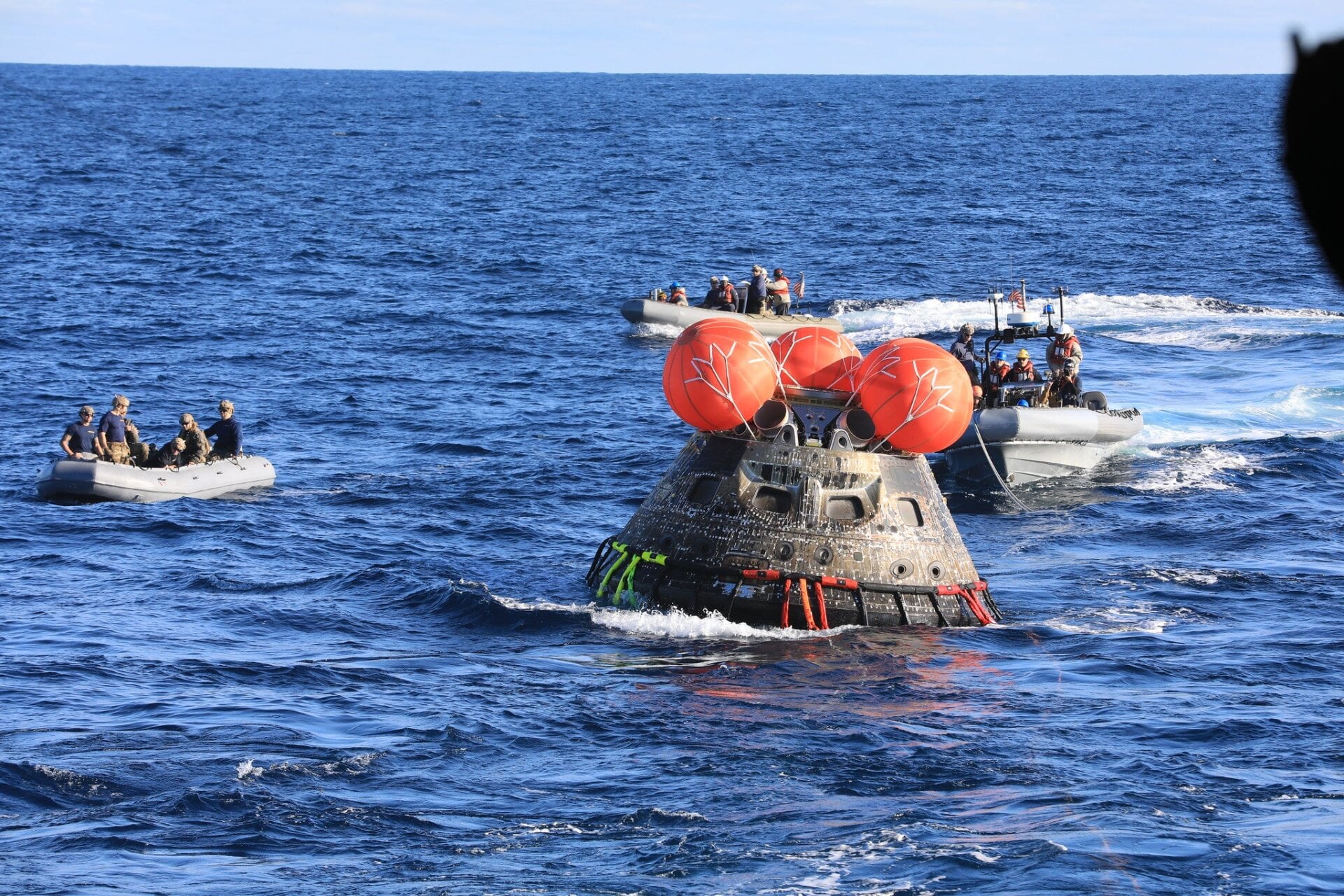
The epic conclusion of NASA’s Artemis 2 mission is going to be action packed. NASA’s live coverage of Orion’s return will kick off at 6:30 p.m. ET on Friday, and you can tune in via Gizmodo’s watch page.
Once Orion performs a return trajectory correction burn, the crew will start working through the reentry checklist and don their Orion Crew Survival System suits. The crew capsule will then separate from the service module, and the capsule will perform another burn to refine its orbit for a safe, targeted reentry and splashdown.
The crew will reenter the atmosphere at roughly 400,00 feet above Earth’s surface. At 36,000 feet, the capsule will jettison its forward bay cover, allowing the drogue parachutes to deploy at 25,000 feet. The pilot parachutes will deploy at 9,500 feet and pull out the three main parachutes. The capsule will slow from a blazing 25,000 mph to just 17 mph for a soft splashdown in the Pacific Ocean.
After splashdown, recovery teams will retrieve the crew by helicopter and fly them to the USS John P. Murtha. Once aboard the ship, the astronauts will undergo post-mission medical evaluations before traveling back to shore to board a flight to NASA’s Johnson Space Center in Houston, Texas.
Happy Flight Day 9!
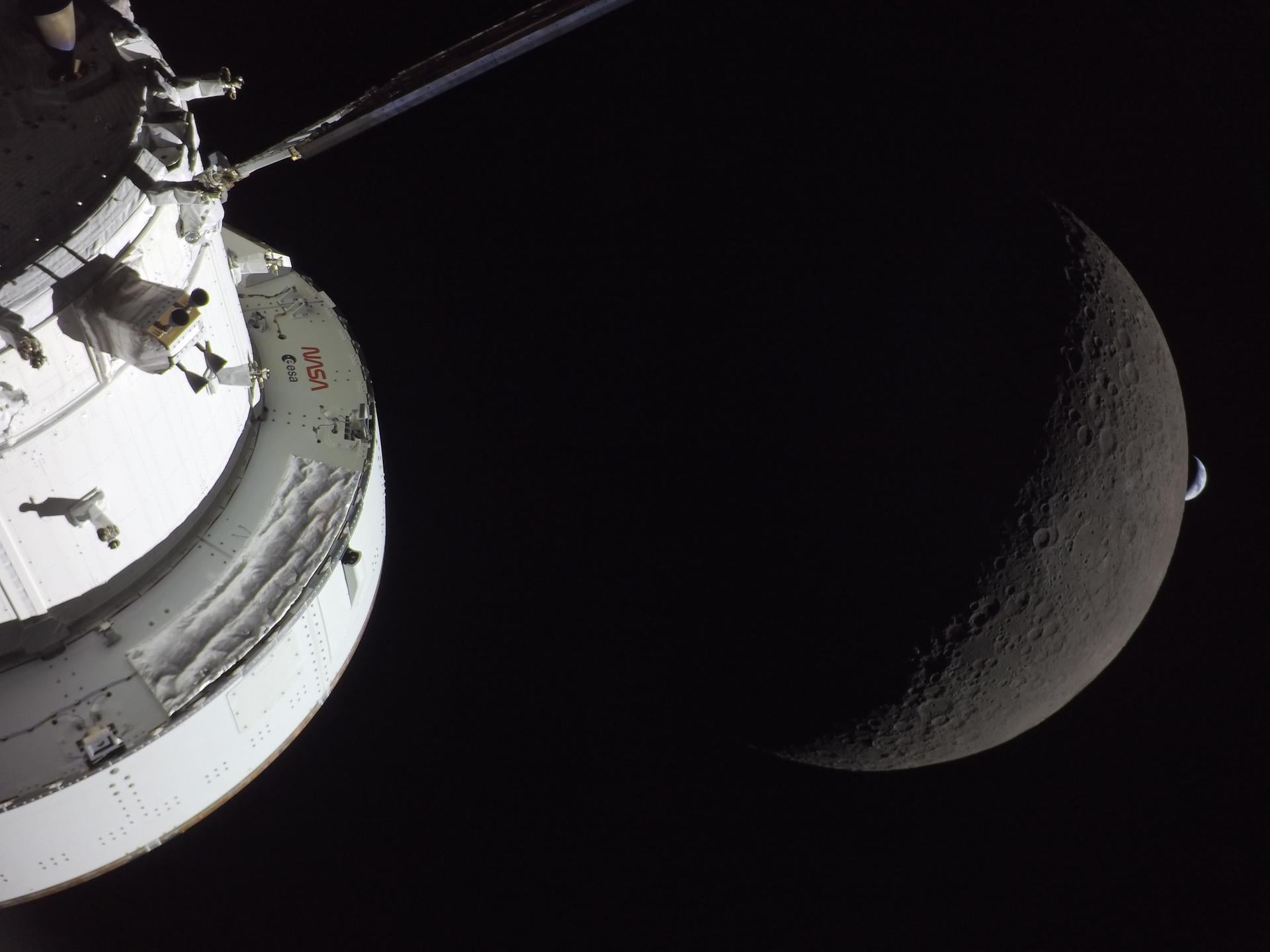
It’s the penultimate day of NASA’s Artemis 2 mission. The Orion spacecraft and its crew are currently hurtling back to Earth, picking up speed as they get closer to our planet.
The astronauts’ last full day in space will kick off with preparations for their return to Earth. They will review reentry and splashdown procedures and conference with the flight control team. Orion is scheduled to perform another return trajectory correction burn to ensure the spacecraft remains on target.
The crew will also complete a few more demonstrations, including testing contingency waste collection systems in case the toilet malfunctions (though they already have plenty of experience with that) and orthostatic intolerance garments.
NASA has released some more photos that Artemis 2 beamed back to Earth. The one above captures Orion, the Moon, and the Earth in one frame during the lunar flyby on the sixth day of the mission.
Want to Join NASA’s Lunar Science Team? Here’s Your Chance
NASA is inviting skilled amateur astronomers to document impact flashes on the lunar surface, just like the Artemis 2 astronauts did during Monday’s flyby.
If you have a telescope with video capability, you can produce recordings that will help NASA scientists quantify impact rates and refine models of crater formation and lunar interior response. To learn more about getting involved with this awesome project, head to science.nasa.gov.
Observing the Moon ✅ Now it’s your turn.
We’re inviting skilled observers to monitor the Moon’s surface for meteoroid‑impact flashes using a telescope with video capability. Your recordings will help quantify impact rates and refine models of crater formation and lunar… pic.twitter.com/2VRq7Jq5rt
— NASA Science (@NASAScience_) April 8, 2026
Wakey Wakey, Artemis 2 Crew!
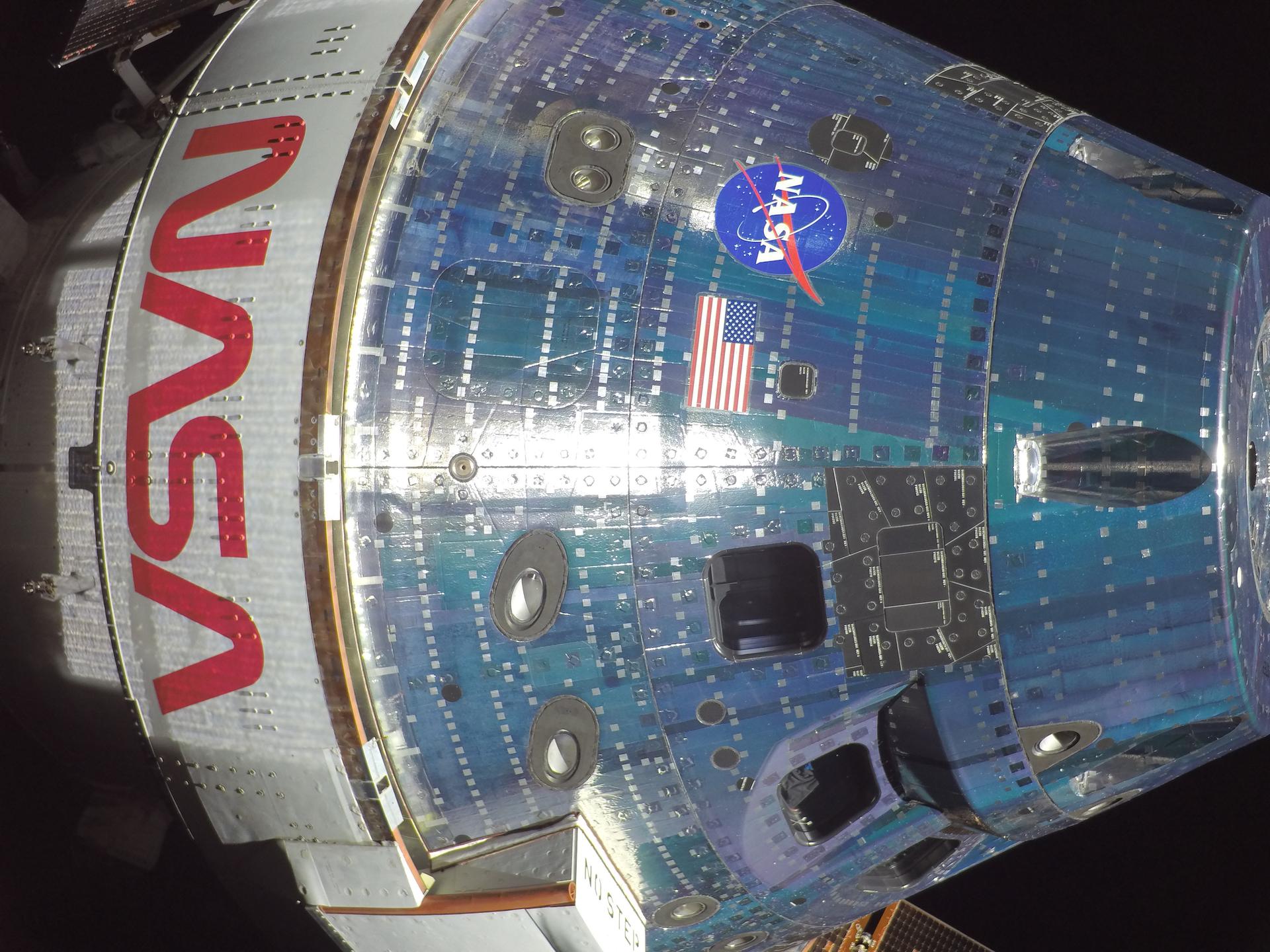
The Artemis 2 astronauts woke up to the sounds of “Under Pressure,” by Queen and David Bowie and are now preparing for today’s demonstrations. At wakeup, they were 200,278 miles from Earth and 83,549 miles from the Moon. The crew also received a message from the Canadian Space Agency.
Above is a gorgeous shot of the exterior of the Orion spacecraft, taken by one of the cameras mounted on its solar array wings on Tuesday.
A Busy Day Ahead
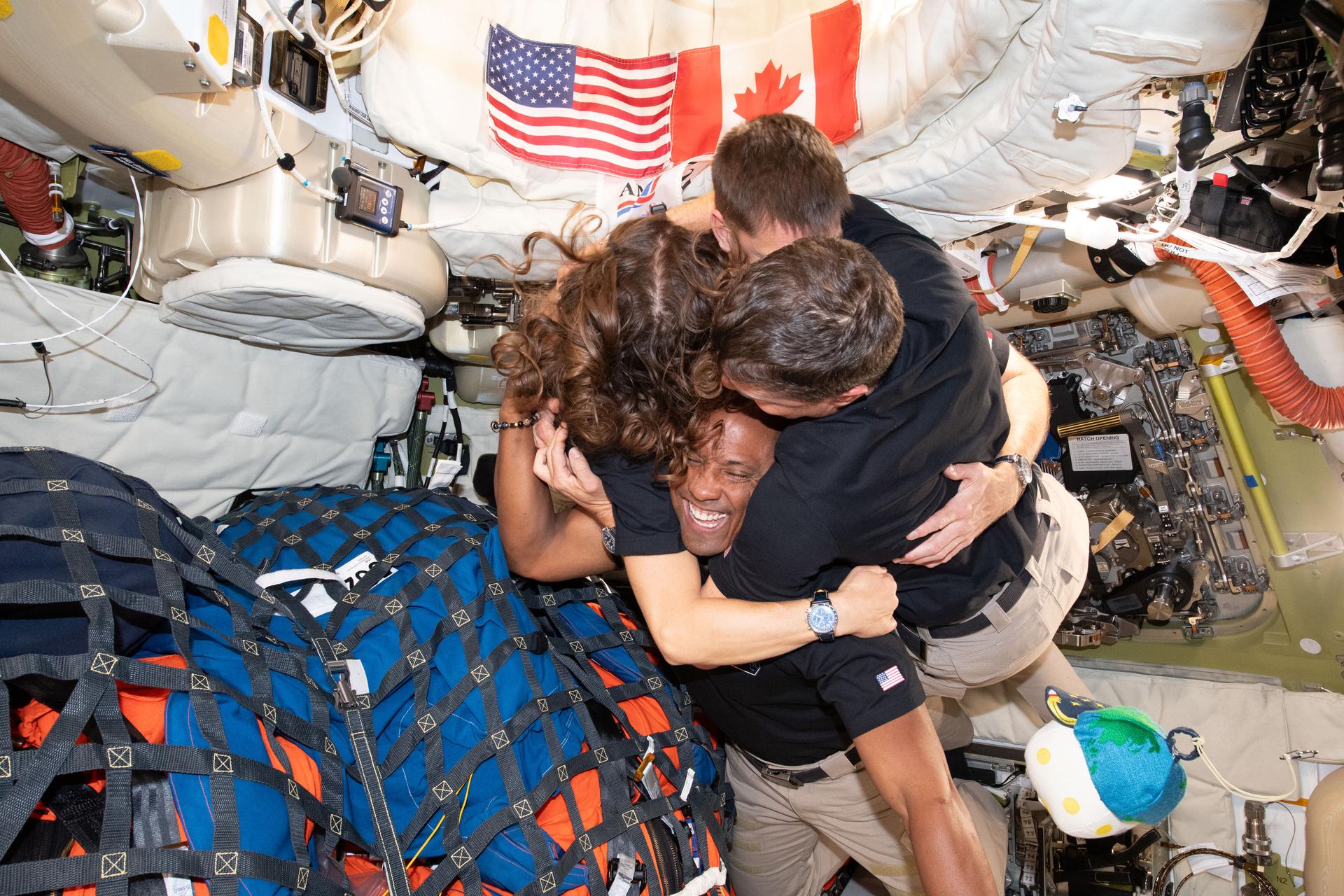
The Artemis 2 crew has a busy day ahead, filled with science, demonstrations, and reentry preparations.
The astronauts will run a drill to practice protecting themselves from a high-radiation event such as a solar flare. They will pull supplies and equipment out of Orion’s storage to build a makeshift shelter, lining the spacecraft’s walls with bulky items that would help block out radiation. This is what the crew would actually do if there was a bout of severe solar weather.
The crew will also test orthostatic intolerance garments, designed to help astronauts maintain blood pressure and circulation during the transition back to Earth’s gravity.
Then, at the end of the day, the crew will take manual control of Orion to steer the spacecraft through a series of tasks. The astronauts will use Orion’s field of view to center a designated target before guiding it into a tail-to-Sun attitude. They will also compare the spacecraft’s control modes. The manual piloting demonstration is scheduled to start at 9:59 p.m. ET.
Good Morning, It’s Flight Day 8!
Artemis 2 is in the home stretch. At 8:03 p.m. ET on Tuesday, Orion ignited its thrusters for 15 seconds to change its velocity by 1.6 feet per second. This adjusted the spacecraft’s trajectory to ensure it remains on target for splashdown in the Pacific Ocean on Friday. Mission Specialists Christina Koch and Jeremy Hansen reviewed procedures and monitored Orion’s configuration and navigation data.
During yesterday’s mission briefing, NASA officials confirmed that the USS John P. Murtha has left port and is on its way to the midway point toward the recovery site in the Pacific Ocean.
The crew spent some more time taking photos out Orion’s windows yesterday. They captured this dazzling view of the Milky Way, our home galaxy. There should be more photos to come today as NASA continues to process and release the crew’s downlinked images
Sky full of stars.
Following a successful lunar flyby, the Artemis II astronauts captured this breathtaking photo of our galaxy, the Milky Way, on April 7, 2026. pic.twitter.com/pzqcLZNB71
— NASA (@NASA) April 8, 2026
Christina Koch to Capture More Images of Earth
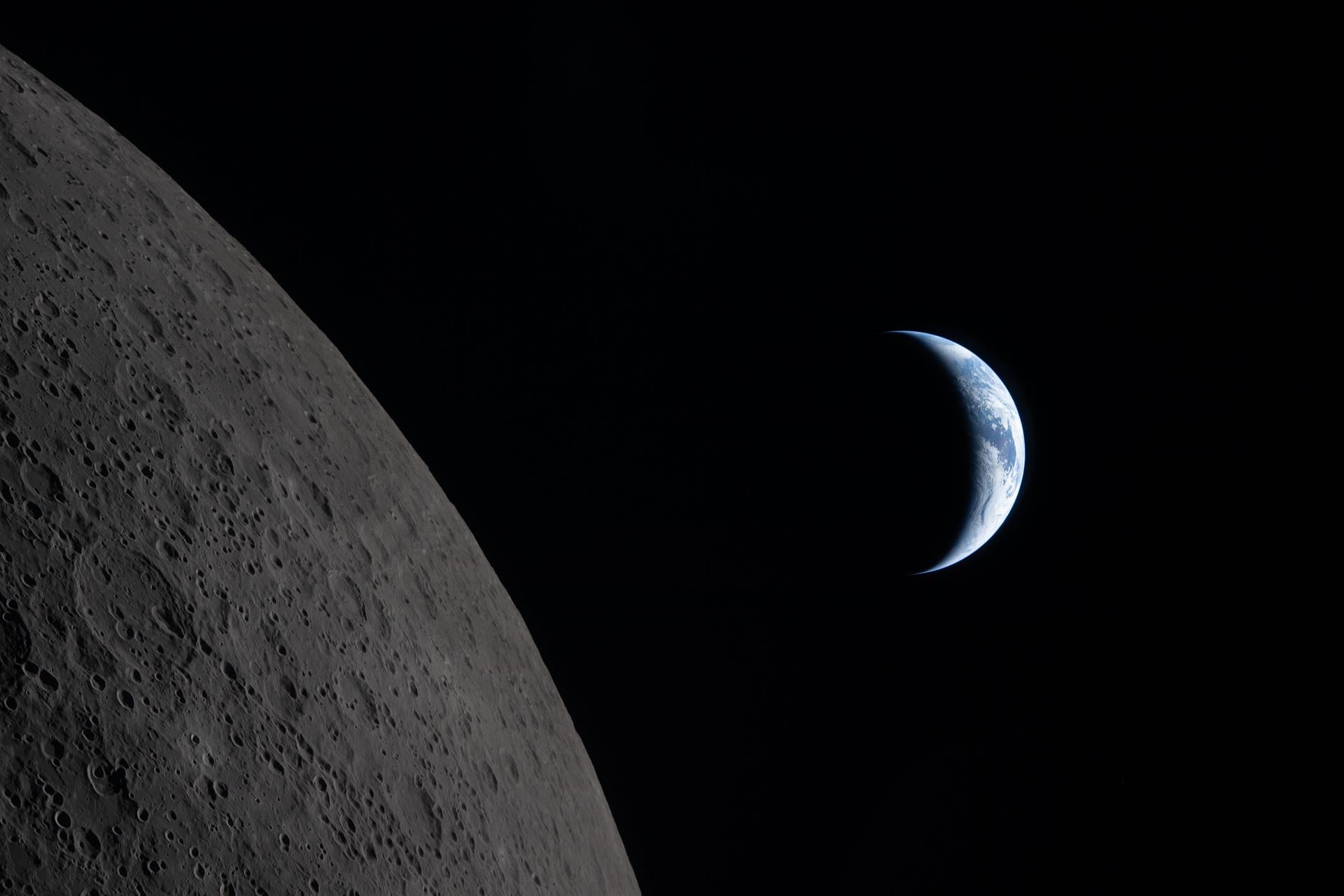
Koch is about to take some more photos of Earth as Orion gradually approaches our home planet. If you haven’t seen the incredible Earth images taken as the spacecraft departed LEO, definitely check those out.
Above is an image of Earth and the Moon taken during yesterday’s lunar flyby. This photo was taken about six minutes before Earthset, and shows the planet in a crescent phase.
Artemis 2 Crew Describes “Pinprick” Impact Flashes
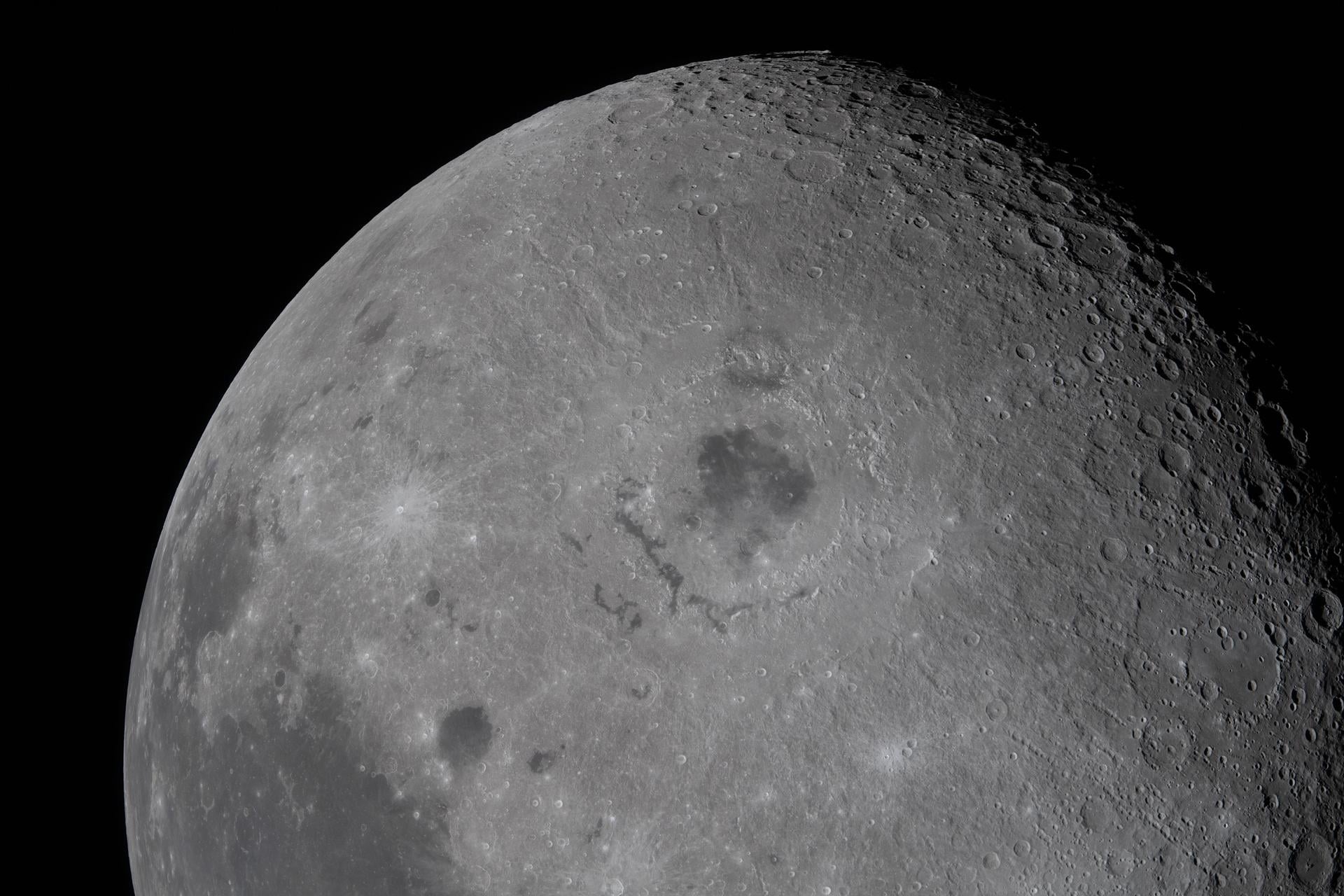
During the flyby, some of the astronauts were able to spot tiny, bright flashes on the lunar surface. These are impact flashes caused by meteoroids hitting the Moon.
Directly observing them is incredibly valuable to science. By tracking when and where impact flashes happen, scientists can better understand how often impacts of different sizes occur, what kinds of craters they create, and how the shock waves travel through the Moon’s interior.
Lunar Flyby Science Debrief Has Begun
The Artemis 2 crew is speaking with NASA’s lunar science team to discuss the observations and photos gathered during yesterday’s flyby. You can tune in via the livestream above.
Hansen and Koch Join the Association of Space Explorers
Before hoping on the call with the ISS crew, Artemis 2 Pilot Victor Glover took a moment to congratulate Mission Specialists Jeremy Hansen and Christina Koch on joining the Association of Space Explorers. This organization is represented by over 400 space fliers from 43 countries. The criterium for joining is to have completed at least one orbit of Earth from a spacecraft.
Glover also extended congratulations to Jack Hathaway, a NASA astronaut currently serving his first mission aboard the ISS.
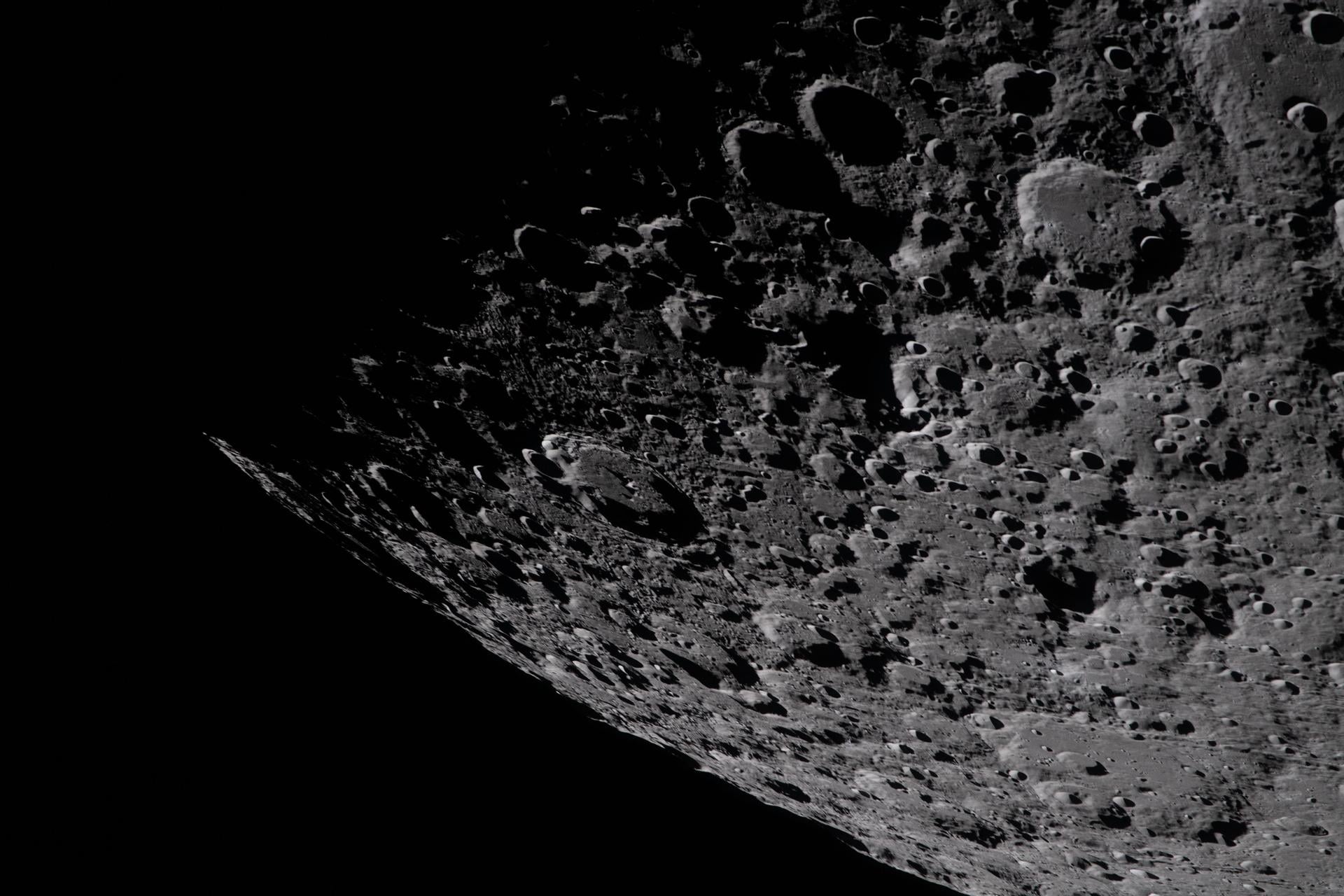
Above is another striking image from the first batch of Artemis 2 flyby photos. This one shows the complex topography of the eastern edge of the South Pole-Aitken basin. This is the largest and oldest basin on the Moon, providing a glimpse into an ancient geologic history built up over billions of years.
ISS Crew Speaks With Artemis 2
The astronauts aboard the International Space Station are currently speaking with the Artemis 2 crew, sharing their encouragement and admiration for the mission.
When the ISS crew asked Artemis 2 how it feels to be in space and beyond low-Earth orbit, Mission Specialist Christina Koch said she misses being aboard the space station, and especially its views of Earth. She noted the darkness of deep space and how it made her realize just how vast the universe is.
Between the ISS and Artemis 2, there are currently 14 humans in space.
Good Morning, Artemis 2! Have a Safe Flight Home
As of 11:37 a.m. ET, the Artemis 2 astronauts were awake and preparing for the journey back to Earth. They woke up to the song “Tokyo Drifting,” by Glass Animals and Denzel Curry, starting their day 36,286 miles from the Moon and 236,022 miles from Earth.
NASA expects Orion to exit the lunar sphere of influence at 1:23 p.m. ET today. At that point, the pull of Earth’s gravity will be stronger than lunar gravity. This will naturally guide the spacecraft home for splashdown in the Pacific Ocean on Friday.
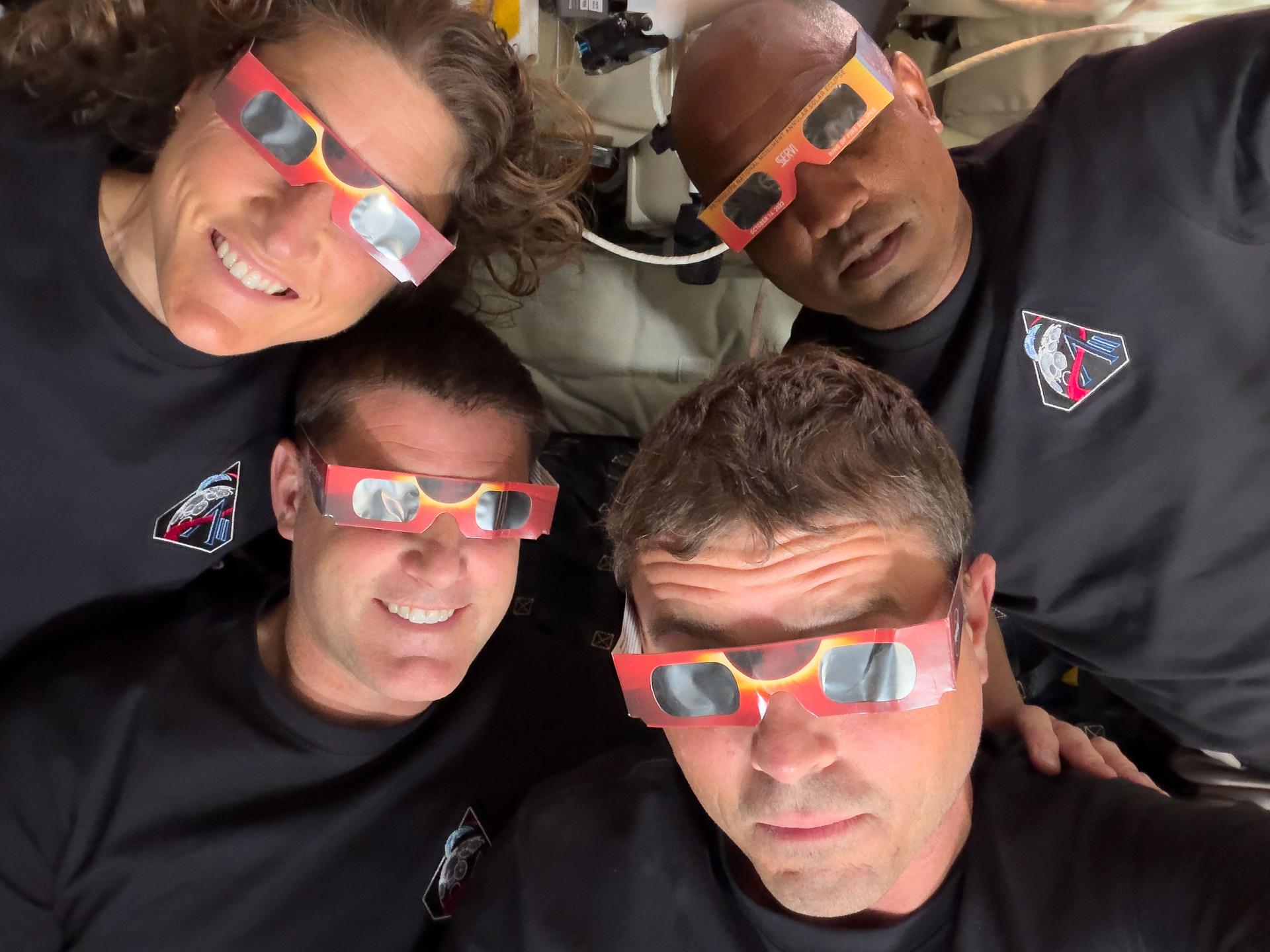
Here’s a selfie the crew took during yesterday’s lunar flyby. They wore eclipse glasses to protect their eyes at key moments during the solar eclipse they experienced.
NASA Releases First Batch of Flyby Images

NASA has shared some incredible photos taken during the Artemis 2 lunar flyby yesterday, you can check out the gallery here.
The photo above is my favorite from this initial release. The crew captured “Earthset,” the moment when Earth dipped behind the horizon of the Moon, through one of Orion’s windows at 6:41 p.m. ET on Monday. In the image, you can clearly see Earth’s terminator line, which separates the night-darkened and day-lit portions of the planet. You can also see clouds swirling over the Australia and Oceania region.
The Moon’s Ohm crater is visible in the foreground, with terraced edges and a flat floor interrupted by central peaks. Those peaks formed when the impact caused the lunar surface to liquify and splash upward.
Good Morning, It’s Flight Day 7!
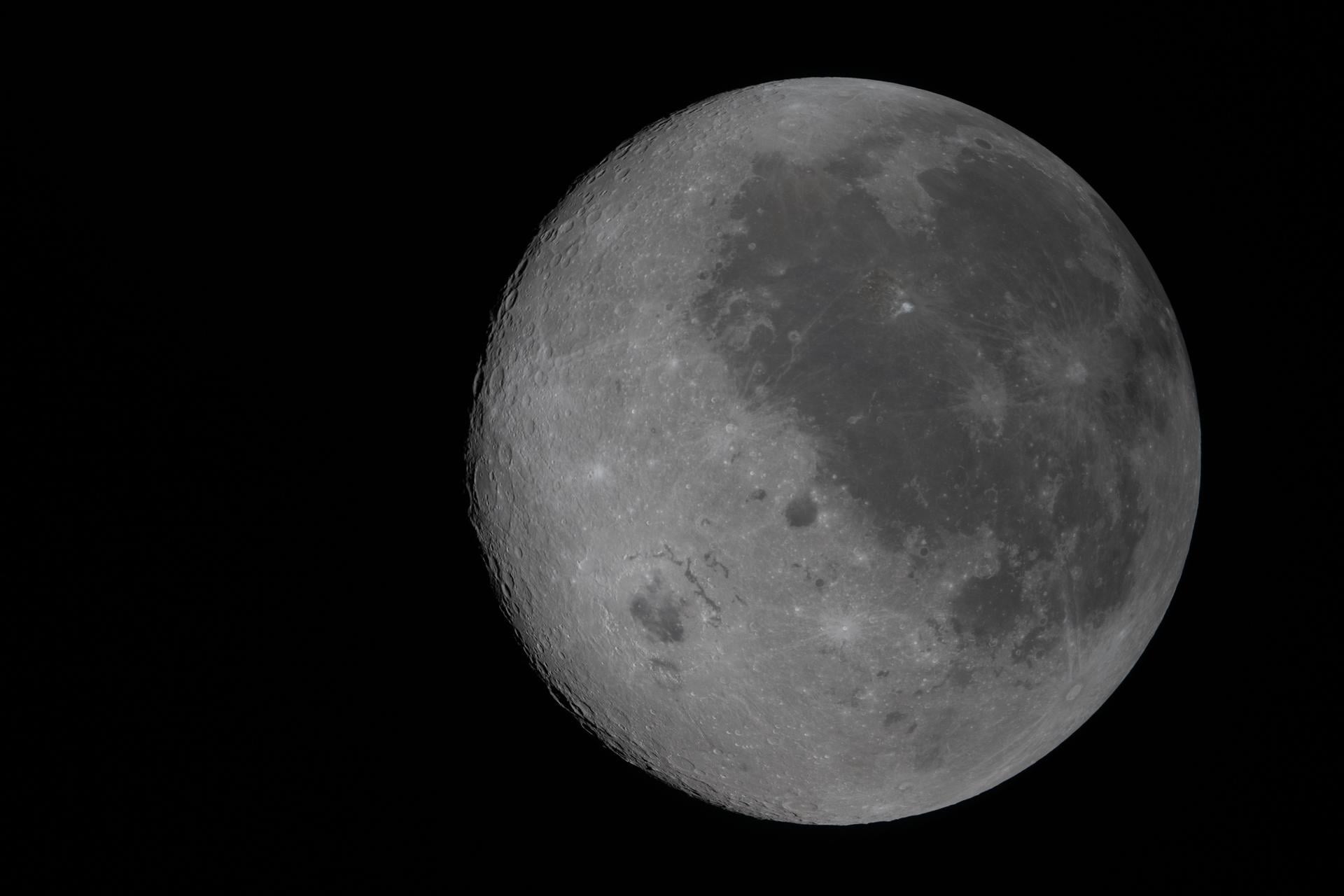
Orion has emerged from behind the Moon after completing a historic seven-hour flyby on Monday. The Artemis 2 astronauts took numerous photos and observations of the surface, documenting far side features never before seen with the naked eye.
They spotted impact craters, ancient lava flows, surface cracks, ridges, and noted differences in color, brightness, and texture. The crew also witnessed an eclipse, Earthset (when Earth dropped below the lunar horizon), and Earthrise. We should get to see a bunch of their photos today.
After the lunar observation period ended, President Trump called the Artemis 2 astronauts to congratulated them in a live conversation aired as part of NASA’s mission coverage. The crew also spoke with NASA Administrator Jared Isaacman and took some questions from social media.
The crew will discuss their observations with the lunar science team today in a conversation that will broadcast in NASA’s live coverage.
Artemis 2 Reaches Farthest Distance From Earth
At 7:02 p.m. ET, Orion reached its maximum distance from Earth at 252,756 miles away. This achievement has broken another spaceflight record, placing the Artemis 2 crew 4,111 miles farther from Earth than the maximum distance of Apollo 13.
Orion will soon begin to emerge from behind the Moon, and Mission Control should be able to re-establish communication with the Artemis 2 crew shortly. At approximately 8:35 p.m., Orion should enter a period with the Moon eclipsing the Sun, and that will last through the end of the flyby observation period at 9:20 p.m.
We’ll be back tomorrow to bring you live updates on the lunar science debrief and all the incredible images and observations Artemis 2 will be downlinking to Mission Control.
Artemis 2 Makes Closest Lunar Approach
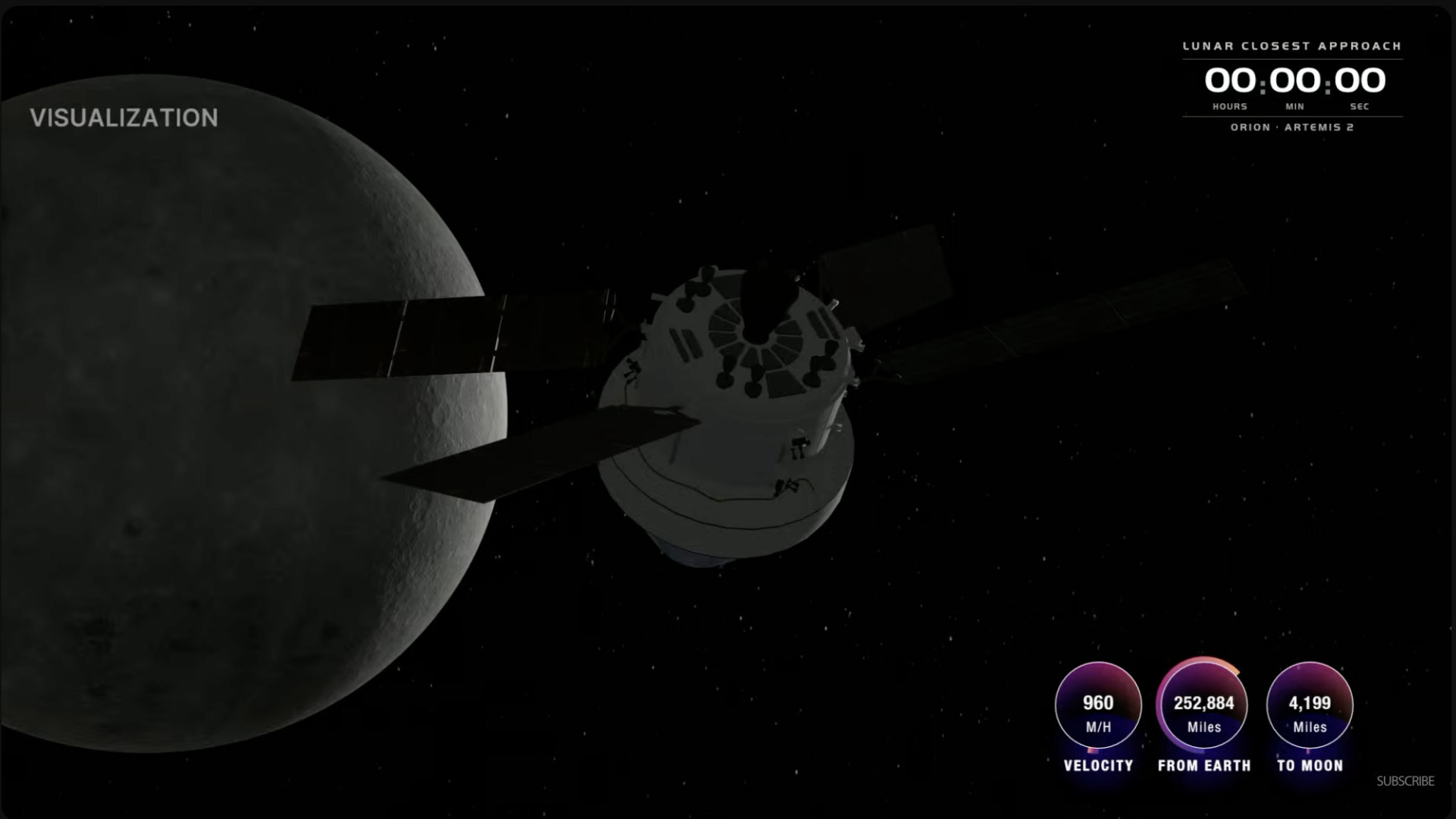
At 7:00 p.m. ET, Orion made its closest approach to the Moon, coming within just 4,067 miles of the surface. At this point, the spacecraft is traveling about 60,863 miles an hour relative to Earth, but only 3,139 miles an hour relative to the Moon, according to NASA.
The Science Evaluation Room Is Buzzing
According to a 4:00 p.m. ET NASA update, the Science Evaluation Room at Johnson Space Center in Houston, Texas is buzzing with excitement over the Artemis 2 crew’s lunar observations. Scientists in the SER are supporting the observations from Mission Control. As they receive reports from the crew, they are updating the observation plan based on their follow-up questions and sending new guidance over the comms system.
The Moon Looks Brown, Artemis 2 Astronauts Say
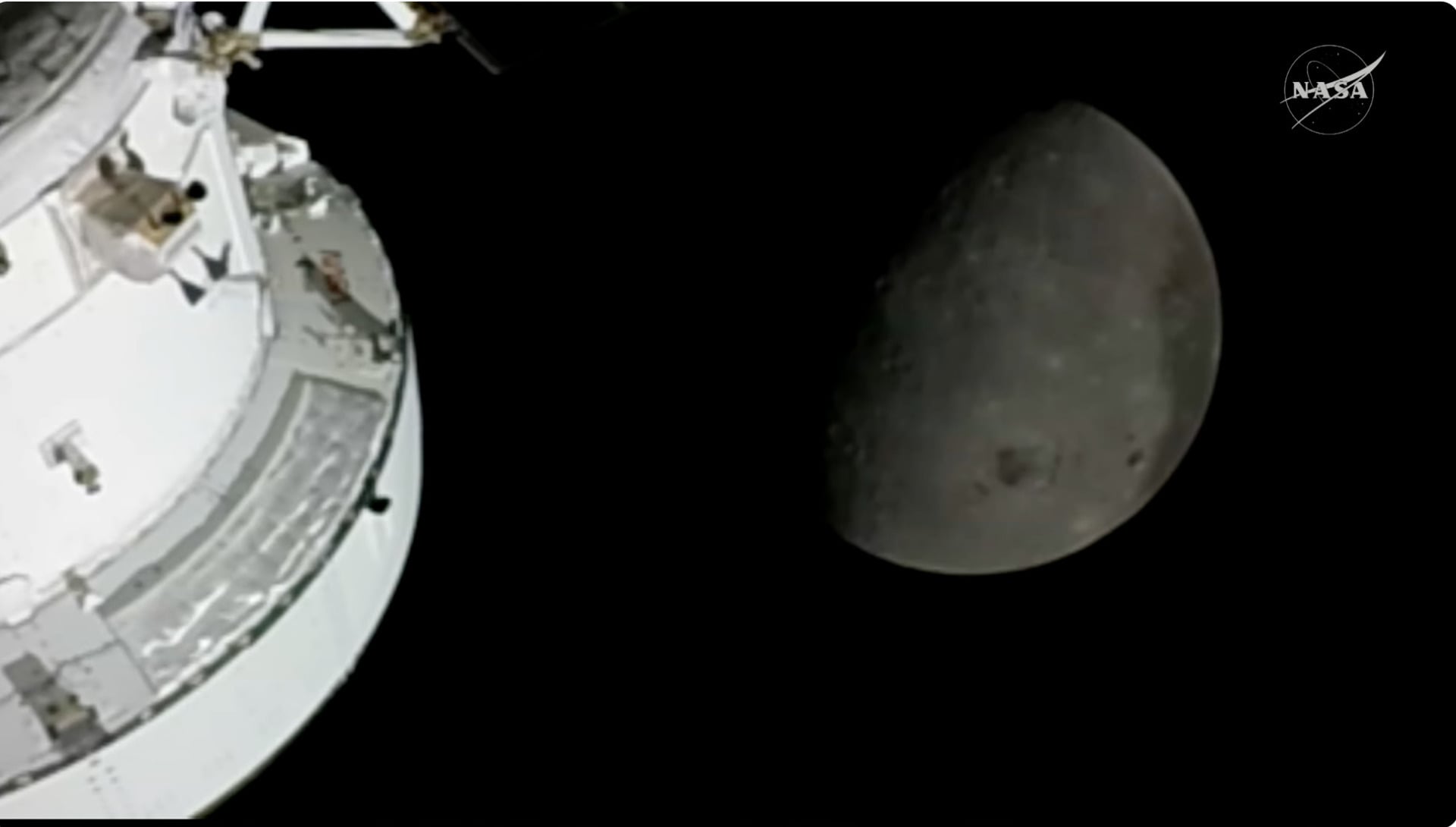
When we look up at the night sky, the Moon typically looks silvery white. In photos, it appears dusty gray. But up close, it apparently looks brown.
Several of the Artemis 2 astronauts have described brown or greenish hues on the lunar surface during the observation period today. At one point, Christina Koch said that the more she looks at the Moon, the browner it looks.
It’s a Bird, It’s a Plane, It’s… A Jar of Nutella?
We interrupt our coverage of the lunar observations to bring you this hilarious clip of a jar of Nutella just floating around Orion’s cabin. Of course this beloved, shelf-stable chocolate spread made it onto the Artemis 2 menu. The only question we have is—how much did Ferrero pay for this GOATed ad placement?
#NEWS 🚨: Watch as a random jar of Nutella photobombs the Artemis II livestream pic.twitter.com/MpVsHoWmPy
— Latest in space (@latestinspace) April 6, 2026
What Are Crater “Rays?”
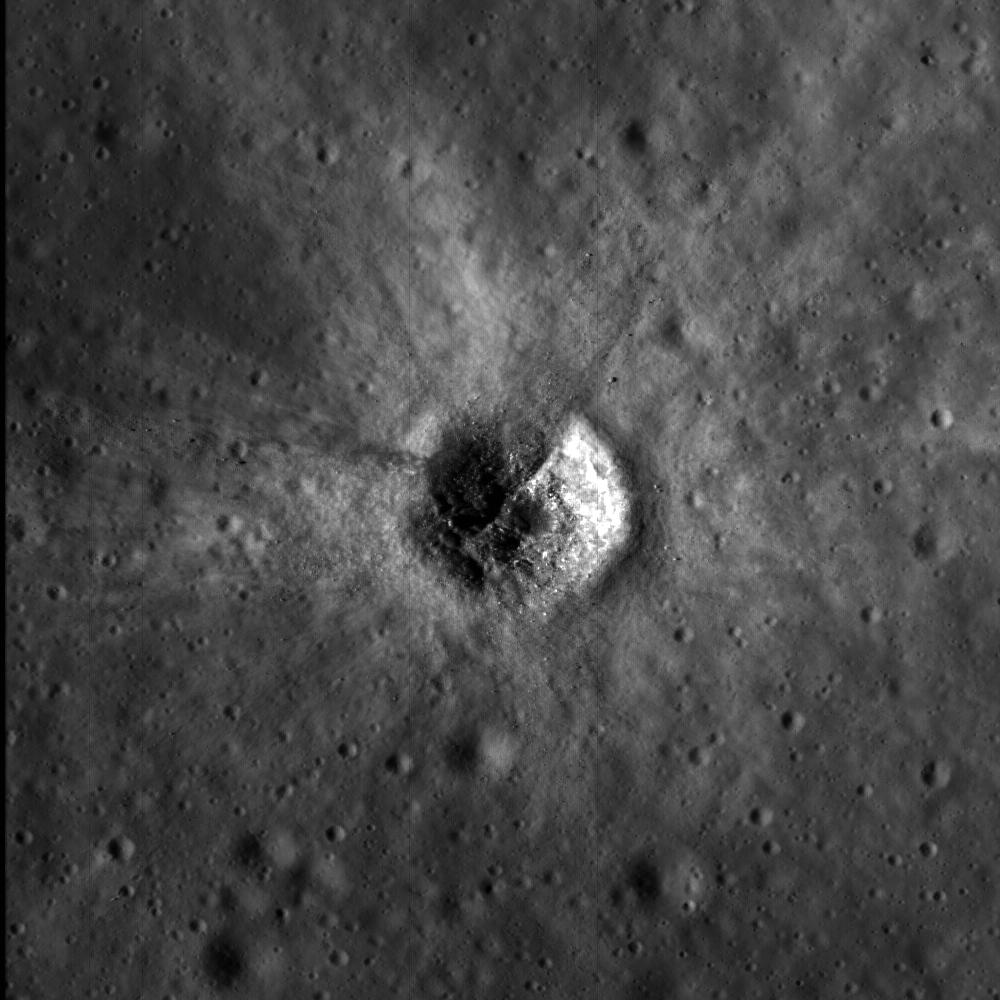
You may have just heard the Artemis 2 crew discussing “rays” coming out of the crater Ohm. This term is used to describe impact craters with streaks of higher-albedo material extending away from the center. This pulverized material gets ejected during the impact, and studying them can reveal information about the age of the crater, the subsurface composition, and impact dynamics.
Christina Koch Describes “Bright” New Craters
Mission Specialist Christina Koch just said that newer craters are much brighter than the rest of the lunar surface, describing them as “pinprick holes” in a lampshade that allow the light to shine through.
Artemis 2 Crew Should See Apollo Landing Sites
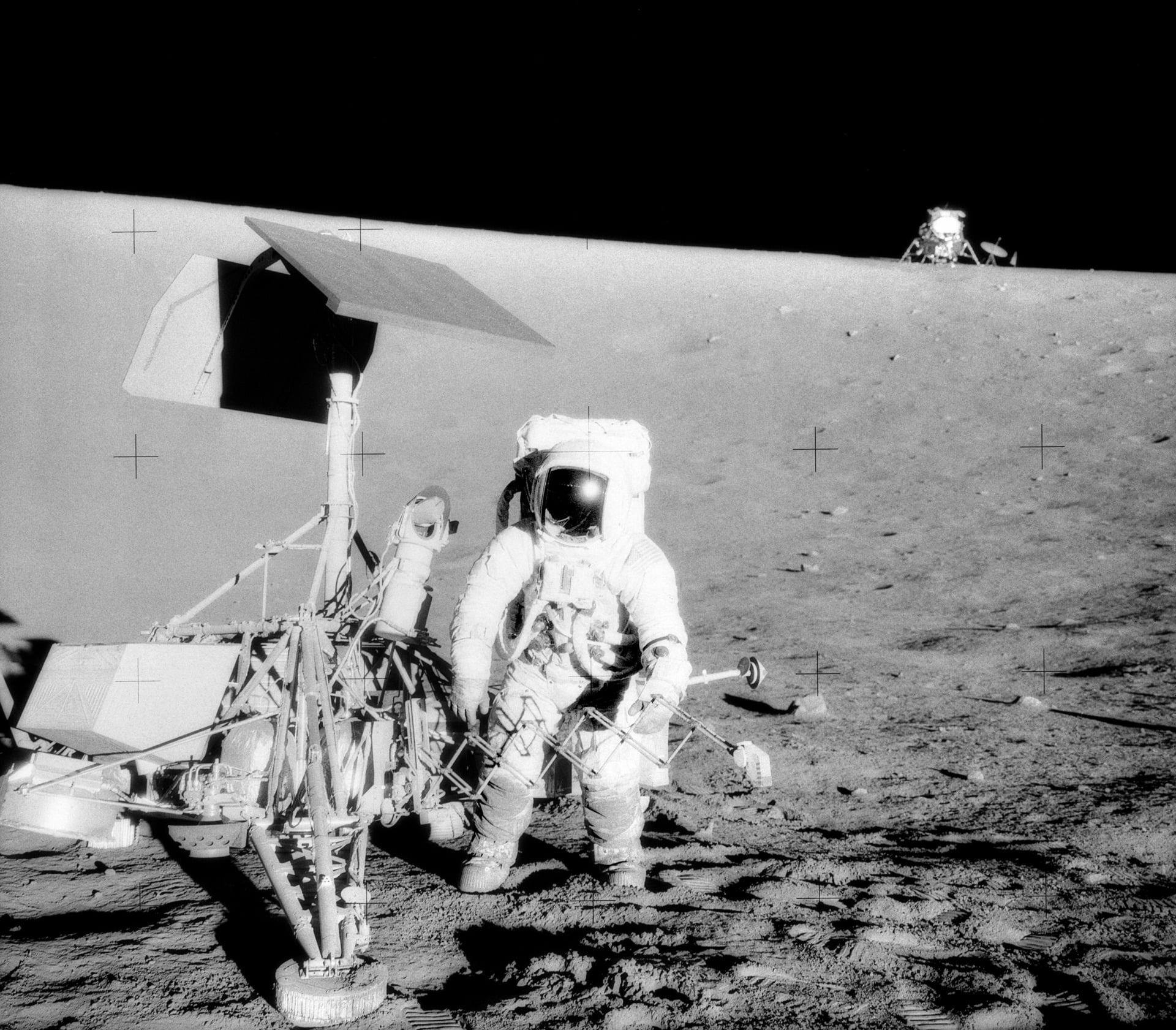
On top of observing lunar features important to science, the Artemis 2 astronauts will be able to spot some historic parts of the Moon as well. They should be able to see the Apollo 12 and Apollo 14 landing sites, located on the near side of the Moon.
The crew’s observations will also help inform landing site selection for Artemis 4, the first crewed lunar landing under the Artemis program.
The Crew Is Already Describing Incredible Detail
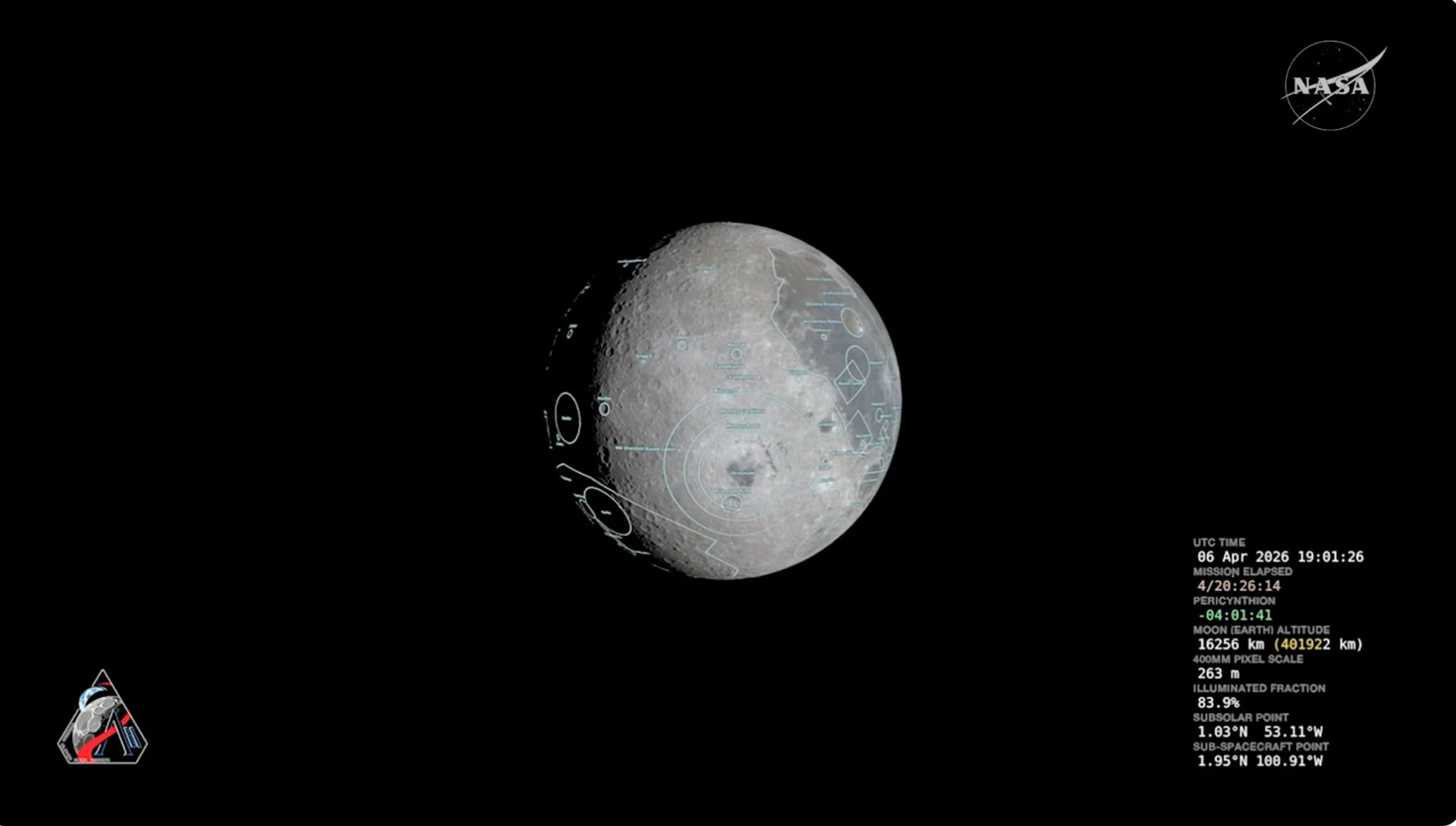
Mission Pilot Victor Glover is giving updates via the comms system as Commander Reid Wiseman and Mission Specialist Jeremy Hansen gather observations out of Orion’s windows. In his latest report, he described a wide range of features in impressive detail, from snow-like coloration on the tops of peaks to shadowy, uniquely shaped mares and craters.
Now, Glover and Mission Specialist Christina Koch will take up observations at the windows as Wiseman and Hansen support. The crew currently has the opportunity to observe a pair of craters called Ohm and Glushko.
Orion Is Less Than 10,000 Miles From the Moon
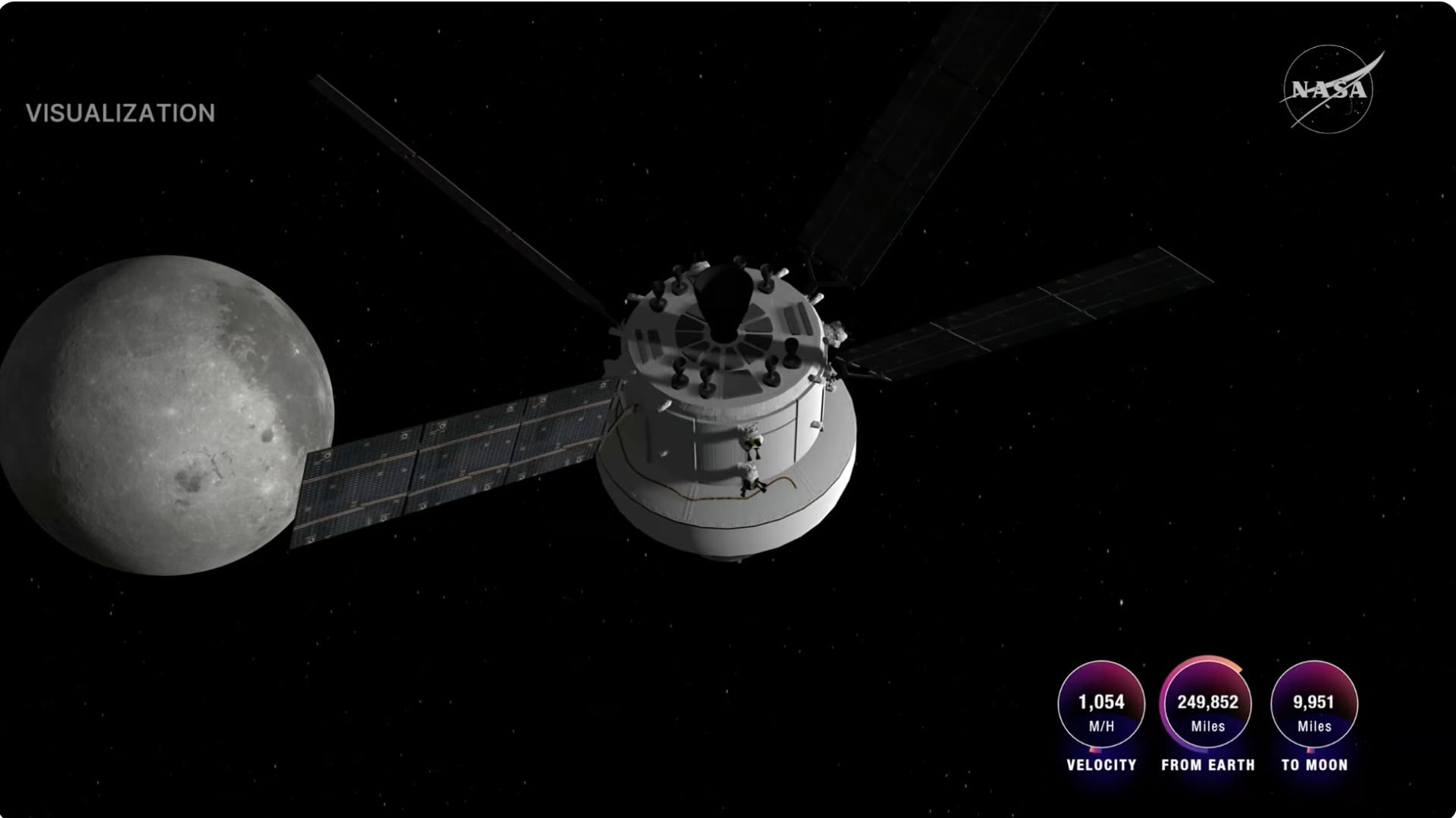
At 3:05 p.m. ET, the Orion spacecraft was officially less than 10,000 miles from the Moon and approaching. As a reminder, the capsule is due to make its closest approach at approximately 7:02 p.m. ET this evening.
Artemis 2 Astronauts Spot Hertzsprung and Orientale
Mission Specialist Christina Koch just informed the science team that they have spotted two of the science targets, Hertzsprung basin and Orientale basin. She noted that the two craters are about the same size. Being able to compare them side-by-side will offer insight into how these kinds of features evolve over timescales, as Hertzprung is much older than Orientale.
With Earth still in view as well, Koch added our planet looks much brighter than the Moon, suggesting it has a higher albedo.
Commander Reid Wiseman Describes the View
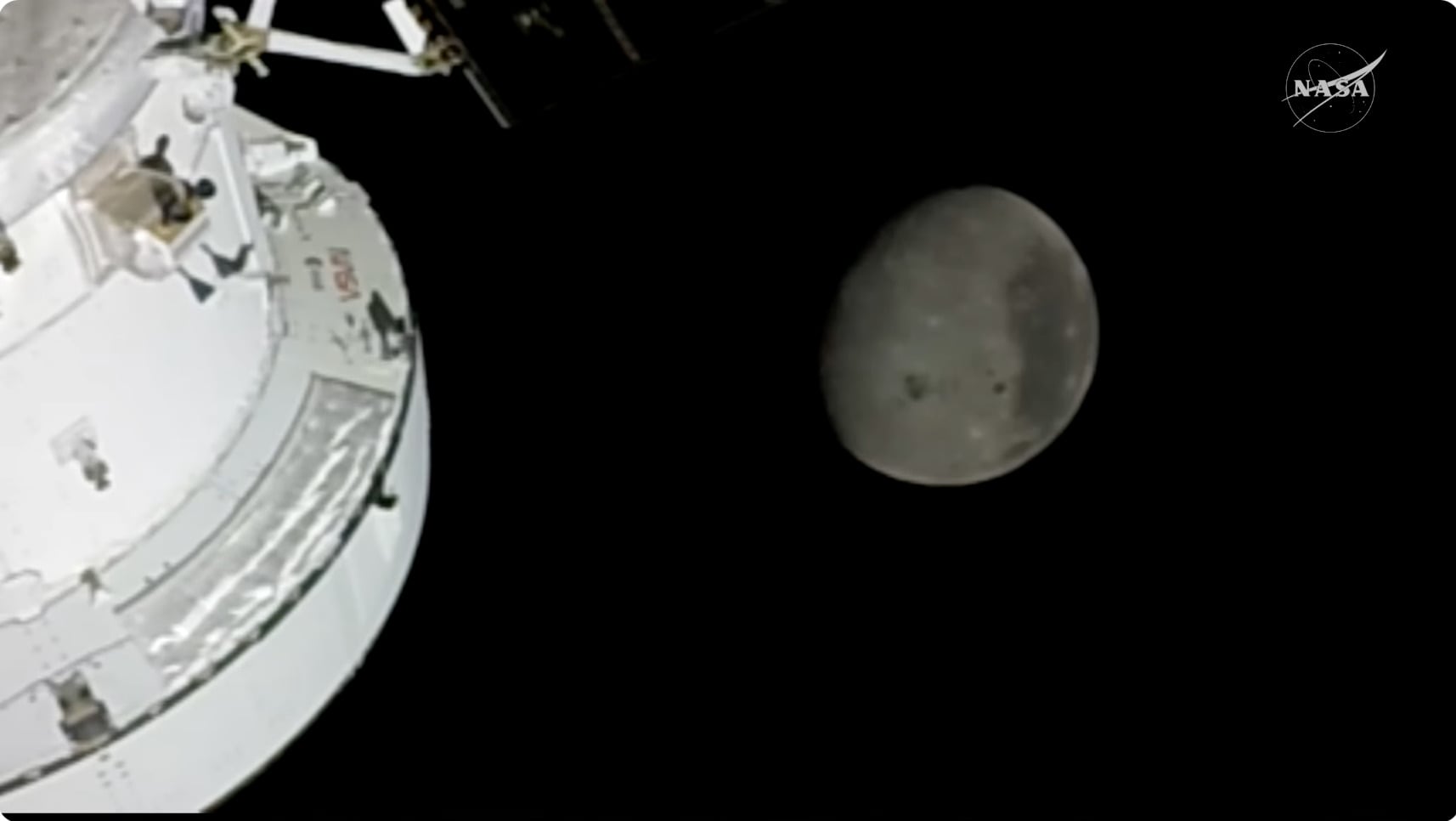
Commander Reid Wiseman just called down over the comms system to say that he and his crewmates can see the Moon out of one of Orion’s windows, and Earth out of the other. From their vantage point, the Moon looks three to four times bigger than our home planet, which appears as just a tiny crescent in the distance, he said.
Wiseman added that he snapped a picture of Earth from this perspective. Can’t wait to see that shot.
Artemis 2 Astronauts Propose Names for 2 Unnamed Craters

After surpassing the Apollo 13 distance record, Mission Specialist Jeremy Hansen gave the following statement.
“From the cabin of Integrity here, as we surpass the furthest distance humans have ever traveled from planet Earth, we do so in honoring the extraordinary efforts and feats of our predecessors in human space exploration. We will continue our journey even further into space before Mother Earth succeeds in pulling us back to everything that we hold dear,” he added. “But we most importantly choose this moment to challenge this generation and the next to make sure this record is not long lived.”
Hansen then said he and his crewmates had decided on names for two unnamed lunar craters, suggesting that one near the far side of Orientale be called “Integrity” after their spacecraft. They suggested that the other, located on the boundary between the near side and far side, be called “Carroll” after Commander Reid Wiseman’s late wife. In the photo above, the entire crew can be seen embracing after Hansen tearfully delivered the message to Mission Control.
Artemis 2 Surpasses Apollo 13 Distance Record

At approximately 1:57 p.m. ET, the Artemis 2 crew—NASA’s Reid Wiseman, Victor Glover, Christina Koch, and the Canadian Space Agency’s Jeremy Hansen—broke the record for the farthest distance humans have ever traveled from Earth. That record was set by the Apollo 13 crew in 1970 at 248,655 miles (400,171 kilometers) from our home planet.
Lunar Science Conference Begins
Just after 1:30 p.m. ET, the Artemis 2 astronauts began a conference with the lunar science team at Mission Control. The crew is strategizing with the science team about the best way to approach observations and photography. Views inside Orion showed that the astronauts had dimmed the lights to improve the clarity of their photos and help them get the best views of the lunar surface.
Artemis 2 Flying With Patch From Apollo 8

Jim Lovell’s family sent the Artemis 2 crew a patch from his Apollo 8 mission, and it is now flying aboard Orion.
“When this showed up in our office from his family, we were completely honored,” Artemis 2 Mission Specialist Christina Koch said over the comms system, holding up the patch. She added that she had the Apollo 8 “Earthrise” photo in her room as a kid, and said it inspired her to keep working hard.
NASA’s Lunar Flyby Coverage Begins
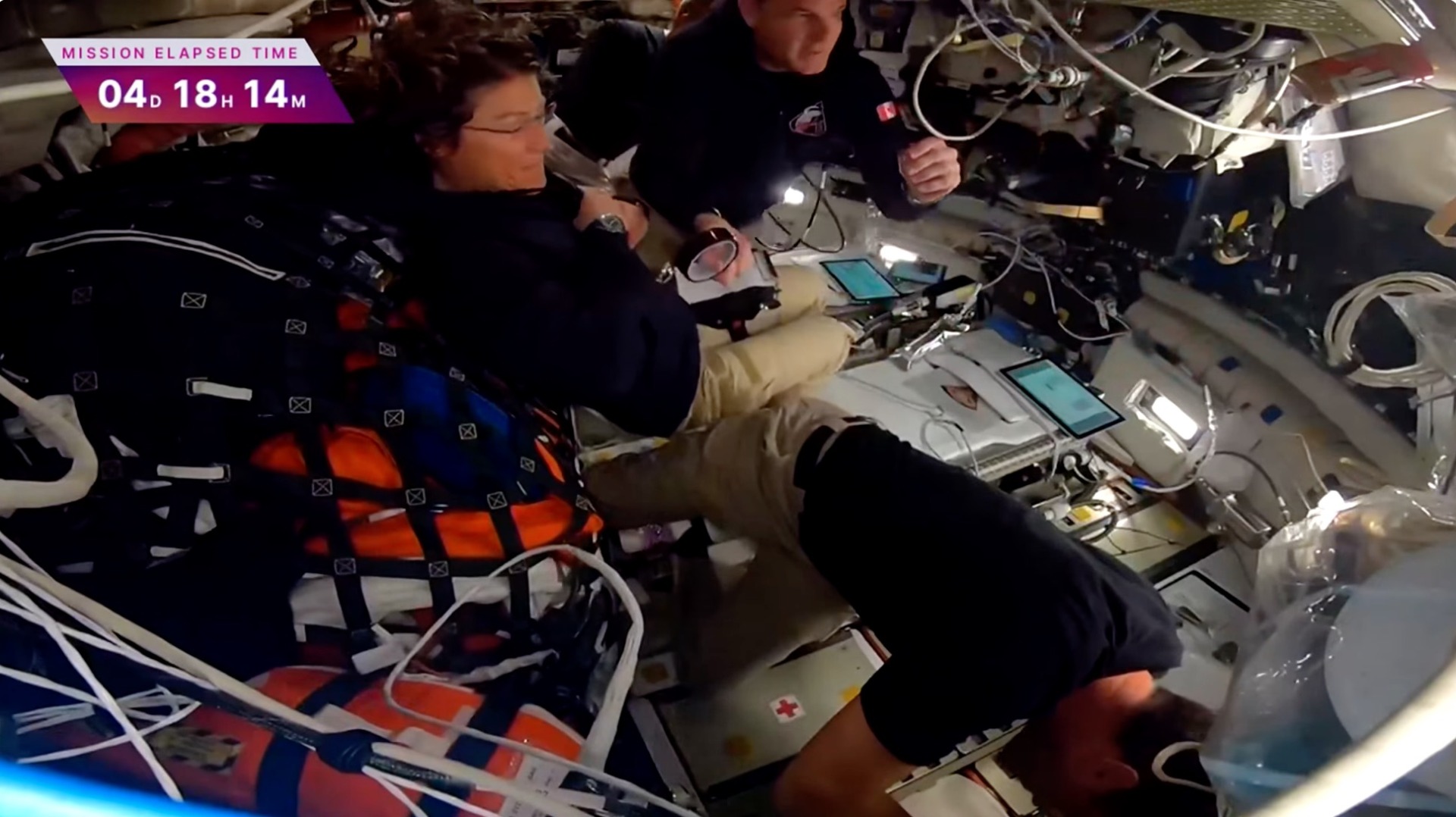
NASA’s live broadcast of the Artemis 2 flyby has officially begun. Head to Gizmodo’s watch page to tune in!
Good Morning, Artemis 2 Crew!

The crew started Flight Day 6 to the sounds of “Good Morning,” by Mandisa and TobyMac, followed by a special message that Apollo 8 and Apollo 13 astronaut Jim Lovell recorded for the mission before his passing at the age of 97 in 2025. Here is his full message to the Artemis 2 astronauts.
“Hello, Artemis 2! This is Apollo astronaut Jim Lovell. Welcome to my old neighborhood! When Frank Borman, Bill Anders, and I orbited the Moon on Apollo 8, we got humanity’s first up-close look at the Moon and got a view of the home planet that inspired and united people around the world. I’m proud to pass that torch on to you—as you swing around the Moon and lay the groundwork for missions to Mars … for the benefit of all. It’s a historic day, and I know how busy you’ll be. But don’t forget to enjoy the view. So, Reid, Victor, Christina, and Jeremy, and all the great teams supporting you—good luck and Godspeed from all of us here on the good Earth.”
At approximately 1:56 p.m. EDT, Artemis 2 will break the record for the farthest distance from Earth set by Lovell and his crew during the Apollo 13 mission.
Lunar Features the Artemis 2 Crew Will Observe Today
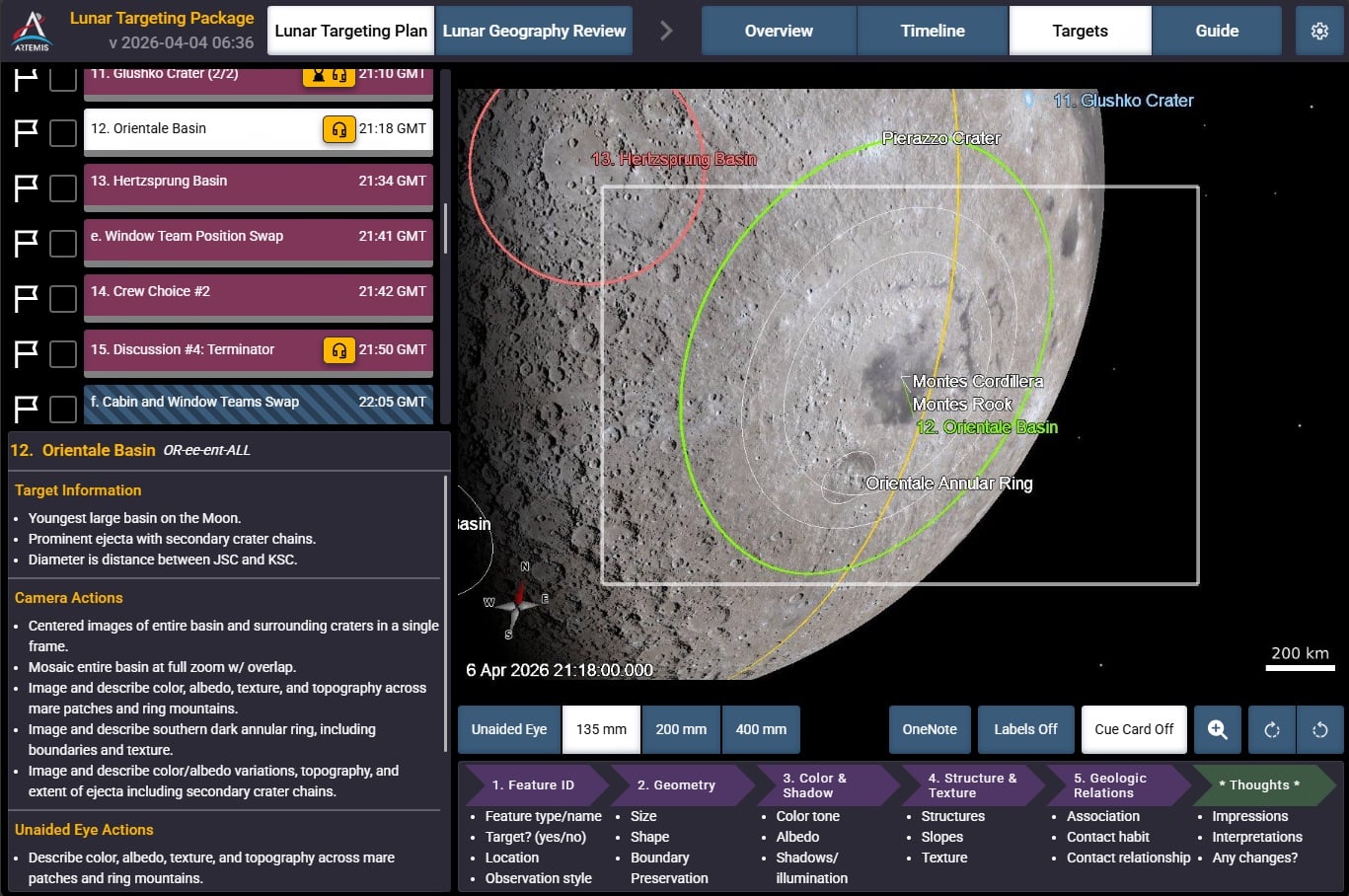
On Sunday, the crew received its final list of 30 lunar surface features to photograph and observe during the flyby.
One of these features is the Orientale basin, a nearly 600-mile-wide crater that straddles the Moon’s near and far sides. The 3.8-billion-year-old ringed crater formed when a large object struck the lunar surface and retains clear evidence of that collision, such as the topography of its rings. Orientale will be fully sunlit and visible as Orion approaches the Moon, allowing the astronauts to study its features up close and from multiple angles.
Humans have never directly laid eyes on the far-side portion of this crater before. As the youngest and best-preserved multi-ring impact basin on the lunar surface, Orientale is a natural laboratory for investigating the Moon’s impact history and how ringed craters form.
Also on the crew’s list of targets is Hertzsprung basin. This 400-mile-wide ringed crater is located northwest of Orientale on the Moon’s far side. It’s older than Orientale, and therefore offers a unique contrast because its features have been degraded by subsequent impacts. Comparing the topography of these two craters will provide insight into how features evolve over geologic timescales.
What Did the Crew Do This Weekend?
Over the weekend, the Artemis 2 astronauts kept busy with research, maintenance, exercise, and more.
On Saturday, the crew began preparing Orion’s cabin for the lunar flyby set to take place today. Mission pilot Victor Glover briefly took manual control of the spacecraft for a piloting demonstration to test out its handling qualities across different movements. Then, the astronauts reviewed the list of 30 lunar surface features they will observe during the flyby.
On Sunday, the crew performed a demonstration of the Orion crew survival system spacesuit, conducting leak checks, simulating seat entry, and assessing mobility and the ability to eat and drink. The astronauts then continued to review their science targets and prepare for the final outbound trajectory correction burn ahead of the lunar flyby.
That burn began at 11:03 p.m. ET and lasted 17.5 seconds, keeping Orion on a precise path to reach the Moon. The spacecraft entered the lunar sphere of influence at 12:41 a.m. today. At that point, the Moon’s gravity became the dominant force controlling Orion’s trajectory.
Oh, it’s also worth mentioning that there was another issue with the spacecraft’s toilet. It’s unclear whether that has been resolved.
The Collapsable Contingency Urinal (CCU) now being used on Artemis 2 after a toilet malfunction. Essentially an open container (reusable, sealable, and drainable) that controls the urine-air interface using capillary forces like my Space Cup does coffee. When you are in cislunar… pic.twitter.com/LsQLYYxXcK
— Don Pettit (@astro_Pettit) April 4, 2026
The Moment We’ve All Been Waiting For
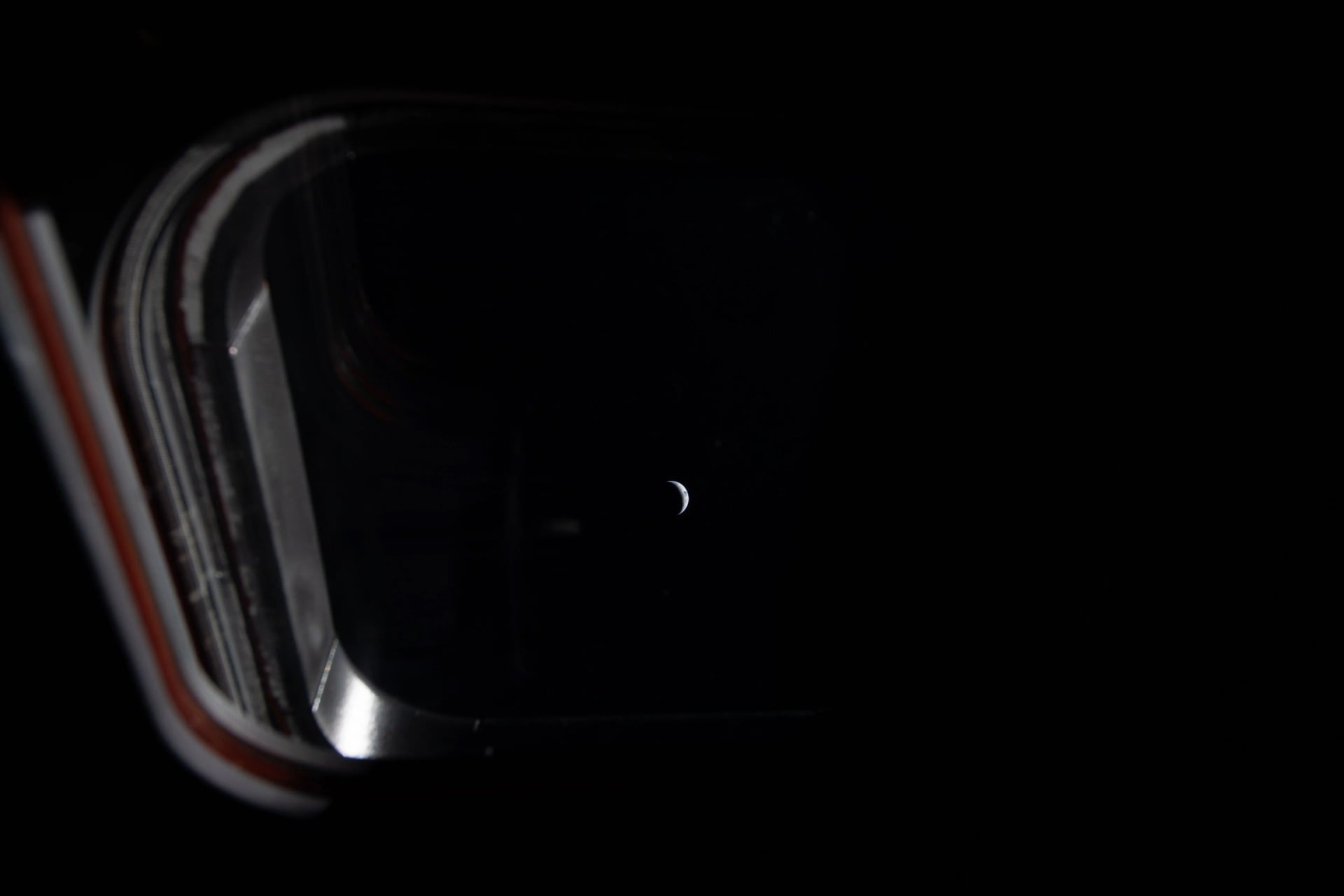
Good morning, Artemis 2 fans! It’s Flight Day 6—the day we’ve all been waiting for. Today, the Orion spacecraft will fly by the Moon, giving the crew approximately 7 hours to observe parts of the far side humans have never laid eyes on before.
Here’s NASA’s rough schedule of events for today, with exact times subject to change. All times are ET.
- 1 p.m.: Live flyby coverage begins. You’ll be able to watch via Gizmodo’s watch page, coming soon.
- 1:30 p.m.: NASA hosts a conversation between the crew and the science officer in the Mission Control Center to go over the objectives and timeline for the flyby.
- 1:56 p.m.: The Artemis 2 crew is expected surpass the record previously set by the Apollo 13 crew in 1970 for the farthest humans have ever traveled from Earth.
- 2:45 p.m.: The seven-hour lunar observation period begins.
- 6:44 p.m.: Mission control expects to temporarily lose communication with the crew for roughly 40 minutes as Orion passes behind the Moon.
- 7:02 p.m.: Astronauts will make their closest approach to the Moon (4,070 miles), and reach its farthest point from Earth at 7:07 p.m.
- 7:25 p.m.: NASA’s Mission Control Center should re-acquire communication with the astronauts.
- 8:35 p.m.: Orion enters period with Moon eclipsing the Sun and continues until 9:32 p.m.
- 9:20 p.m.: The flyby observation period wraps, and crew will begin transferring some of the imagery to the ground.
What’s Coming Up This Weekend
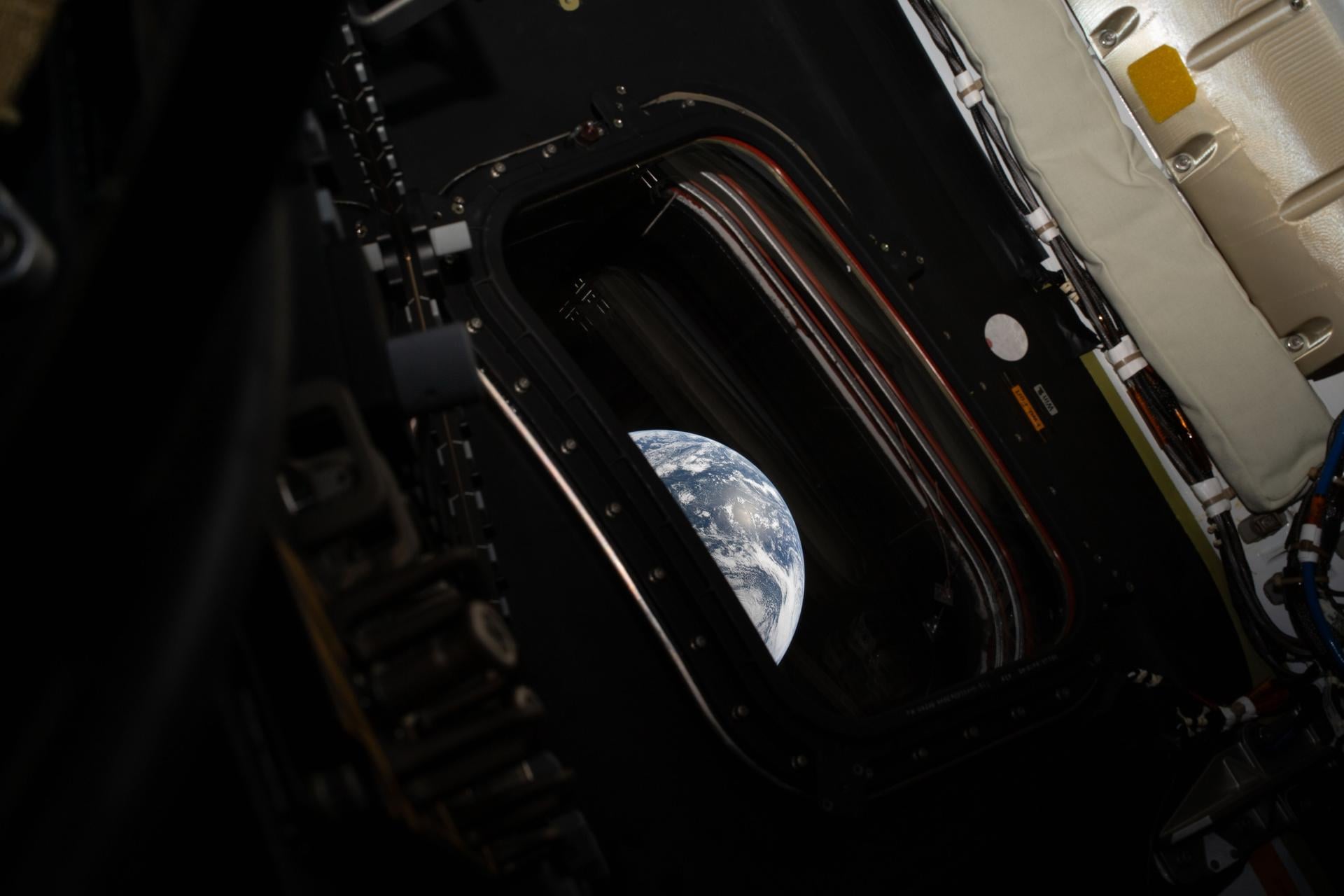
On Saturday, Orion is expected to perform a trajectory correction burn to make sure it remains on track for its lunar flyby, though Mission Control may forgo this maneuver again if there’s no need for it. The crew will spend some time reviewing the lunar flyby imaging plan ahead of Monday’s far side observation period.
On Sunday, the astronauts will conduct a rapid spacesuits donning and pressurization demonstration. This contingency drill ensures they are ready to suit up in the event of an emergency, such as a sudden loss of cabin pressure. Orion is scheduled to perform another OTC burn before entering the lunar sphere of influence later that day.
Gizmodo will be reporting live on Monday’s lunar flyby, and you’ll be able to watch NASA’s coverage via our watch page, coming soon. Stay tuned for more updates on all things Artemis 2!
OTC burn canceled
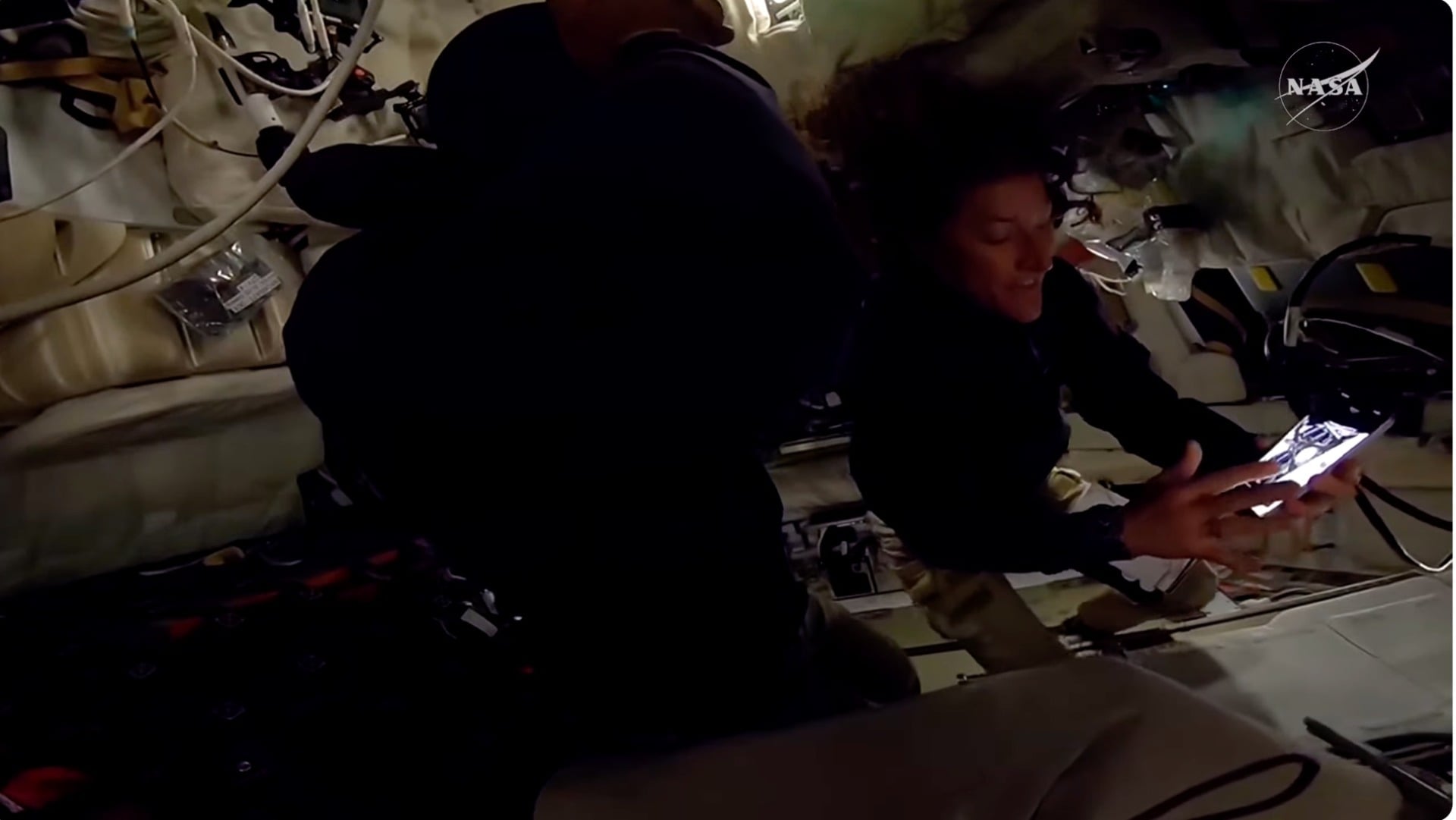
During the Artemis 2 burn conference today, Mission Control informed the crew that Orion’s trajectory is already right on track, and there is no need to perform the OTC burn today.
“We copy. Snow day!” Christina Koch said over the comms system.
Mission Control will cancel the burn with no crew action or monitoring necessary. NASA’s live stream is now treating us to some live views inside Orion.
The First OTC Burn Is Coming Up
At 6:49 p.m. ET today, Orion will perform the first of three outbound trajectory correction (OTC) burns. The burn will last just eight second, changing the spacecraft’s velocity by 0.7 feet per second. This will fine-tune Orion’s path to ensure it reaches the precise point in space that will set it up for a lunar flyby.
Orion’s Stunning View of Earth

From Orion’s windows, the astronauts have been snapping stunning photos of Earth—and they’ve now beamed some of those images back to mission control.
The vast majority of humanity will never see Earth from this perspective with the naked eye. The Artemis 2 astronauts are the first people to view our fully illuminated planet from deep space in more than 50 years. Their photos conjure a wave of emotions, from wonder to insignificance.
You can check out the first few images NASA has received here.
How the Crew Is Keeping Fit in Space
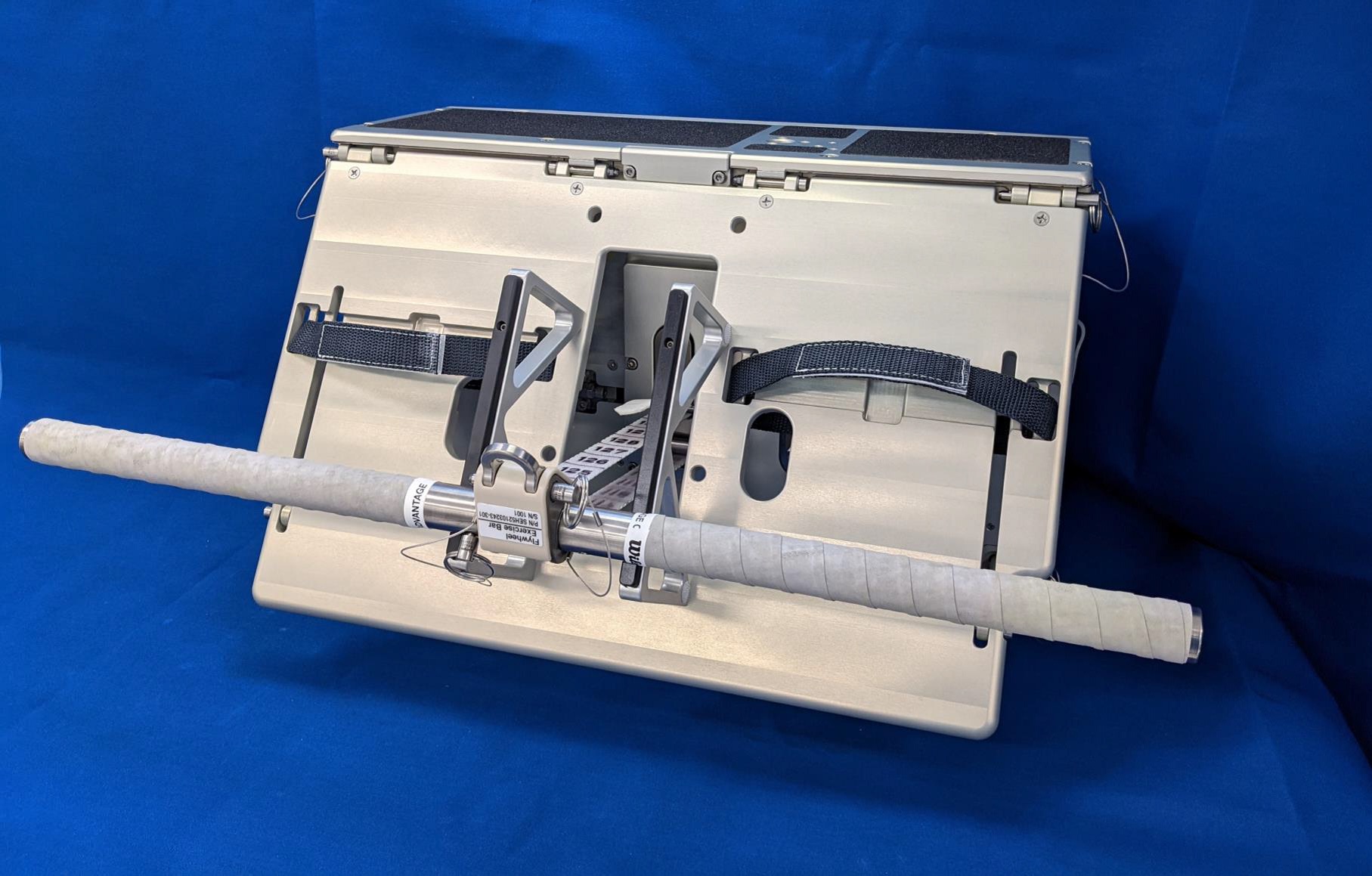
Before ending their day yesterday, the Artemis 2 astronauts got a workout in. Over the course of this 10-day mission, they will use Orion’s flywheel exercise device to do aerobic and resistance exercises. This will mitigate muscle and bone density loss caused by microgravity.
The flywheel is uses a simple cable-based mechanism that enables exercises such as rowing, squats, and deadlifts. According to NASA, it works kind of like a yo-yo, providing resistance proportional to the force applied.
Because this singular, lightweight piece of equipment can support a variety of exercises, it meets both the crew health demands and strict mass and volume constraints of deep space missions like Artemis 2.
What’s the Crew Up to Today?
The crew’s third day in space has just begun. They started their morning with the song “In a Daydream,” by the Freddy Jones Band.
Today is a slower day for the Artemis 2 astronauts. Their main task will be to practice CPR, demonstrating how this life-saving procedure can be safely performed in a cramped, microgravity environment. Wiseman and Glover will also check out some of Orion’s medical kit, including the thermometer, blood pressure monitor, stethoscope, and otoscope.
How to Track Artemis 2 on Its Way to the Moon
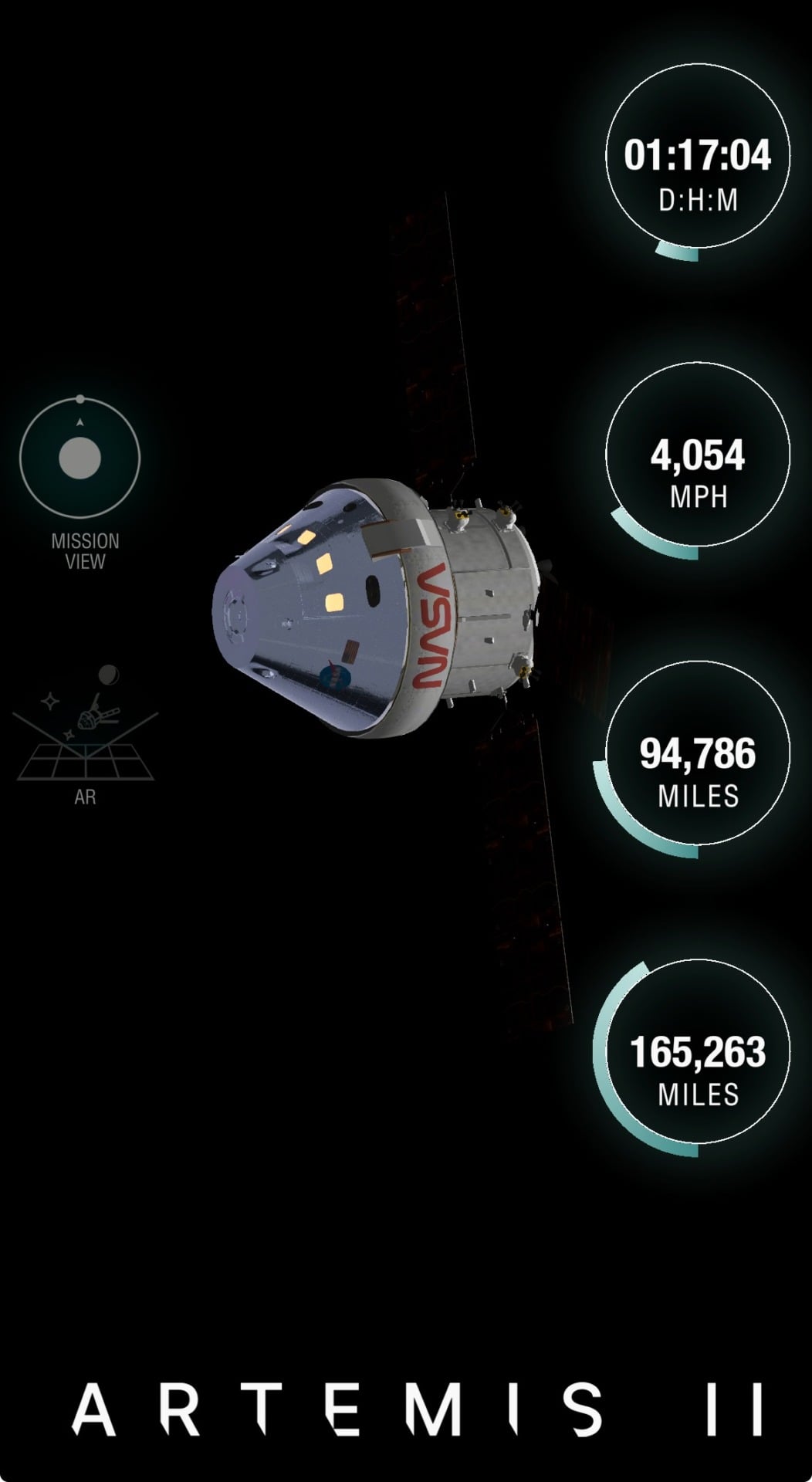
As the Orion spacecraft flies toward the Moon, you can track the journey in real time via NASA’s Artemis Real-time Orbit Website (AROW). After playing around with the program this morning, Gizmodo found that it runs better on a smartphone web browser than a PC, but works best in the NASA app.
As of 11:30 a.m. ET on Friday, Orion was approximately 94,000 miles from Earth, 166,000 miles from the Moon, and zooming through space at about 4,000 m/hr. At that incredible speed, the spacecraft will cover the remaining distance to the Moon in just a few days, with the far side fly by taking place on Monday.
Flight Day 3 Begins!

It’s official, folks: Following a successful TLI last night, Artemis 2 is on its way to the Moon. The nearly 6-minute engine firing burned about 1,000 pounds of fuel and set Orion on a trajectory that will swing the spacecraft around the lunar far side and naturally return it to Earth in about a week.
With that critical step complete, NASA’s lunar science team began formulating its Lunar Targeting Plan. The Artemis 2 crew will use this guide to help them observe the Moon’s surface during the approximately six-hour close fly-by on Monday.
The astronauts will document far side features such as craters, ancient lava flows, cracks, and ridges to help scientists understand how the Moon and early solar system formed. They will also observe a solar eclipse, which will last about an hour toward the end of the flyby window as the Moon blocks the Sun from Orion’s view.
With the lunar far side shrouded in darkness during the eclipse, the crew will get a chance to look for flashes of light caused by meteoroids striking the Moon’s surface. It will also be easier to see dust lofting above the edge of the Moon, far-off planets, and the solar corona.
Bon Voyage, Artemis 2! Translunar Injection Burn Complete
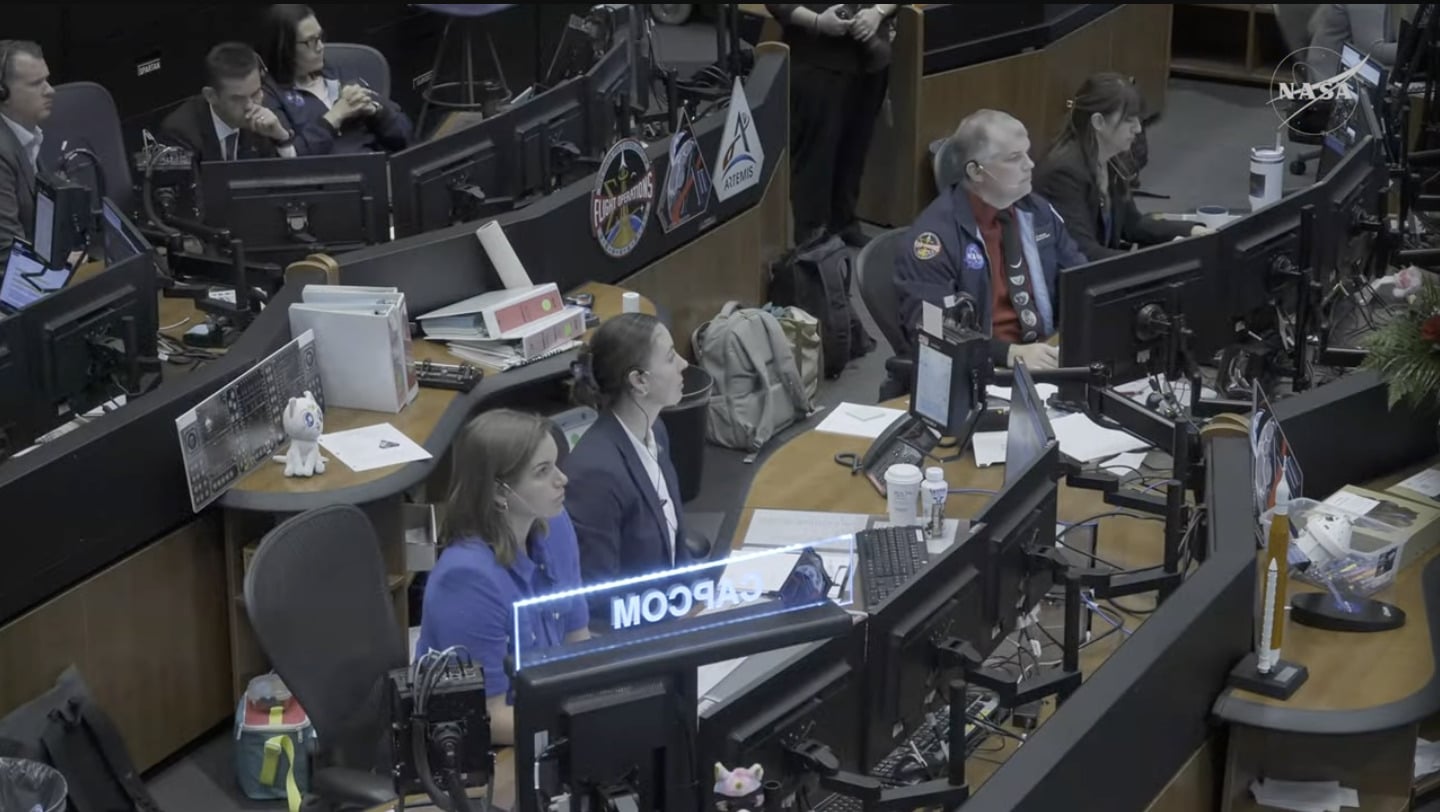
Orion completed the translunar injection burn at approximately 7:57 p.m. ET. The Artemis 2 astronauts are officially the first humans to leave low-Earth orbit in 54 years.
It was quiet in the mission control room as teams (and NASA Administrator Jared Isaacman) monitored the autonomous burn to ensure everything went smoothly. No issues arose over the course of the nearly six-minute maneuver.
Translunar Injection Burn Initiated
Orion’s main engine fired at 7:49 p.m. ET and will continue to burn for the next several minutes to complete the translunar injection. This will send the spacecraft beyond low-Earth orbit and on to the Moon.
This is also the deorbit burn. The maneuver not only commits Orion to its lunar trajectory, but also the free-return trajectory that will bring Artemis 2 home.
NASA Polls “Go” for Translunar Injection
At 4:24 p.m. ET, the mission management team polled “Go” for the translunar injection burn that will send Artemis 2 on to the Moon. This will be the first time humans have left low-Earth orbit since 1972.
At 7:49 p.m., Orion’s main engine will fire for 5 minutes and 49 seconds, producing up to 6,000 pounds of thrust to increase the spacecraft’s velocity and set it on the path to the Moon. This path will bring also the spacecraft back to Earth after it completes a lunar flyby.
Artemis 2 Crew Awakens
After catching a few more hours of rest, the Artemis 2 crew is awake and has officially begun their day. The astronauts just wrapped up their morning conference with ground control, discussing the basic orbital maneuver plan for later today and other housekeeping items such as the temperature inside Orion.
They requested that ground control raise the temperature slightly while they’re sleeping—apparently it’s a little chilly onboard.
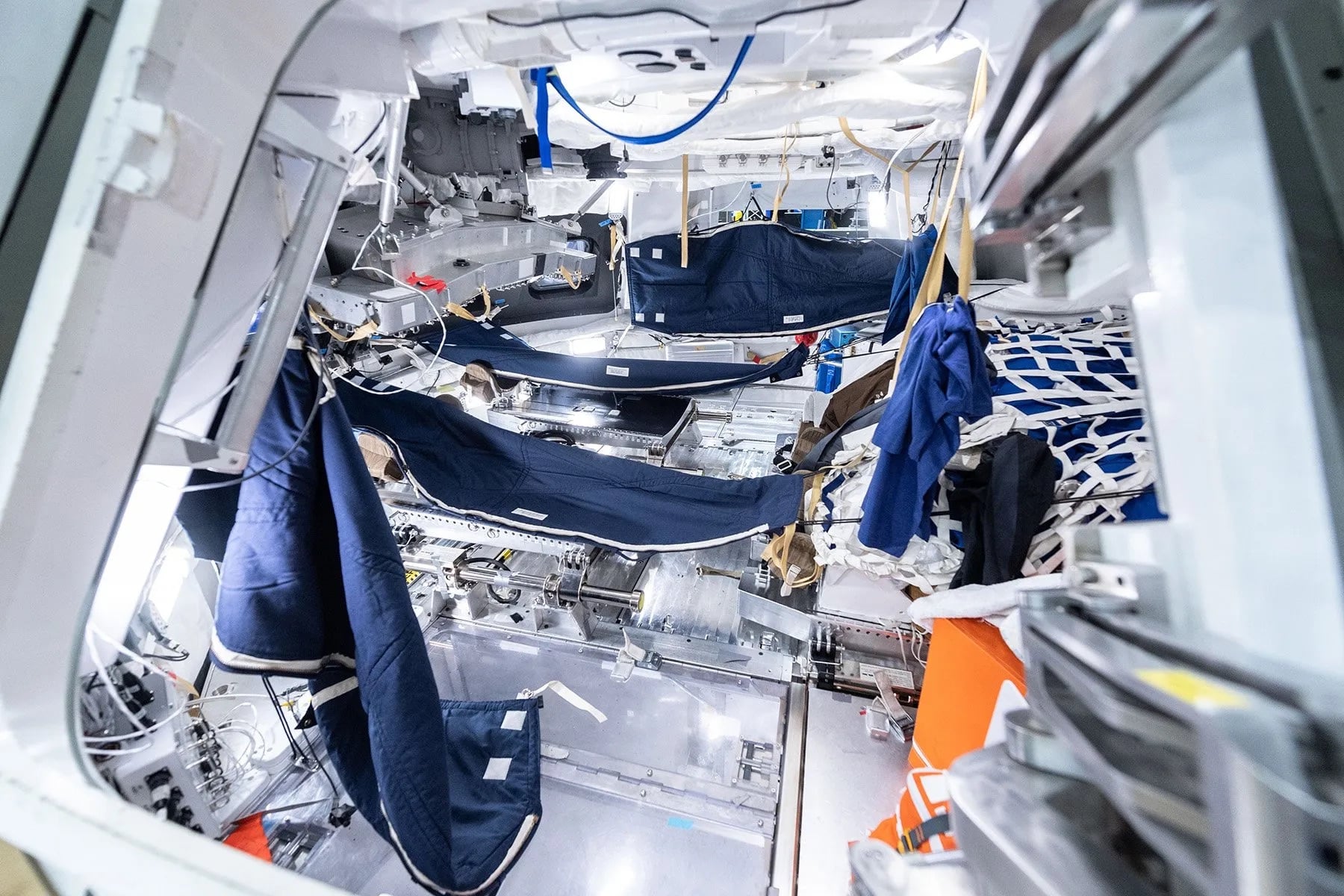
Wondering where the Artemis 2 crew tucks in at night? Check out the image of Orion’s sleeping quarters above. The astronauts attach sleeping bags to the spacecraft’s walls to prevent them from drifting in microgravity.
Today’s Big Event: Translunar Injection
Today, the Artemis 2 mission management team will meet to assess Orion’s systems and decide whether to proceed with the translunar injection burn that will send the spacecraft beyond low-Earth orbit and onward to the Moon.
If the mission management team pulls go on the TLI, that burn should take place around 7:49 p.m. ET today, according to NASA. It will last just under 6 minutes, producing a velocity change of nearly 1,300 feet per second. Orion’s main engine will perform this burn autonomously, but flight controllers will monitor performance, guidance, and navigation data throughout the burn.
Flight Day 2 Begins!
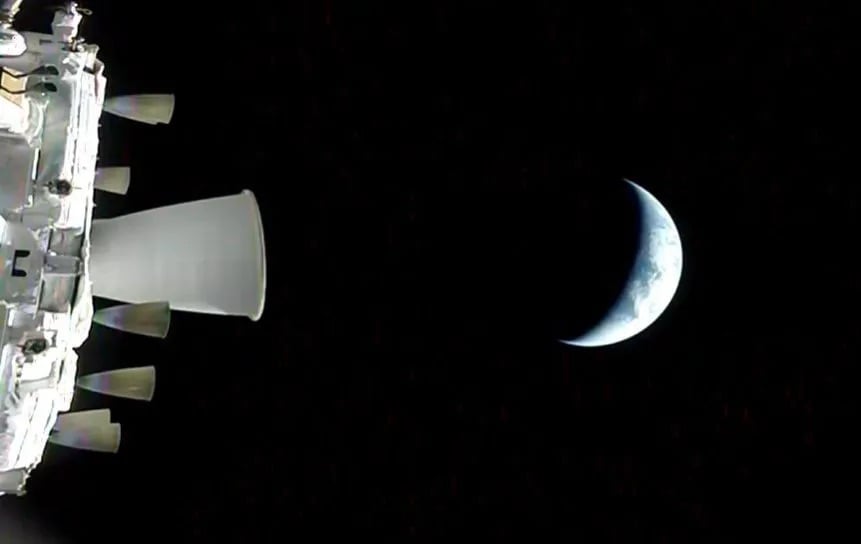
Good morning, Artemis 2 fans! How ’bout that launch yesterday? It was incredible to see the SLS rocket perform so spectacularly. Later today, Gizmodo will bring you a rundown of all the cool details you may have missed. But first things first—here’s an update on where the mission currently stands.
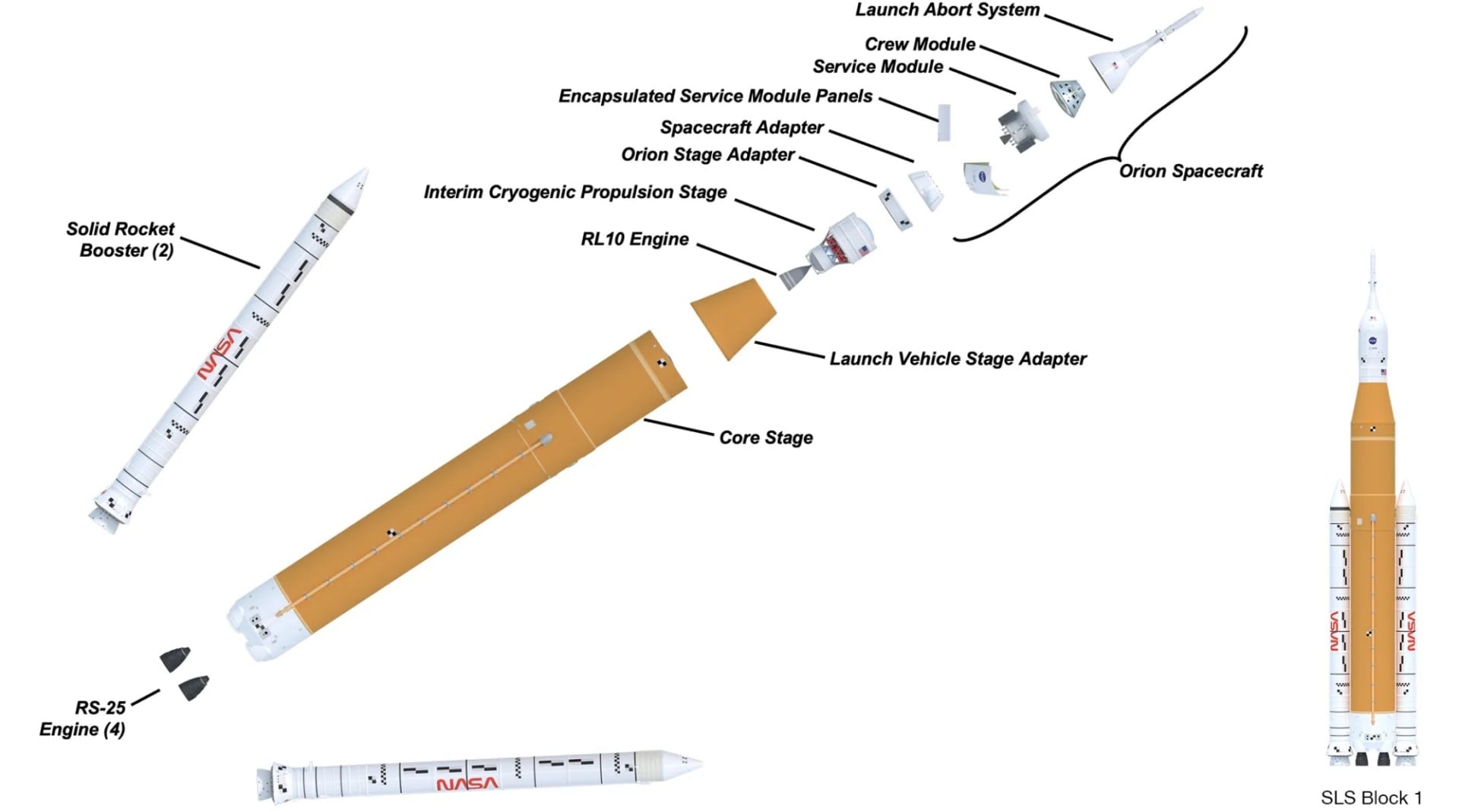
After the ICPS boosted Orion into a high-Earth orbit last night, the two separated from each other, and the Artemis 2 crew performed a proximity operations demonstration to test Orion’s ability to maneuver safely near another vehicle, in this case ICPS. The crew was then allowed to rest for a brief period before waking at 7:06 a.m. ET to the song “Sleepyhead” by Young and Sick.
Orion’s main engine then performed a 43-second burn to raise the lowest point of the spacecraft’s orbit, refining its trajectory as it orbits Earth. This placed Orion into a stable high-Earth orbit that aligns with its path to the Moon. As of 9:15 a.m., the crew was settling back in for another 4.5 hours of rest before they wake again to officially start their first full day in space.
ICPS Successfully Boosts Orion to High Earth Orbit
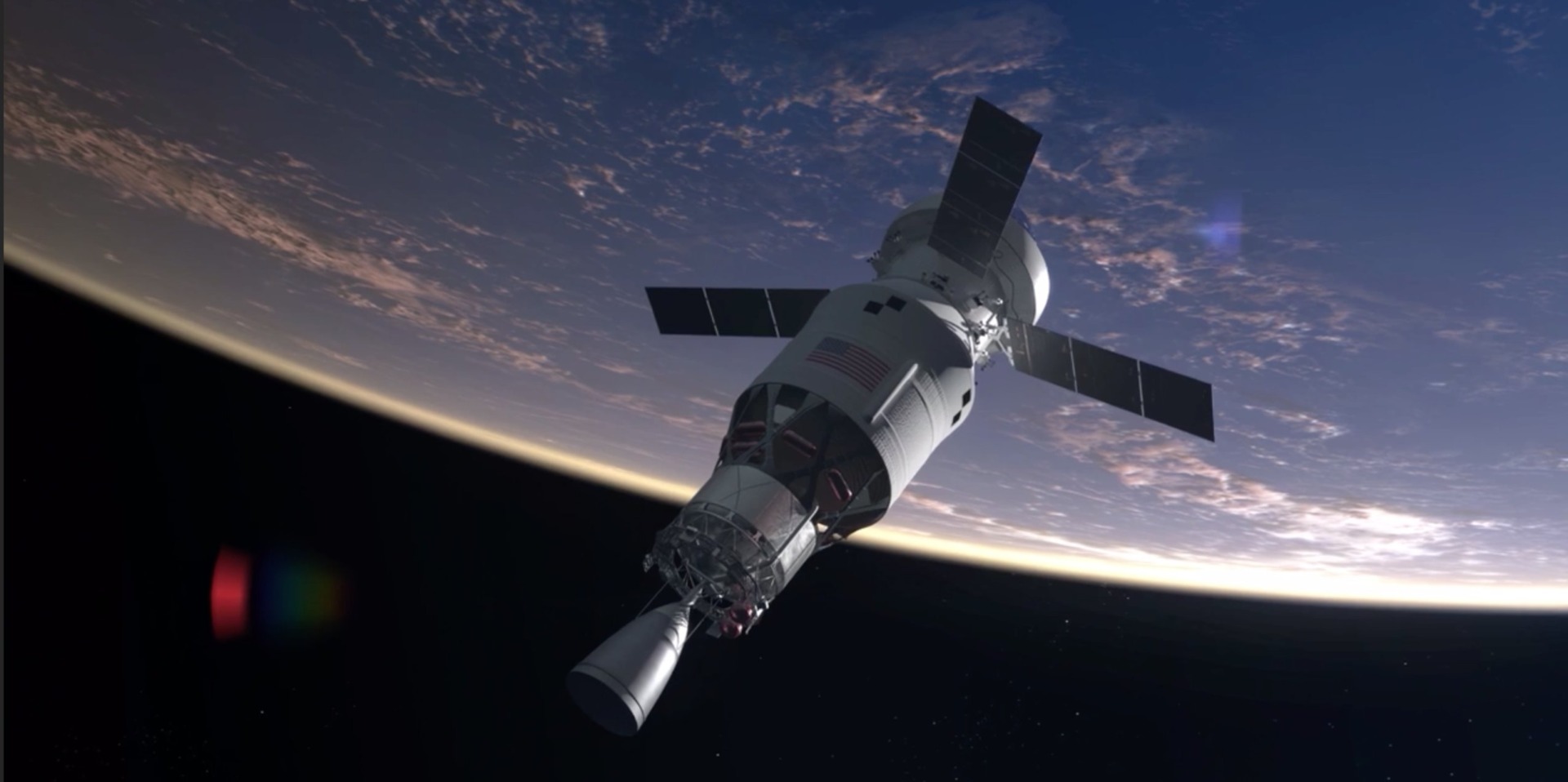
Orion and its four-person crew have reached their final orbit of the day, with ICPS boosting the spacecraft to a high-Earth orbit at approximately 8:40 p.m. ET. The next big milestone—sending Orion on a trajectory to the Moon—will happen on Thursday at roughly 7:30 p.m. Despite some seemingly minor glitches and hiccups, day one of Artemis 2 should be considered a resounding success.
Perigee maneuver complete
The ICPS completed the perigee maneuver to raise the Orion spacecraft into a more stable orbit. This will set the stage for a second, longer ICPS burn that will raise Orion into a high-Earth orbit.
Today’s Next Big Milestones
With MECO and the first separation out of the way, there are two major milestones still left to go today. At 7:24 p.m. ET, the ICPS will fire its engine to raise Orion’s perigee to about 100 miles (161 kilometers) above Earth, followed by a second burn around 8:24 p.m. that will push the spacecraft into a high-Earth, or parking, orbit. Once that’s done, the crew will spend the next 25 hours checking Orion’s systems, configuring the cabin, and preparing for the next major milestone: tomorrow’s critical translunar injection burn.
Good MECO and Separation
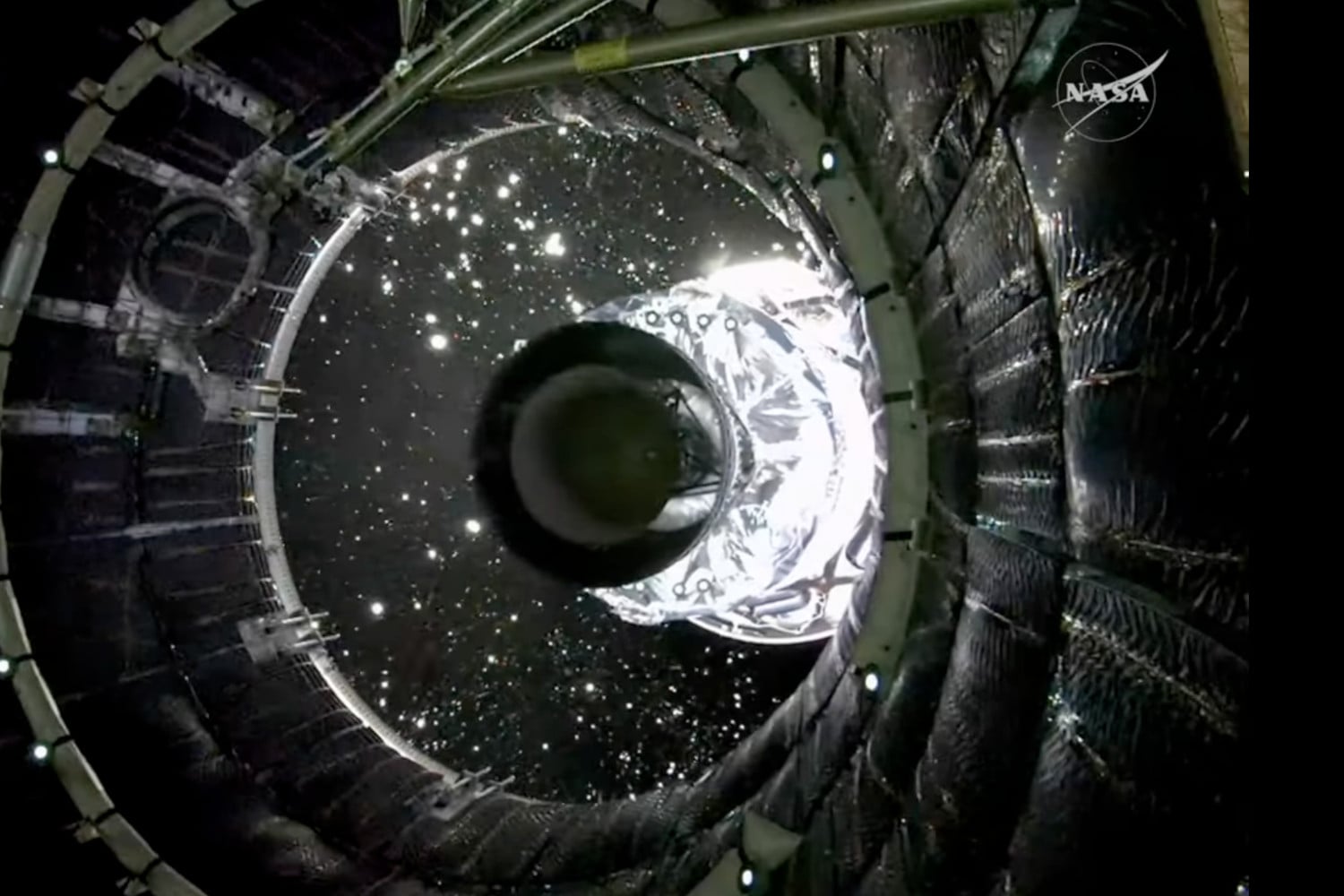
SLS cruised past MaxQ—the point at which the rocket experiences maximum aerodynamic pressure—and ventured higher towards space. The side boosters fell away as planned, followed by main engine cutoff (MECO) and separation of Orion and the ICPS from the core stage approximately 8 minutes into the mission. Looking good so far.
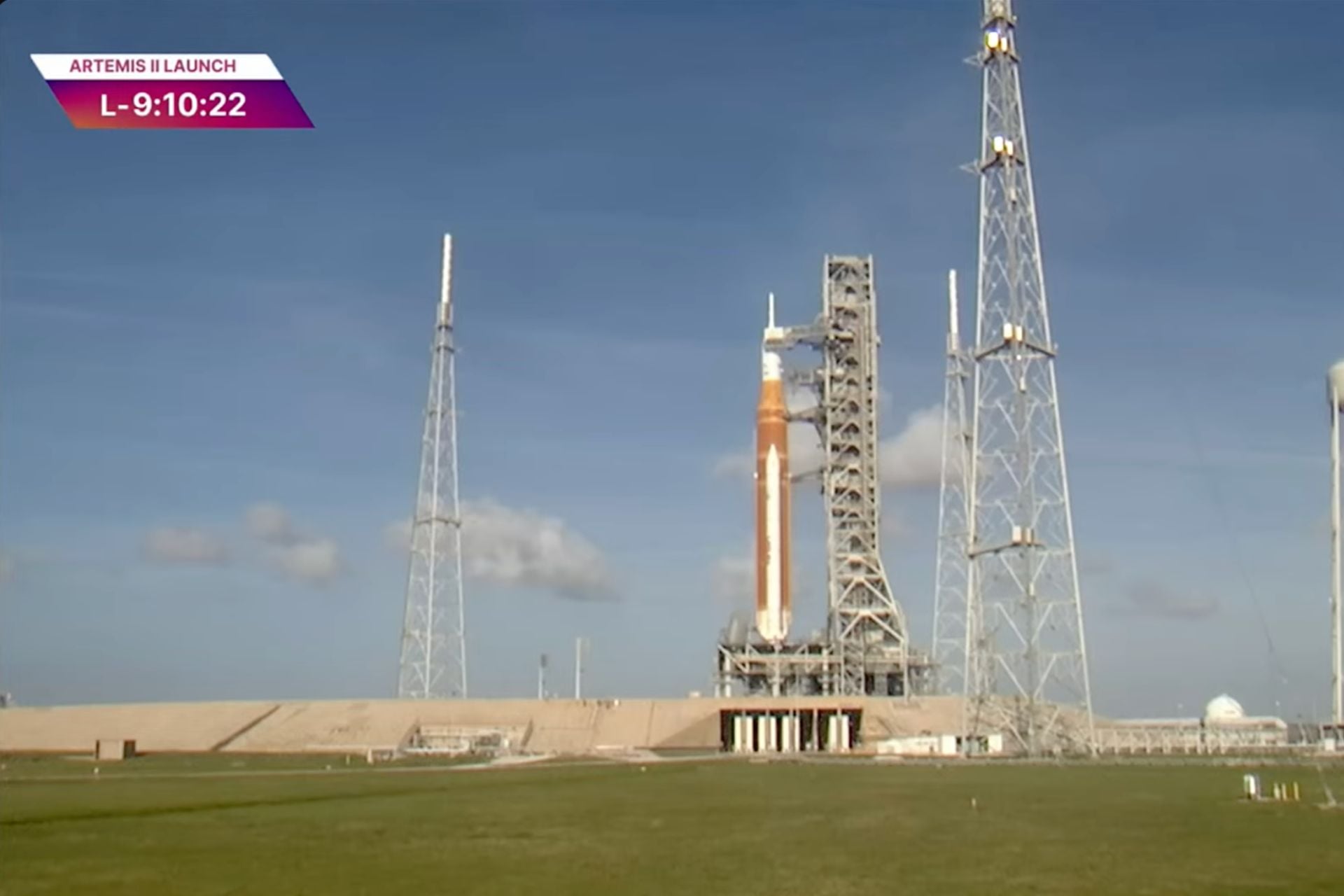
The rocket has cleared the tower
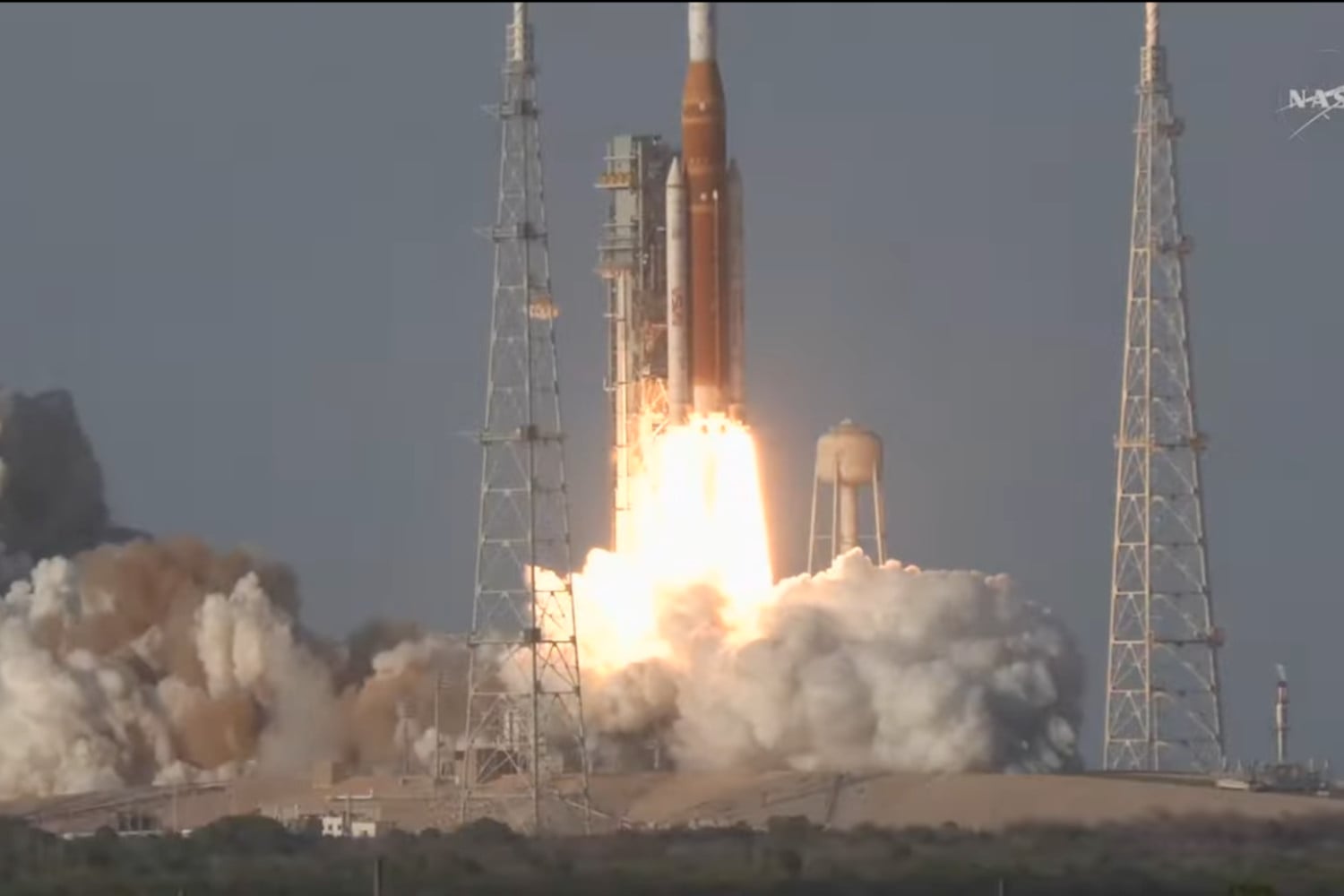
At 6:35 p.m. ET, the SLS boosters ignited, generating 8.8 million pounds of thrust to propel the Orion spacecraft skyward. The rocket has now cleared the tower and entered space.
All systems go for launch
The terminal countdown is about to begin.
“Full send,” Artemis 2 Commander Reid Wiseman said, concluding the launch poll.
Orion is sealed and ready for flight
At 5:57 p.m. ET, the closeout crew completed its final tasks and departed Launch Complex 39B. The Orion spacecraft is now sealed and ready for flight.
Now, the launch control team is preparing to initiate the final countdown. With just minutes to go before the launch window opens, anticipation is building.
Engineers investigated the LAS battery issue and determined that it will not affect today’s launch.
Trump wishes NASA luck
White House Deputy Chief of Staff Dan Scavino said President Trump called NASA Administrator Jared Isaacman to “wish everyone luck this evening.”
President Donald Trump will be monitoring the planned launch of Artemis II from the White House, a White House official told NBC News.
President Trump called @NASAAdmin Jared Isaacman down at @NASAKennedy in Florida to wish everyone luck this evening. We will all be watching, along with the rest of the world.
The countdown to history is underway!
Let’s go Artemis II 🇺🇸🚀
Great accounts to follow:… pic.twitter.com/bsOTwKgOTX
— Dan Scavino (@Scavino47) April 1, 2026
Weather forecast is now a 90% go, engineers addressing battery issue
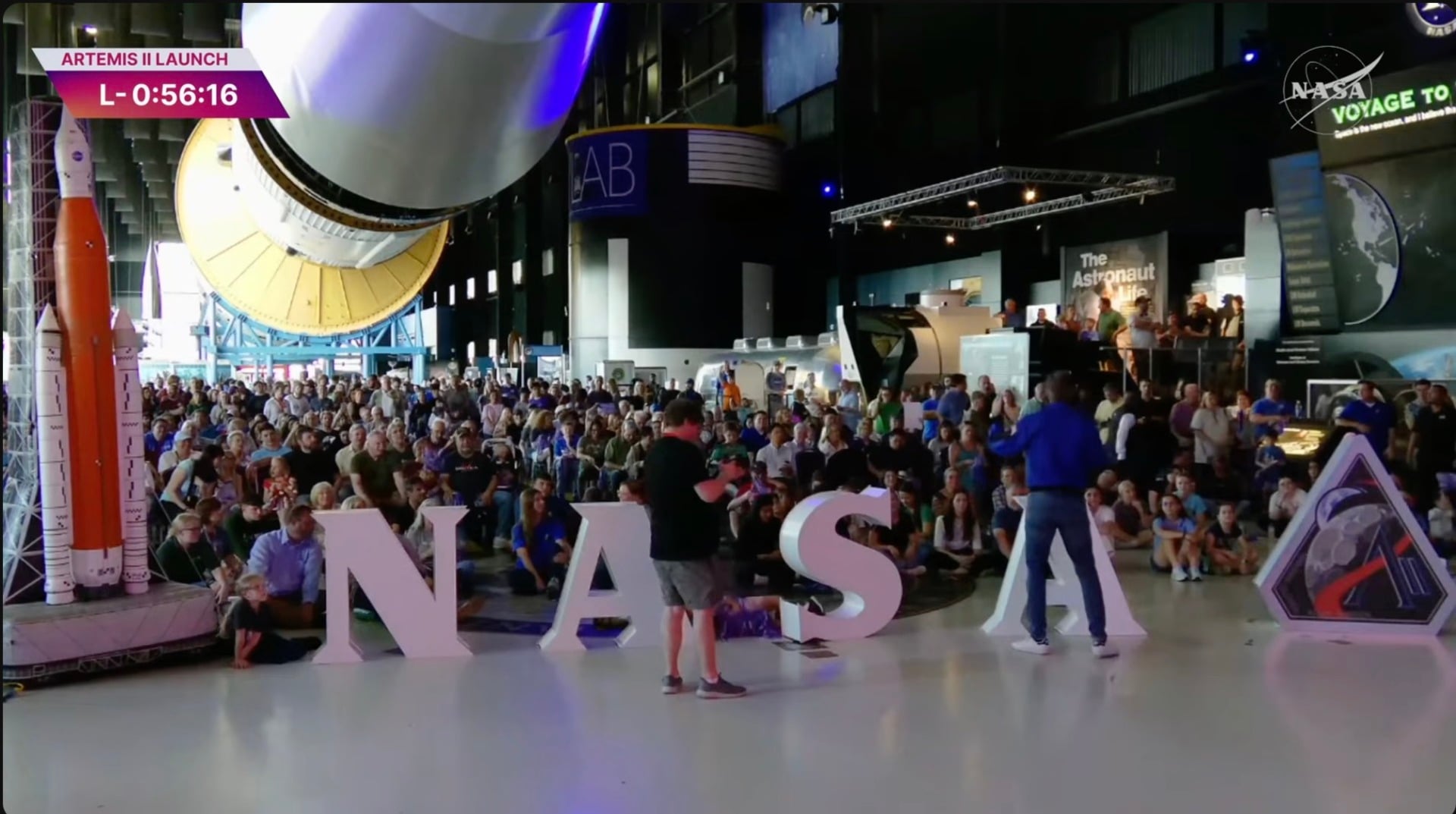
The rain has dissipated, and the latest weather report says conditions are 90% favorable for launch during the two-hour window. While clouds are no longer gathering at Kennedy Space Center, spectators certainly are.
Now for the bad news. One of the two Launch Abort System (LAS) batteries is outside its allowable temperature range. It’s not a problem at the moment, but it could become one later in the countdown. Teams are currently working to troubleshoot it.
One Excited Dude
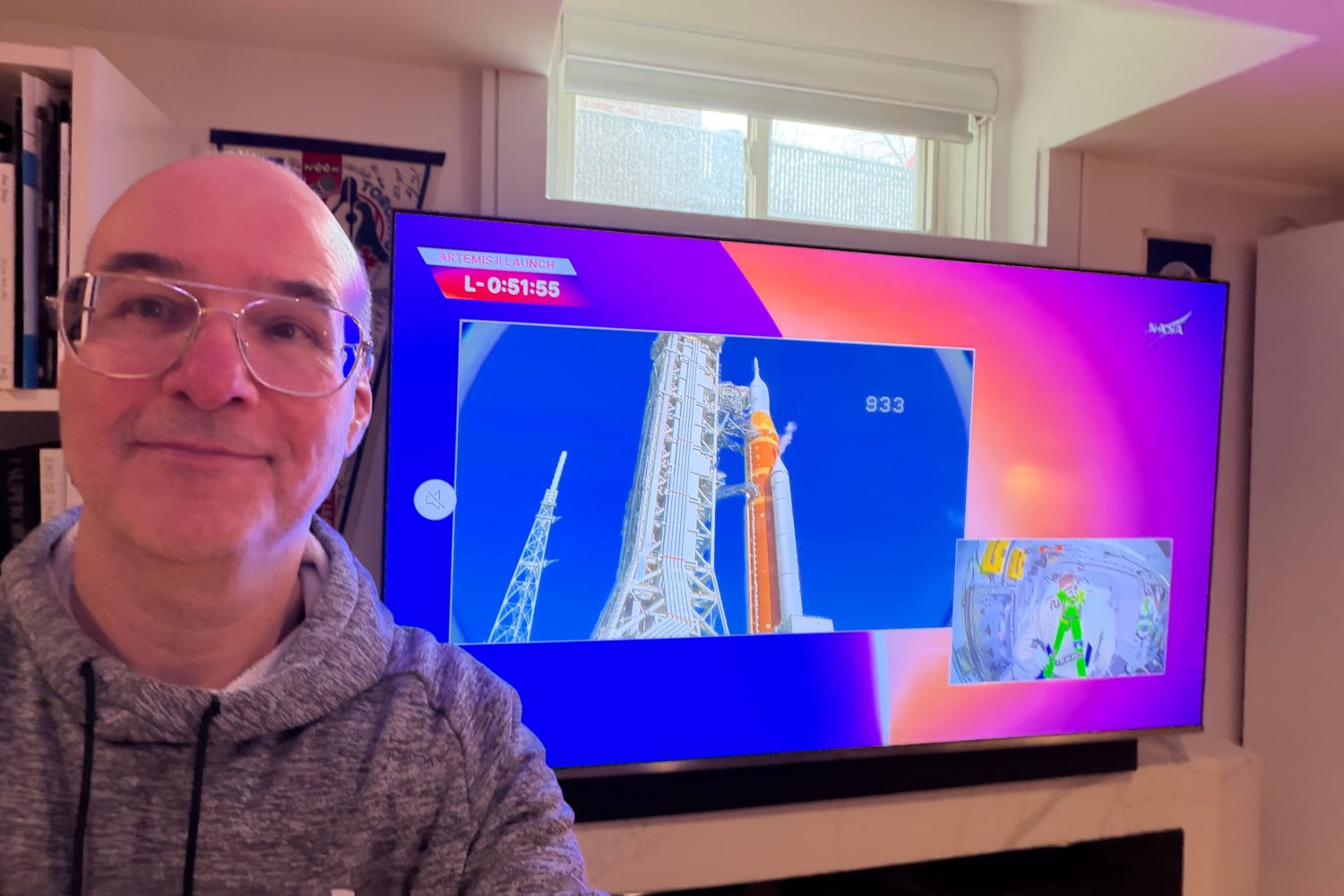
Here’s me and my viewing setup for today’s launch. Needless to say, it’s my first time experiencing a crewed Moon mission, and I am stoked. I was a mere two-year-old when Apollo 17—the last of NASA’s Cold War Moon missions—came to a close in December 1972. I don’t recall that, but I do remember the inaugural launch of the Space Shuttle Columbia in 1981 and was instantly hooked on space and spaceflight. Pretty wild to think that, as a 55-year-old, I’m witnessing a crewed Moon mission for the first time. I’m sure many of you feel the same way—this is long overdue.
“Godspeed, Artemis 2!”
NASA astronaut and Crew-12 mission commander Jessica Meir posted a video on X of astronauts aboard the International Space Station wishing the Artemis 2 crew a safe flight.
“Godspeed, Artemis 2!” they said, with a laptop showing live coverage of the pre-launch proceedings at Kennedy Space Center.
Godspeed, Artemis II! pic.twitter.com/lNLtud6ldO
— Jessica Meir (@Astro_Jessica) April 1, 2026
Flight termination system fixed, launch window opens in 1 hour
NASA broadcasters said just before 5:15 p.m. ET that the range is clear for launch, signaling that the issue with the flight termination system has been resolved.
Technicians have also completed the launch abort system hatch closure, which is essential to ensuring that Orion is fully sealed and ready for launch, according to NASA. The hatch provides an additional protective barrier for the crew module and enables a rapid escape route in the event of an emergency.
We are one hour away from the start of the launch window. Aside from a risk of rain showers, NASA is not working any constraints.
It’s been a remarkably smooth day so far. Seeing such a flawless tanking was likely surprising to many who have been following the Artemis program since the beginning. Here’s hoping the weather holds out.
NASA addressing a flight termination system issue
A NASA commentator said engineers are working to address an issue with the SLS rocket’s flight termination system. The Eastern Range, a division of the U.S. Space Force, uses this system to send a destruct signal to the rocket in the unlikely event that it veers off course. In that scenario, the crew capsule would separate from the rocket, saving the astronauts before SLS self-destructs.
Countdown procedures are still proceeding normally. The commentator said engineers are planning to use a piece of hardware stored in the Vehicle Assembly Building to try and fix the problem.
“Without assurance that this system would work if needed, today’s launch would be no-go,” NASA stated in a 5:00 p.m. ET update. “However, engineers have devised a way to verify the system and are currently preparing to test this solution.”
The Artemis 2 menu
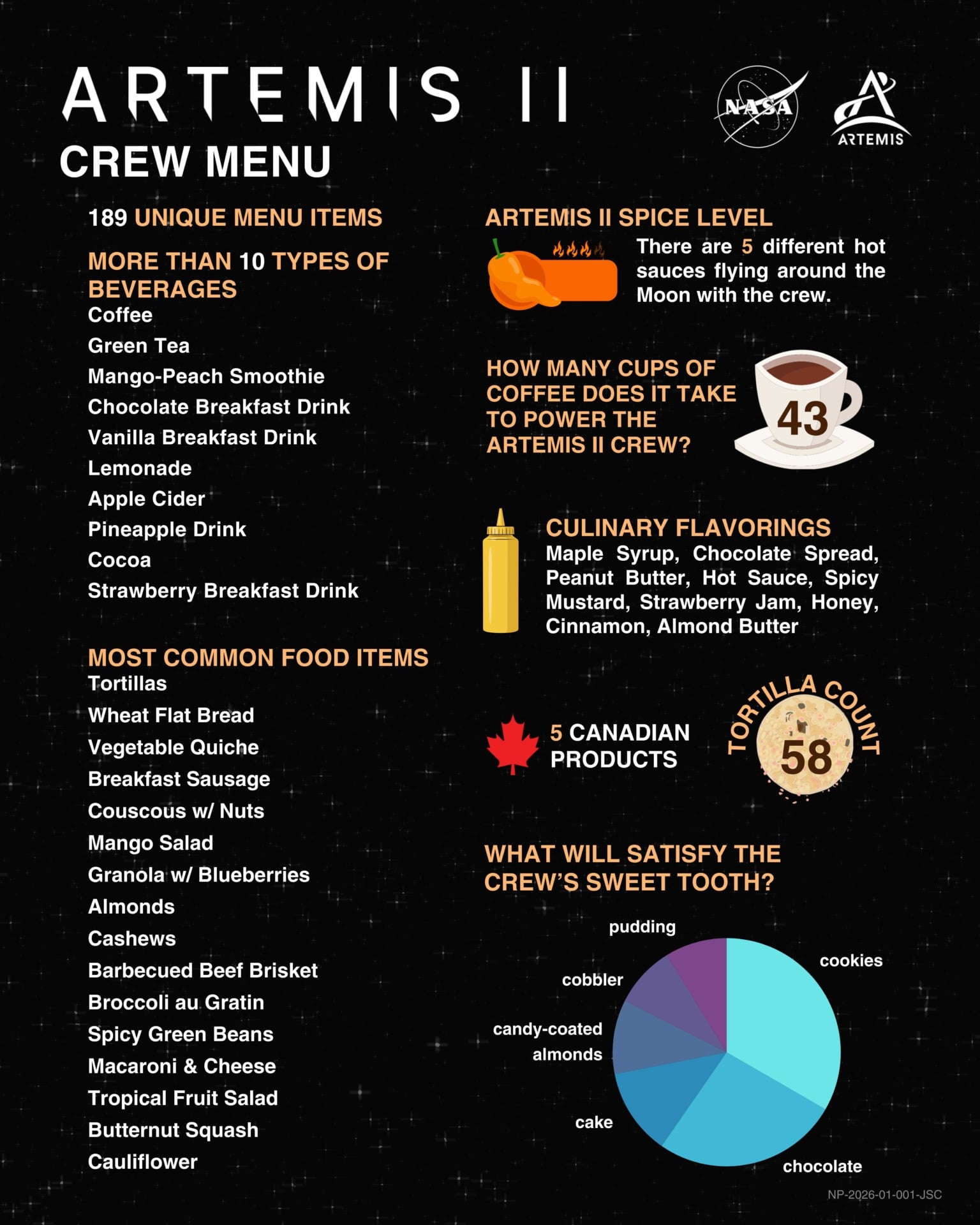
The food the Artemis 2 astronauts will eat over the course of their mission was specifically chosen to support crew health and performance—and to be shelf-stable, of course! With no resupply, refrigeration, or late-load capacity, NASA must select meals that will be safe to eat and easy to prepare throughout the entirety of the flight.
Some notable items on the menu include barbecued beef brisket, mango-peach smoothies, and 58 tortillas, to be exact.
Closeout operations progressing smoothly
At 4:02 p.m. ET, technicians began installing the crew module hatch service panel on the Orion spacecraft. This panel will protect key connections and ensure the hatch area is secure for flight, according to NASA.
The closeout team is also confirming that all systems around the hatch are properly sealed and ready for launch. Once the hatch area is secured, ground teams will proceed through final checks and countdown operations.
Big Crowds Are Gathering Along Florida’s Space Coast

Florida Today says upwards of 400,000 people are expected to gather along the Space Coast to watch the big launch. Incredibly, these rocket gazers could inject as much as $160 million into the local economy.
“Most folks are going to spend a few days in town. They’re going to spend money in restaurants, hotels, bars,” John Boyd, principal with The Boyd Company Inc. of Boca Raton, told Florida Today. “All of that drives economic impact, and it all creates new tax revenue.”
The city of Titusville is posting images to its Facebook page, showing large crowds gathering on the beach. The city has a clear view of Kennedy Space Center, making it a prime spot for spectators (people are gathering at the very aptly named Space View Park). Needless to say, these visitors are bringing a lot of extra traffic to the area. A recently reported car crash near Titusville is unfortunately causing major traffic delays.
Crew module hatch closeout underway
At 3:17 p.m. ET, the closeout crew was preparing and closing the crew module hatch to the Orion spacecraft. This is one of the most critical steps before launch, according to NASA. The crew will work meticulously to inspect seals, secure fasteners, and verify that the hatch is airtight.
This process will ensure that Orion is fully pressurized and ready for flight. Once the hatch is closed and locked, the astronauts are sealed inside the capsule.
Jeremy Hansen’s patch for the Artemis 2 mission

Check out Jeremy Hansen’s patch. Designed by Manitoba Anishinaabe artist Henry Guimond (with a contribution from Turtle Lodge leader Dave Courchene III), it was made specifically for the pioneering Canadian astronaut. The patch incorporates indigenous knowledge and symbolism, including the Seven Sacred Laws represented by animals.
“While the patch contains elements of Anishinaabe culture that do not reflect all First Nations, Inuit and Métis cultures, working with an Indigenous artist to create the patch he will wear with great humility as he represents our country in space was Jeremy’s way to recognize the importance of traditional knowledge and Indigenous Peoples in Canada,” according to a Canadian Space Agency statement.
The personalized Artemis 2 patch combines this cultural imagery (along with symbols of Canada) with space and spaceflight elements, namely stars for navigation and the Orion spacecraft. Fun fact (at least for me): Hansen and I share the same hometown: London, Ontario.
Artemis 2 crew boards Orion
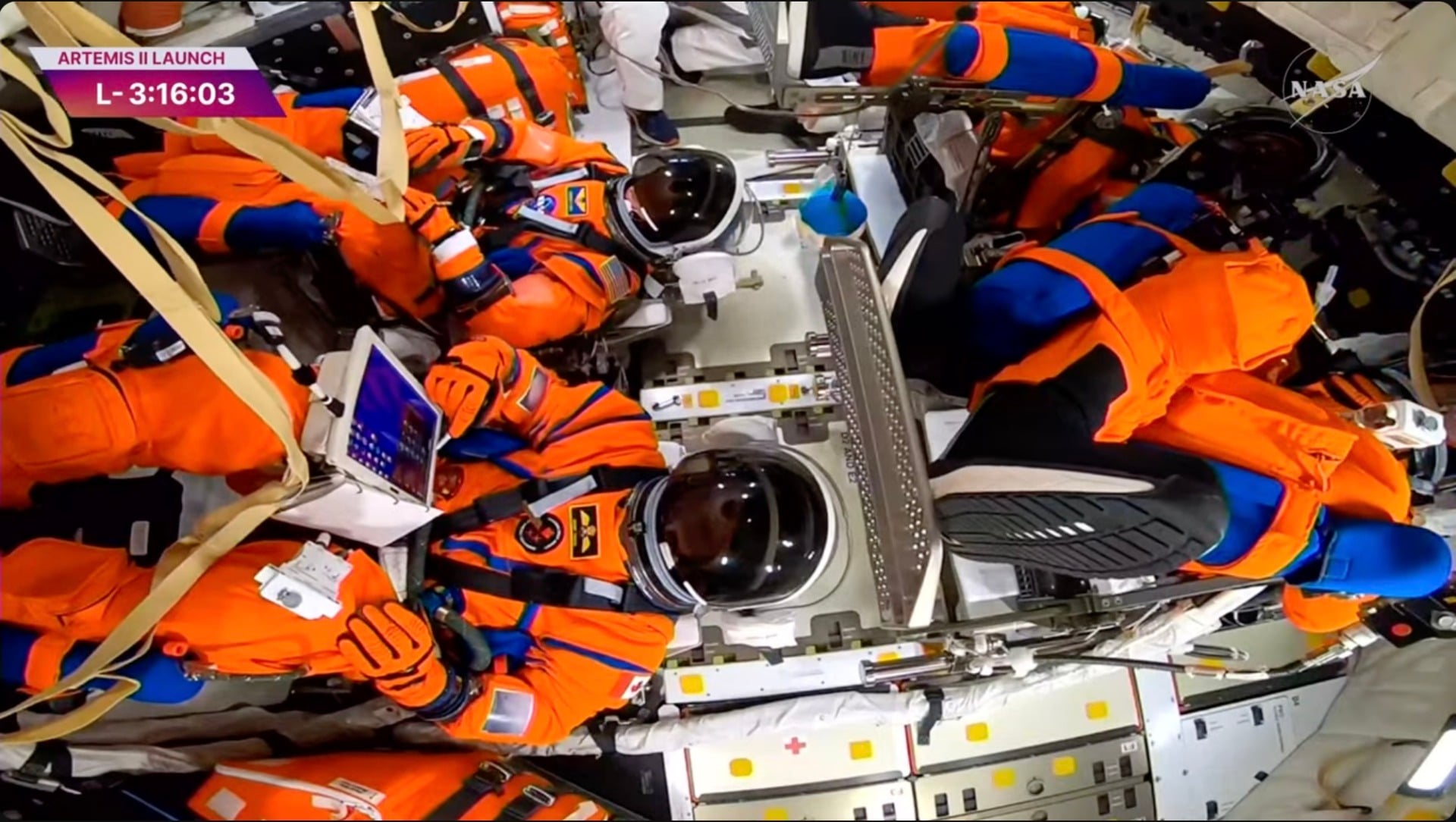
Just before 3:00 p.m. ET, The Artemis 2 astronauts were strapped into their seats inside the Orion spacecraft.
Before entering the capsule, each crew member signed the inside of the white room—another NASA tradition. The closeout crew assisted them into their seats, ensuring that their spacesuits and helmets did not catch on the hardware inside Orion. Now, the Artemis 2 astronauts are running through voice checks to ensure the communication system is working as expected.
Once all checks are complete, the closeout crew will prepare to close the crew module and exterior launch abort system hatches. This is a challenging and complex process—even a single strand of hair inside the hatch doors can cause issues, according to NASA. To ensure airtight seals and communication readiness, the closeout crew will slowly move through closeout procedures over the course of up to four hours.
Artemis 2 human health research: biology beyond Earth
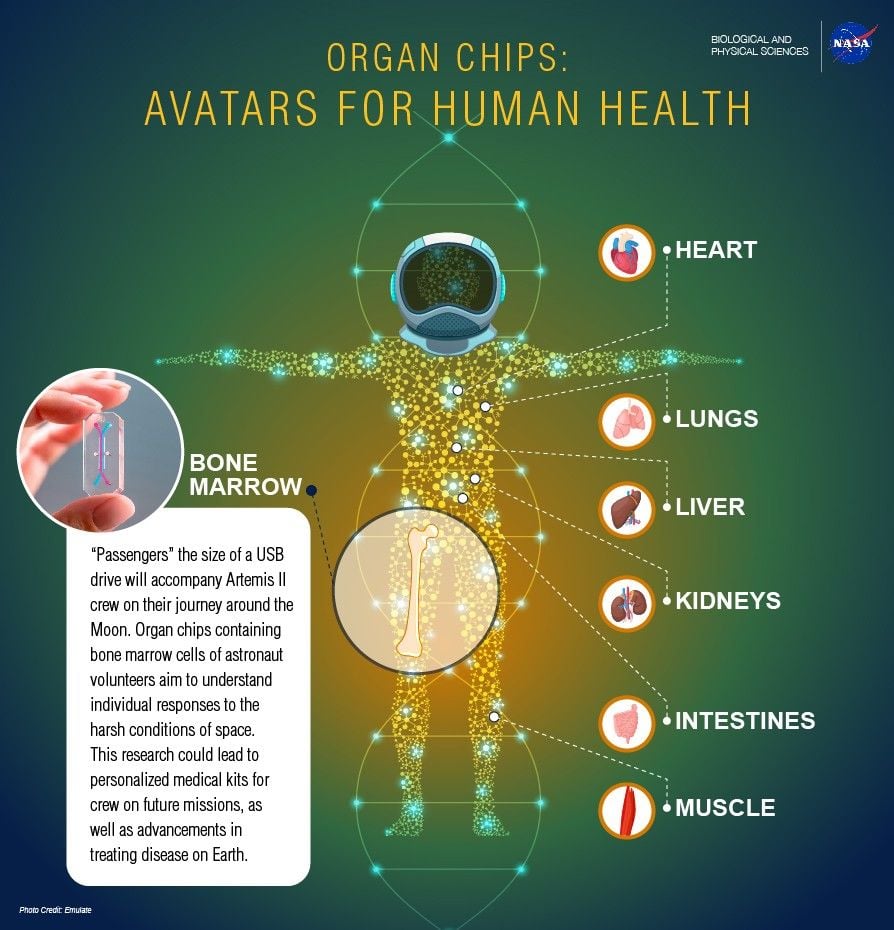
The Artemis 2 mission will send four astronauts farther from Earth than any human has gone before. During their 10-day flight around the Moon, they will encounter high levels of space radiation and reach a maximum distance of 250,000 miles from Earth.
“I often talk about the most complicated system on this vehicle is going to be the human,” Steven Platts, chief scientist of the Human Research Program at NASA’s Johnson Space Center, previously told Gizmodo. “We need to understand exactly what’s going to happen in order to prevent anything bad from happening and keep them safe and healthy.”
Over the course of their mission, the Artemis 2 astronauts will serve as both researchers and human test subjects, gathering data on how the spaceflight environment impacts their health. They will use continuous radiation monitoring, wearable sensors, biological sampling, and cutting-edge “organ-on-a-chip” technology to track changes in sleep, stress, cognition, and overall physiology.
Artemis 2 astronauts arrive at Launch Complex 39B

At 2:14 p.m. ET, the Artemis 2 astronauts arrived at Launch Complex 39B. They are now in the white room and preparing to board the Orion spacecraft.
In this clean, controlled environment at the end of the crew access arm, the closeout crew will assist the astronauts with hatch operations and verify that all safety systems are ready for launch, according to NASA. At 2:27 p.m., the astronauts were donning their helmets and gloves while the closeout crew finalized suit integrity checks. These last steps ensure airtight seals and communication readiness for the mission.
The opening of the launch window is just four hours away.
The crew watches “Point Break” and “Top Gun” in the astrovan
During the 20 minute astrovan ride to the launch pad, the Artemis 2 astronauts will be watching clips of “Top Gun” and “Point Break” via the van’s TV and sound system. Not a bad way to get pumped up!
Artemis 2 crew heads to the launch pad
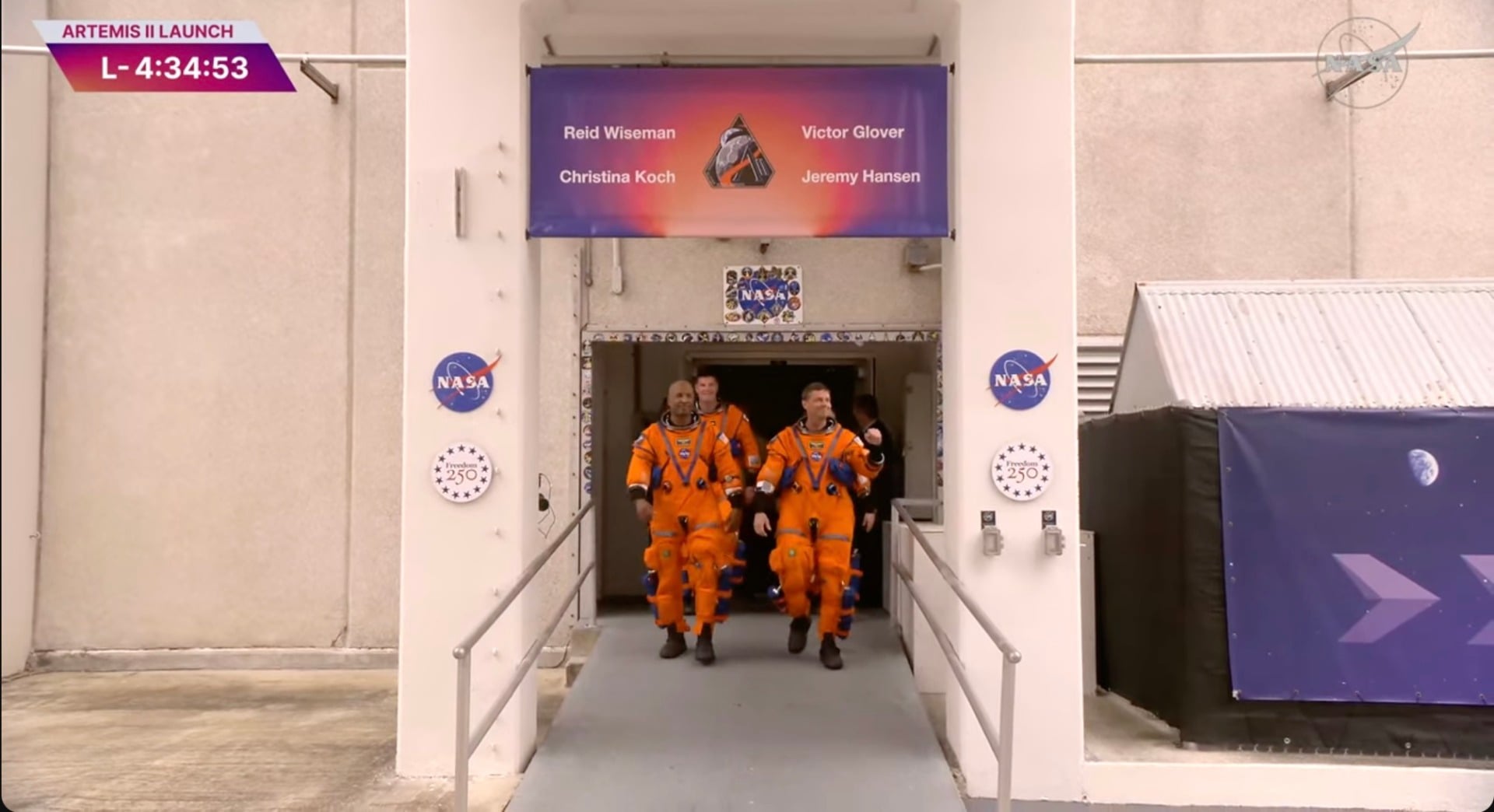
At 1:50 p.m. ET, the Artemis 2 astronauts stepped outside the double doors at the Neil A. Armstrong Operations and Checkout Building to cheers and applause from family and friends. Every NASA astronaut since Apollo 7 in 1968 has made this same walk.
“It’s a great day for us, a great day for this team,” Artemis 2 Commander Reid Wiseman said.
The crew embraced the friends and family they had quarantined with, then hopped into the van that will take them to the launch pad.
Before leaving the crew quarters, the astronauts upheld a long-standing spaceflight tradition. At this point in the pre-launch proceedings, NASA crews play cards until the commander loses, according to NASA. The hope is that by losing, the commander burns off all his or her bad luck, thereby clearing the mission for only good luck.
Pad rescue and closeout crew teams arrive at Launch Complex 39B
At 1:36 p.m. ET, NASA’s pad rescue and closeout crew teams arrived at Launch Complex 39B. These specialized teams play a vital role in protecting agency personnel and hardware throughout the countdown, according to NASA. They will ensure safety and readiness during critical final fueling operations.
The pad rescue team will respond immediately in the unlikely event of an emergency, while the closeout crew is responsible for closing the Orion crew module and launch abort system hatches, securing access points, certifying pad configurations, and maintaining the integrity of the launch area during propellant loading and system checks.
Artemis 2 lunar science will be out of this world
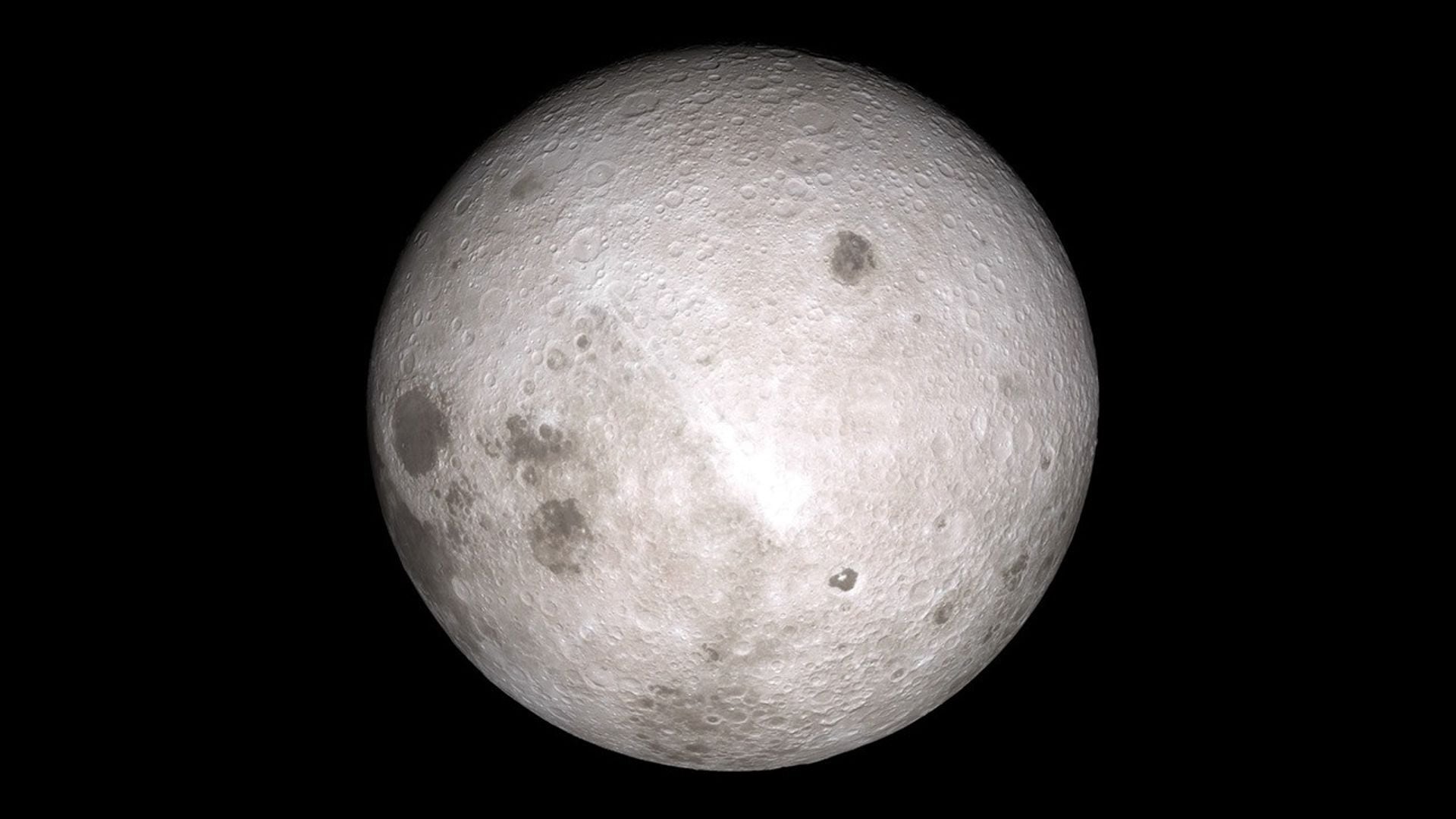
Artemis 2 is, first and foremost, a crewed test flight of the SLS and Orion. But this mission will also gather invaluable data on the Moon’s far side. During their 10-day flight, the astronauts will act as researchers, observing parts of the lunar surface never before seen with the naked eye.
“I’m really excited about this test flight,” Jacob Richardson, deputy lunar science lead for Artemis 2, previously told Gizmodo. “There is a super special place in my heart for Artemis 2—for the crew that has completely leaned into being a part of our science team and for the science that we’ll get out of this mission.”
According to Richardson, the Artemis 2 crew will be the first humans to see virtually the entire far side disk in a single view. From their vantage point, they’ll be able to observe and compare surface features thousands of miles apart from each other—a perspective orbiters can’t provide.
The crew will dedicate one full day to observing the Moon’s surface. Richardson and his colleagues on the lunar science team have provided them with extensive training on how to look for certain features, photograph or videotape them, and write detailed descriptions of what they see.
All SLS tanks fueled to 100%
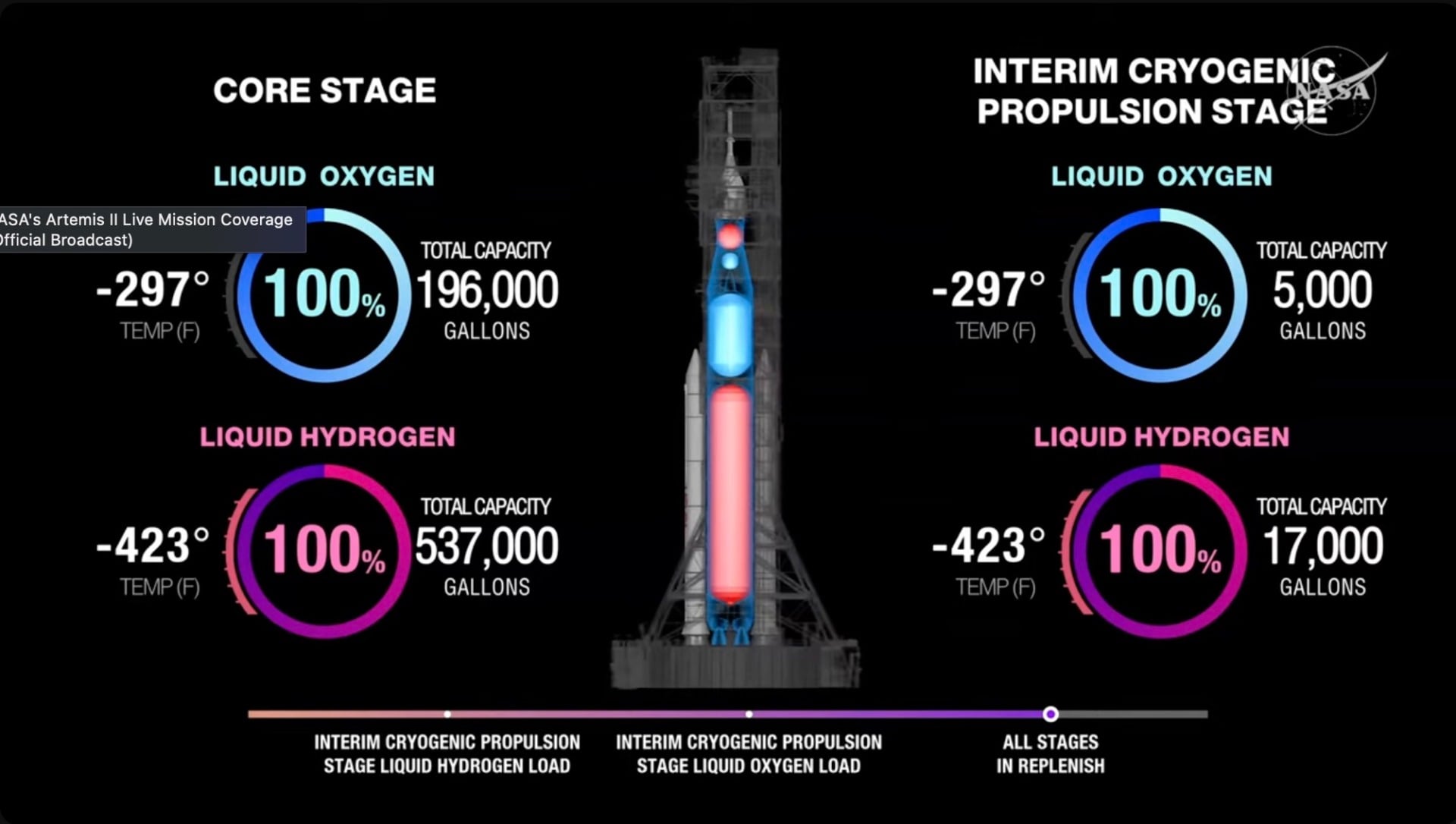
NASA has confirmed that all liquid hydrogen and liquid oxygen tanks aboard the SLS rocket are 100% full, in the replenish phase, and ready for launch. This is a huge win for the Artemis 2 team, as hydrogen leaks and other tanking-related issues were among the biggest concerns leading up to lift off.
“No leaks, no issues, and we’re looking good at this point,” Derrol Nail, a member of NASA’s communications team, reported from Firing Room 1 in the Launch Control Center.
Now, the Artemis 2 countdown is entering a planned 1-hour and 10-minute built-in hold. This scheduled pause will allow teams to complete crucial systems checks, verify launch readiness, and make any last-minute adjustments before the crew boards Orion and final fueling operations begin, according to NASA.
Once the hold concludes, the countdown will resume with preparations for astronaut arrival at Launch Pad 39B.
Artemis 2 crew suiting up
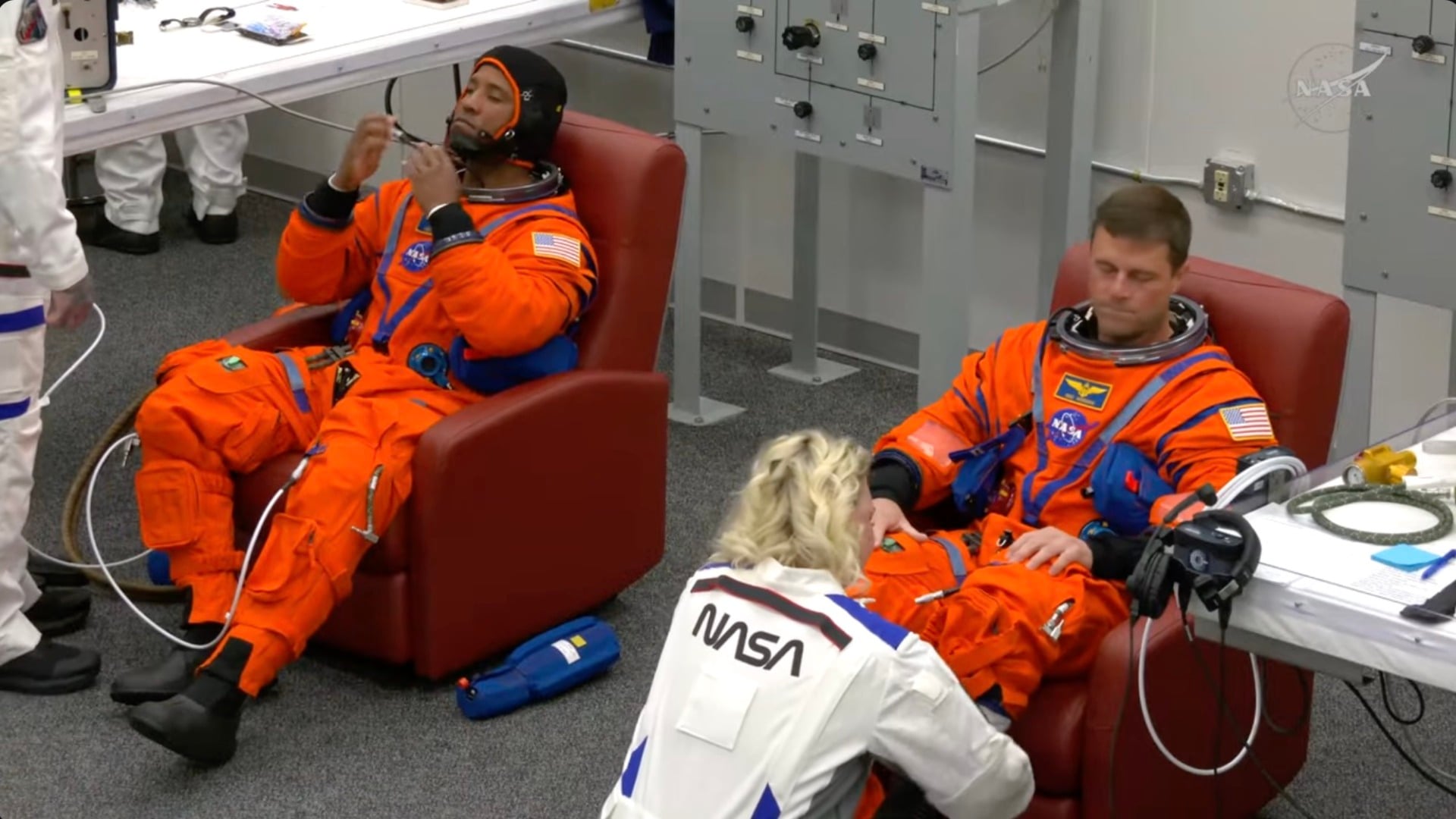
NASA’s live broadcast of the Artemis 2 proceedings began at 1 p.m. ET with a glimpse of the crew in the suit-up room getting prepped for launch. Above you can see mission pilot Victor Glover (left) and mission commander Reid Wiseman (right) donning their orange Orion Crew Survival System suits.
Suit technicians are helping the astronauts into their spacesuits, which are designed to protect them and keep the cool and dry during launch and reentry. The crew will also wear them if an emergency situation arises and during high-risk parts of their mission.
During the suit-up process, technicians will check for leaks and ensure that all connecting life support systems, including air and power, are operating as expected.
Weather forecast is still 80% go for launch

Just after 12:40 p.m. ET, Artemis 2 launch director Charlie Blackwell-Thompson provided an update from the mission’s weather officer, confirming that the forecast is still 80% go for launch. Blackwell-Thompson said teams are monitoring some precipitation that is making its way toward the pad, but they expect it to dissipate before the launch window opens at 6:24 p.m. tonight.
SLS upper stage liquid oxygen fast fill complete
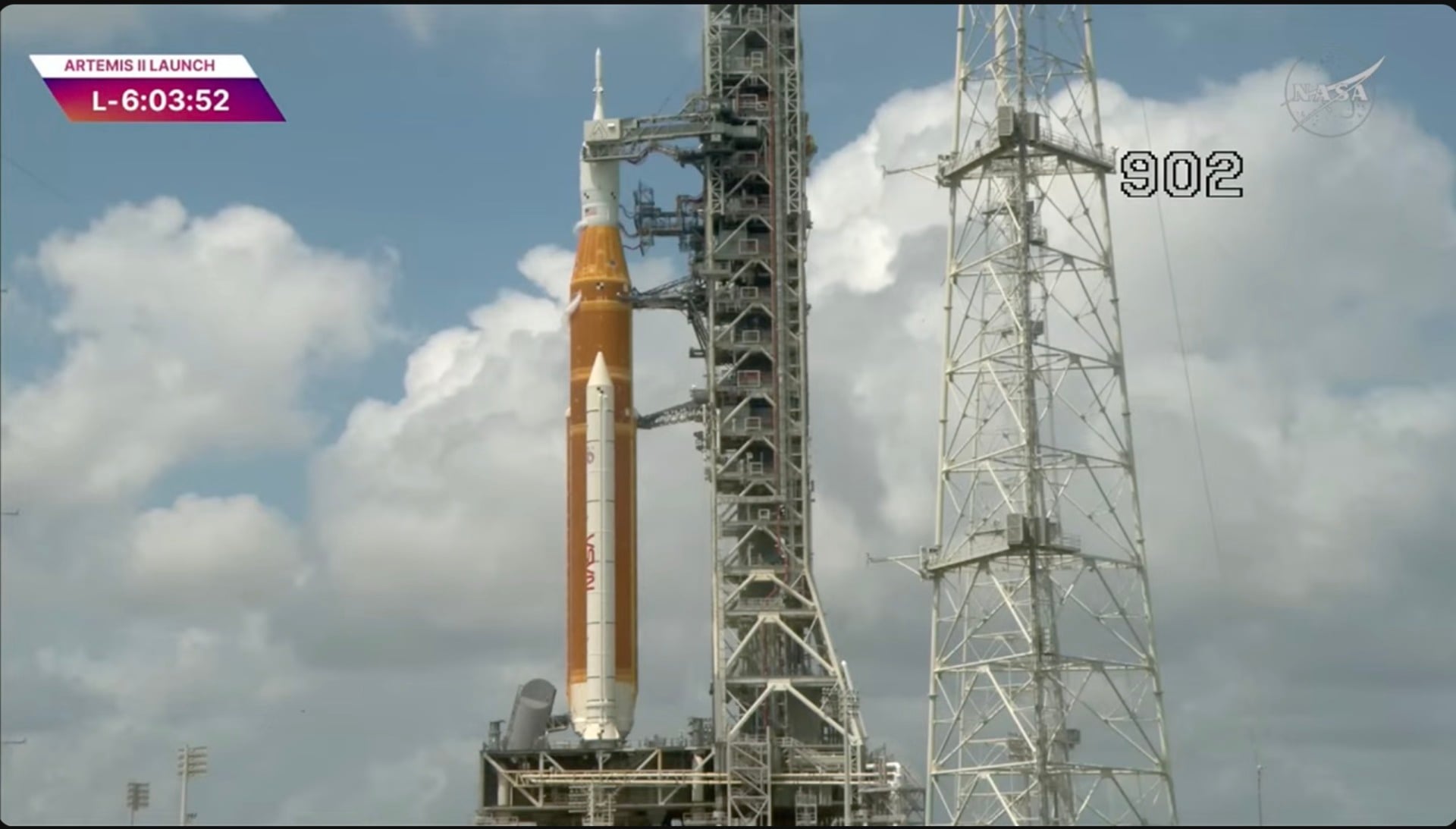
At 12:23 p.m. ET, the launch team finished fast filling the SLS rocket’s upper stage with liquid oxygen and confirmed that it is ready to proceed with the LOX vent and relief test. This step will verify proper pressure regulation and ensure the system is ready to transition into topping and replenish operations, according to NASA.
We should be getting a forecast update for the launch window shortly. Right now, some clouds are gathering over Kennedy Space Center, and there is a chance of showers later today, according to the National Weather Service.
Liquid oxygen replenish phase for SLS core stage begins
At 12:03 p.m. ET, the launch team entered replenish mode for liquid oxygen tanking into the SLS rocket’s core stage. With LOX fast fill and topping complete, this will ensure the oxidizer remains at flight-ready levels ahead of launch.
Liquid oxygen fast fill for SLS upper stage begins
At 11:42 a.m. ET, the launch team began fast filling liquid oxygen into the SLS rocket’s upper stage (ICPS). With chilldown complete, this phase rapidly loads LOX into ICPS to bring the upper stage closer to full readiness for liftoff, according to NASA.
The Artemis 2 flight path
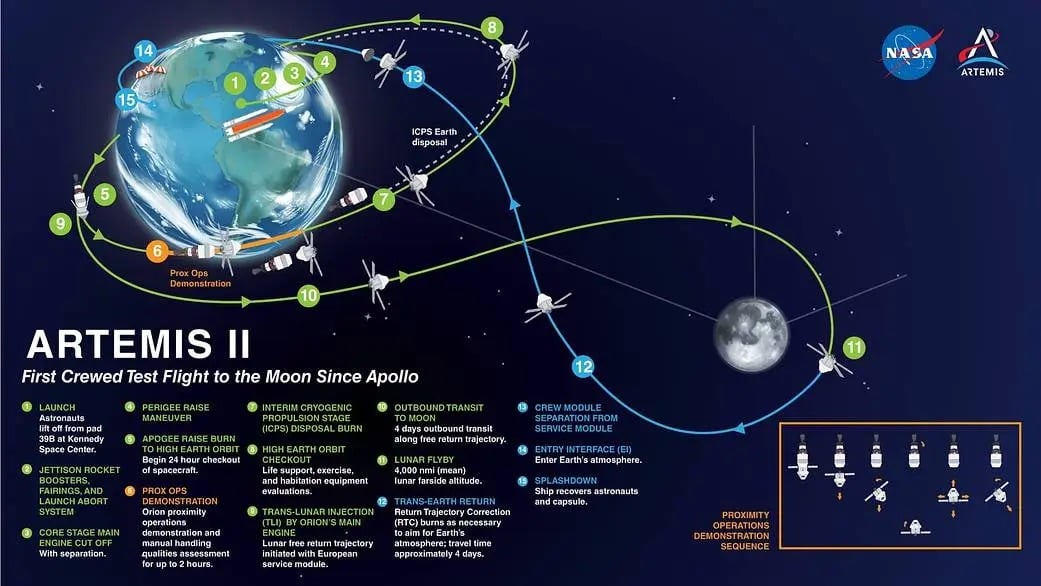
About 25 hours after launch, Orion’s main engine will perform a translunar injection burn to set course toward the Moon. Just before the crew goes to sleep on the fifth day of flight, Orion will enter the lunar sphere of influence. As the force of the Moon’s gravity becomes stronger than Earth’s, the spacecraft will be naturally pulled toward the Moon.
On the sixth day of flight, the lunar flyby will begin. As Orion zooms over the lunar far side, the Artemis 2 astronauts will observe parts of the surface humans have never laid eyes on. The information they gather will greatly enhance lunar science, helping researchers on Earth better understand our closest celestial neighbor.
The next day, Orion will exit the lunar sphere of influence and embark on a free-return trajectory back to Earth. On the tenth day of flight, the crew capsule will separate from the service module and reenter Earth’s atmosphere at 24,700 miles per hour (39,750 kilometers per hour). The capsule will splash down off the coast of San Diego, California, bringing an end to the mission.
Liquid hydrogen replenish phase for SLS upper stage begins
At 11:09 a.m. ET, the launch team initiated the liquid hydrogen topping phase for the SLS rocket’s upper stage, or ICPS. This step takes place after chilldown and vent-and-relief checks are complete to ensure the LH2 tank reaches full capacity. With topping complete, the team transitioned to replenish mode at 11:15 a.m.
Meet “Rise,” the Artemis 2 zero gravity indicator
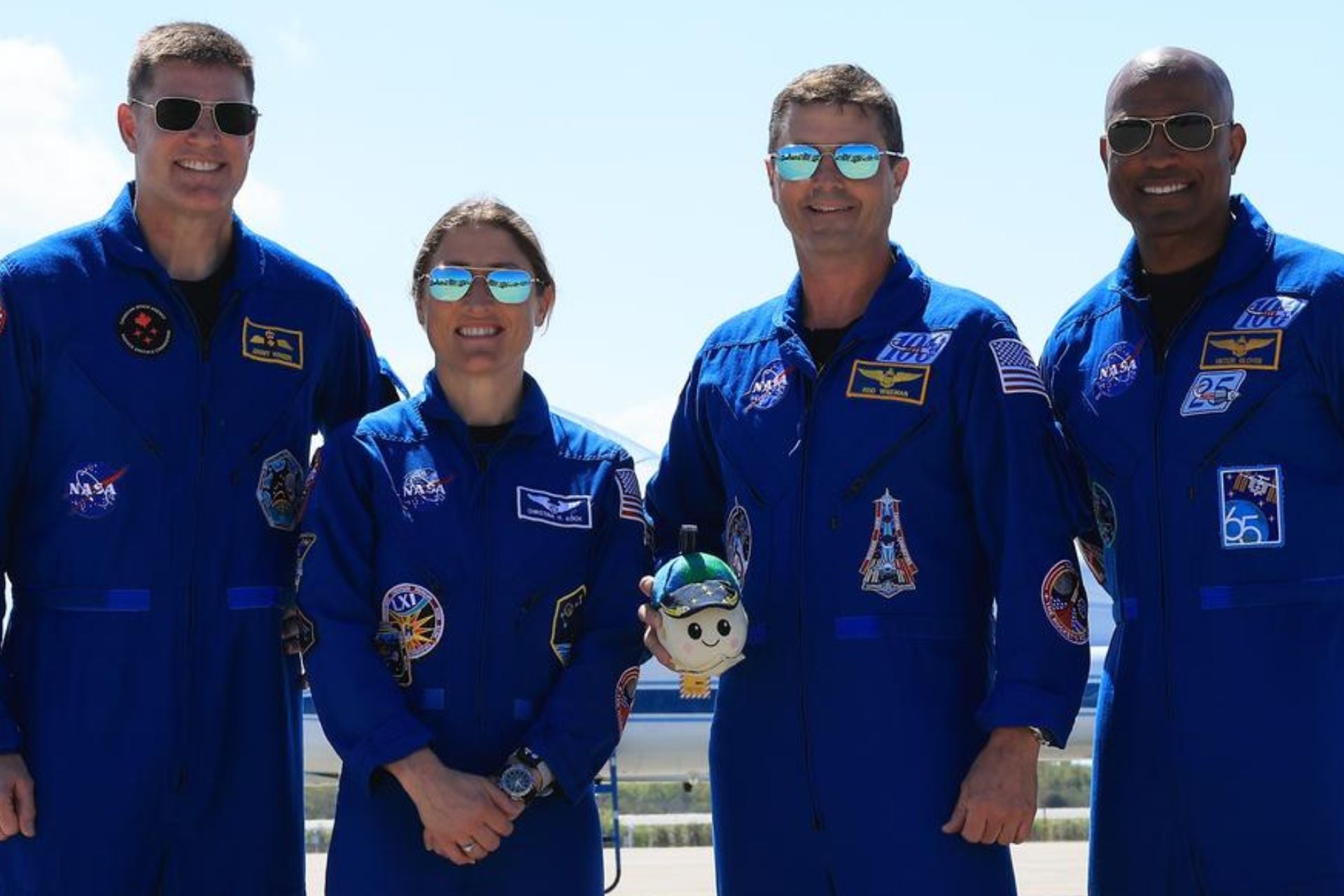
That cute little plushie Artemis 2 commander Reid Wiseman is holding is actually the fifth member of the crew. Called “Rise,” the toy was designed by Lucas Ye, a second-grader from Mountain View, California. Ye’s design was inspired by the iconic Earthrise photo from the Apollo 8 mission.
Rise will serve as the mission’s zero gravity indicator—a small plush object that rides with a crew to visually indicate when they are in the microgravity environment of space. Here’s Ye showing off his incredible design below.

The Artemis II zero gravity indicator “Rise” was having a main character moment as the Artemis II astronauts flew to @NASAKennedy today to prepare for launch. pic.twitter.com/VlTx6OhovG
— NASA Artemis (@NASAArtemis) March 27, 2026
Liquid hydrogen replenish phase for SLS core stage begins
At 10:24 a.m. ET, the launch team began liquid hydrogen topping for the SLS rocket’s core stage. This process involves adding small amounts of LH2 to the fuel tanks after fast fill is complete to ensure they remain at full capacity ahead of launch.
That’s because the super-cold propellant naturally boils off, according to NASA. This step will maintain the precise fuel levels needed for launch while keeping the system thermally stable.
At 10:35 a.m., the team entered the “replenish” phase for SLS core stage LH2 tanking. This continuous, low-rate flow of LH2 into the tanks keeps them topped off and thermally stable as the cryogenic propellant boils off. It is the final step in the fueling process.
How the Artemis 2 mission could go dangerously wrong
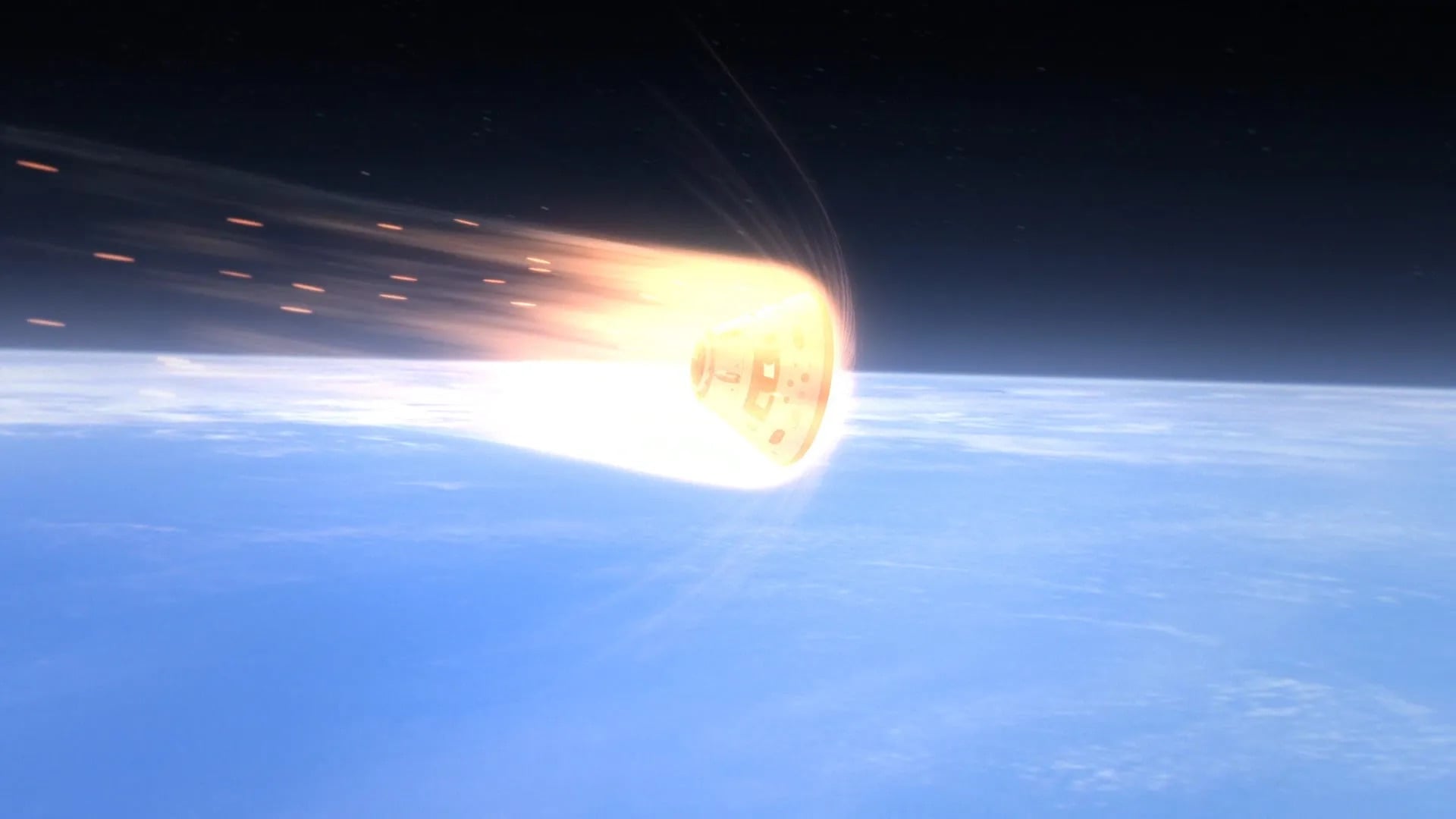
Spaceflight is hard, and no mission has higher stakes than a crewed deep-space flight. Of course, NASA would not be pursuing a launch attempt today without strong confidence in the mission and crew safety, but no spaceflight is risk-free, and the agency can’t predict every anomaly.
Some of the worst-case scenarios that could arise over the course of Artemis 2 include an orbital injection error, a failed translunar injection, an Orion service module systems failure, a heat shield malfunctions, or a bout of violent solar weather. These issues could prevent the mission from achieving its key objectives, or worse—endanger the crew. You can learn more about the risks associated with Artemis 2 here.