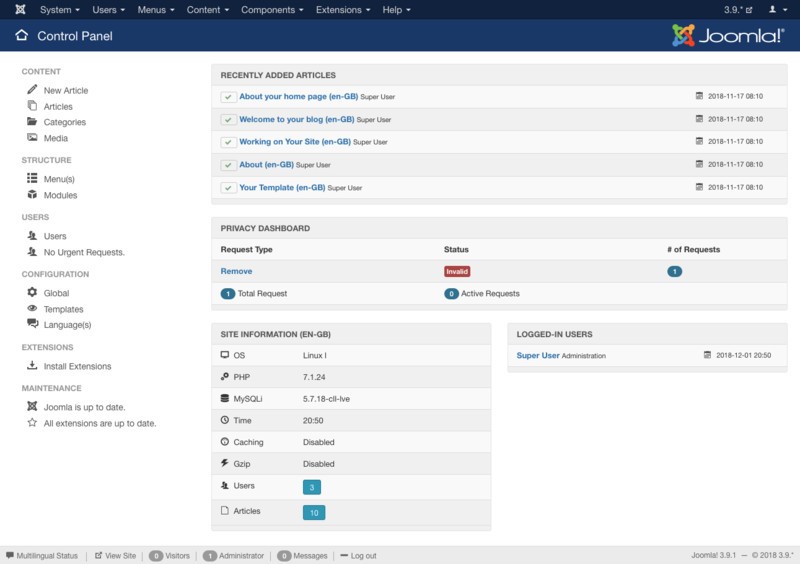
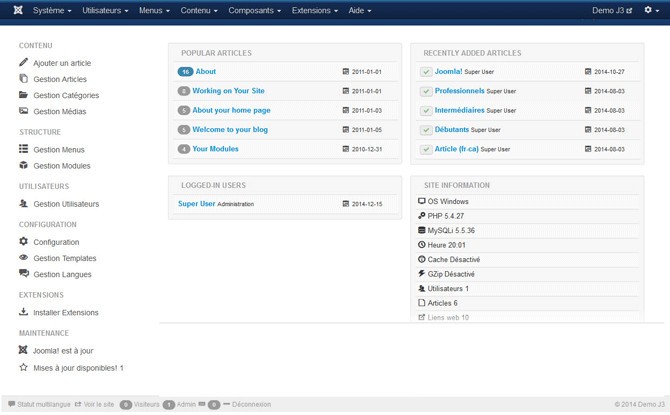
Joomla is a free, open-source CMS platform specifically designed to make it easy for non-programmers to build their website. Since its creation in 2005, Joomla never ceased to deliver, continuously driving a massive network of websites for the last several years.
Using this platform, you can create blogs, retail sites, personal portfolios, etc., all from a single dashboard that handles pages, menus, and media. Joomla is successful because it combines orderly controls with open possibilities. You can bring your own creative touches to your site, but it also allows it to be neatly and user-friendly organized.
The basis of Joomla is wrapped around modules and extensions, which merge to create your site. These sections complement each other to produce dynamic and feature-laden internet platforms. Whether it’s a private blog or a multiple-user site with different roles to be played, Joomla allows you the flexibility to do a custom design and site navigation without requiring anything too technical. It’s both powerful and welcoming.
You start with a simple setup, but Joomla is capable of growing with your website. You start with a good footing in place, so your site has a chance to grow and accommodate future additions.
Why Should I Download Joomla?
If you want to create your own website but don’t know anything about web coding, then Joomla is your go-to. It allows you to achieve professional ends without the burden of unwanted techno intricacies. Your website can be customized far more efficiently than you could through simple drag-and-drop by yourself, and Joomla is easily usable by non-developers.
As you are likely to need to structure your content, manage multiple users, or devise multiple language pages, Joomla will provide you with such an adaptable set of tools to go about these issues within a strong framework. It is perfect for people who are already interested in a more serious system to blog with but yet don’t want to start everything from scratch themselves.
One of Joomla's strengths is its flexibility: you can customize your site in countless ways. You are free to use any available theme or even write your own. To change the style of your site or add new tools, extensions allow you to do so. The Joomla ecosystem has a huge repository of extensions, including SEO extension, online photography galleries, online form integrations, to name but a few – all courtesy of fellow Joomla users.
Having Joomla in play, there are no limitations to what you can do to make your site unique, without having to create it from the ground up. Joomla changes from some systems because it does not need frequent upgrades, and also does not require you to pay for every feature to be used. As soon as you get it running, you own the customisation process and are free to make alterations to suit your needs.
The backing endowment of Joomla by strong members of the community helps ensure its long-term success. Interact with a friendly community, using support forums, guide articles, and eager users who will work together and brainstorm. Many proprietary platforms, or newer tools, don’t include such a wide range of support by default. One of Joomla’s greatest strengths is its more powerful user permissions, which allow you to set what each member of your team can do or access on your site.
Is Joomla Free?
You never have to pay a fee to get or use Joomla. As Joomla is an open-source project, the core software and its updates are free, without any subscription or hidden charges, without any blocks upon access. Using Joomla, you have flexibility in hosting it on your account and designing the site that your project requires. You may be charged hosting fees or purchase premium additions but, but you always get the basic Joomla software and updates free.
What Operating Systems Are Compatible with Joomla?
Joomla runs as a web-based CMS; it does not rely on the operating system assigned to your computer. In order to use Joomla, you have to prepare your site on a server with PHP and MySQL or PostgreSQL support, to allow it to run on most Linux and Windows hosting platforms. Regardless of whether you’re using Windows, macOS, or Linux on your laptop, you can easily access and manage your Joomla site using any current web browser. To prepare their site before going live, some developers install Joomla on their local machines using XAMPP or MAMP for development. Joomla will be trouble-free if your server has the appropriate backend requirements.
What are the Alternatives to Joomla?
WordPress is the first alternative people have in mind to consider if Joomla is on the list when it comes to creating a new website. The platform is easy for beginners to use, and they can customize their site with lots of customization options using various plugins and themes. WordPress is particularly strong at providing ease of setup alongside strong built-in features for complex web projects. It is usually associated with the availability of a robust support system due to its constant usage, though too many plugins can overload the site sometimes. Although the primary users of Joomla and WordPress are the same, Joomla tends to typically offer more customization with much less add-ons.
Drupal is another good option if one desires to choose another option, but having a steeper learning curve compared to Joomla, this may be one of the reasons to avoid it. Its natural scalability and flexibility make Drupal a good choice to create big enterprise websites or government applications. Despite the initial difficulty presented by Drupal, people who require sophisticated data and user management systems will find them extremely effective. Joomla presents a flexible compromise, more sophisticated than WordPress but simpler to use than Drupal.
Wix is an expert in offering a user-friendly interface with a powerful visual editor. Simply conform to the site, pick a design template, and start organizing your site’s layout. If you want to create a website with some speed and a simple design, then Wix is a preferred option for personalized or small business-based websites. But it’s a closed platform. Your website with Wix is located on their servers, so you are dependent on their terms and costs; any changes to that may compel you to remain with Wix. With Joomla, you own all your files and data because Host management is flexible and customizable.
Dotclear, although maybe less popular, represents a reliable choice among the options. This is a French-born open-source platform that continues to shine for its simplicity and focus on blog management. Dotclear wants to provide simplicity, easy writing, and simple publishing without excessive functionality. For those who merely require a structured blog using no additional software, Dotclear offers them a clean, simple environment. Joomla provides greater functionality, but for the kind of people who do not need more than a quick, simple way of publishing their blog posts, Dotclear comes in a smaller, easier-to-use package.