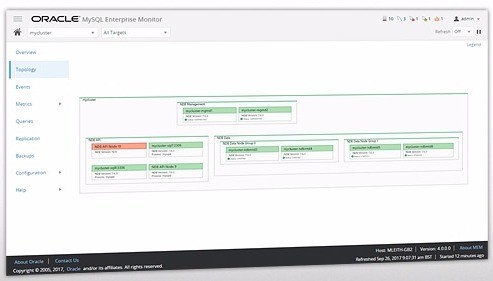
MySQL is the kind of tool you might not notice at first; it runs quietly in the background, powering many sites, applications, and systems you use daily. It is a relational database management system; even if you’re not deep into programming, you can still get a clear idea of what it’s about. In simple terms, MySQL dumps, indexes, and retrieves data in an effective way that allows websites and apps to perform smooth functions without losing track of the data they rely on.
Basically, it runs on structured data rows, tables, and relationships. It is as if we had a digital filing cabinet that can be searched, updated, and changed with a couple of lines of query language. Unlike a basic file system, it handles large volumes of data without getting overwhelmed. It is this trait that makes it trustworthy even on small websites and huge systems.
The reliability of MySQL has been the reason why it has survived since its creation in 2001. It has decades of existence, but it remains present in contemporary applications. Developers trust it as it is stable and mature. It does not make any attempt at being showy, and it is one of its strongest points. It is a system that continues doing its thing every day, day in, day out, regardless of whether you can see it or not.
Why Should I Download MySQL?
Unless you happen to be too cool to use word processors and spreadsheets, chances are you will get to a point where a spreadsheet or paper can no longer handle your data needs. That is where MySQL can prove its point. It also gives your data consistency and provides you with a sound platform to retrieve the information whenever you require it.
One does not have to be a database administrator when beginning to use MySQL. Most people can be trained to create a simple database, make simple queries, and begin organizing and managing their data with just a little curiosity and some patience. You don’t need extensive coding skills to communicate with the database, thanks to SQL, or Structured Query Language. Basic knowledge opens the doors very soon.
Another reason to use MySQL is its performance. It can accommodate read-heavy and write-heavy workloads, which implies that, whether you are reading or constantly giving new information, it can cope with that. That is why it is applied to the industries where performance is not negotiable, such as finance, healthcare, and even e-commerce.
Portability is another plus point. MySQL operates in the majority of current operating systems, such as Windows, Linux, and macOS. Not only are you not limited to one environment, but it also works well with some of the most popular programming languages, such as PHP, Python, Java, and C#.
Of course, there is the other section, which is easy to miss: documentation and community help. MySQL is so old that almost all the questions you might ever have about a problem or setting up, you will find the answer to them somewhere. Online resources, along with official documentation, help ease to fixing bugs and getting better at your database over time.
Whether you are creating a simple portfolio site or you want to work out a feature-packed web application, MySQL provides you with the framework you require to keep everything organized. It doesn’t do everything for you, but it provides you with the proper equipment to construct what you require neatly and cleanly.
Is MySQL Free?
Yes, MySQL can be used free of charge. The Community Edition is open-sourced and is free of charge. In addition to that, there is also a commercial version provided by Oracle, which has more advanced features and support for enterprise users. The free and open source version has, however, everything required by most individual developers and small to medium-sized projects.
What Operating Systems Are Compatible with MySQL?
MySQL supports various platforms such as Windows, Linux, and macOS. It has the support of 32-bit and 64-bit architectures. It is lightweight and flexible, and hence does not require too many system resources. It can be operated on personal laptops and even on cloud servers, and it can be scaled effortlessly with the increase of data. Installation is simple, whether in a locally developed machine or on a hosted server.
What Are the Alternatives to MySQL?
Sometimes you realize that, while MySQL works well for many use cases, there are other tools that offer different approaches to handling data. No matter if you need a new interface, additional capabilities, or some other types of data flexibility, it’s good to know the alternatives.
As an example, DBeaver is not really a database, such as MySQL; it is a universal database management system. It connects to MySQL (and many others) and gives it something more visual and interactive in which to run and manage your databases. You are able to build tables, execute queries, and analyze data in a clear interface. It is wonderful with those programmers who like graphical interface tools more than command-line communication. DBeaver is not a substitute for MySQL in case you already run it, but it can be used as a friend, with simpler interfaces to manipulate your data.
Navicat, however, is indeed more specialized. It is an expensive software engineered to handle MySQL and other databases accurately. It is bundled with such features as data modeling, data backup, and synchronization. What separates it is the amount of control and access to insight it provides you with regarding your database structures. It is not free, but in most cases, it is worthwhile to spend some money on it when a user has to deal with big or complicated databases on a daily basis.
There is also dBase, which is more ancient. It was among the first database systems, and it has been reformed up to these days, but in a different use related directly to a more specific field. It is somewhat more oriented to desktop applications; it is still the same sort of tables and fields, with its own format. It is more appropriate in particular business contexts/legacy systems upon which it has been dependent over the years. Although not a current web database tool, dBase demonstrates how older database systems can still serve specific legacy purposes effectively.