
A few years ago, WireGuard was a setting you went looking for in a VPN app. Today it’s the default protocol in most of them, and even ExpressVPN, which spent years promoting its own alternative, now offers it. So a VPN that lists WireGuard tells you very little on its own. The difference lies in how each VPN builds around the protocol’s weak spots.
Out of the box, WireGuard keeps your IP address on the server, has no disguise for networks that block VPNs, and uses a key exchange that future quantum computers could break. Some VPNs fix all three, while others leave the defaults in place. We tested five that handle it well.
Top 5 WireGuard VPNs for 2026
- NordVPN: Best Overall. Its NordLynx protocol keeps WireGuard’s speed and removes its privacy weak spot.
- Proton VPN: Best for Privacy. Its Stealth protocol disguises WireGuard-based traffic on networks that block VPNs.
- ExpressVPN: Best for Simple Apps. It replaces keys and IP addresses on every WireGuard connection.
- Private Internet Access: Best for Customization. It offers more connection settings than any other VPN we tested.
- Surfshark: Best Value. It was the quickest on WireGuard in our UK speed test and has no device limit.
WireGuard VPNs Compared
Speed loss compares each VPN’s UK server, with WireGuard or the VPN’s WireGuard-based protocol selected, against our connection with no VPN.
| VPN | WireGuard version | UK speed loss | Post-quantum WireGuard | Devices | Price (2-year plan) |
|---|---|---|---|---|---|
| NordVPN | NordLynx | 3.0% | Yes | 10 | About $3.50/mo |
| Proton VPN | WireGuard, plus Stealth | 6.0% | No | 10 | About $3/mo |
| ExpressVPN | WireGuard, plus Lightway | 3.1% | Yes | 10 | About $3/mo |
| Private Internet Access | WireGuard | 4.8% | No | Unlimited | About $2/mo |
| Surfshark | WireGuard | 1.8% | Yes | Unlimited | About $2.50/mo |
WireGuard VPNs We Recommend
1. NordVPN: Best Overall WireGuard VPN
Pros
- Keeps no IP address on the server
- Post-quantum encryption in every app
- Among the fastest VPNs we tested
- Private networks between your devices
- Independently audited no-logs policy
Cons
- Higher price after the first term
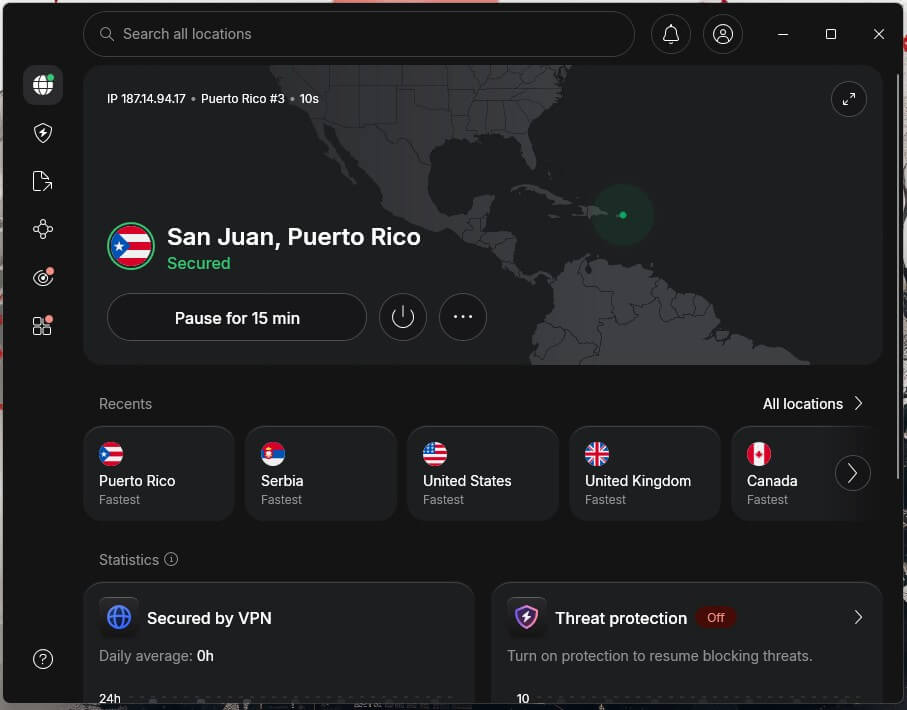
NordVPN didn’t stop at adding WireGuard. It built NordLynx on top of the protocol to fix its main privacy weak spot, the IP address a plain WireGuard server stores. With a double NAT system, each session receives an internal IP address that isn’t tied to you.
NordLynx also adds post-quantum encryption to the key exchange, now in every NordVPN app. As a result, you keep WireGuard’s speed without its usual trade-off. On NordLynx, NordVPN’s US server lost only 4.7% of our speed, and our NordVPN review shows that was the best US result in our tests.
For that reason, long-distance streams and downloads barely slowed. On top of that, NordLynx powers Meshnet, which links your own devices into a private network for file sharing or remote access. The downside is cost later on: the first term starts at about $3.50 a month for the Basic plan, but the renewal price is much higher.
For that reason, the two-year plan is the better buy: it keeps the low rate the longest.
2. Proton VPN: Best for Privacy
Pros
- Disguises WireGuard traffic on strict networks
- Open-source, independently audited apps
- Multi-hop servers for extra privacy
- Based in privacy-friendly Switzerland
- Downloadable WireGuard setup files
Cons
- No post-quantum encryption yet
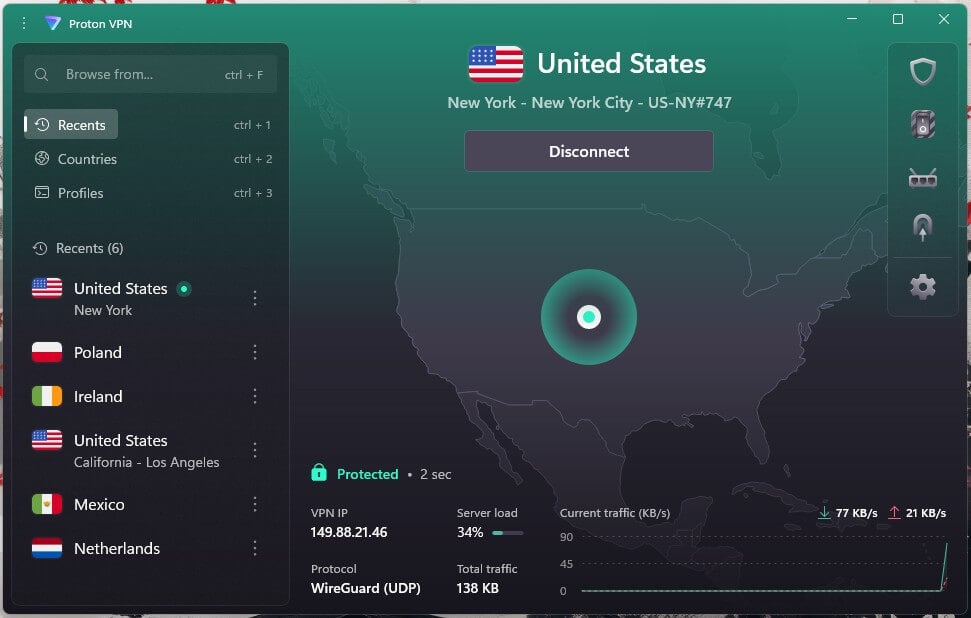
Proton VPN solves the problem most WireGuard VPNs ignore: networks that block VPN traffic. Its Stealth protocol, built on a WireGuard framework, uses obfuscation to make the connection look like ordinary encrypted web traffic. In our UK test, Stealth was only 1.9% slower than plain WireGuard.
So, you lose almost nothing by leaving it on at work, at school, or abroad. Beyond that, the VPN Plus plan adds Secure Core, which sends your traffic through hardened servers in Switzerland, Iceland, or Sweden before it exits. Proton VPN’s privacy record is strong too, with open-source apps and independent audits.
On standard WireGuard, it averaged a 10.2% speed loss across three server locations, and the UK result was the slowest of the five. Even so, that’s plenty for HD streaming and video calls. VPN Plus costs about $3 a month when you commit to two years, and there are ways to try Proton VPN for free before you pay.
Before you subscribe, though, know its main drawback: Proton VPN doesn’t offer post-quantum encryption yet. A new WireGuard codebase in beta lays the groundwork for it, but until it arrives, NordVPN or ExpressVPN is the better choice if long-term encryption is your priority.
3. ExpressVPN: Best for Simple Apps
Pros
- Post-quantum WireGuard by default
- New keys and IP address every session
- Lightway as a second fast protocol
- Easy apps for beginners
Cons
- Ad blocker doesn’t work with WireGuard
- No WireGuard in the Linux app
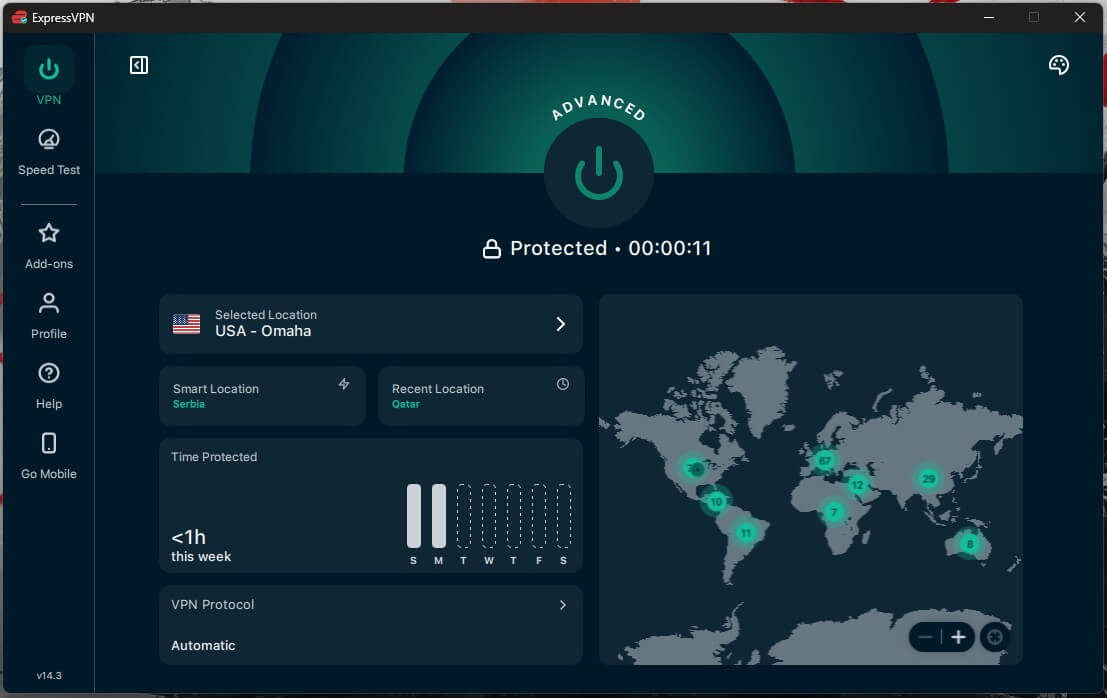
ExpressVPN avoided WireGuard for years in favor of its own Lightway protocol. When it finally added WireGuard, it rebuilt the setup: every session starts with a post-quantum key exchange, fresh keys, and a new internal IP address. So, like NordVPN, it leaves nothing persistent on the server, but it does so by replacing credentials each time you connect.
In practice, the protocol barely changed its speed. WireGuard lost 3.1% on our UK server, while Lightway lost 2.4%, so you can choose either and not notice the difference on a stream or a download. The apps are among the easiest we tested, too. To switch protocols, open your profile and choose WireGuard under Protocol.
However, there’s a trade-off. In our Windows tests, enabling Advanced Protection, ExpressVPN’s ad and tracker blocker, grayed out WireGuard and left only Lightway or Automatic. If you prefer WireGuard, keep that blocker disabled and use a browser ad blocker instead.
ExpressVPN’s Linux app doesn’t offer WireGuard either. The Basic plan, which covers 10 devices, is about $3 a month over two years.
4. Private Internet Access: Best for Customization
Pros
- Highly adjustable connection settings
- Port forwarding for torrent clients
- No-logs policy proven in court
- Open-source apps
- Unlimited devices on one plan
Cons
- WireGuard must be selected by hand
- Traffic disguise works only on OpenVPN
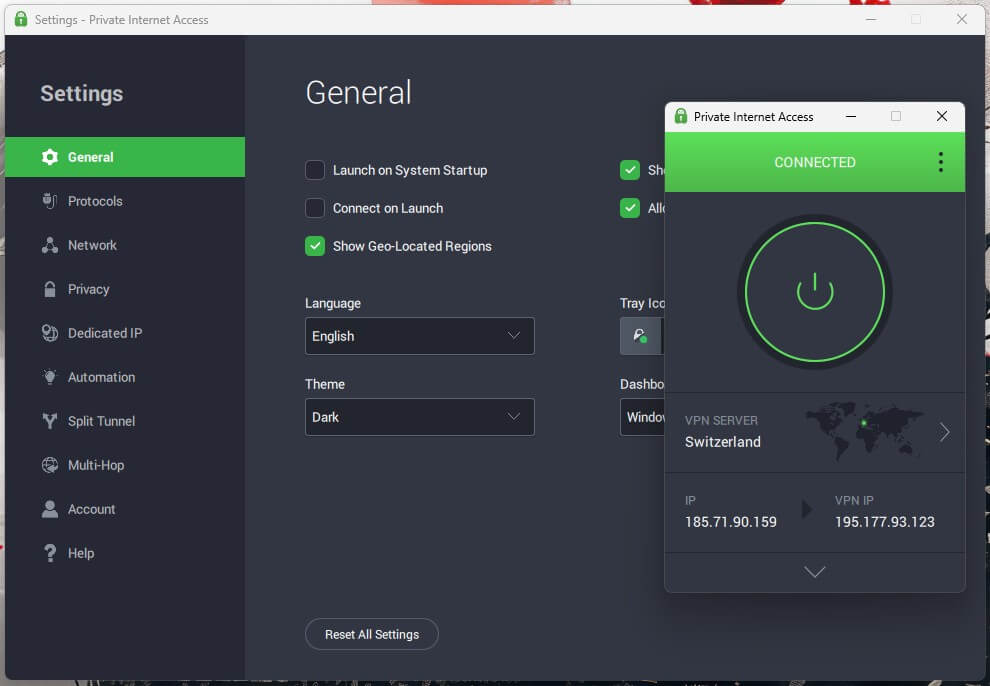
Private Internet Access is the most adjustable VPN we tested, but you have to find WireGuard first. The Windows app starts on OpenVPN with no automatic option, so open Settings and choose WireGuard before your first session. After that, you can still fine-tune ports, encryption, and multi-hop for the times you switch back to OpenVPN.
On WireGuard, PIA’s average speed loss was 12.7%, the largest of the five but still enough for 4K streaming. Its port forwarding also works on WireGuard, which helps torrent clients find more peers and makes PIA a reliable VPN for torrenting. One subscription covers unlimited devices for around $2 a month.
Courts have confirmed PIA’s no-logs policy, because it had no user data to hand over when asked. Still, a couple of issues keep it fourth. Its Shadowsocks proxy, PIA’s obfuscation, works only on OpenVPN, so on a network that blocks VPNs, you lose WireGuard.
Its kill switch also leaked traffic when we restarted the PC, which we didn’t expect from a VPN this focused on privacy. But you can always enable its strictest mode, use WireGuard, and keep your data safe.
5. Surfshark: Best Value WireGuard VPN
Pros
- Post-quantum WireGuard in its apps
- Unblocks Netflix and BBC iPlayer
- Built-in ad and malware blocker
- WireGuard setup files for routers
- No limit on devices
Cons
- Camouflage Mode works only on OpenVPN
- Sometimes slow to connect
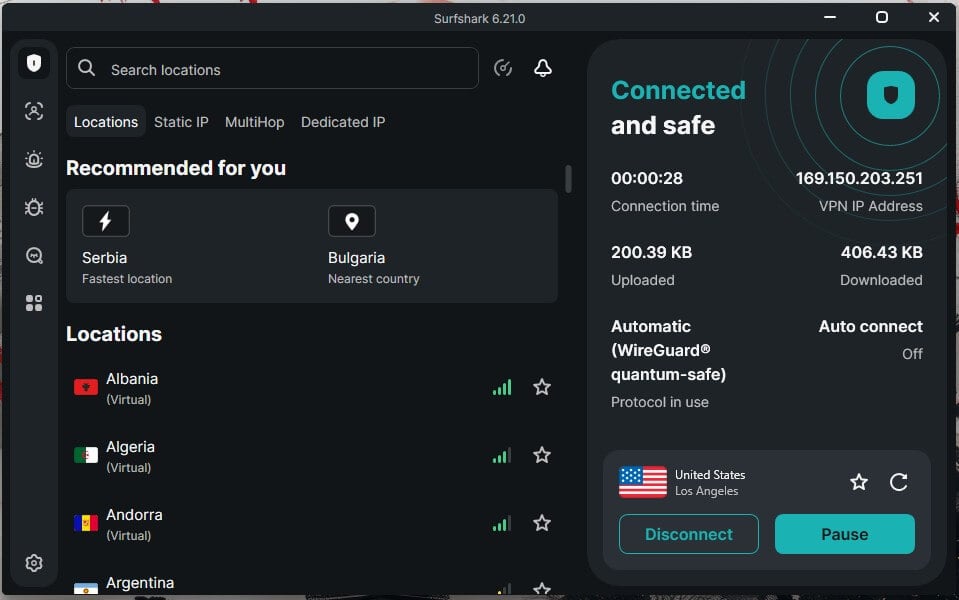
Surfshark turned in the best single result in our WireGuard tests: a 1.8% speed loss on its UK server. Surfshark’s version of WireGuard also adds post-quantum protection in the apps, so you have the speed and the stronger key exchange with one setting. For streaming, it unblocked 13 of the 14 services we tested, including Netflix and BBC iPlayer.
ITVX was the only one it couldn’t unblock. CleanWeb, its built-in blocker, removes ads and malware sites without a browser extension. With no device limit and a price of about $2.50 a month on the two-year Starter plan, it’s also one of the most affordable VPNs we tested.
That said, two things keep it at fifth. Camouflage Mode, Surfshark’s obfuscation setting, is limited to OpenVPN, which makes Surfshark a weaker choice for strict networks. Connections also took longer than usual now and then, so wait a few seconds before you try to reconnect.
What WireGuard Does Well, and Where It Falls Short
How Much Faster Is WireGuard?
On a fast home connection, the difference is small. NordVPN’s NordLynx averaged a 7.8% speed loss on our UK, US, and Japanese servers, while OpenVPN lost 9.5% on the same servers, a result our OpenVPN and WireGuard comparison explores in more detail. That’s only 1.7% apart, and OpenVPN even had the lower ping on the UK server.
WireGuard’s advantage shows up elsewhere. It connects in a second or two, uses less of your device’s processor, and reconnects almost instantly when a phone moves between Wi-Fi and mobile data. That makes it the protocol to choose on a phone, whether you use one of our top VPNs for iPhone or an Android app.
The same efficiency helps battery life. In our Android VPN tests, the WireGuard-based protocols added little drain during video playback, and older laptops and routers benefit in the same way.
Lean Code and Modern Encryption
WireGuard has about 4,000 lines of code, against hundreds of thousands for OpenVPN. A smaller codebase leaves fewer places for bugs to hide and makes independent audits faster. It also uses a fixed set of modern ciphers, ChaCha20 for encryption and Curve25519 for the key exchange, so there’s no weak setting for an app to choose by mistake.
However, that key exchange isn’t safe against future quantum computers. Someone could record encrypted traffic today and decrypt it once those computers exist. WireGuard’s own documentation recommends adding a post-quantum handshake on top, and NordVPN, ExpressVPN, and Surfshark have done that.
The IP Address Problem
By design, a plain WireGuard server stores each user’s actual IP address and assigns them the same internal IP address every time. That’s a problem for a VPN that promises not to keep logs, because the server keeps a record until it restarts.
NordVPN and ExpressVPN solve it in different ways, but the result is the same. Once you disconnect, the server keeps nothing that ties your activity to you.
Why Some Networks Block WireGuard
WireGuard sends traffic only over UDP, and its handshake has a recognizable pattern. As a result, office, school, and hotel networks that block VPNs can spot it easily, and so can countries that filter the internet. The protocol has no obfuscation built in.
So the VPN has to add it. Proton VPN’s Stealth does that while keeping a WireGuard-based design, and NordVPN switches to its separate NordWhisper protocol on obfuscated servers. Several others rely on OpenVPN for their disguise modes, which means giving up WireGuard on strict networks.
How to Use WireGuard With a VPN
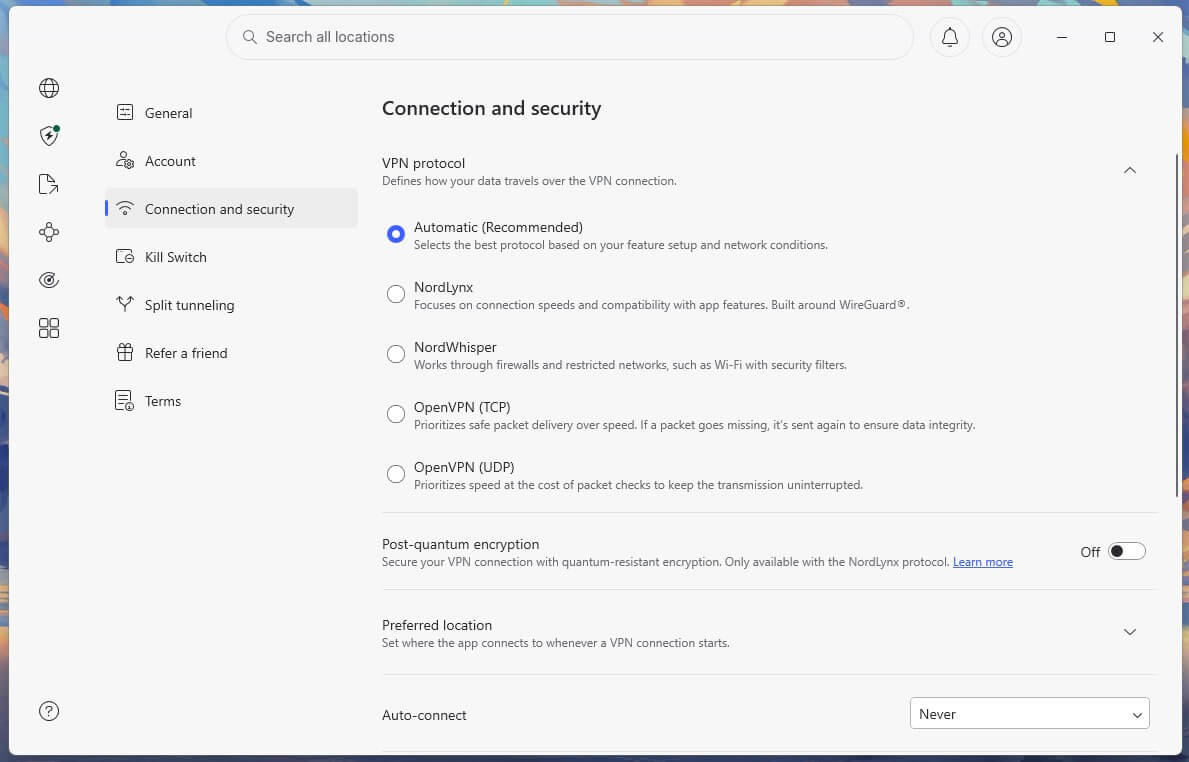
In most apps, you don’t have to do anything. NordVPN, Proton VPN, Surfshark, and ExpressVPN choose a protocol automatically, and they usually settle on WireGuard or their own protocol. To set it yourself, open the app’s protocol settings and select WireGuard, or NordLynx on NordVPN.
A router or the official WireGuard app requires a configuration file instead. Proton VPN and Surfshark let you create one in your online account, choose a server location, and import the file into any WireGuard client. Surfshark’s post-quantum protection doesn’t apply to these manual setups, so use its apps where you can.
Among the free VPNs we tested, Proton VPN’s plan is the simplest way to use WireGuard. It connects over WireGuard, and free accounts can download configuration files for the free countries. The free app still chooses the server for you.
Conclusion
WireGuard won’t decide which VPN is fastest. In our tests, the difference between protocols was small, and every VPN on our list of the best VPNs is quick enough for 4K. What decides it is how each one handles the protocol’s three weak spots: the stored IP address, the missing disguise, and the key exchange.
NordVPN fixes the stored IP address and the key exchange without giving up speed, so it’s the WireGuard VPN most people should choose. If you often connect from networks that block VPNs, choose Proton VPN instead, even before its post-quantum update arrives.
FAQ
Is WireGuard safe to use?
Yes. WireGuard uses modern encryption, including ChaCha20 and Curve25519, and its small codebase is easy to audit. Its weak point is that servers store IP addresses, which good VPNs work around.
Can WireGuard be blocked?
Yes. WireGuard sends traffic over UDP with a recognizable handshake, so strict networks can block it. Proton VPN disguises it with its Stealth protocol, while NordVPN switches to NordWhisper on obfuscated servers.
Is WireGuard TCP or UDP?
WireGuard uses UDP only. That keeps connections quick, but networks that allow only TCP traffic block it, so VPNs keep OpenVPN or a disguise protocol available as a fallback.
Is there a free VPN with WireGuard?
Yes. Proton VPN's free plan connects over WireGuard and lets free accounts download WireGuard configuration files, but the free app chooses the server location automatically.
Does NordVPN use WireGuard?
Yes. NordVPN's NordLynx protocol is built on WireGuard and adds a double NAT system, so servers don't keep a user's IP address. NordLynx also includes post-quantum encryption.