Private Internet Access pricing starts lower than almost any big-name VPN, but the headline number only tells half the story. PIA built its reputation on substance over flash: open-source apps, independent audits, and settings you can tweak down to the cipher level. It’s a toolbox, not a toy, and it charges accordingly.
The question for 2026 is what that low price actually buys you. Monthly plans, long-term deals, add-ons like antivirus and dedicated IP, and a money-back guarantee all factor in. Here’s a full breakdown of PIA’s plans and whether the long-term subscription is still worth locking in now in October.
Private Internet Pricing Recap: Updated October 2026
| Monthly Plan | 6-Month Plan | 2-Year Plan + 2 FREE Months | |
| VPN Subscription | $11.95/mo | $7.50/mo | $1.33/mo |
| Dedicated IP | $5/mo | $4.25/mo | $2.50/mo |
| Antivirus | $4.50/mo | $2.76/mo | $1.45/mo |
| Renewal Price | $11.95/mo | $45 every 6 months | $56.94 annually |
PIA VPN Price: Plans and Subscriptions Explained
Private Internet Access doesn’t deal in gimmicks or tiered limitations. It offers a single, all-inclusive plan with every feature unlocked (unlimited devices, all protocols, full customization), no matter how long you subscribe. The only variable is the duration, and naturally, the longer you go, the less you pay per month.
1-Month Plan: Total Flexibility, Highest Price
If you only need a VPN for a short-term trip, to access region-blocked content, or just want to test the waters, PIA’s $11.95/month plan gives you complete access with no restrictions. It’s not the cheapest short-term VPN out there, but it’s still more affordable than most monthly plans. You get everything included (no watered-down experience), but the per-month cost adds up fast, so this one’s best for brief use or testing before going long-term.
6-Month Plan: Decent Middle Ground
Private Internet Access also offers a 6-month plan for $7.50/month, billed at $45. It’s a lesser-known option that doesn’t get much attention, but it’s good if you want more than a month without committing to a full year or two. If long-term privacy is the goal, the 2-year plan below is the better buy.
2-Year + 2 Months Free: The Best Value (With Our Deal)
This is where PIA earns its budget reputation. With our exclusive Private Internet Access deal, you get 2 years plus 2 free months for just $1.33/month. That comes out to a one-time payment of around $35 for 26 months of full-service VPN coverage, hard to beat at this level. If you buy directly from Private Internet Access’s homepage, you might see a slightly higher rate. So this deal is exclusive to Gizmodo.
Nothing’s held back. You get unlimited simultaneous connections, 90 server countries, RAM infrastructure, advanced kill switch options, and split tunneling by app or IP. During our tests, this long-term plan easily handled 14 connected devices simultaneously, without a hiccup in speed or performance. If you’re ready to go all-in on digital privacy, this is the plan to get in October 2026.
Renewal Pricing: Still Reasonable Long-Term
After your initial deal ends, PIA bumps you up to a renewal rate of just over $56 per year, which works out to $4.70/month. That’s still well below what most VPNs charge on renewal, and far more transparent than services that double or triple the cost after year one (NordVPN and even ExpressVPN are good examples).
Features That Actually Matter
Everything below is included at every subscription length, whether you pay $11.95 for a month or $1.33/month on the long-term deal. There are no feature tiers to decode, and unlike rivals that reshuffle their pricing structure every few months, PIA’s model has stayed the same for years. In other words, this list is exactly what your money buys. Here’s what stood out during our full PIA VPN review.
Unlimited Simultaneous Connections
One of PIA’s biggest flexes is its complete lack of device limits. Unlike most VPNs that cap you at 5 or maybe 10 devices, PIA lets you connect as many as you want, all at once. We tested it with a hefty lineup (three laptops, two phones, a tablet, a smart TV, and even a router) and saw zero slowdowns. This makes it a killer option for large households, digital nomads, or anyone with a growing collection of gadgets.
Server Coverage That Goes the Distance
PIA VPN gives you access to a fleet of over 30,000 servers across 90 countries, so you’re rarely more than a few milliseconds away from a reliable, fast connection. And because of its mix of physical and virtual servers, you’re not boxed into major regions. There’s solid coverage even in places that other VPNs tend to skip. During testing, we were able to switch between the US, Europe (it’s one of the best VPNs for Europe), and Southeast Asia with minimal lag and zero drops.
Customizable Encryption and Protocols
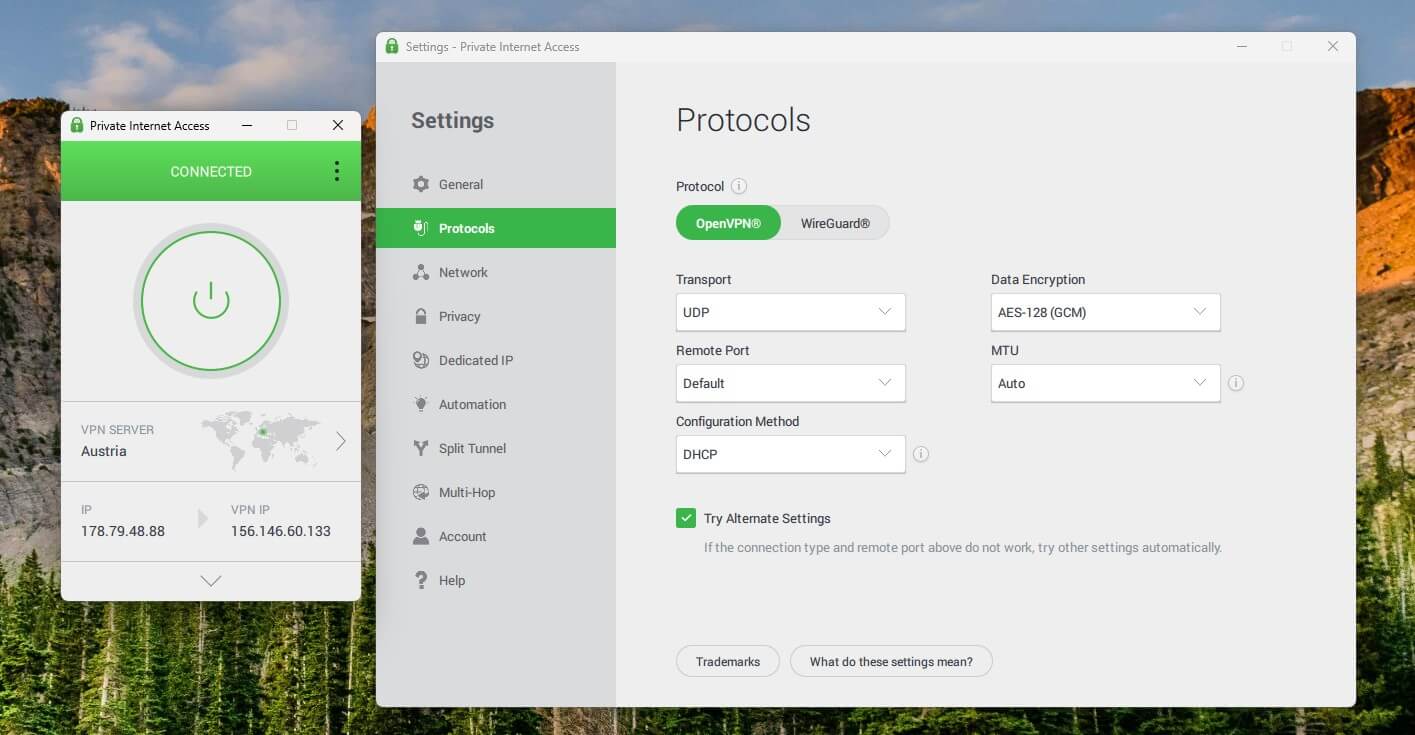
If you like your privacy settings dialed in just right, Private Internet Access gives you real control. It supports both WireGuard and OpenVPN (the two most trusted VPN protocols right now) and even lets you pick between 128-bit and 256-bit AES encryption on OpenVPN, so you can prioritize speed when gaming or streaming, and tighten things up when handling sensitive data. It’s one of the few VPNs that gives you this level of hands-on tuning.
Split Tunneling That Works by App and IP
Split tunneling is standard on premium VPNs, but PIA takes it a step further. Not only can you route individual apps outside the VPN tunnel, but you can also set specific IP addresses to bypass the VPN. Useful if you’re connecting to local servers, printers, or smart home devices that don’t play well with encrypted traffic.
A Smarter Kill Switch With Two Modes
It comes in two flavors: a traditional mode that activates if your VPN connection drops, and an advanced mode that blocks all internet access unless the VPN is running, even if you turn it off. The latter is perfect for people who want an always-on privacy setup, especially in countries with aggressive internet surveillance.
MACE Ad and Malware Blocking
While it won’t replace a dedicated ad-blocker, PIA’s built-in MACE feature does a solid job of cleaning up your browsing experience. It blocks malware domains, trackers, and banner and pop-up ads at the DNS level. We noticed cleaner pages and faster load times on ad-heavy sites on Windows and Android.
RAM-Only Servers and Proven No-Logs Policy
All of PIA’s infrastructure runs on RAM-only servers, which automatically wipe all data with every reboot, with no hard drives and no lingering logs. Its no-logs policy isn’t just a promise. It was tested in court, and unlike many VPNs, PIA VPN doesn’t opt you into anonymous diagnostic tracking by default. If you want to share usage data to help improve the service, you can, but it’s off unless you say otherwise.
PIA VPN Pricing: Conclusion
Private Internet Access proves you don’t need to overspend for serious privacy. It remains one of the most affordable VPNs, with real privacy tools, deep customization, and unlimited device support at a price rivals struggle to match. The 2-year + 2 months deal is the one to get at $1.33/mo. You’re getting a proven no-logs VPN with split tunneling, RAM-only servers, and open-source transparency.
It’s not perfect for streaming (some platforms still block it), and mobile upload speeds aren’t the fastest we’ve seen. But for consistent privacy across all your devices, PIA delivers. Bottom line of this PIA VPN pricing analysis? If you want a low-cost VPN that feels anything but cheap, this provider still punches above its price tag. Grab the long-term deal, because the monthly price no longer offers good value.
Try Private Internet Access Now
Frequently Asked Questions
💲 How much is PIA VPN subscription?
It's currently $1.33 per month for 2 years, with 2 free months. The price is active during the World Cup, but will go up after it ends.
💰 What is the lowest PIA VPN dedicated IP price?
The lowest price of PIA VPN for a dedicated IP is $2.50 per month for 2 years. The shorter the chosen plan, the higher the dedicated IP price.
🔖 How much is PIA monthly subscription?
A monthly subscription on Private Internet Access is $11.95 per month, making it one of the least attractive options for long-term users. However, it's also fully refundable for 30 days, so you can easily get your money back.