A phone is the device you travel with, so we tested all five of these VPNs on a Galaxy S26 Ultra and an iPhone 17 Pro. NordVPN cost the least speed, averaging a 16.9% loss across UK, US, and Japanese servers. ExpressVPN was the gentlest on battery of the five. Proton VPN and NordVPN cover 149 countries, and on a trip, the country list decides where you can connect. Prices run from $2.19 to $3.49/mo.
Best VPN for Travel: Our Five Travel VPNs
- NordVPN: Best travel VPN overall, and the fastest on both phones
- Proton VPN: Widest country coverage, tied with NordVPN at 149
- ExpressVPN: Kindest to a phone battery on a long travel day
- Private Internet Access: Cheapest, and no cap on devices for a family trip
- Surfshark: Strongest streaming access for the money
Travel VPNs Compared
| Mobile speed loss | Countries | Extra battery | Devices at once | Starting price | |
| NordVPN | 16.9% | 149 | 2% | 10 | $3.49/mo |
| Proton VPN | 22.2% | 149 | 2% | 10 | $2.99/mo |
| ExpressVPN | 19.5% | 113 | 1% | 10 | $2.99/mo |
| Private Internet Access | 26.7% | 91 | 3% | Unlimited | $2.19/mo |
| Surfshark | 23.6% | 100 | 3% | Unlimited | $2.49/mo |
Best VPNs for Travel Reviewed
Both handsets ran on the same WiFi: 54.7 Mbps down, 37 ms ping, nothing connected. Each app was tested against UK, US, and Japanese servers on the Galaxy S26 Ultra and the iPhone 17 Pro, with battery drawn from 20 minutes of YouTube at 1440p at full brightness. A phone costs roughly three times what a wired desktop does, so these percentages are the realistic travel figures.
1. NordVPN: Best and Fastest Overall
Pros
- Quickest on both phones
- 149-country network
- Quantum-safe protocol
- Obfuscated servers
- All 50 states
- Threat Protection
Cons
- Renewal price climbs
- Crowded app screen
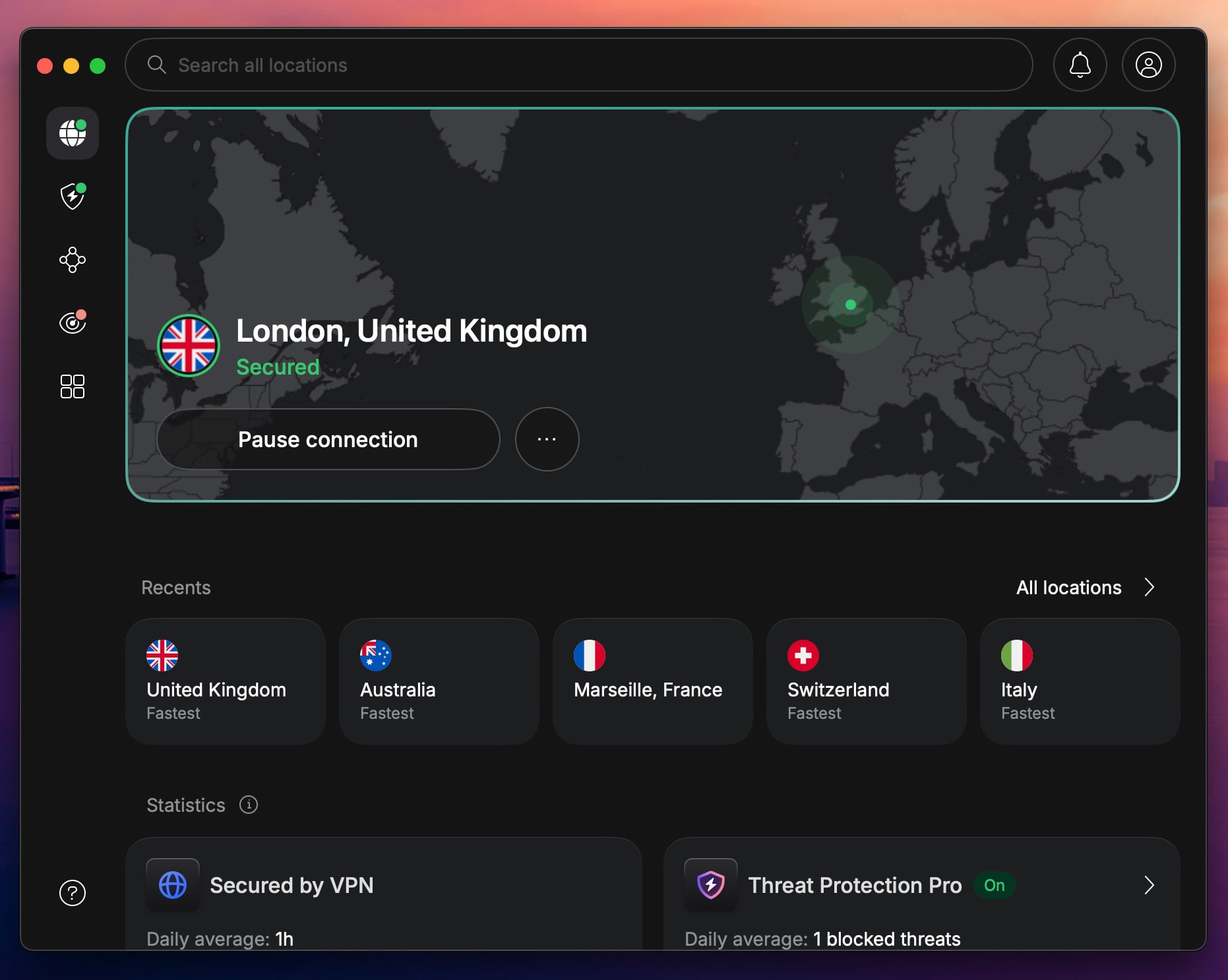
NordVPN averaged 16.9% across the two handsets and was the only app to stay under 15% on the iPhone. The margin widens with distance, so a traveler in Asia connecting back to Europe will feel it. Coverage is the other half of the case. NordVPN spans 149 countries and puts at least one location in all 50 US states, so a domestic trip has something nearby too.
Onion over VPN and Double VPN handle the sensitive end, and obfuscated servers plus the NordWhisper protocol disguise the connection where VPNs are restricted, which is why it is among the more reliable VPNs in China. Post-quantum encryption is a simple toggle on NordLynx. At $3.49 a month on the 27-month Basic plan, it is the most expensive of these five, and the renewal climbs further.
Its app is also the busiest of the group on a phone screen. Our NordVPN review covers the desktop side. 10 devices and a 30-day money-back guarantee apply.
2. Proton VPN: Widest Country Coverage
Pros
- 149 countries covered
- Code open to inspect
- Based in Switzerland
- Hardened entry servers
- Stealth on free plan
- Free plan, no cap
Cons
- No Smart DNS option
- No quantum-safe option
- Renewal nearly doubles
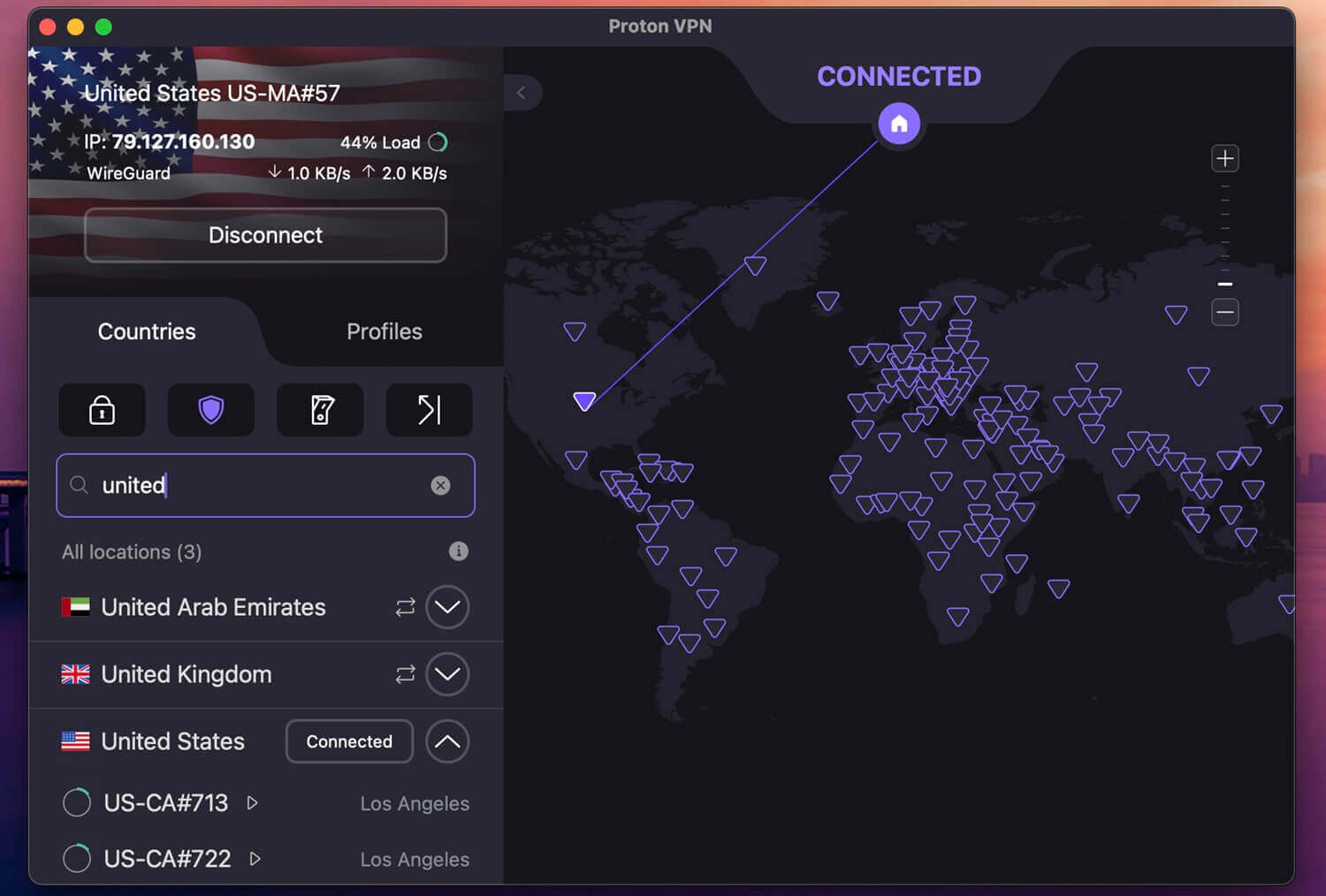
Proton VPN matches NordVPN on coverage at 149 countries, spread over 20,798 servers and 196 locations, and neither company is ahead of the other on that measure. It lost 22.2% averaged across the two phones, with its iPhone build well ahead of its Android one. Secure Core suits a trip specifically. The connection makes its first stop on a server Proton VPN owns in Switzerland, Iceland or Sweden, and only then continues to the destination country.
On a hotel network you know nothing about, that first stage is the point. Proton Stealth obfuscation covers restrictive networks, and it worked well for us in Dubai and the wider UAE. The apps are open source, and the no-log policy has passed five audits in five years. The free plan earns a mention for travel, since it has no data limit and costs nothing to keep as a backup.
Paid pricing is $2.99 a month on the two-year term, $71.76 up front, then $83.88 a year, covering 10 devices with a 30-day refund. Smart DNS is absent, so a hotel TV requires a workaround.
3. ExpressVPN: Smallest Battery Consumption
Pros
- Gentlest on battery
- Obfuscation by default
- Easiest app to learn
- Stable across networks
- MediaStreamer included
- Nothing stored on disk
Cons
- Just 113 countries
- No second-hop routing
- Sharp renewal increase
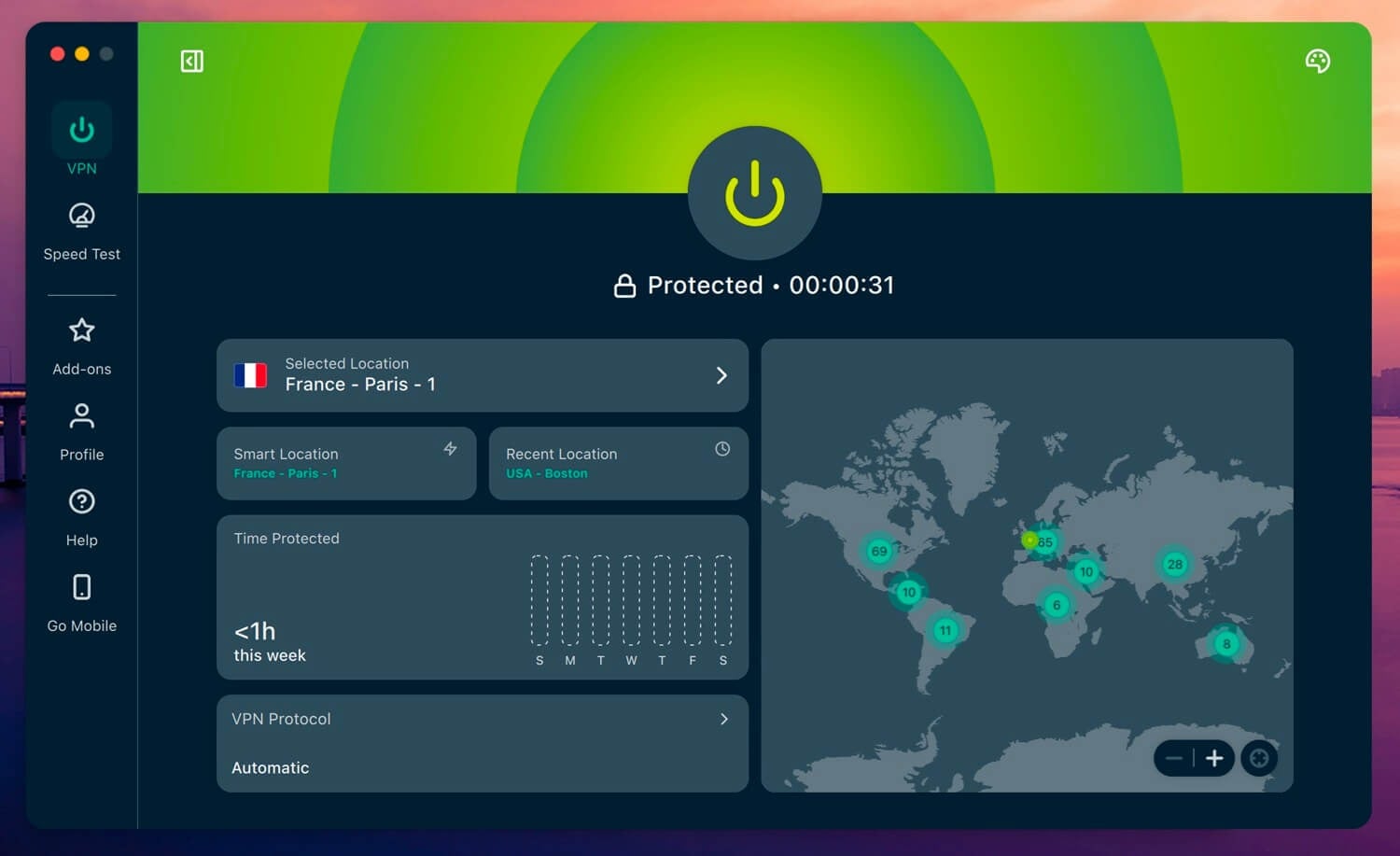
ExpressVPN wins on battery. The same video session that cost the others 2% or 3% cost ExpressVPN 1%. Across a day of airports, transfers, and no charger, that adds up. Speed came second overall at 19.5%. Every connection is obfuscated automatically, with no protocol to choose and no switch to find, so a hotel or airport network that filters VPN traffic requires nothing configured.
Lightway Turbo was built for the WiFi-to-cellular handoff a phone makes. Smart DNS (called MediaStreamer) covers a television, and the ExpressVPN review has the full picture on its speed record. At 113 countries and 214 locations, it trails both VPNs above it, which shows on a trip to a less-visited destination. Pricing is $2.99 a month across 28 months, renewing at $99.95 a year.
4. Private Internet Access: Cheapest VPN for Travel
Pros
- Unlimited connections
- Lowest price here
- Obfuscation via Shadowsocks
- Logs proven absent
- 50-state coverage
Cons
- Last on both phones
- Narrowest country list
- Cluttered app
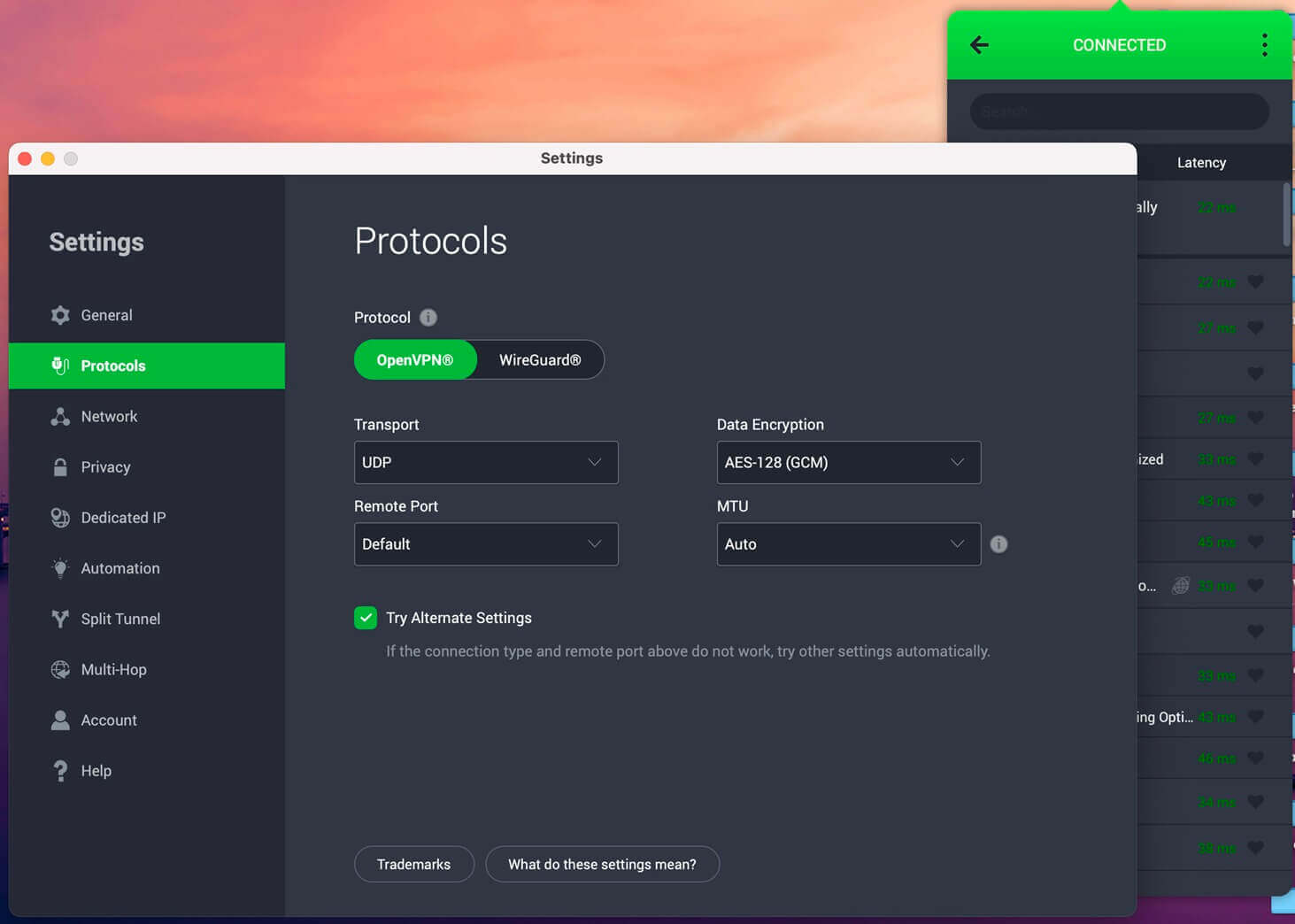
PIA suits a family trip, because a single subscription covers as many phones, tablets and laptops as the group brings. At $2.19 a month, it is also the cheapest here, and the renewal stays flat instead of climbing. It is headquartered in the United States, a Five Eyes member, which it answers with RAM-based servers, open-source apps, and a no-log policy tested in court twice. MACE strips ad and tracker domains, and Shadowsocks works on networks that filter VPN traffic.
It lists 26,000-plus servers across just 91 countries, so the network thins out at an unusual destination. The American network is the strongest part, with every state represented. Two drawbacks. It came last in speed on both phones at a 26.7% average loss, and the app is the least pleasant of the five to use on a small screen. Streaming access is patchier than the rest: Netflix works, while Prime Video, Hulu, and HBO Max were blocked in our testing.
5. Surfshark: Best for Streaming and Unlimited Devices
Pros
- No connection cap
- Broadest streaming access
- NoBorders mode
- MultiHop routing
- Throwaway identities
Cons
- Weakest Japan speeds
- Long connect times
- Dutch jurisdiction
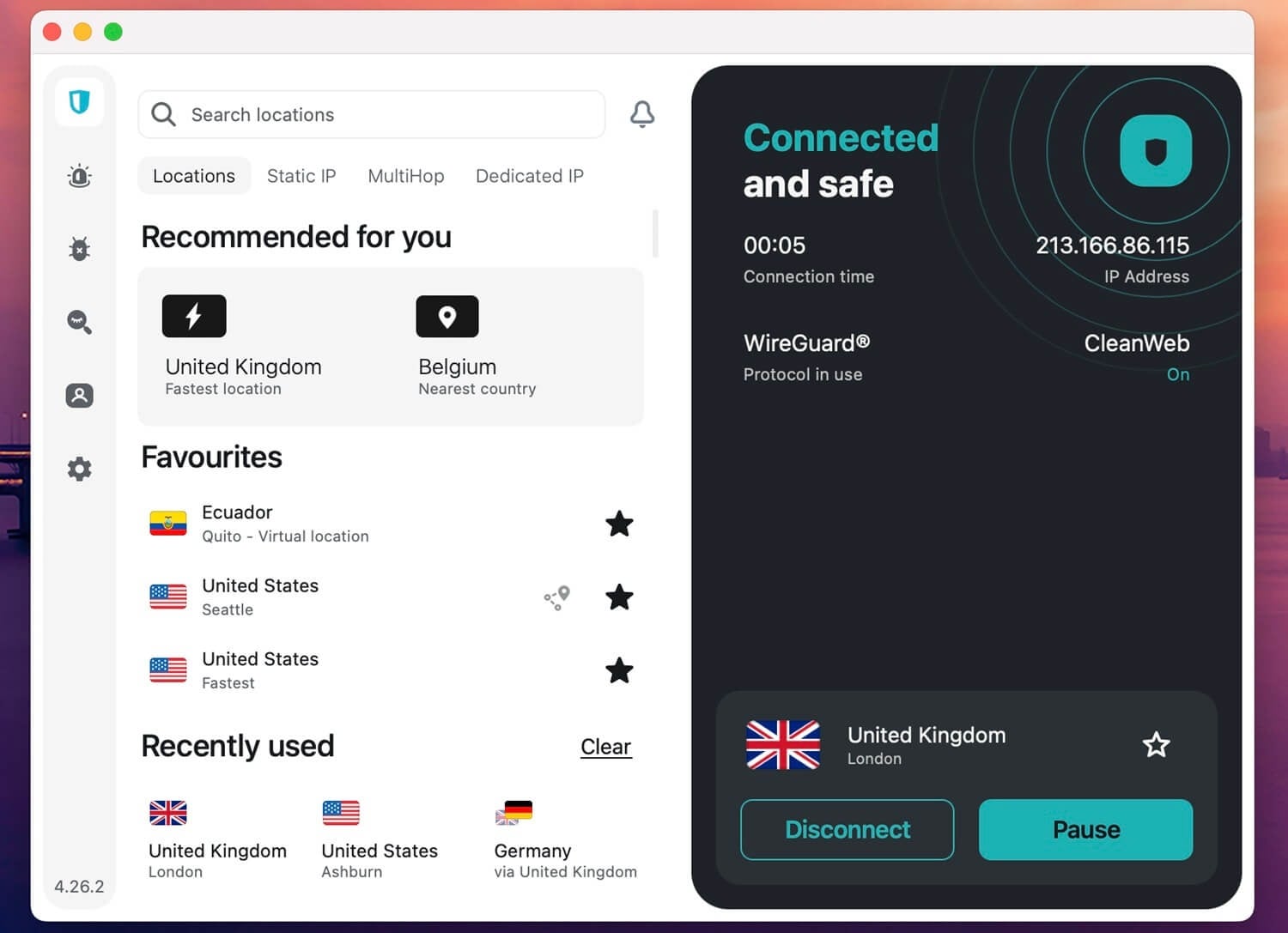
Surfshark opened 13 of the 14 streaming platforms we tried, behind only NordVPN and ExpressVPN on 14 each, and it needed no browser extension to do it. For a traveler whose main use is watching what they pay for at home, that record is the argument. NoBorders and obfuscation handle restrictive countries, and Dynamic MultiHop routes your connection through two servers.
Device connections are uncapped, so it competes with PIA for group trips. The no-log policy was audited by Deloitte. Distance is its weakness. On the iPhone, it fell slowest of the five on the Japanese server, losing 38.2% there, so a trip to Asia-Pacific suits another name better. It averaged 23.6% overall. Surfshark costs $2.49 a month on the Starter 2-year plan, refundable for 30 days.
What a VPN Changes Overseas
- Your bank stops recognizing you. Card issuers and banking apps flag logins from a foreign IP address, and some freeze access. Connecting to a server in your home country before you open the app avoids the problem, and most people buy a VPN before a trip for exactly this.
- Public networks stop being private. Hotel, airport, café, and cruise-ship WiFi are shared by strangers, and encryption stops the rest of them from reading your traffic. Turn on the kill switch and the auto-connect option so protection applies the moment the phone joins an unknown network.
- Websites you use daily disappear. China, Russia, Iran, and the UAE block sites and apps that work in most other countries. Obfuscation decides whether a VPN connects in those places. ExpressVPN turns it on by itself; the other four leave it to you.
- Roaming costs replace your data plan. A VPN does nothing about that, and a travel eSIM does. Our guide to eSIM plans for international travel covers the options, and running a VPN over an eSIM connection works the same as over WiFi.
One thing a VPN does not do: it is not antivirus software. Phishing and malware are still your problem, so keep your usual protection running alongside it.
Watching Sky Go, iPlayer and Home Streaming Abroad
British subscriptions break hardest the moment you leave. Sky Go reads your location from the IP address, so a UK server restores it. BBC iPlayer and ITVX work the same way. All five VPNs here have UK servers. American libraries behave similarly. Netflix swaps to the local catalog based on your IP address, and connecting to a US server brings the home version back.
The VPNs differ on how many platforms they open: NordVPN opened all 14 we tested and Surfshark 13, while PIA opened 9. Download what you want before you fly where you can. Netflix, Prime Video, and Disney+ allow offline downloads, and a plane with no WiFi makes a VPN irrelevant.
VPNs for Expats and Long Stays
An expat has a different problem from a tourist. The trip doesn’tend, so the VPN becomes part of daily life instead of a two-week convenience. Three things change over a long stay. A dedicated IP address stops banks and work systems from treating every login as suspicious, and NordVPN, PIA, and Surfshark all sell one as an add-on. Country coverage has to include both your home country and the one you live in, which puts NordVPN and Proton VPN at 149 countries ahead.
And renewal pricing stops being a detail once a subscription lasts for years. Working abroad, split tunneling is worth setting up so local banking and government sites use the local connection while work traffic stays tunnelled.
Set It Up Before You Fly
- Subscribe at home. Some countries block VPN websites and app stores, so buying on arrival may not be possible. NordVPN is our pick.
- Install on every device you are packing. Phone, laptop, tablet, and any streaming stick. Sign in to each one while the connection is still reliable.
- Turn on the kill switch and auto-connect. Both stay off until enabled in most apps, and both are what protect you on a network you did not choose.
- Pick your protocol. NordLynx, Lightway, and WireGuard are the fast defaults. Switch to obfuscation only if the connection fails.
- Test it before you leave. Connect to a server abroad and check that your IP address has changed, then open your banking app and your streaming service to confirm both behave.
For a fuller walkthrough, our guide on how to use a VPN covers the settings in detail, and changing your apparent location explains what a server switch does and doesn’t affect.
Can You Travel With a Free VPN?
Only as a backup. Free plans cap data between 500 MB and 10 GB a month, which a single evening of streaming will exhaust, and the plans with no cap are usually funded by selling browsing data. Proton VPN’s free tier is the exception worth having on your device, since it has no data limit and comes from a company whose no-log policy has been audited five years running.
The trade is one device at a time, no choice of server country, and no streaming access. Keep it as insurance and pay for something on this list as the main app. The cheapest VPNs begin at $2.19 a month.
Best VPN for Travel: Conclusion
Pack NordVPN. It lost the least speed on both phones, covers 149 countries including all 50 US states, and its obfuscated servers work in the places where a VPN is hardest to use. The price is the highest here, and the app takes some learning. Proton VPN matches it on coverage and undercuts it on price, with open-source code and a Swiss base for travelers buying on privacy grounds.
ExpressVPN suits a long day away from a charger. PIA is the budget answer at $2.19 a month, regardless of group size. Surfshark opens the most streaming platforms for the money, as long as your trip stays out of Asia-Pacific.
FAQs About Traveling With a VPN
Which VPN is best for traveling abroad and staying secure on public WiFi?
NordVPN. It combines coverage in 149 countries with obfuscated servers for restrictive networks, and its kill switch blocks traffic the moment a hotel or airport connection drops.
Does a VPN work with Sky Go abroad?
Yes, from a UK server. The service reads location from the IP address, so a British one restores it. The Sky account behind it still has to be a UK subscription.
What is the best VPN for expats?
NordVPN and Proton VPN suit long stays best, since both cover 149 countries. Adding a static IP address on top keeps banking and work logins from looking suspicious every time.
Is it legal to use a VPN overseas?
Yes, in most destinations. VPNs are legal across the US, Canada, the UK, and the European Union. China, Russia, Iran, and the UAE restrict unapproved apps, so install before departure.
Does a VPN slow down a phone abroad?
Yes, by roughly a fifth on a modern protocol, which still leaves enough bandwidth for HD streaming and video calls. A server near the traveler's actual location keeps that loss smallest.