
Alaska’s internet traffic travels to the Lower 48 through a handful of subsea cables that come ashore in Washington and Oregon. Many remote communities rely on satellite links instead, and Alaska finished last among US states for internet speed in 2026. Then there’s the public Wi-Fi at airports, at lodges, and on cruise ships, shared with strangers on networks you don’t control.
A good VPN for Alaska protects you on those shared networks, and the right server keeps your connection quick despite the distance. Some VPNs also offer an Anchorage location, which helps when you’re away and want sites to see an Alaska IP address. Here’s how the four we recommend compare.
Our Top VPNs for Alaska
- NordVPN: Best overall for Alaska, thanks to a fast Anchorage server
- Proton VPN: Best for airport and cruise ship Wi-Fi, with a Swiss privacy record
- ExpressVPN: Best for staying connected on the move
- Private Internet Access: Best for locations in all 50 states, for about $2 a month
Alaska VPNs Compared
| VPN | Server tested | Download speed | Speed loss | Devices | Long-term price |
| NordVPN | Anchorage | 176.14 Mbps | 7.5% | 10 | $3.49 a month |
| Proton VPN | Seattle (no Alaska location) | 140.02 Mbps | 26.4% | 10 | $2.99 a month |
| ExpressVPN | Anchorage | 146.24 Mbps | 23.2% | 10 | $2.99 a month |
| Private Internet Access | Anchorage | 148.15 Mbps | 22.2% | Unlimited | About $2 a month |
The Four Best VPNs for Alaska in Detail
In October, we connected to the Anchorage locations of NordVPN, ExpressVPN, and PIA, confirmed the city with an IP lookup, and checked speeds from Europe on Windows 11. Proton VPN has no Alaska location, and we tested its Seattle server instead. Results from Alaska will differ, though the figures show how the four VPNs compare.
1. NordVPN: Best for Fast Anchorage Connections
Pros
- Anchorage server for an Alaska IP address
- Auto-connect on public Wi-Fi
- Split tunneling for selected apps
- Optional dedicated IP in Seattle
Cons
- First-term discount ends at renewal
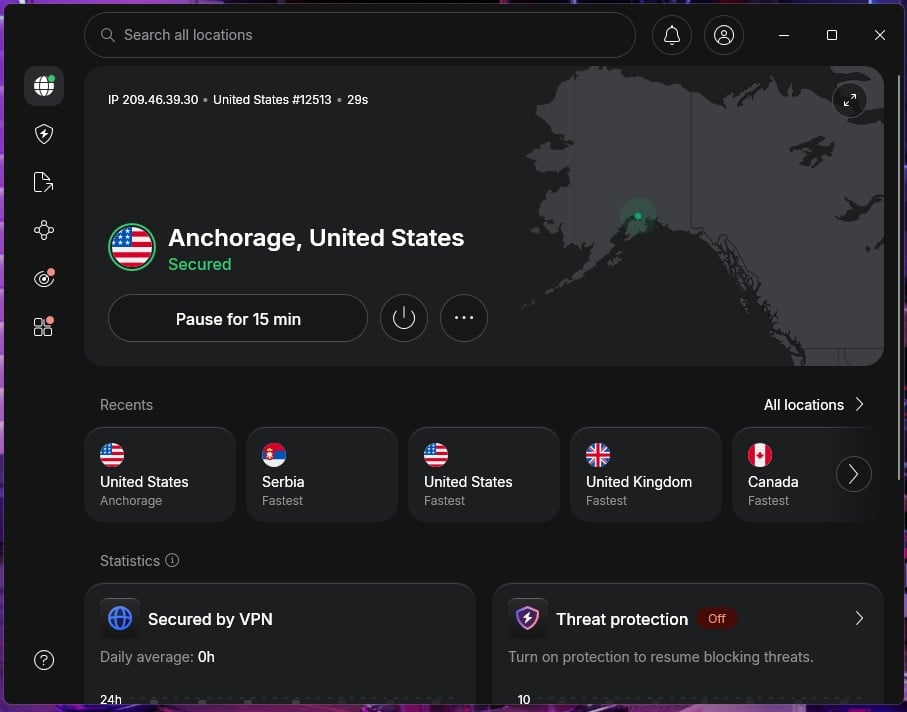
NordVPN was the fastest VPN we tested for Alaska. On its Anchorage server, it lost only 7.5% of our speed, and the IP lookup placed us in Anchorage, Alaska. NordVPN also covers 152 countries for trips farther afield. For travelers, NordVPN can connect automatically as soon as you join public Wi-Fi, such as the free network at Anchorage’s airport.
Split tunneling lets chosen apps, such as a streaming app that requires your local connection, bypass the VPN while everything else stays encrypted. The renewal price is much higher than the first-term rate, though. The 27-month plan keeps the lower rate for the longest.
New subscribers pay $3.49 a month for NordVPN’s Basic plan over the first 27 months, and it rises to $139.08 a year at renewal.
2. Proton VPN: Best for Airport and Cruise Ship Wi-Fi
Pros
- VPN Accelerator for long-distance connections
- Seattle servers close to Alaska
- Open-source apps for desktop and mobile
Cons
- No Alaska location
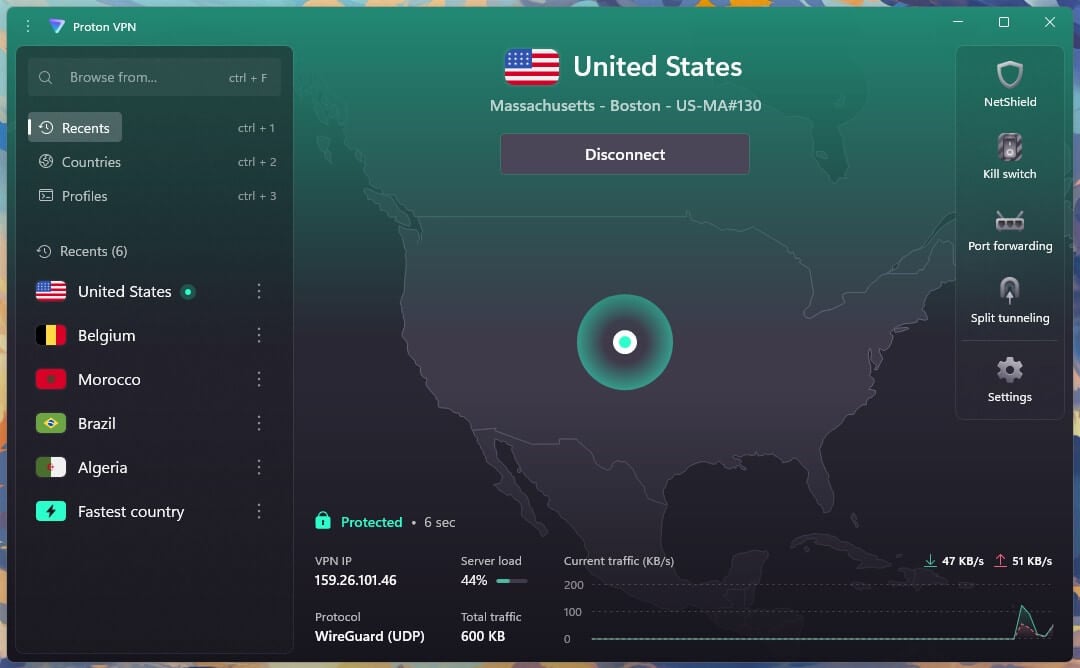
Proton VPN has the privacy record we’d want on shared networks, from airport terminals to cruise ships. The company is Swiss, independent auditors review its no-logs policy annually, and its apps are open source. Proton VPN is also one of the best free VPNs we’ve tested. Its free plan has no data limit, but the app picks the server. There’s no Alaska location, though. For privacy alone, its Seattle servers are enough.
Proton VPN lost 26.4% of our speed on a Seattle server, and VPN Accelerator, enabled by default, is designed to keep speeds up on long-distance connections. Choose NordVPN, ExpressVPN, or PIA if you want an Anchorage location. A two-year Proton VPN Plus subscription is $2.99 a month ($71.76 in total), and the yearly renewal is $83.88.
3. ExpressVPN: Best for Switching Networks on the Go
Pros
- Anchorage and Seattle locations
- Lightway built for quick reconnects
- Unblocks Netflix US and Peacock when traveling
Cons
- Few options to customize the connection
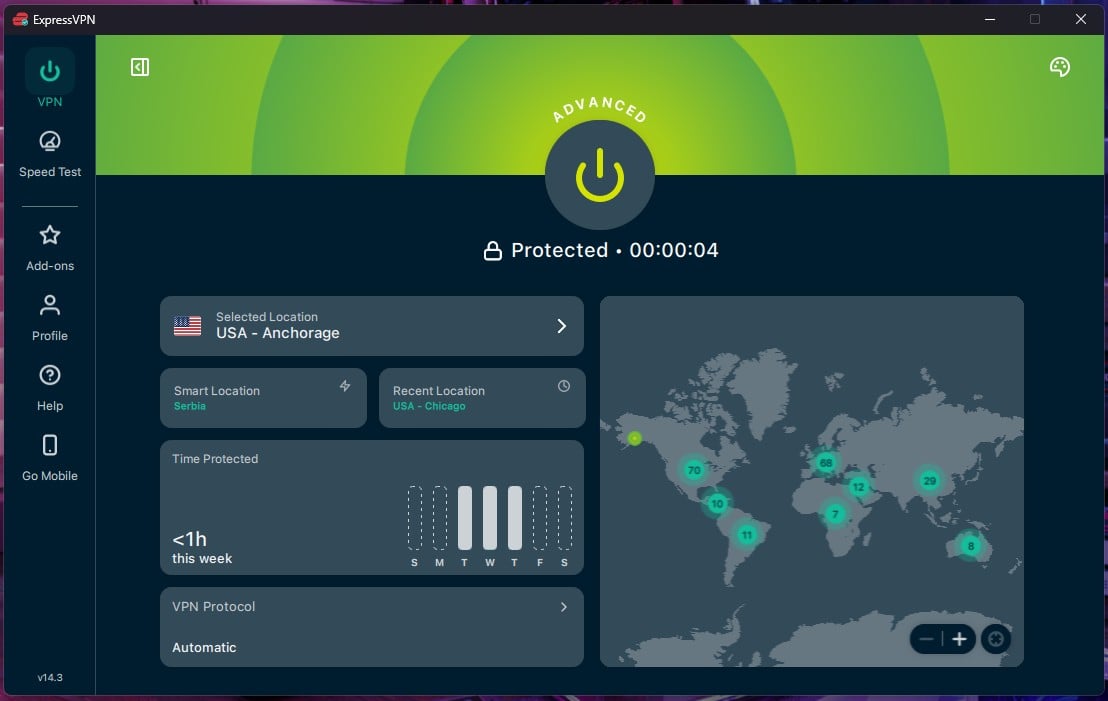
ExpressVPN offers an Anchorage location, and our IP lookup on it showed Anchorage, Alaska. It lost 23.2% of our speed there, a slowdown you’d hardly notice while browsing or streaming in HD. Its Lightway protocol is designed to reconnect quickly when your device changes networks, for example from lodge Wi-Fi to mobile data on the road.
Settings are minimal, and in practice, the Automatic protocol setting is the right one for most people. ExpressVPN also has an Apple TV app. ExpressVPN costs $2.99 a month on the Basic plan’s 28-month term ($83.72), then $99.95 for each renewal year.
4. Private Internet Access: Best for Locations in All 50 States
Pros
- Covers every phone, laptop, and TV at home
- MACE ad blocker saves data on capped plans
- Inexpensive to renew
Cons
- Windows app looks dated
- OpenVPN set as the default protocol
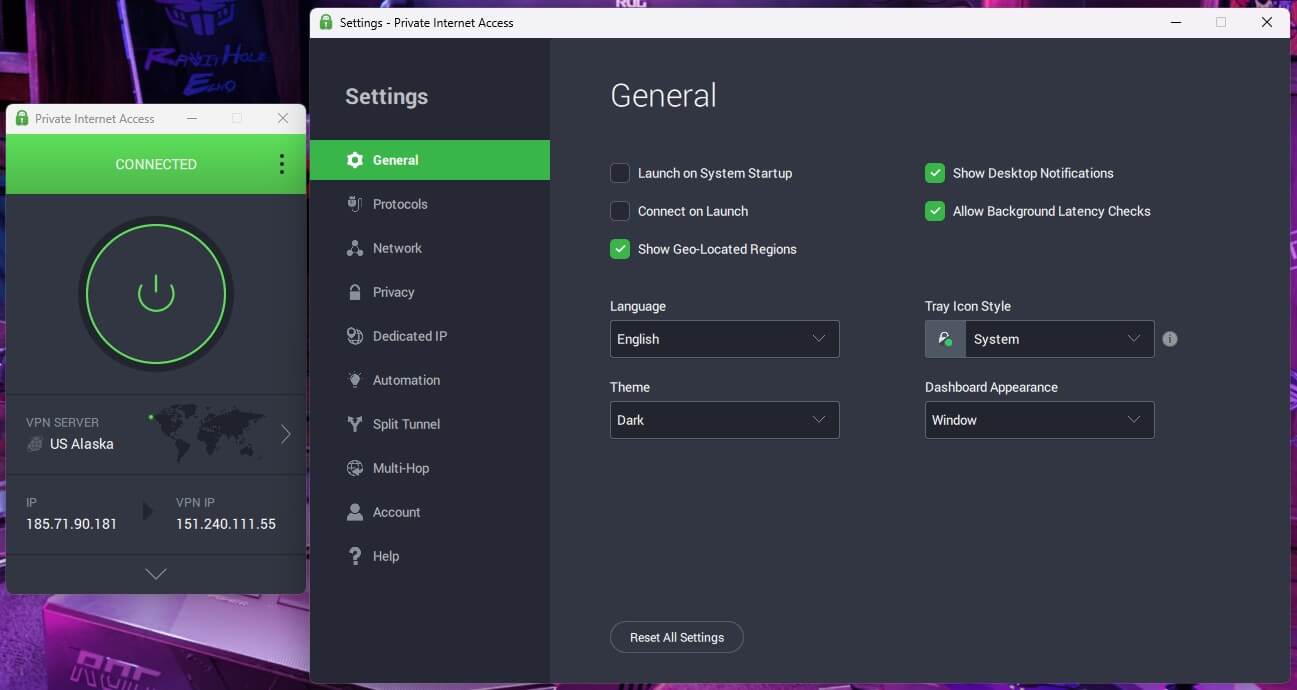
Private Internet Access lists a location in every US state, including Alaska. Its Alaska server showed Anchorage in our IP lookup and lost 22.2% of our speed, close to ExpressVPN’s result. There’s no limit on devices either. On Windows, the interface feels old-fashioned, though that doesn’t affect how the VPN works.
New installs use OpenVPN, and changing the protocol to WireGuard speeds up your connections. Our NordVPN vs PIA comparison sets their apps, prices, and speeds side by side. On a two-year plan, PIA is about $2 a month, and renewing costs less than with NordVPN, Proton VPN, or ExpressVPN.
Anchorage or Seattle: Which Server to Use
For an Alaska IP address, connect to Anchorage. NordVPN, ExpressVPN, and PIA offer it. For everyday browsing in Alaska, a Seattle server is a good alternative. GCI’s subsea cables connect Anchorage and Juneau to Seattle, and Alaska Communications’ cable comes ashore in Oregon. Traffic leaving the state passes through the Pacific Northwest either way.
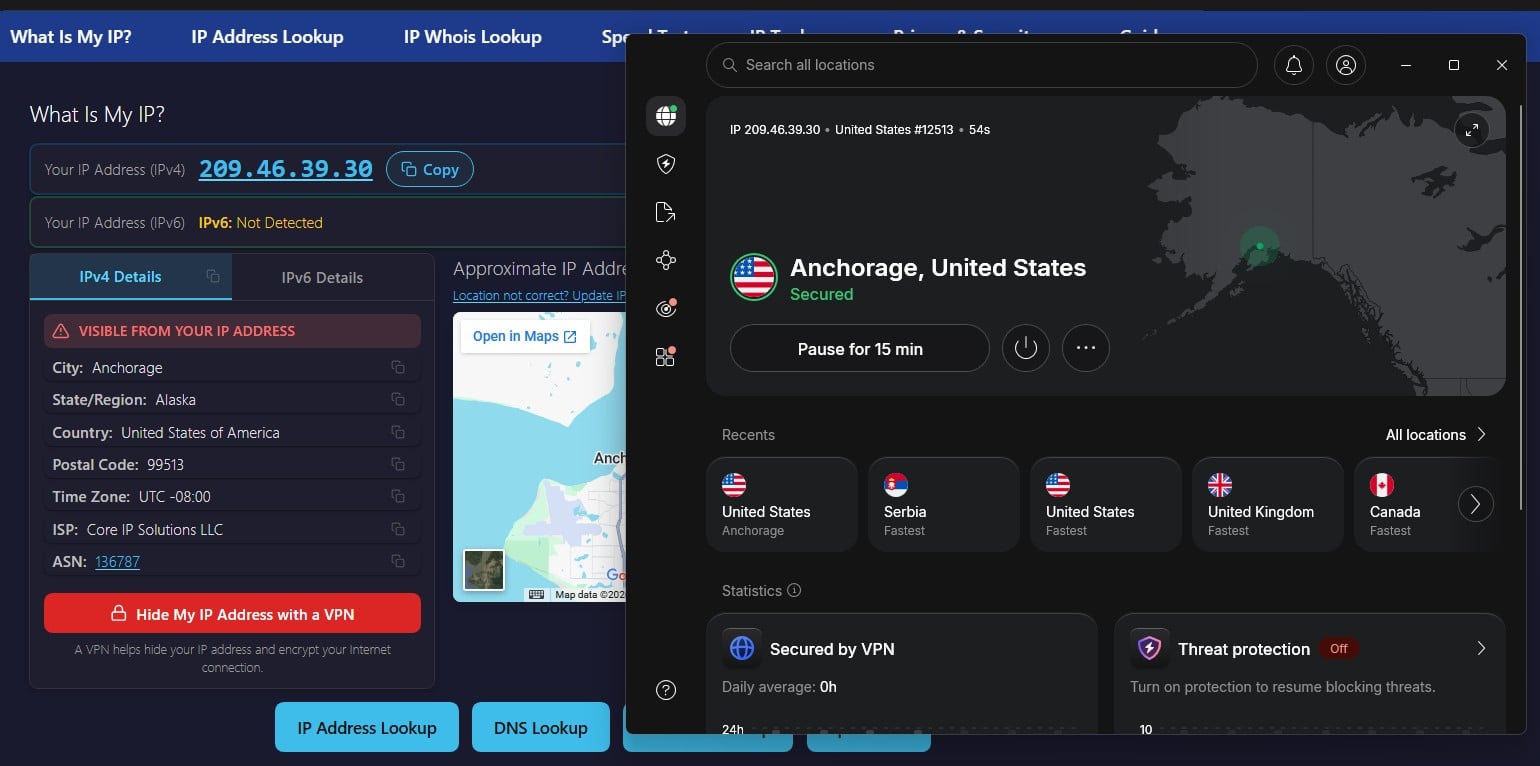
In our tests, NordVPN’s and ExpressVPN’s Anchorage servers were slightly faster than their Seattle servers. Your own connection decides the result. Try the two from home and keep the quicker one. Away from Alaska, an Anchorage server makes sites treat you as if you were home.
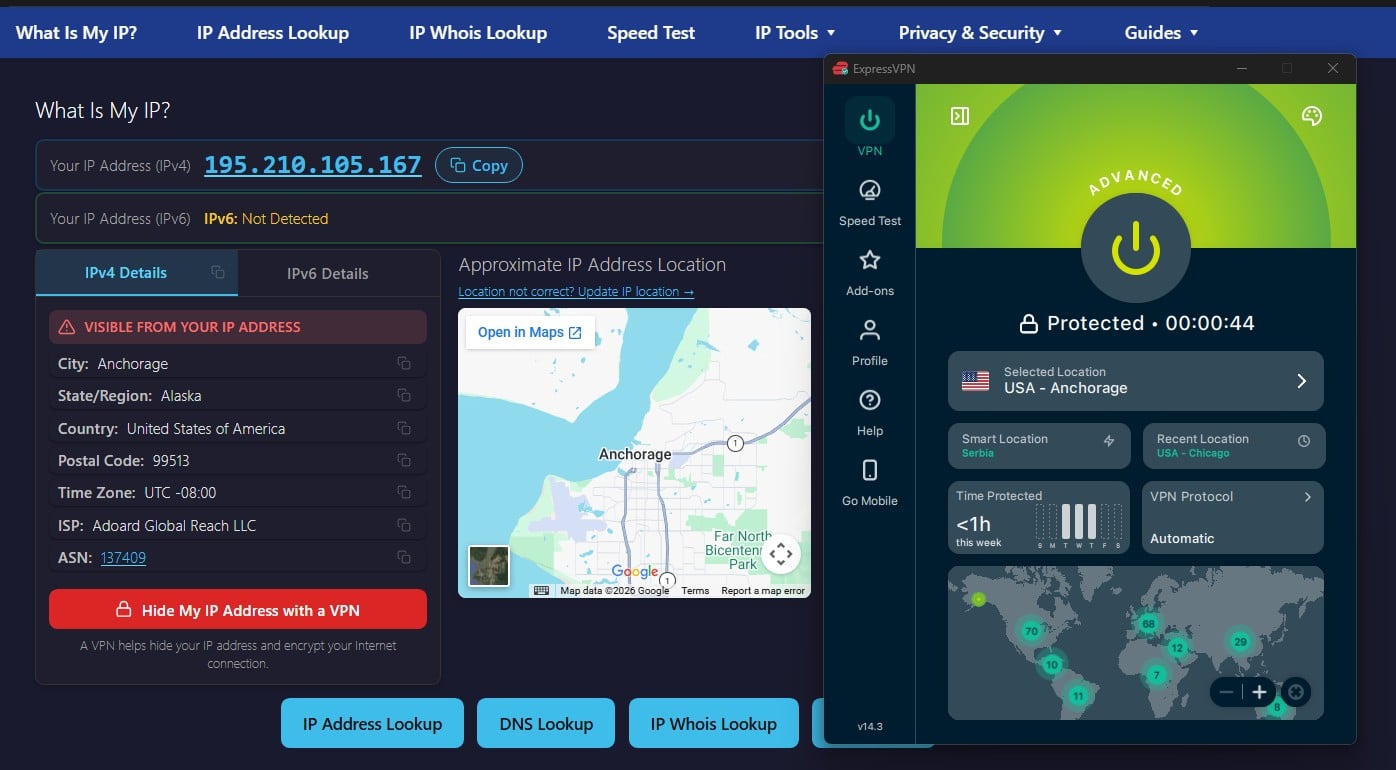
On a trip to Canada or overseas, any US server, including Anchorage, provides the US IP address that Sling TV and other US-only services require.
VPNs on Starlink, GCI, and Capped Data Plans
A VPN can’t make a slow connection faster, and encryption adds a little extra data to everything you do. In Alaska, Starlink also performs worse than in any other state. On satellite internet, choose a nearby server and a modern protocol such as WireGuard, NordLynx, or Lightway.
Apart from its unlimited plan, GCI’s home internet plans range from 250 GB to 1 TB a month, and extra data is sold in $10 blocks. The VPN’s overhead counts toward that cap. An ad blocker such as PIA’s MACE or Proton VPN’s NetShield helps in the other direction, because blocked ads don’t download. Alaska Communications’ plans have no data cap.
Mariners and Kraken Games in Alaska
Alaska is part of the Seattle Mariners’ home TV territory. ROOT Sports closed after the 2025 season, and MLB now streams Mariners games in the territory through Mariners.TV, with no local blackouts. An MLB.TV subscription on its own blacks out Mariners games in Alaska. Kraken games are simpler.
For the 2026-27 season, KAUU in Anchorage, KYEX in Juneau, and KFXF in Fairbanks air 77 regional games. Prime Video also streams them to Prime members in the region at no extra cost. MLB says it can use your IP address to check where you are.
In Alaska, keep the VPN on an Anchorage or Seattle server while you watch Mariners.TV. Those cities are in the Mariners’ territory. Split tunneling also works: let the MLB app bypass the VPN. Alaska is four hours behind Eastern time and one hour behind Pacific. A 1 p.m. ET NFL kickoff is 9 a.m. in Anchorage, and a 7:10 p.m.
PT Mariners home game starts at 6:10 p.m. in Anchorage. The western Aleutians are one more hour behind.
Public Wi-Fi at the Airport and on Cruise Ships
The free Wi-Fi at Ted Stevens Anchorage International Airport comes with terms stating that users have no expectation of privacy. Library, hotel, and lodge Wi-Fi networks are also open to other users. Start the VPN before logging in to email or your bank, and enable its kill switch to stop traffic when the VPN disconnects.
Alaska drew over 3 million visitors in 2024-25, and over half arrived by cruise ship. Princess and Holland America use Starlink for onboard Wi-Fi, a network shared by every passenger who buys a package. The VPN’s encryption covers that network too, though the satellite connection adds some delay.
Verdict
NordVPN comes out on top for Alaska. No VPN we tested was faster on an Anchorage server, and the IP lookup confirmed the location. Auto-connect protects you on airport and lodge Wi-Fi, and NordVPN also tops our overall VPN tests. The renewal price is its one drawback. If privacy comes first and you can do without an Alaska IP address, Proton VPN and its Seattle servers are the alternative.
ExpressVPN’s Lightway protocol is built for moving between networks, and PIA has no device limit and costs about $2 a month. Before your next trip, set the VPN to connect automatically on public Wi-Fi.
Frequently Asked Questions
What is the best VPN for Alaska?
NordVPN is the best VPN for Alaska, offering an Anchorage location, auto-connect on public Wi-Fi, and fast speeds across the US. For privacy, Proton VPN is a strong alternative.
Which VPNs have servers in Alaska?
NordVPN, Private Internet Access, and ExpressVPN offer Anchorage servers with an Alaska IP address. Proton VPN doesn't; its nearest US servers are in Seattle.
How can I get an Alaska IP address?
Connecting to a VPN's Anchorage server provides one. Websites then see an IP address in Anchorage, Alaska, instead of the device's actual location, even when it's outside the US.
Is a VPN legal in Alaska?
Yes. Alaska, like every US state, allows VPN use, and its constitution recognizes a right to privacy. Streaming services can still restrict VPN use under their own terms.
Does a VPN work with Starlink in Alaska?
Yes. VPNs work over Starlink like any other connection, though satellite links add delay. WireGuard-based protocols such as NordLynx add little extra delay on top.
Does a VPN use more data?
Yes, slightly. VPN encryption adds extra bytes to every data packet, and those bytes count toward capped home internet plans. WireGuard-based protocols add less than OpenVPN.