
Most people who end up on this page are not in a crisis: They have had an email saying a company they used lost some data, or they have noticed a charge they do not recognise, and they want to know whether paying for something would actually help. That is a fair question, and the honest answer is that it depends on what you expect.
Identity theft protection services monitor your personal and credit data, tell you when it surfaces somewhere it shouldn’t, and reimburse you when things go wrong. None of them can stop a breach: What they do is shorten the gap between the moment your details leak and the moment you find out, and that gap is usually what decides how much mess you end up cleaning up.
I signed up for five of them and ran them side by side for several weeks, looking at insurance limits, how deep each one sees into your credit file, how fast the alerts arrive, what the household plans cost, and what happens to the price in year two. Here is how they compare.
Best Identity Theft Protection Services: At a Glance
- Coveron: Best identity theft protection overall
- LifeLock: Best for large insurance payouts
- Surfshark One+: Best cheap ID theft protection service
- Aura: Best for trying before you commit
- IdentityIQ: Best for credit monitoring
| From | ID Theft Insurance | Home Title Cover | Credit Bureaus | Family Plan | Best For | |
|---|---|---|---|---|---|---|
| Coveron | $4.99/mo | Up to $2M | $100,000 | 1 or 3 by tier | Yes, from $17.99/mo | Overall value |
| LifeLock | $10.42/mo | Up to $3M | Monitoring only, top tier | 2 or 3 by tier | Yes, 2 adults max | Largest payout |
| Surfshark One+ | $4.49/mo | Up to $1M | No | None | No | Budget bundles |
| Aura | $12/mo | Up to $1M per adult | No | 3, all plans | Yes, $32/mo | Trying before committing |
| IdentityIQ | $7.44/mo | Up to $1M | No | 3 | Yes | Credit monitoring |
How I Tested: Important ⚠️
I signed up for each service with my own details, completed setup the way anyone would, and ran all five alongside each other for several weeks. I checked how quickly dark web alerts arrived, how much of my credit file each one could actually see, whether credit lock worked from inside the app rather than sending me to a bureau’s website, and what the insurance covers once you read past the headline number.
Prices were re-verified in October 2026, which matters more than usual this year because three providers changed their plans in the past few months, and one of them changed its name as well. If you read a comparison written last winter, a lot of it is now wrong.
Best Identity Theft Protection Services: Full Comparison
All five do the core job competently, so nobody here is going to leave you unprotected. They differ on how much the insurance pays, how deep they see into your credit file, and how much unrelated software they bundle in to justify the price.
1. Coveron: Best Overall
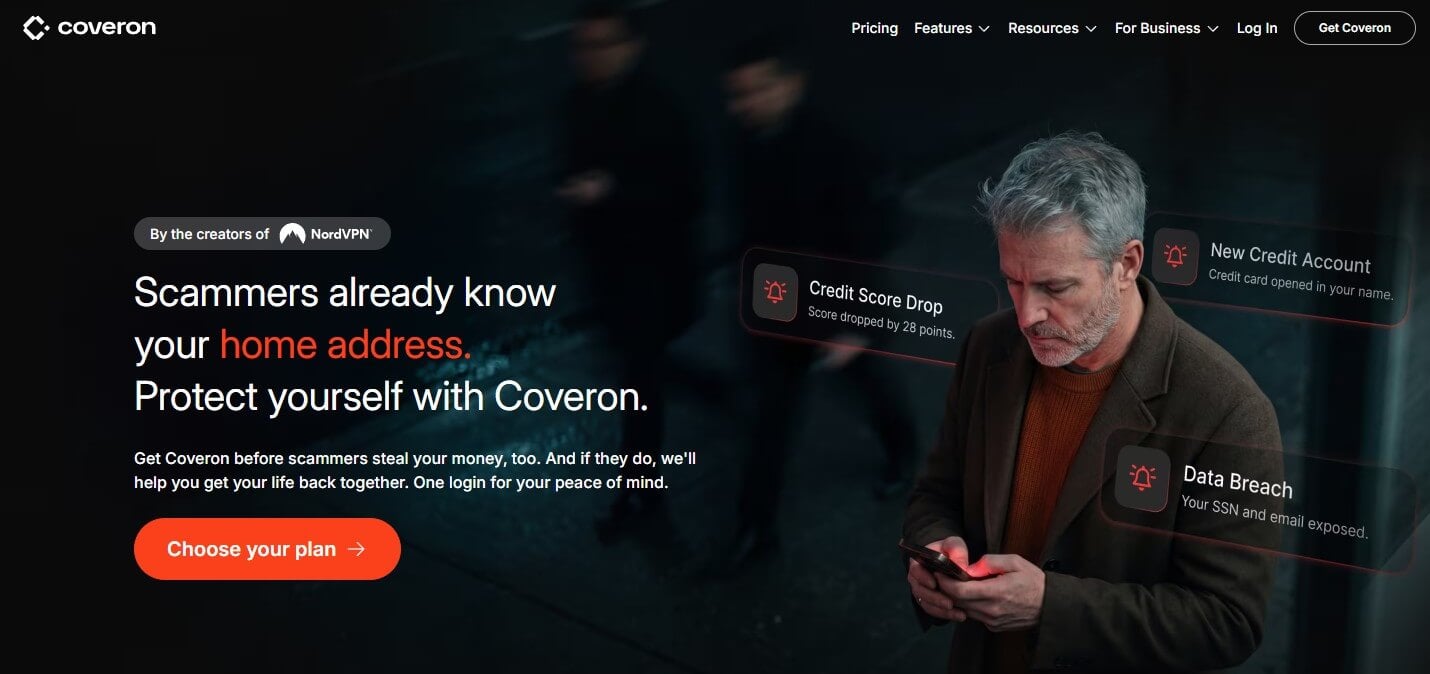
Coveron is Nord Security’s identity protection service, from the same company behind NordVPN. It was called NordProtect until May 2026, it restructured its tiers in July, and it added household plans in August, so almost every write-up you will find describes a product that no longer exists in that form.
Pros
- Up to $2M identity theft insurance
- $100,000 home title fraud cover
- Family plan covers 5 adults, unlimited kids
- Credit lock and freeze assistance in-app
- NordVPN, antivirus, and Incogni on the top tier
Cons
- 1-bureau credit monitoring below the top tier
- No credit report at all below the top tier
- US only, excluding New York
- Renewal price roughly doubles
❇️ Coveron Features
Dark web monitoring is the headline feature, and it earned its keep while I was testing, flagging exposed credentials on a few sites and giving me time to change those passwords before anything came of it. That is the whole value of this category in one sentence: nothing dramatic happened, because I found out early. Coveron also watches criminal records, short-term loan applications, and financial accounts from the mid tier up.
Credit is the weak spot, and it needs saying plainly because the marketing does not. Identity Theft Protection monitors one bureau and gives you no credit report at all. Three-bureau monitoring, a three-bureau score, and an actual report only arrive on Full Protection. What you do get on both paid tiers is credit lock and freeze assistance through TransUnion without leaving the dashboard, which is more useful than it sounds the first time you need it in a hurry.
The insurance changed on July 2, 2026. Coverage doubled from $1M to $2M, and Coveron added $100,000 in home title fraud protection, covering attorney and court costs if someone tries to transfer your property title. Cyber extortion and online fraud each sit at $100,000, with another $10,000 for cyberattack losses. Policies are underwritten by HSB. Setup is quick, and the alerts are specific enough to act on rather than just worry about. My Coveron review covers the dashboard in more depth.
🪙 How Much is Coveron?
Coveron cut its individual lineup from four plans to three in 2026. Starter, Silver, Gold, and Platinum no longer exist. The current 2-year pricing:
- Scam Protection at $4.99/mo, with $100,000 in online fraud cover but no identity theft insurance and no credit monitoring
- Identity Theft Protection at $6.99/mo, the cheapest tier with the $2M policy, home title cover, and credit monitoring
- Full Protection at $10.99/mo, adding 3-bureau monitoring, credit reports, NordVPN, antivirus, and Incogni
- Full Couple Protection at $17.99/mo and Full Family Protection at $27.99/mo, both at Full Protection level
Identity Theft Protection at $6.99 is the tier most people want. Scam Protection is easy to misread, and I misread it myself at first: it reimburses online fraud but carries no identity theft insurance and no credit monitoring, which are the two reasons anyone buys this category of product.
One caveat the pricing page buries in a strikethrough. Those are introductory rates covering the first 24 months. Renewals land at $9.99, $15.99, and $27.99 a month. Coveron is still decent value at those numbers, but it is no longer the cheapest thing here, so budget for the second price rather than the first. All plans carry a 30-day money-back guarantee.
One thing worth doing before you check out: the code Gizmodo5 takes a further 5% off any Coveron plan, and it stacks with the two-year pricing above. It applies to the first term only, which is the term you are actually choosing here.
2. LifeLock: Best for ID Theft Insurance
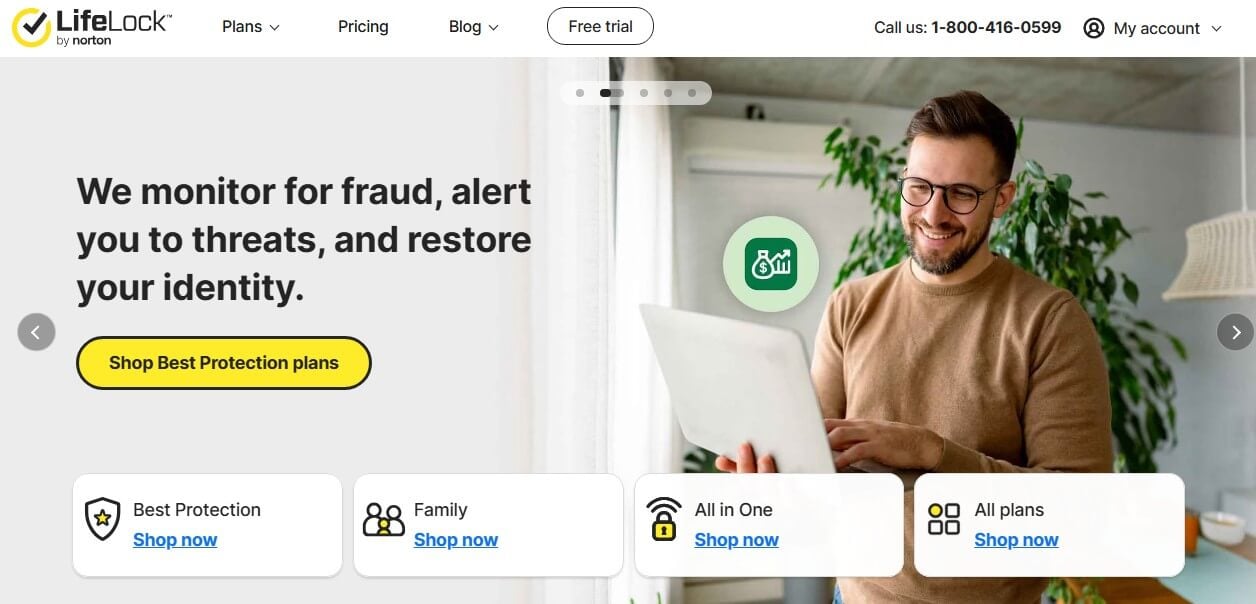
LifeLock has the biggest insurance ceiling here at $3 million, though it overhauled its plan structure in 2026 and the changes are not all improvements.
Pros
- Up to $3M insurance, plus $1M for stolen funds
- 3-bureau credit monitoring from the mid tier
- Social media monitoring and data broker removal on every plan
- 60-day money-back guarantee on annual plans
- Home title and 401(k) monitoring on Total
Cons
- New plans exclude antivirus and VPN
- Core skips scam reimbursement entirely
- Most expensive entry price on this list
- Convoluted app interface
❇️ LifeLock Features
I tested the mid-tier Advanced plan. It carries $1.2M in identity theft reimbursement plus $100,000 for stolen funds, tracks buy-now-pay-later transactions and payday loans, monitors five financial accounts, and lets you lock your credit and payday loans from the interface.
The tier split is worth reading closely, because LifeLock keeps its most distinctive monitoring for Total. 401(k) and investment activity alerts, bank account takeover alerts, home title monitoring, and phone takeover monitoring are all Total-only. Scam reimbursement follows the same pattern: nothing on Core, $5,000 on Advanced, $10,000 on Total.
Dark web monitoring, breach alerts, identity verification alerts, social media monitoring, and automatic data broker removal are on every plan, which is unusually generous at the entry level. One change that catches people out: LifeLock’s Core, Advanced, and Total plans no longer include antivirus or the VPN. Device protection now comes with the legacy Select and Ultimate Plus plans, so if you signed up years ago for the bundle, check what you are actually still getting.
🪙 How Much is LifeLock?
Three tiers. Paying annually saves 16% over the monthly rate, and the annual charge lands up front:
- Core at $10.42/mo billed annually ($124.99), or $12.49 monthly
- Advanced at $16.67/mo billed annually ($199.99), or $19.99 monthly
- Total at $29.17/mo billed annually ($349.99), or $34.99 monthly
Core covers two bureaus, two financial accounts, and no scam reimbursement, which is why it is the cheap one. Three-bureau monitoring arrives at Advanced, so you do not need the top tier for it. What Total buys you is the headline $3 million ceiling, $1 million for stolen funds, daily credit report access, and the home title, 401(k), and phone takeover monitoring the lower tiers skip.
LifeLock has the highest entry price here by some distance. Against that, it does not run a two-year intro rate that doubles later, and the 60-day money-back guarantee on annual plans is the most generous refund window on this list. Over three or four years, that closes much of the gap against Coveron, which is the sort of thing worth working out before the cheaper sticker price decides for you.
Household pricing exists but is limited. Every tier can be bought for two adults, or two adults plus unlimited children, and there is no option above that. Two adults start at $18.75/mo on Core and reach $52.50/mo on Total; add children and those become $28.75 and $62.50. A household with three or more adults cannot be covered on one LifeLock plan, which is where Coveron and Aura pull ahead.
3. Surfshark One+: Best Cheap Protection
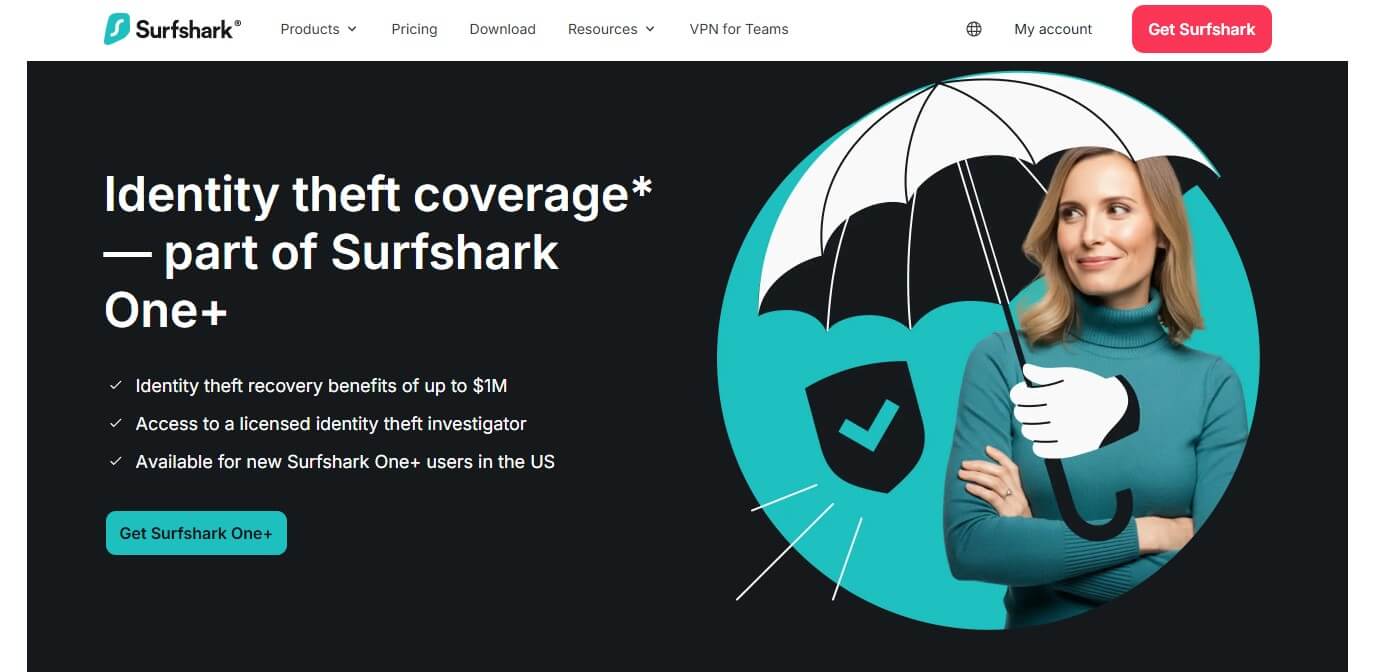
Surfshark is a VPN first, but its One+ tier bundles identity monitoring, data removal, antivirus, and the VPN into one of the cheapest packages here.
Pros
- Data removal via Incogni
- Cheapest full bundle on this list
- Unlimited devices
- VPN and antivirus included
- Credit card leak monitoring
Cons
- No credit bureau monitoring
- No credit lock or freeze
- No free version
❇️ Surfshark One+ Features
Alert handles the monitoring. It watches email addresses, IDs, and credit card numbers, and it surfaced four dark web leaks across two of my own accounts within minutes of setup. None of them was recent, which is the point: that information had been sitting out there for years and I had no idea.
Read the cons carefully, though, because this is where people get caught. Alert monitors credit cards for leaked numbers. It does not monitor your credit file at any bureau, so there is no score tracking, no report access, and no credit freeze. If credit protection is why you are shopping, this is not the one.
Incogni covers the other half, removing your data from brokers and people-search sites in the US, UK, EU, Switzerland, and Canada. Identity theft coverage reaches $1 million and includes access to a licensed investigator.
Worth watching: in September 2026, Surfshark acquired Optery, a data removal service that covers more brokers than Incogni and sends screenshot proof of each removal. Nothing has changed in the One+ bundle yet, but the data removal half of this package is the piece most likely to improve over the next year.
🪙 How Much is Surfshark One+?
Surfshark stays a cheap option here. One+ costs $4.49/mo on the 2-year term with three free months, billed at $121.23 for 27 months. The step-down, Surfshark One at $2.79/mo, works out to $75.33 across the same period. You keep Alert but lose Incogni. Both carry a 30-day money-back guarantee.
4. Aura: Best for Trying Before You Commit
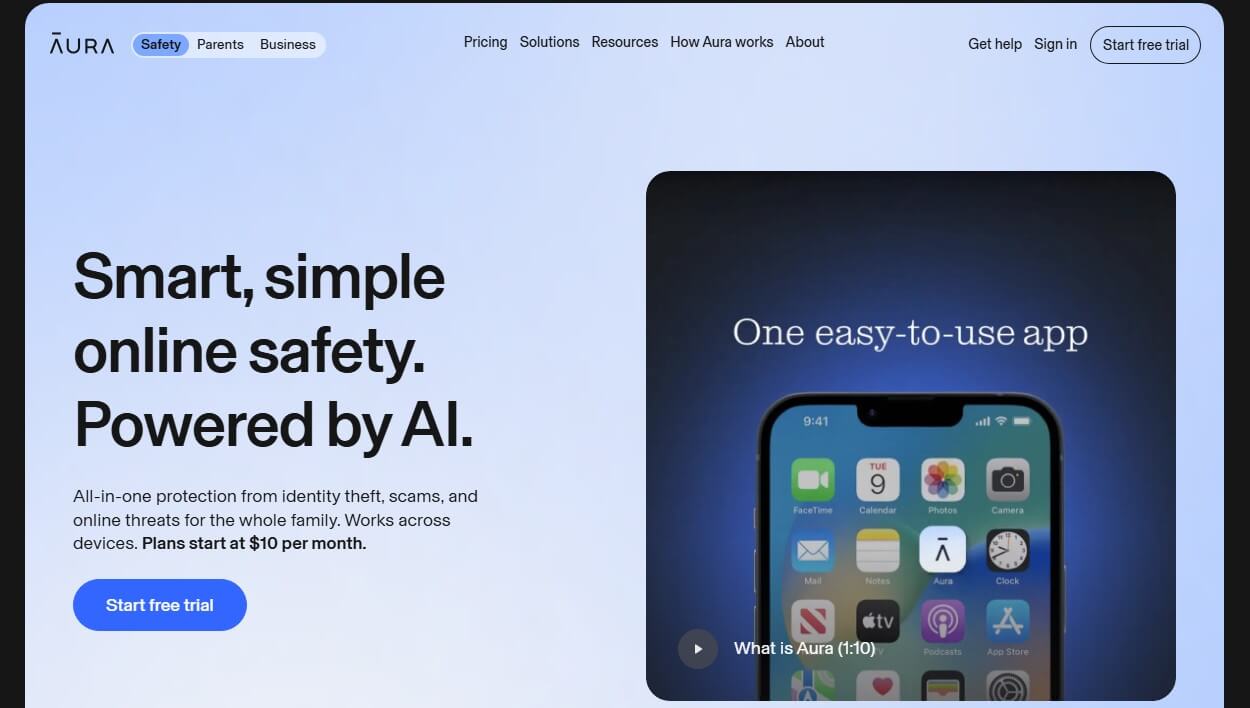
Aura’s advantage is simplicity: every plan includes every feature, and the only variable is how many people it covers. It also has the most generous try-before-you-buy terms here by a wide margin, which matters more than it sounds when you are being asked to hand over a Social Security number on faith.
Pros
- 3-bureau credit monitoring on all plans
- Same features at every price point
- 14-day free trial plus 60-day money-back guarantee
- Family plan covers 5 adults, unlimited kids
- Antivirus, VPN, and password manager included
Cons
- Suffered a data breach in March 2026
- Limited VPN locations
- Among the pricier options
❇️ Aura Features
Monitoring spans the dark web, data breaches, criminal and court records, and PII, with 3-bureau credit monitoring on every plan. That is the thing Coveron makes you pay $10.99 for, and it costs nothing extra here. Credit lock works inside the app, and insurance covers $1 million per adult. There is also spam call and junk mail removal, a password manager, antivirus, a VPN, and Aura Vault for file storage. The top plan adds parental controls and gaming safety tools.
About the breach, because you would reasonably want to know. In March 2026, Aura disclosed that a voice phishing attack on one employee gave an attacker roughly an hour of access to about 900,000 contact records. The data came from a legacy marketing database inherited in a 2021 acquisition. No Social Security numbers, passwords, or financial data were exposed, Aura’s identity protection platform itself was not accessed, and fewer than 20,000 active customers were affected.
Have I Been Pwned found roughly 90% of the exposed email addresses were already circulating from earlier, unrelated breaches. It is a poor look for a company selling identity protection and it belongs in your decision, but it is not the catastrophe the headline number suggests. My Aura alternatives guide covers the options if it changes your mind.
🪙 How Much is Aura?
- Individual: $12/mo billed annually, or $15 monthly
- Couple: $22/mo billed annually, covering two adults
- Family: $32/mo billed annually, covering five adults and unlimited children
A 14-day free trial lets you test before paying, and a 60-day money-back guarantee backs every plan. LifeLock matches the 60 days on annual plans, but only Aura lets you try the product without handing over money first. If you want to see whether the alerts tell you anything useful before committing a year of budget, that combination has no equal here. Aura also owns several well-regarded VPN brands.
5. IdentityIQ: Best for Credit Monitoring
IdentityIQ is the least known name here and the most focused on credit.
Pros
- Detailed credit score and report tracking
- Family ID theft insurance on top tiers
- Bitdefender antivirus available
Cons
- Subpar customer support
- VPN and antivirus cost extra
- Three separate apps to manage
❇️ IdentityIQ Features
Dark web monitoring includes SSN alerts and watches public records for your details. It will also register your number on the Do Not Call List, which noticeably cut the spam calls I was getting, and that was the first thing anyone I showed it to actually reacted to. Credit is where it is strongest: 3-bureau report monitoring, score change alerts, monthly reports, and alerts for crimes committed in your name.
Insurance reaches $1 million, with $25,000 in family cover and legal expenses covered on the rest. Its weakness is integration. The VPN and antivirus are rebadged Bitdefender products, so you end up managing three separate apps. Bitdefender’s VPN is decent, and its antivirus is better, but the experience is disjointed in a way you feel every time you need to check something.
🪙 How Much is IdentityIQ?
- Basic: $7.44/mo, billed annually
- Plus: $10/mo, billed annually
- Pro: $18.49/mo, billed annually
- Max: $27/mo, billed annually
Adding the VPN and antivirus costs roughly $3/mo more.
Best for Credit Monitoring and Credit Scores
Credit monitoring is the feature people most often assume they are buying and most often do not get. It is also the part that does the real work, because almost everything that costs you money starts with somebody opening something in your name. Here is what each service actually sees:
| Bureaus Monitored | Credit Reports | Credit Lock/Freeze | Score Tracking | |
|---|---|---|---|---|
| Coveron | 1 on mid tier, 3 on Full | Full Protection only | Lock and freeze help, TransUnion | Yes |
| LifeLock | 2 on Core, 3 from Advanced | 1-bureau monthly, 3-bureau yearly, daily on Total | Yes, plus payday loan lock | Yes |
| Surfshark One+ | None | No | No | No |
| Aura | All 3, every plan | 3-bureau | Yes | Yes |
| IdentityIQ | All 3 | Monthly, all 3 | No | Yes |
For pure credit tracking, IdentityIQ and Aura lead. Both pull all three bureaus on every plan, and IdentityIQ has monthly reports from each. Aura adds credit lock, which IdentityIQ lacks.
Credit is the weakest part of Coveron’s otherwise strong package. The $6.99 tier most people buy watches a single bureau and gives you no report at all, so you are told your file moved without being able to go and look at what moved. If credit is your main reason for buying, Aura at $12 does more for your money than Coveron at $6.99, and that is the clearest case on this page for paying more rather than less.
Skip Surfshark if credit is your priority. It monitors card numbers for leaks, not your credit file.
One thing no paid service replaces, and I would rather you knew it than spent money unnecessarily: you are entitled to free weekly credit reports from all three bureaus at AnnualCreditReport.com, and a credit freeze is free by law. Paid monitoring buys you speed and alerts, not access you could not otherwise get yourself.
Best Identity Theft Protection for Families
This used to be a straight recommendation for Aura but it is not any more. Coveron added household plans in August 2026, and they sit at the top feature level rather than being a stripped-down family tier. Full Family Protection costs $27.99/mo for five adults and unlimited children, against Aura’s $32/mo for the same headcount. Every Coveron member gets $2 million in insurance where Aura gives $1 million per adult, and both include 3-bureau monitoring, VPN, antivirus, and data removal. Coveron’s couples plan is $17.99/mo against Aura’s $22. There is more detail on how the household plans divide access in my Coveron review.
The child coverage is the part worth pausing on, and not because it is frightening. A child has no credit history, so nobody thinks to check one, and a stolen Social Security number can sit unused for a decade before it turns up when a teenager applies for a first loan or a phone contract. Both Coveron and Aura cover unlimited children at no extra cost, which is the cheapest piece of protection on this entire page.
On price and insurance, Coveron wins. Three things still push some households to Aura: the 14-day trial and 60-day guarantee instead of 30 days, the fact that Aura’s price does not double at renewal, and availability, since Coveron cannot sell its insurance benefits to New York residents at all.
LifeLock is the odd one out here, and not only on price. Its household plans cap at two adults plus unlimited children, so a house with three or more grown-ups simply cannot use them. Two adults with kids costs $28.75/mo on Core, $40/mo on Advanced, and $62.50/mo on Total, all billed annually. That last figure buys the $3 million ceiling, which nothing else here matches, but it is more than double Coveron’s five-adult plan.
For couples specifically the gap narrows a lot: Coveron at $17.99, LifeLock Core at $18.75, Aura at $22. Coveron still leads on insurance at that price, though LifeLock Core is close enough that the stable renewal rate is worth weighing.
For most US households outside New York, Coveron’s family plan is now the better buy, and it is the change that most affects who should read this page differently than they would have six months ago.
What are Identity Theft Protection Services?
These services monitor personally identifiable information and credit data, then alert you when either shows up somewhere it should not be. Typical coverage includes credit card activity, credit reports, public records, and dark web marketplaces. Most bundle a VPN or antivirus to reduce how much of your data leaks in the first place.
When theft does happen, insurance covers the costs of recovery: legal fees, lost wages, document replacement, and in some cases direct reimbursement for stolen funds. Those costs are the part people underestimate, because the stolen money is often the smaller problem next to the weeks of phone calls and paperwork needed to prove it was not you.
What none of them do is prevention. These are detection and recovery tools. Nothing here stops a company you have done business with from being breached, and any marketing that implies otherwise is overselling.
Is Free Identity Theft Protection Worth it?
Free tools are better than nothing and worse than they look. They generally cover basic dark web and credit report monitoring, and stop there. What you do not get: insurance, 3-bureau monitoring, credit locking, restoration case managers, or data broker removal. Buying those separately costs more than a bundled paid plan.
Here is the sequence I would follow if you are not sure whether to spend anything. Freeze your credit at each bureau first, since that costs nothing, takes about twenty minutes, and blocks the single most common form of identity theft outright. Then live with that for a while and see whether you still feel exposed. If you do, this page tells you what the paid options add.
The same logic applies to security software generally. Plenty of people pay for things they already have, which is why I keep a separate guide to the best free antivirus rather than assuming everyone should subscribe to something.
Types of Identity Theft Explained
These are the forms it actually takes, and most of them are slower and more boring than the dramatic version people imagine.
- Financial ID theft. The most common form by a wide margin. Someone uses a stolen card number or SSN to drain accounts or open new ones in your name.
- Criminal ID theft. Somebody commits an offence and gives your details to police, leaving you with a record to dispute that you knew nothing about.
- Medical ID theft. A stranger uses your health insurance, which saddles you with their bills and, worse, puts their medical history into your file.
- Senior ID theft. Older adults get targeted disproportionately, usually by phone, and are the least likely to have monitoring in place to catch it.
- Child ID fraud. A child’s SSN has no credit history attached, so misuse can run undetected for years until they apply for a first loan.
Conclusion: What is the Best Identity Theft Protection?
Coveron is the best identity theft protection service for most people in 2026. Its Identity Theft Protection tier at $6.99/mo carries $2 million in insurance and $100,000 in home title fraud cover, a combination nothing else here comes close to at the price, and the code Gizmodo5 takes another 5% off at checkout. Its limits are real, though: one bureau and no credit report below the $10.99 tier, no availability for New York residents, and a renewal rate that roughly doubles after two years.
Choose LifeLock if you want the largest payout on the market and will pay for the Total tier to get it, or if a stable price matters more to you than a cheap first two years. Choose Aura if credit is your priority or you want to test properly before paying, since 3-bureau monitoring comes on every plan and it is the only service here with a free trial. Choose IdentityIQ if credit reporting is the whole reason you are buying. Choose Surfshark One+ if you want a VPN, antivirus, and data removal cheaply and do not need credit monitoring.
For households, Coveron’s $27.99 family plan covers five adults with $2 million each, which undercuts Aura on both counts.
Whichever you pick, do the free thing first: freeze your credit at all three bureaus. It costs nothing, it takes twenty minutes, and it blocks the most common form of identity theft outright. Everything on this page is what you buy on top of that, not instead of it.
Frequently Asked Questions
What is the best identity theft protection service?
Coveron, for most people. Its $4.99/mo tier includes $2 million in identity theft insurance, $25,000 in home title fraud cover, 3-bureau credit monitoring, and in-app credit freezing. LifeLock offers a larger $3 million ceiling, and Aura is the better pick for families.
How much does identity theft protection cost?
Between $2.99 and $32 per month, depending on coverage and how many people it protects. Coveron's Scam Protection tier is the cheapest entry at $2.99/mo, though meaningful insurance and credit monitoring start at $4.99/mo. Family plans run $22 to $32/mo.
Which identity theft protection has the best credit monitoring?
IdentityIQ and Aura. Both monitor all three bureaus on every plan, and IdentityIQ supplies monthly reports from each. Aura adds credit lock inside the app. Coveron monitors all three at a lower price but pulls full reports from TransUnion only.
Do I really need identity theft protection?
It depends on what you'd otherwise do yourself. Freezing your credit at all three bureaus is free and blocks most new-account fraud. Paid services add speed, dark web monitoring, insurance, and a case manager who handles recovery for you. If you'd never get around to checking your reports, monitoring earns its cost.
Can I prevent identity theft?
Not entirely, since most exposure comes from breaches at companies holding your data. You can reduce risk substantially: freeze your credit, use unique passwords with a manager, enable two-factor authentication, treat unexpected calls asking for details as hostile, and check bank statements monthly.