One of these is built to be cheap, the other to be private, and both succeed. Proton VPN wins 5 rounds, CyberGhost 1, and 2 end in a draw. Proton reaches 48 more countries, it’s faster, and publishes the code behind its apps. CyberGhost costs 80 cents less, offers a 45-day refund instead of 30, and sells the cheapest dedicated IPs anywhere. Read on for more details.
Proton VPN vs CyberGhost VPN: Quick Comparison
| 🏆 Proton VPN | CyberGhost | |
| Our Current Ranking 📋 | #2 | #6 |
| Prices 🤑 | Starting at $2.99/mo | Starting at $2.19/mo |
| Money-Back Guarantee 🪙 | 30 days | Up to 45 days |
| Free Version/Free Trial 🆓 | Yes/No free trial | No/Yes (24 hours Windows/macOS, 3 days Android, 7 days iOS) |
| Logging/Jurisdiction 🕵️ | No/Switzerland | No/Romania |
| Third-Party Audits 📝 | Audited, plus open-source apps | Deloitte, quarterly since 2011 |
| Protocols 🌐 | OpenVPN, WireGuard, IKEv2, Stealth | OpenVPN, WireGuard, IKEv2 |
| Servers 🏠 | 20,000+ in 148 countries | 12,000 in 100 countries |
| Specialty Servers ✅ | Torrenting, Tor over VPN, Secure Core | Torrenting, streaming, gaming, NoSpy, dedicated IP |
| RAM-Only Servers 🛡️ | No, full-disk encryption | Yes |
| Working With Netflix 📺 | Yes, almost all major libraries | Yes, some major libraries |
| P2P Allowance ↔️ | Yes | Yes |
| Customer support ☎️ | Live chat, email | Live chat, email |
| Concurrent Connections 📟 | 10 | 7 |
Apps and Compatibility Comparison
Device coverage is effectively identical. Desktop and mobile systems, Fire TV, Apple TV, Chromecast, Nvidia Shield, routers, consoles, and Raspberry Pi are handled by both, with configuration guides for anything unusual.
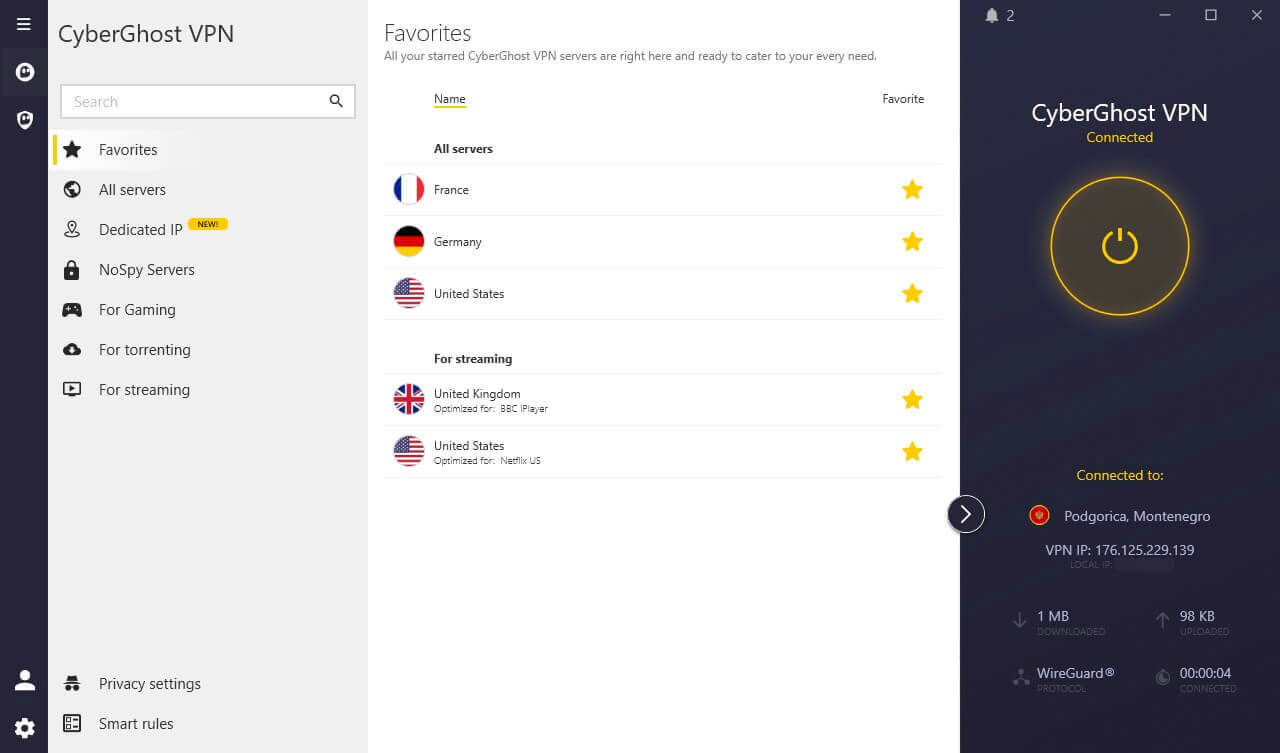
CyberGhost’s desktop client looks good and can expand or collapse depending on how much you want on screen. Its weakness is organization: settings are spread across several menus, and finding a specific toggle takes longer than it should. Our CyberGhost testing praised Smart DNS, which puts a foreign library onto hardware that refuses VPN. Proton VPN has no counterpart.
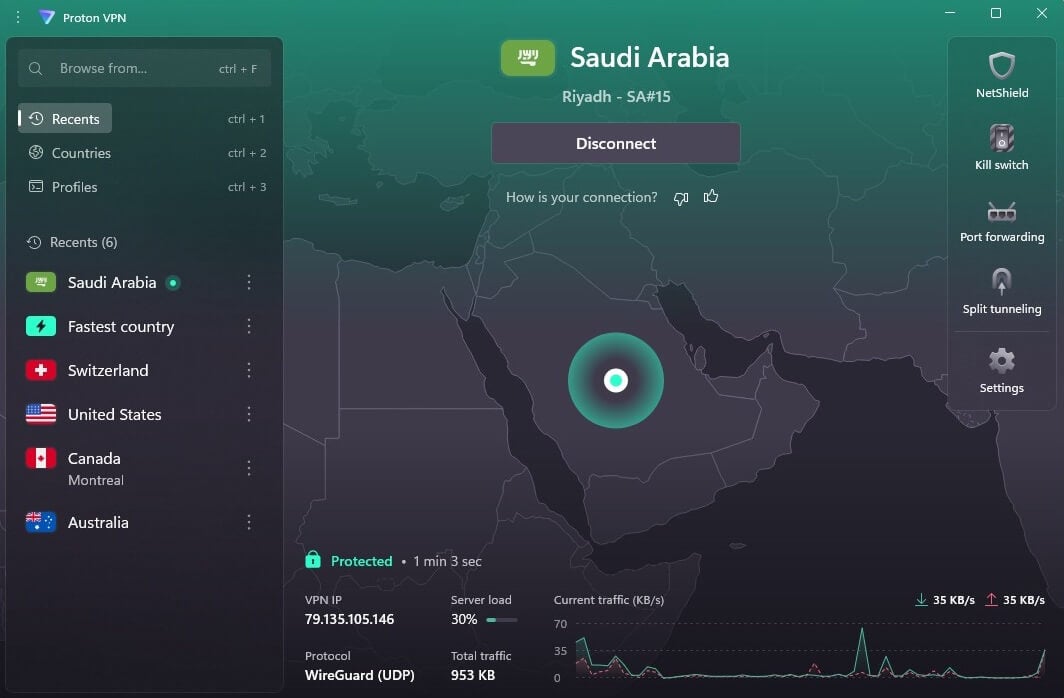
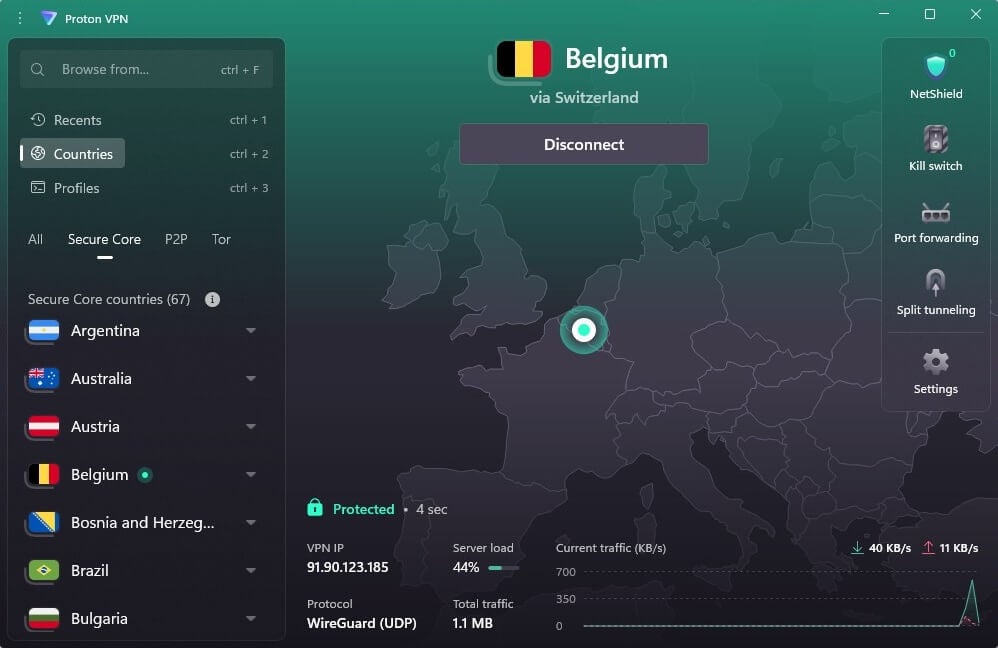
Proton VPN puts its server list beside a world map, with settings now opening inside the main window rather than spawning a separate one. Everything you use regularly sits on the home screen. Its mobile builds carry the same layout. Device counts split them: Proton VPN allows 10 concurrent connections, CyberGhost 7.
Winner: Proton VPN
Three more devices and software that doesn’t hide its own settings. CyberGhost’s Smart DNS is a real advantage for anyone streaming on a console.
CyberGhost is Cheaper Than Proton VPN: Plans Compared
Proton VPN keeps its structure plain. The 24-month Plus plan costs $2.99 a month, and the 12-month option sits near $3.99. Monthly billing at $9.99 exists mainly to make the longer terms look sensible.
There’s also a free tier with no data cap, which CyberGhost doesn’t match, though it withholds server choice and streaming access. CyberGhost’s two-year plan includes 2 bonus months and comes to $2.19 a month, or $56.94 for the full 26-month term. Six-month and monthly options carry no discount worth taking.
| 2-Year Price | 1-Year Price | Monthly Price | Renewal Price | |
| CyberGhost | $56.94 | N/A | $12.99 | $56.94/year |
| Proton VPN | $71.76 | $47.88 | $9.99 | $79.95/year |
Two extras belong here. Its Security Suite adds Windows antivirus for $1 a month, and dedicated IPs cost $2.50, among the cheapest anywhere. Renewals favour CyberGhost too, at roughly $56.94 annually against Proton VPN’s $79.95.
The refund windows aren’t comparable either. CyberGhost gives 45 days on any plan longer than a month, where Proton VPN gives 30.
Winner: CyberGhost
Cheaper to buy, cheaper to renew, and six weeks to change your mind instead of four. Neither is expensive by current market standards, and CyberGhost is the better value at every point.
Proton VPN is Safer Than CyberGhost: Features Compared
Here’s why I prefer Proton VPN for overall security.
Shared Features and Tools
Both cover 256-bit encryption, an automatic kill switch, WireGuard and OpenVPN, split tunneling, leak protection, and Forward Secrecy. Ad blocking appears on each, and Proton VPN’s NetShield stopped more of it in testing than CyberGhost’s filter did. But here’s the bigger difference.
Advanced Features
CyberGhost’s exclusives are physical and commercial:
- NoSpy servers, housed in CyberGhost’s own Romanian data centre so no third party touches the hardware.
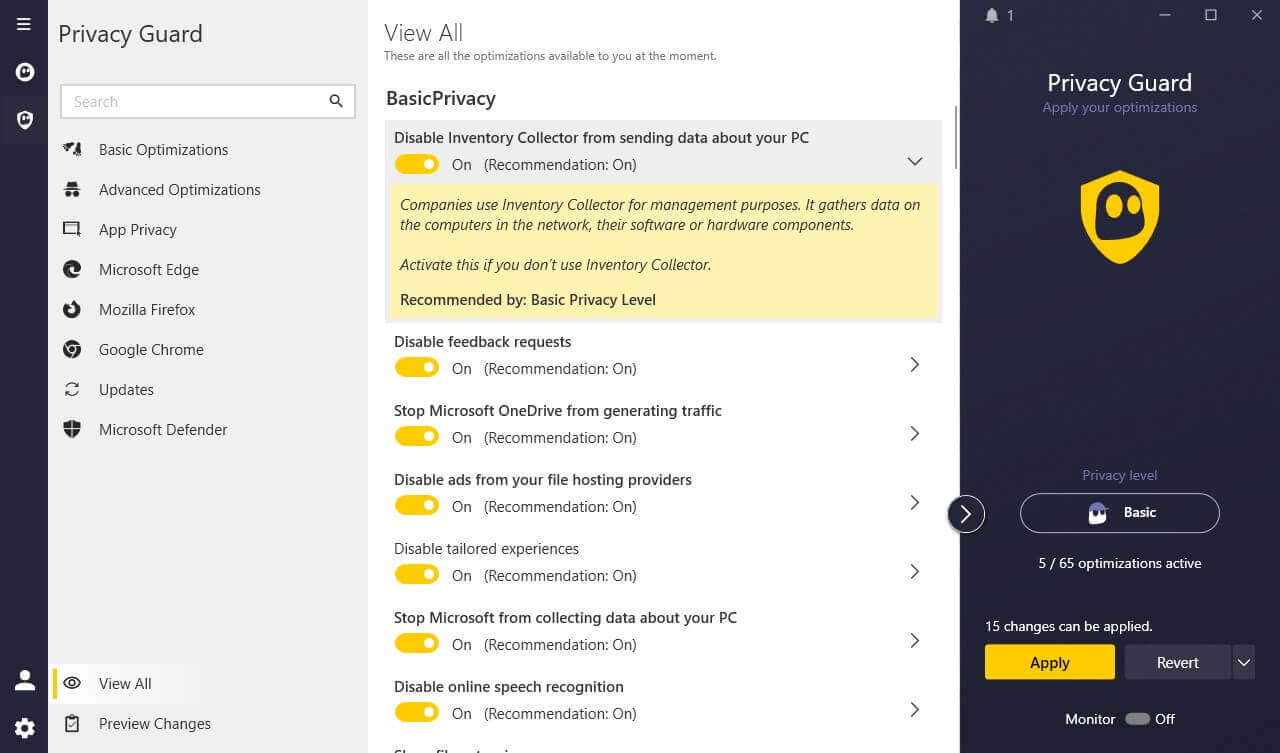
- Privacy Guard, a Windows tool that switches off Microsoft’s own data collection: the advertising ID, telemetry, the Inventory Collector, Bluetooth ads, and the Customer Experience Improvement Program, roughly 69 toggles in total. A monitor keeps watch and tells you when Windows turns any of them back on. It addresses a privacy problem no VPN touches, since the leak is your operating system. Windows only, and part of the paid Security Suite.
- Security Suite, optional Windows antivirus at $1 a month that also flags outdated software.
- Smart DNS, covering devices with no capacity for a VPN client.
Proton VPN’s are architectural:
- Secure Core, routing traffic through Proton-owned hardware in Switzerland, Iceland, or Sweden before it reaches your chosen exit.
- Tor over VPN, opening .onion sites without a separate browser.
- Stealth, disguising the tunnel as ordinary TLS traffic, with alternative routing reconnecting when a path is blocked.
- NetShield, filtering ads, trackers, and malicious domains.
- Dark Web Monitor, sending breach alerts through your account.
Winner: Proton VPN
While both have advanced tools, Proton VPN takes it because it’s VPN-oriented. Stealth for bypassing censorship, Double Hop with Secure Core, and more effective tracker/ad-blocking. CyberGhost’s extras boil down to virus protection and Windows-only Privacy Guard.
Privacy Comparison: Both Take Points
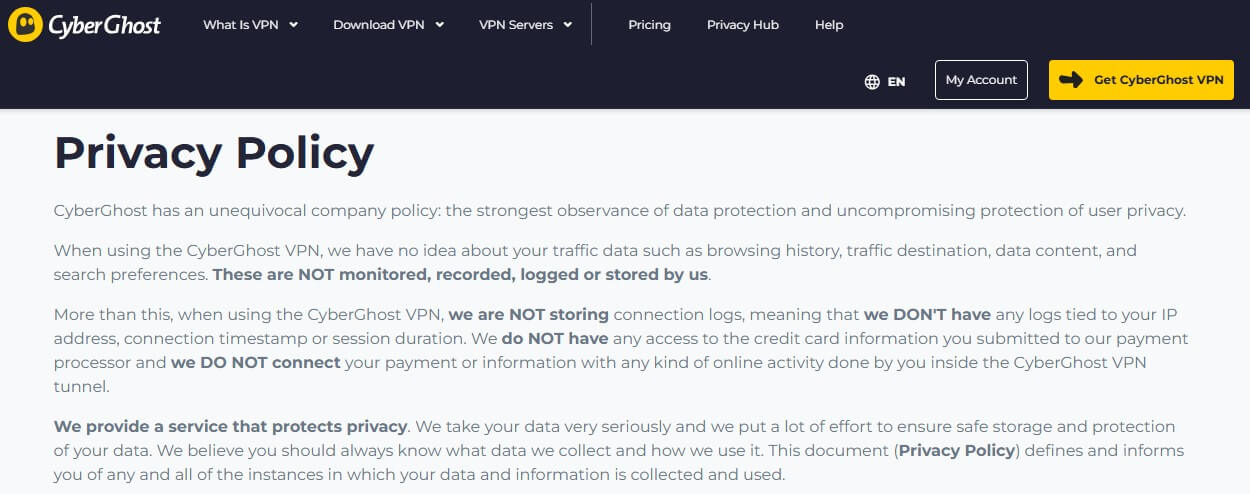
Neither retains IP addresses, browsing history, visited sites, connection metadata, or location. Both keep only what’s needed to operate an account. CyberGhost’s verification record is stronger than it ever advertises. Deloitte has examined it every quarter since 2011, a cadence no competitor keeps up, and Romania sits outside the 5, 9, and 14 Eyes alliances.
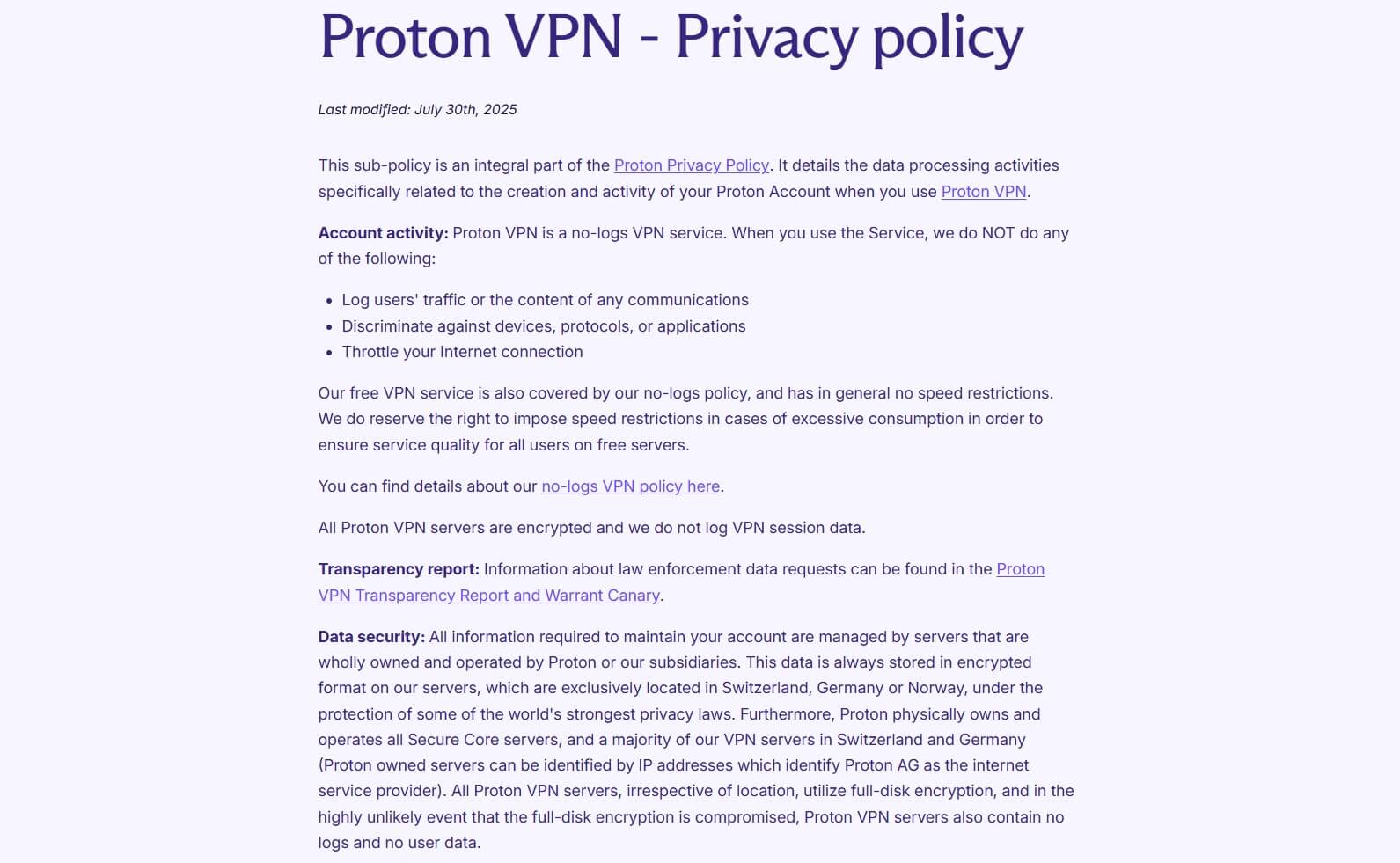
Proton VPN answers with a different kind of proof. Its no-logs policy is independently audited, and the source code for every client is published, so the claim can be read rather than accepted. Switzerland imposes no data retention requirement, either, so you can fully trust the VPN.
Winner: Tie
Quarterly inspection against inspectable code. Both jurisdictions are outside the intelligence alliances, and neither has a logging incident behind it.
Proton VPN is Faster Than CyberGhost: Speed Tests
Three days of testing from Southeastern Europe, three sessions daily, across UK, US, and Japanese servers with WireGuard on both sides.
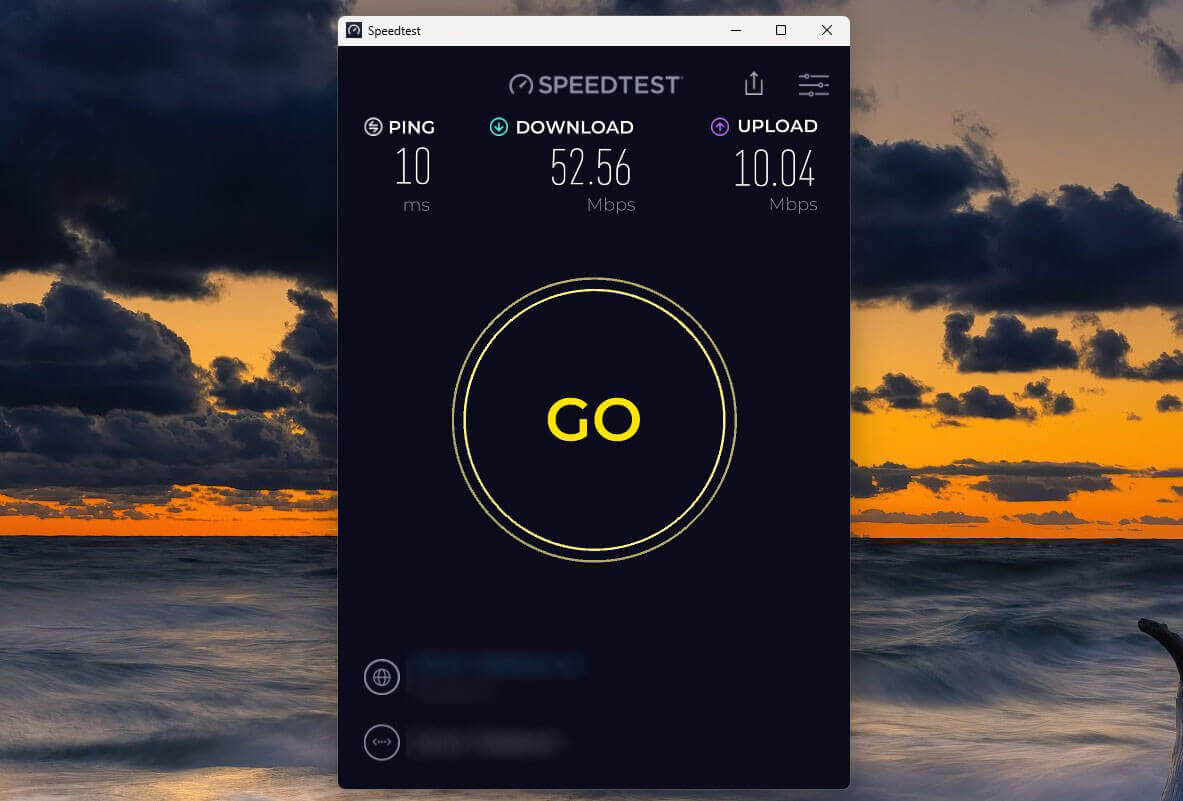
The results are here:
| Download Speed Loss ⬇️ | Upload Speed Loss ⬆️ | |
| 🟡 CyberGhost | 42% | 8% |
| 🟣 Proton VPN | 28% | 15% |
CyberGhost took uploads, 8% against 15%, and lost downloads by 14%. Proton VPN also posted lower latency throughout, helped by VPN Accelerator, which props up speeds and stability when a connection is unsteady.
| UK (Download/Upload) | US (Download/Upload) | Japan (Download/Upload) | |
| 🟡 CyberGhost | 37.31/9.43 Mbps | 29.43/9.23 Mbps | 25.23/9.12 Mbps |
| 🟣 Proton VPN | 46.25/9.43 Mbps | 36.79/8.73 Mbps | 29.96/7.42 Mbps |
Winner: Proton VPN
Downloads decide it, since page loads, streaming, and gaming all lean that way. CyberGhost is the better pick if you upload more frequently.
Streaming and Torrenting: CyberGhost vs Proton VPN
Both handled Netflix US, UK, Japan, and Canada, plus smaller catalogs. Japanese Netflix opened cleanly on each, as did BBC iPlayer and Hotstar from outside India. Their approaches differ on hardware and on servers. CyberGhost keeps a streaming-tuned category and adds Smart DNS for consoles or older televisions with no VPN app involved.

Proton VPN has withdrawn its separate streaming servers, so any location has to do the work. Proton VPN’s browser extension covers Chrome, Firefox, and Brave, and reports a separate location to sites that check position twice (Geo-Spoofing). Neither stuttered on 4K. Torrenting is close.
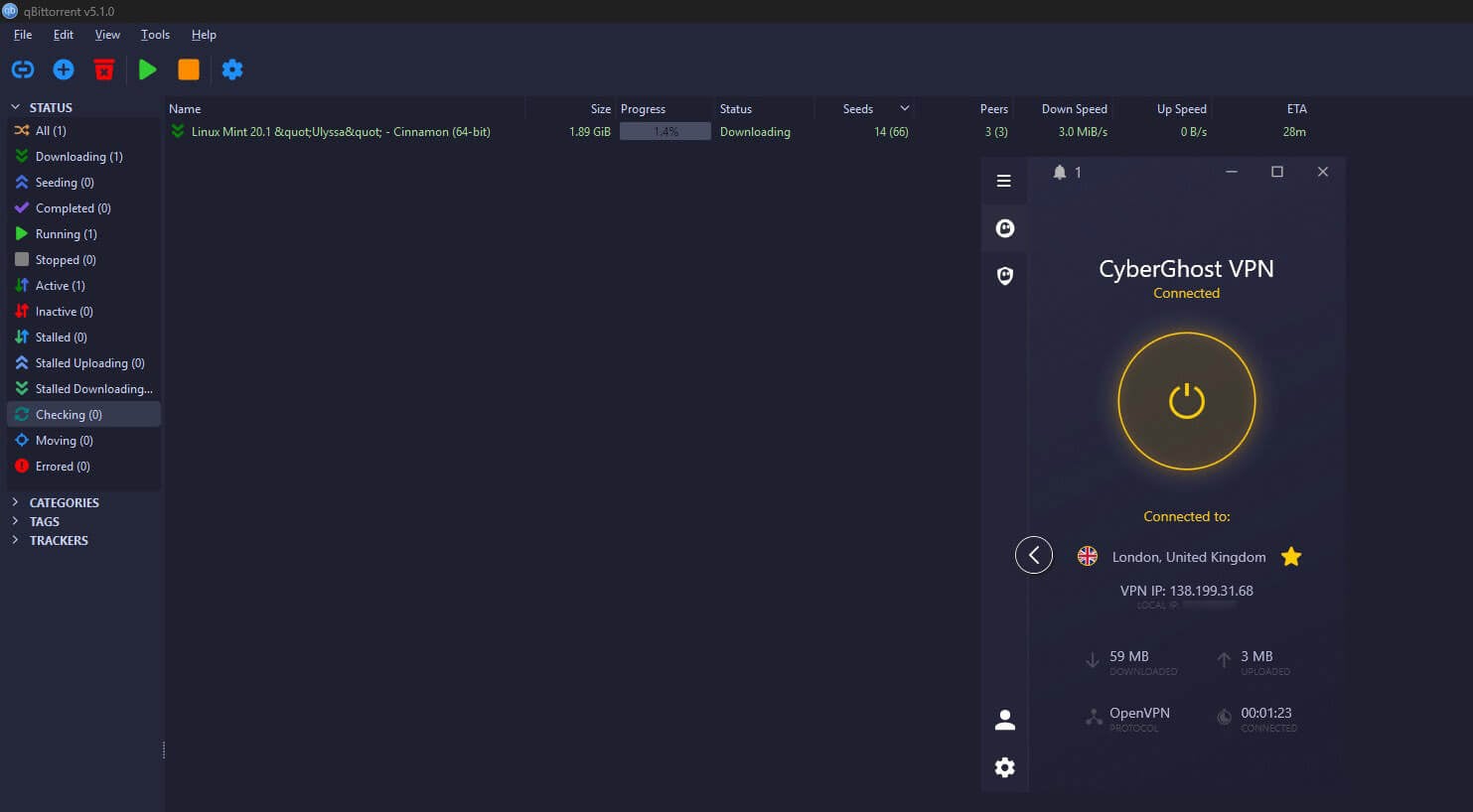
Both have P2P servers, and download speeds on nearby locations were indistinguishable. Proton VPN adds port forwarding, which lifts seeding throughput, and CyberGhost has no equivalent.
Winner: Tie
Streaming was equally enjoyable on both sides: Unblocking, streaming quality, and stability were on par. Torrenting is the same: Both offer P2P-first servers optimized for speed and privacy.
Proton VPN Has More Server Locations in 2026
| 🟡 CyberGhost | 🟣 Proton VPN | |
| #️⃣ Server number | 12,000 | 20,000+ |
| 🌐 Countries | 100 | 148 |
| 💾 10 Gbps servers | Yes | Yes |
| 🖥️ RAM servers | Yes | No, full-disk encryption |
| 📍 Dedicated servers | Yes | Yes |
Proton VPN has 8,000 more servers across 48 additional countries. Both use 10 Gbps ports, though the storage differs: CyberGhost wipes its servers on restart, while Proton VPN encrypts its disks instead and argues the outcome is equivalent.
Whether you want a server in the USA or somewhere far less common, Proton VPN is likelier to have one. Specialty categories favour CyberGhost. It divides its network into streaming, torrenting, NoSpy, and dedicated IP; Proton VPN offers Secure Core, P2P, and Tor over VPN, having retired its separate streaming category.
CyberGhost also sells dedicated IP addresses for a relatively low price, which Proton VPN keeps exclusively for business accounts.
Winner: Proton VPN
It’s clear: Proton VPN has more servers and more countries, so it wins the numbers game. However, CyberGhost’s network is also substantial, with low-cost dedicated IP addresses and gaming servers.
Bypassing Censorship: Proton VPN Wins Easily
Outside China, both perform. Each is widely used across the UAE, Qatar, and the Gulf, and reports from Turkey and Russia describe occasional brief dropouts. China separates them. CyberGhost has no obfuscation, so the Great Firewall stops it, and no setting changes that. Proton VPN’s Stealth disguises the tunnel and gets through intermittently, at reduced speed and stability.
Neither is a China specialist. NordVPN’s obfuscated servers remain the more dependable route if that’s your reason for subscribing.
Winner: Proton VPN
Just because it works in China, though occasionally, and with reduced speeds. CyberGhost lacks obfuscation entirely, so it’s overall less reliable for those in censored countries.
Conclusion: Proton VPN is Better Than CyberGhost
They’re built around different priorities, and the score reflects which one offers more. CyberGhost is the value pick. It costs less to buy and less to renew, its 45-day window is the longest, its dedicated IPs and $1 antivirus undercut everyone, and quarterly Deloitte audits since 2011 deserve more attention than they get.
Proton VPN earns the extra 80 cents elsewhere: 48 more countries, way faster download speed, 3 additional devices, Secure Core and Tor Over VPN routing, published source code, and obfuscation that gets past filtering CyberGhost cannot touch. Our full Proton VPN review covers the winner in more detail, and both refund without argument if you disagree.