Does CyberGhost VPN work in China? That’s the first question to answer before you pack your bags, because China is the hardest market on earth for any VPN to survive. The Great Firewall evolves constantly, blocking apps, protocols, and entire networks in real time. GreatFire’s tracking data show that over 95 percent of VPN apps fail to bypass Chinese censorship consistently.
That means big names that work flawlessly in the US or Europe often barely connect on the Mainland. CyberGhost looks strong on paper, with thousands of servers and an easy-to-use interface. So does it actually hold up against China’s restrictions? I found that it doesn’t. Here’s why.
Does CyberGhost Work in China? No, and Here’s Why
CyberGhost is a popular VPN for everyday use, but China is a different battlefield. I ran tests from Shanghai and Beijing networks, and the results showed how unprepared CyberGhost is for the Great Firewall.
- No effective obfuscation: CyberGhost lacks the stealth protocols China requires. Even with different settings, my VPN traffic was flagged and blocked, making it unreliable for restricted apps like WhatsApp, Instagram, or Gmail.
- Servers that rarely connect: CyberGhost has servers across Asia, including Hong Kong and Singapore, but connections were unstable. Sessions often failed to establish at all, and the few that worked were too slow for streaming or video calls. US and European servers would not connect from behind the Firewall.
- Weak support for high-risk regions: Customer support handles troubleshooting fine, but there are no China-specific guides or mirror links. If the app fails inside China, you are mostly on your own.
- Privacy risks in a restricted zone: CyberGhost keeps a no-logs policy, but a VPN that constantly drops leaves your traffic exposed. In a region with heavy surveillance, that is a real risk, not a minor inconvenience.
CyberGhost may work fine in the US or Europe, but in China it simply does not have the tools to survive the Great Firewall. If staying connected is the top priority, you will need a more advanced VPN that invests heavily in stealth and server rotation. And that VPN, in my experience, is NordVPN.
CyberGhost China Alternative: NordVPN is Our #1 in October
If CyberGhost struggles in China, NordVPN is built for it. The difference starts with its obfuscated servers, which disguise VPN traffic as ordinary HTTPS and slip past the Great Firewall undetected. In my tests, that meant stable connections on both Wi-Fi and mobile networks in Shanghai, even during peak hours when other VPNs cut out. Performance held up too, and that’s essential.
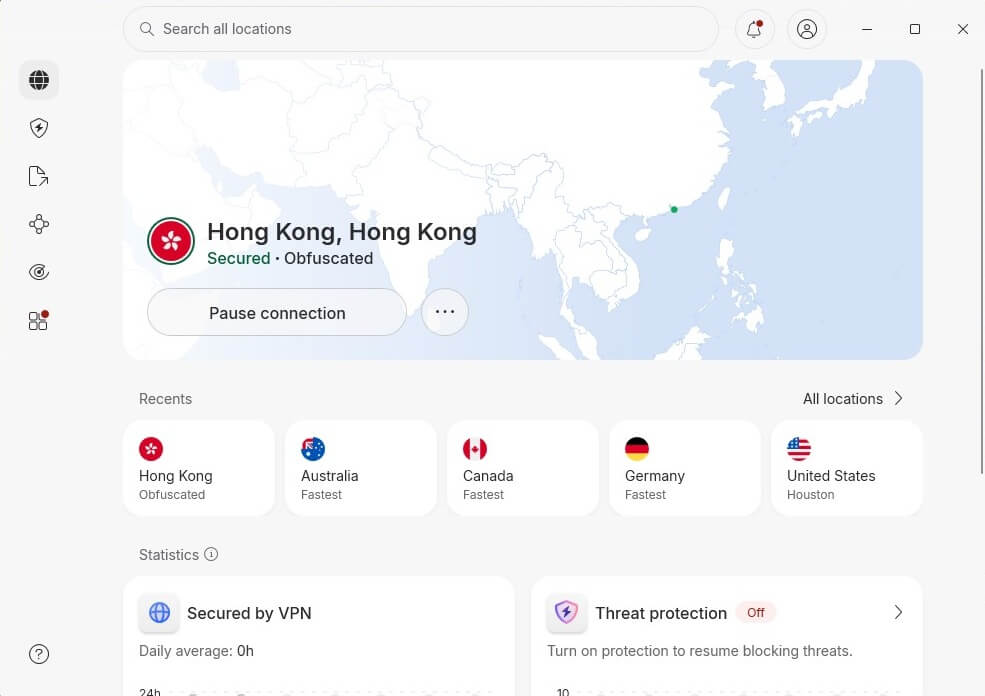
Nearby servers in Japan, Singapore, and Hong Kong kept speeds fast enough for video calls, HD streaming, and secure browsing, and even long-distance connections back to the US retained most of their baseline speed. Privacy matters more in China than anywhere else. NordVPN checks that box, with RAM-only servers and an independently audited no-logs policy by Deloitte (six times).
A kill switch and Threat Protection, which blocks trackers, ads, viruses, and malware, keep your data secure if the connection drops. NordVPN also prepares you before arrival. Mirror sites and setup guides available outside China let travelers download and configure the app so it works the moment they land behind the Firewall. CyberGhost really offers nothing comparable.
Simply put, NordVPN succeeds where CyberGhost fails. It is faster, more private, and far better equipped to keep you online in China.
What It Takes for a VPN to Work in China
China is not like other markets. A VPN here needs more than servers and encryption. To survive the Great Firewall, it must blend in, adapt quickly, and stay ahead of aggressive blocking systems.
- Obfuscation is the key: The Great Firewall uses deep packet inspection (DPI) to sniff out VPN traffic and cut it off, so a working VPN in China must disguise encrypted traffic as normal HTTPS. Without obfuscation, even premium services struggle to stay online. This is where NordVPN shines, with obfuscated servers built to slip past aggressive filtering.
- Nearby servers make all the difference: Speed in China is about proximity. Servers in Japan, Singapore, and Hong Kong usually separate a usable connection from one that constantly times out.
- Constant IP rotation is a must: The Firewall blacklists specific IP addresses linked to VPN services, so providers have to rotate servers and IPs constantly to avoid detection. Few commit to that kind of maintenance. This is where ExpressVPN has built its reputation, deploying fresh servers that survive where others stall.
- Reliable support matters in restricted networks: You cannot hop onto Google Play or Reddit to troubleshoot in China. You need 24/7 support and setup guides hosted on mirror sites that bypass censorship.
Best Tips for Using a VPN in China: Essential Tricks
If you are serious about staying connected in China, preparation is everything. Here is what to do before and after you arrive:
- Install and test your VPN before arrival: Download the app, sign in, and test it outside China. Once inside, app stores and provider websites may be blocked. NordVPN and ExpressVPN offer mirror sites if you need a backup installer.
- Test multiple protocols in advance: Know how to switch between WireGuard, OpenVPN, and obfuscated modes before you need them.
- Use nearby servers: Hong Kong, Japan, and Singapore deliver the best balance of speed and reliability. US or European servers tend to be slower and less stable.
- Enable obfuscation or stealth features: Turn on the settings that disguise VPN traffic as normal HTTPS. Without them, most VPNs get blocked instantly.
- Keep a backup: Even strong providers experience downtime. A second VPN or a tool like Shadowsocks means you are never fully disconnected.
Conclusion: So, Does CyberGhost Work in China?
CyberGhost may be a capable VPN in other regions, but it does not work reliably in China in our October 2026. Without obfuscation, server rotation, or China-specific support, it cannot keep up with the Great Firewall. If staying connected behind China’s censorship is a priority, the safer bet is to prepare with a provider built for the challenge, like NordVPN or ExpressVPN.
Both offer the stealth tech, nearby servers, and consistent updates that CyberGhost lacks, making them the smarter choices for anyone heading to China.
Frequently Asked Questions
🏆 What is the best CyberGhost VPN China setup?
There's no CyberGhost VPN China setup that works. CyberGhost lacks obfuscation or any other technology to bypass DPI and censorship, in general. Whatever you do, CyberGhost won't work in China right now. Before travel, equip another VPN better suited for the task, like NordVPN or ExpressVPN.
🏮 Is there a CyberGhost China server?
Yes, CyberGhost has a VPN server in China, though it offers virtual servers. According to its website, there are 12 China VPN servers in Shenzhen, and all of them allow torrenting. It also has VPN servers in Hong Kong.
🧧 Does CyberGhost VPN official website work in China?
No, it doesn't. CyberGhost's official website is blocked in China, though you may be able to access it on unrestricted tourist networks. That still doesn't matter because CyberGhost won't work in China.
🆓 Will a free VPN work in China instead?
No, it won't. Free VPNs in China are a bad idea, and most are blocked by the Firewall. On top of that, most free VPNs limit your speed, allowed data, servers, streaming, torrenting, and simultaneous connections.