
Georgia doesn’t block social networks or major websites, yet in 2026, Freedom House stopped calling its internet free. The reason is the law: since 2025, people have been fined over social media posts that insult officials, and police have used facial recognition to identify protesters. VPNs remain legal.
On a Magti or Silknet connection, a VPN keeps the sites you visit hidden from your ISP and from surveillance on local networks. For Georgians living abroad, a server back home has the opposite effect.
Imedi, 1TV, and your bank’s website see a Georgian IP address and treat you as local. Only some VPNs offer Georgian servers, and fewer pair them with a solid privacy record.
Top VPNs for Privacy in Georgia
- NordVPN: Best overall, with the fastest Georgian servers and obfuscation built in
- Proton VPN: Best for privacy-first users, with a Swiss base and a disguised protocol even on the free plan
- ExpressVPN: Best for first-time users, with no settings to learn
- Private Internet Access: Best for crowded households, covering every device on one subscription
- Surfshark: Best for streaming on a budget, with a built-in ad blocker
Georgian Servers and Speed, Side by Side
| VPN | Servers in Georgia | Average speed loss | Disguised connection | Devices |
|---|---|---|---|---|
| NordVPN | 4 servers | 7.8% (NordLynx) | Obfuscated servers (NordWhisper) | 10 |
| Proton VPN | 50 servers | 10.2% (WireGuard) | Stealth, on the free plan too | 10 |
| ExpressVPN | 1 location | 7.8% (Lightway) | Automatic on every server | 10 to 14 |
| Private Internet Access | 1 location | 12.7% (WireGuard) | Shadowsocks (OpenVPN only) | Unlimited |
| Surfshark | 8 servers | 9.6% (WireGuard) | Camouflage Mode (OpenVPN) | Unlimited |
Best VPNs for Georgia
1. NordVPN: Best VPN for Georgia Overall
Pros
- Fastest Georgian servers we tested
- NordWhisper obfuscated servers
- Independently audited no-logs policy
- Double VPN through two servers
- App-level kill switch
Con
- Renewal costs well above the intro rate
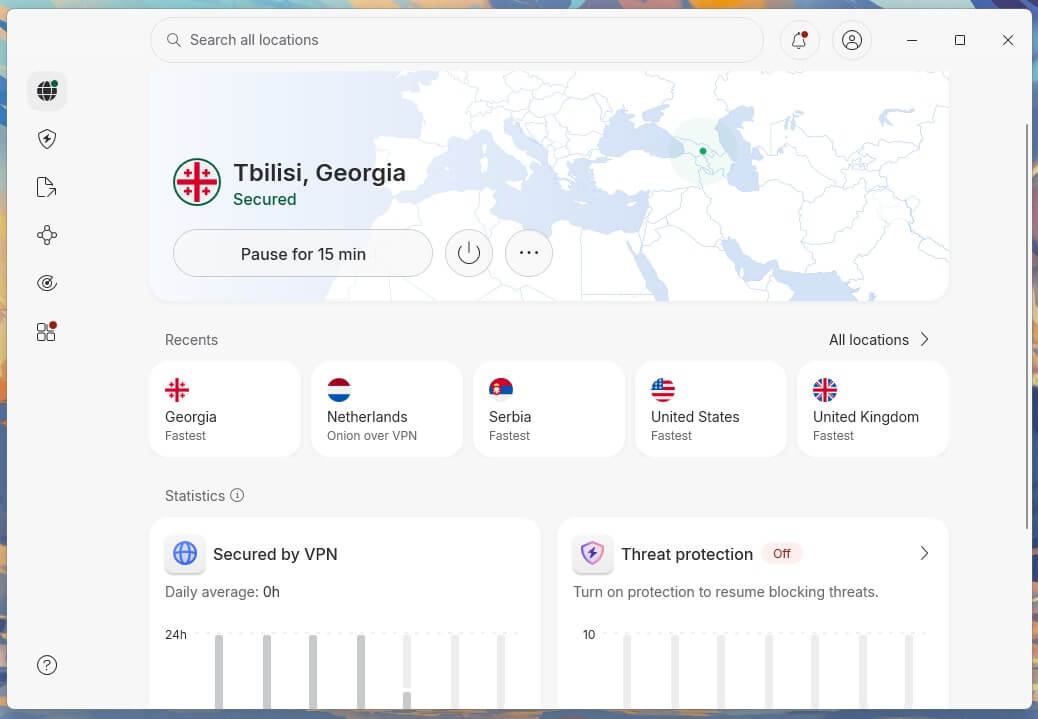
NordVPN has four servers for Georgia, and its Georgian connection lost just 4.5% of our speed, the smallest drop of the three we tested on Georgian servers. For a Georgian living in Berlin or Boston, that’s comfortably enough for live TV in HD and for banking without timeouts.
Its obfuscated servers use NordWhisper, a protocol that makes a VPN session hard for network filters to tell apart from normal HTTPS browsing. Georgian ISPs don’t block VPNs today, but if a network starts doing so during a tense week, open the Obfuscated Servers category and connect.
Double VPN encrypts your traffic twice on its way out, an extra layer for activists and journalists who’d rather keep more distance from their ISP. Its intro price lasts for the first term, and renewal costs noticeably more.
The Basic plan starts below $3.50 monthly with a two-year subscription, and our NordVPN discount codes list the current offer.
2. Proton VPN: Best for Privacy in Georgia
Pros
- Dozens of Georgian servers
- Free accounts can use Stealth
- Swiss jurisdiction
- Public app code
- Secure Core multi-hop servers
Cons
- Free accounts can’t choose a Georgian server
- No post-quantum encryption yet
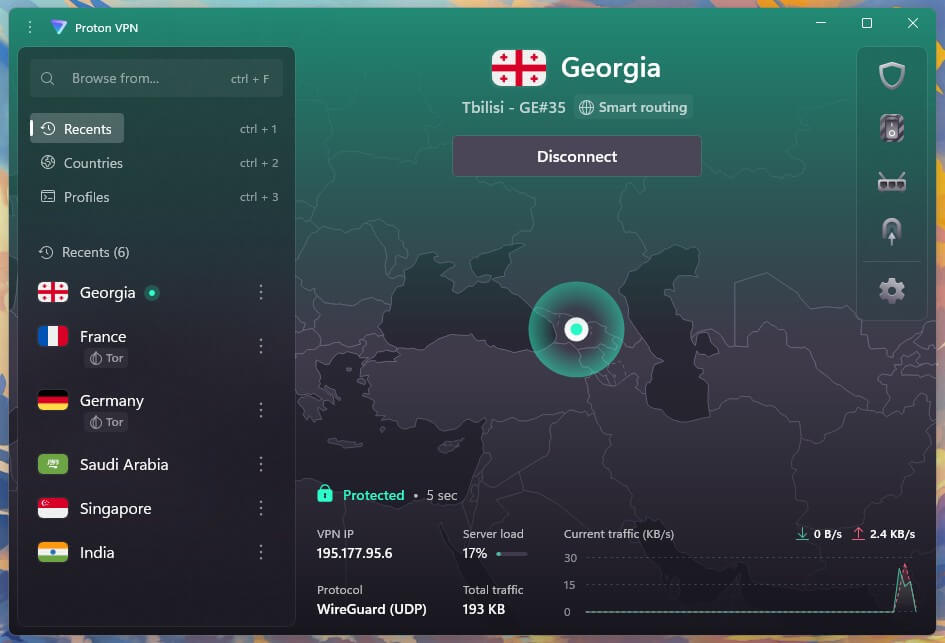
Proton VPN is the one we’d choose if privacy is your main concern in Georgia. The company operates under Swiss law, its app code is public, and an outside firm checks its no-logs policy every year. Its Georgian servers kept the speed loss to 8.1%, comfortable for streaming and video calls.
Stealth keeps network filters from recognizing a Proton VPN connection, and free accounts have it too. That turns the free version into a practical privacy tool for a resident of Tbilisi or Batumi, at no cost. Georgian TV abroad is another matter, since free accounts can’t select a Georgian server.
Paid plans add Secure Core, which sends your traffic first to a Proton-owned server in a country with strong privacy laws. Post-quantum encryption hasn’t arrived yet, while NordVPN and ExpressVPN already use it. That protection targets future code-breaking computers, so its absence shouldn’t stop you today.
With a two-year commitment, VPN Plus comes to just under $3 monthly.
3. ExpressVPN: Best for Beginners in Georgia
Pros
- Connects in one to two seconds
- Obfuscation works automatically
- Post-quantum Lightway protocol
- Apps for routers and smart TVs
Cons
- Slowest of the three on its Georgian server
- Few manual settings
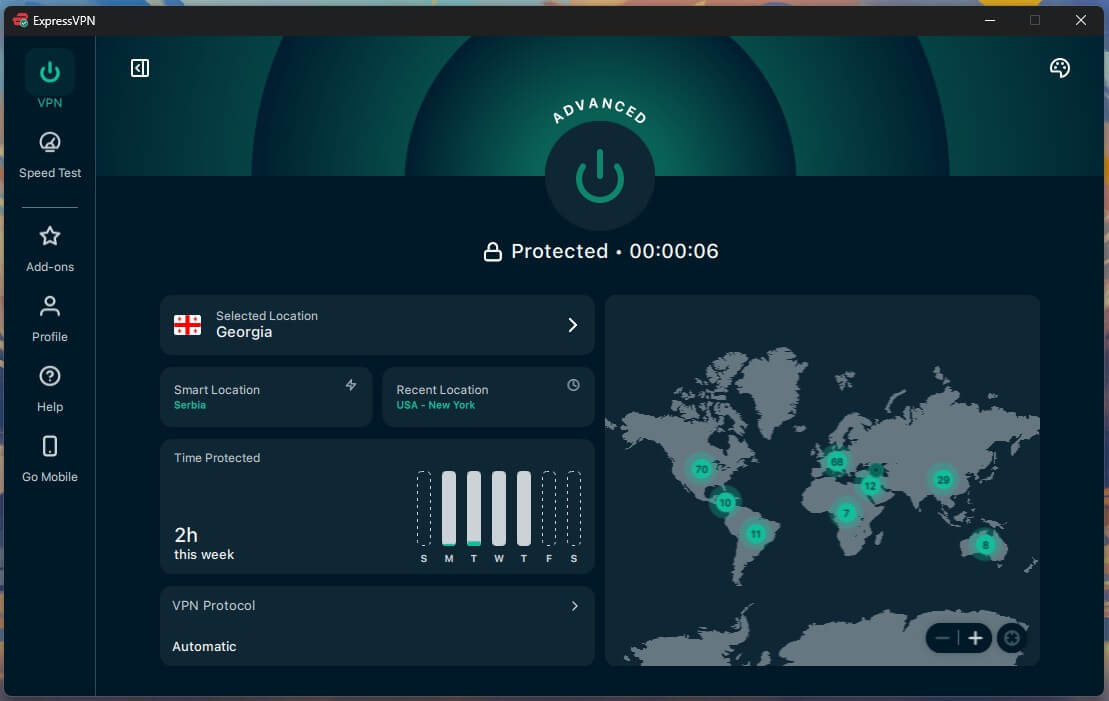
ExpressVPN is the easiest of the five to set up, which helps if you’re installing a VPN for a parent back home. Connections were ready almost instantly, and obfuscation runs on every server with nothing to configure.
Its Lightway protocol also includes post-quantum encryption. Its Georgian server was the slowest in our tests there, with an 11.3% speed loss. That still covered HD streaming without buffering, so you’d notice it when downloading large files over the Georgian connection.
Smart TV owners can install it directly on Apple TV, where it’s among the top-rated tvOS VPNs. If you like adjusting protocols and DNS settings by hand, ExpressVPN offers few options, and NordVPN or PIA will suit you better.
Expect to pay close to $3 monthly for the Basic plan if you commit for two years, with 10 devices included in that price. ExpressVPN covers 12 or 14 devices on higher plans, but in my experience, the Basic plan is enough for most peple.
4. Private Internet Access: Best for Large Households
Pros
- Unlimited simultaneous connections
- Georgian server location
- Open-source apps
- Among the lowest long-term prices
Cons
- Windows app defaults to OpenVPN
- Slowest of the five in our tests
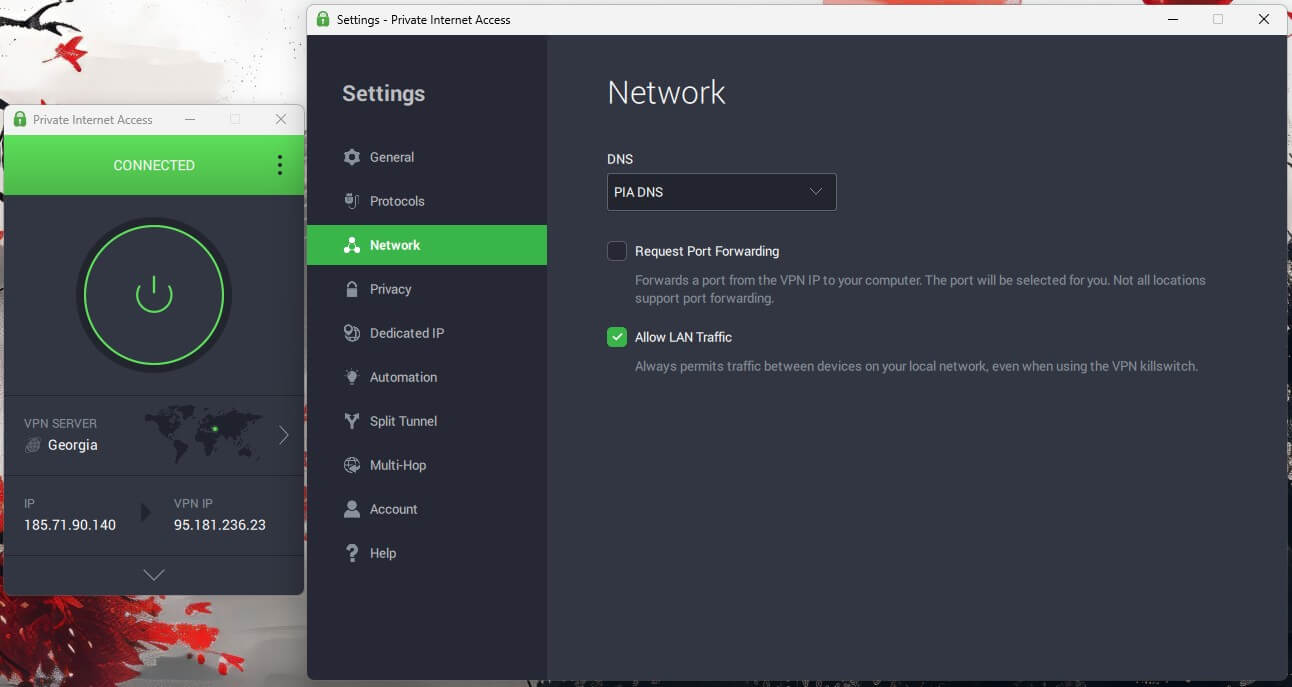
Private Internet Access sets no device limit, so a family of five can connect every device they own at once. Its longest plan works out to roughly $2 a month, and our roundup of VPNs for multiple devices compares how many connections each one allows. PIA’s average speed loss was 12.7%, the largest of the five.
However, it still covers HD video and browsing. Its Windows app connects over OpenVPN by default, and changing the protocol to WireGuard before the first session brings the speed up. PIA’s Shadowsocks proxy disguises traffic on restrictive networks, but only on OpenVPN, which I found a bit limiting.
PIA lists a Georgian location, and its code is published on GitHub for independent review. If you’re weighing it against a simpler app, our PIA vs ExpressVPN comparison sets the two side by side.
5. Surfshark: Best for Streaming on a Budget
Pros
- Netflix, BBC iPlayer, and HBO Max unblocked
- CleanWeb blocks ads and trackers
- Unlimited simultaneous connections
- Post-quantum encryption
- Camouflage Mode for restrictive networks
Cons
- Connections sometimes take a few seconds longer
- Renewal price well above the first term
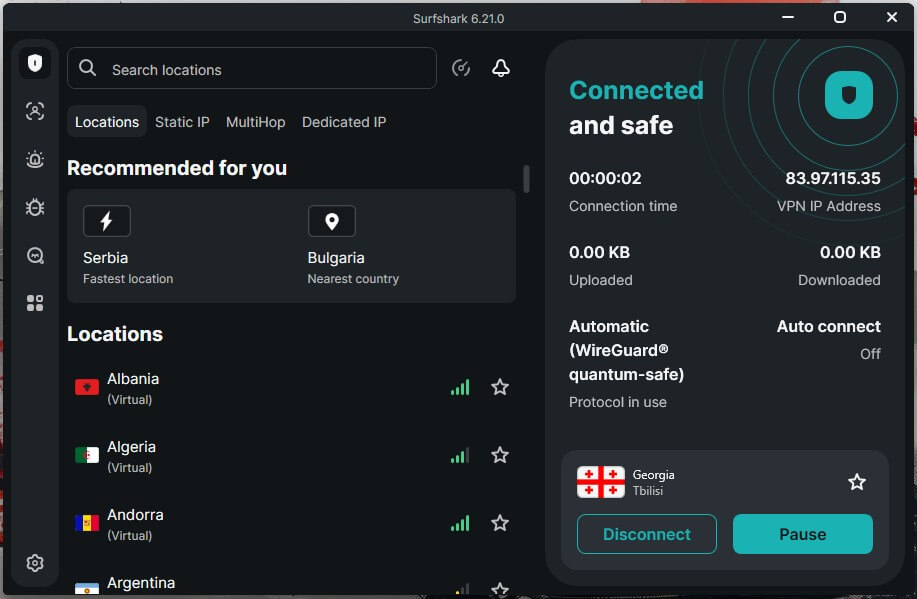
Surfshark has eight servers for Georgia and did well in our streaming tests, unblocking every service we tested apart from ITVX. That makes it a strong choice for expats in Tbilisi who want to keep watching their home catalogs. Its average speed loss was 9.6%, lower than Proton VPN’s and PIA’s.
CleanWeb, its built-in blocker, removes ads, trackers, and malicious links, so ad-heavy news and streaming sites are cleaner to browse. Camouflage Mode disguises OpenVPN connections as ordinary traffic, useful when a hotel or office Wi-Fi blocks VPN connections.
Its WireGuard connections also use post-quantum encryption. Connections occasionally took longer than with the others, so allow the app a few seconds before switching servers. One subscription covers every device you own, and the Starter plan works out to about $2.50 monthly over two years, but it renews at a noticeably higher rate.
Why Use a VPN in Georgia?
These five VPNs cover different situations, and most people in or from Georgia fall into one of these:
- Privacy on Georgian networks: your ISP logs which sites you visit, and the law lets the State Security Service tap telecom networks. With a VPN on, the ISP sees encrypted data headed to one server and little else.
- Public Wi-Fi in Tbilisi and Batumi: cafés and coworking spaces run open networks, and remote workers log in to company systems from them every day. A VPN keeps those logins encrypted on a network you don’t control.
- Georgian TV abroad: 1TV restricts some sports, such as rugby, to viewers in Georgia. 1TV, Imedi, and Rustavi 2 all worked in our tests over the Georgian servers of NordVPN, Proton VPN, and ExpressVPN. Our guide to getting a Georgian IP address has the step-by-step setup.
- Home services while in Georgia: Netflix works in Georgia with a different catalog, while Hulu and BBC iPlayer don’t operate there. A server in your home country unblocks them, and the same applies if you’re looking for the best VPN for Prime Video.
- Banking across borders: TBC Bank and Bank of Georgia can flag logins from foreign or shared IP addresses, and your home bank may do the same when you sign in from Tbilisi. A server in the bank’s country makes the login look routine.
VPN Laws and Online Freedom in Georgia
No Georgian law restricts VPN use. The legal changes since 2024 target what people publish online instead:
- Foreign influence law (2024): outlets, including online media, with more than 20% foreign funding must register.
- Foreign agents law (in force June 2025): prison terms of up to five years for unregistered “foreign agents.”
- Code amendments (2025): fines and detention for insulting officials, which courts have applied to social media posts.
- Extremism offense (March 2026): up to three years in prison for public calls that portray the constitutional order as illegitimate.
Surveillance is the other side. Since 2017, the Operative-Technical Agency within the State Security Service has run covert monitoring of communications networks.
Monitoring at the network level sees only scrambled data while a VPN is connected. It doesn’t make a public post anonymous: content published under your name, or on an account tied to your phone number, can still be traced. And activity that’s illegal without a VPN stays illegal with one. Our overview of what a VPN can and can’t do covers those limits.
Summary of the Best VPNs for Georgia
Private browsing at home doesn’t require a paid VPN in Georgia. Proton VPN’s free plan comes with Stealth and unlimited data, which covers a resident who only wants the ISP kept out.
Paid plans earn their price once you want a Georgian IP address from abroad, a server in another country for your streaming services, or a backup if a network starts blocking VPN traffic. NordVPN handled those best in our tests, with the best Georgian speeds and obfuscation ready when a network turns hostile.
Once the VPN is on your phone and laptop, enable the kill switch so nothing leaks if the connection drops. And remember that a VPN can’t protect a post published under your own name.
Frequently Asked Questions
Can you use a free VPN in Georgia?
Yes. Free VPNs work normally in Georgia, and Proton VPN offers a free tier with unlimited data and Stealth. It offers no Georgian servers, so Georgian TV from abroad requires a paid plan.
Is public Wi-Fi in Tbilisi safe to use?
Mostly, for casual browsing. Café and coworking networks are often open, so others on the same network can try to intercept traffic. A VPN encrypts logins and messages before they leave the device.
Is Netflix available in Georgia?
Yes. Netflix operates in Georgia with its own regional catalog, so some American and British titles may be missing. Connecting to a VPN server in the US or UK unblocks those libraries.
Is Georgia part of the 14 Eyes?
No. Georgia doesn't belong to the 14 Eyes or its smaller Five and Nine Eyes groups. Its intelligence services can still monitor communications networks under national law.
Does Georgia block websites or social media?
No. Georgian ISPs aren't ordered to block social platforms or news sites, and VPN connections work normally. The concern is laws penalizing online speech, which led Freedom House to downgrade the country.
Does a VPN make social media posts anonymous in Georgia?
No. A VPN encrypts traffic between a device and its server, but every post stays linked to the account behind it, including any phone number or real name on that account.
 Do Not Sell My Personal Information