Using a VPN to misrepresent your location breaks the terms of every licensed operator, and it can end in a closed account and a confiscated balance. It can also break state or national law. We're not lawyers, and this isn't legal advice. Check the rules that apply where you are. If gambling has stopped being fun, US residents can call 1-800-MY-RESET or 1-800-GAMBLER.
PokerStars changed shape in the USA on 1 April 2026. Flutter merged its American poker operation into FanDuel, and the site now operates as PokerStars Exclusively on FanDuel. The terms name Betfair Interactive US LLC as the operator; TSG Interactive Services licenses the PokerStars name and doesn’t operate the games.
Encrypting the link between device and poker client leaves a hotel network, or an ISP, with a VPN endpoint and no view of the tables or the cashier. Twelve services went through latency, leak, and audit checks. Four came out ahead: NordVPN, Proton VPN, ExpressVPN, and PIA VPN.
Where PokerStars Is Legal in October 2026
Real-money play covers Michigan, New Jersey and Pennsylvania, each licensed by its own state regulator and all 3 inside the Multi-State Internet Gaming Agreement, which is what lets them share a player pool. Players must be 21 and physically present. Six states have live online poker. Nevada, Delaware, and West Virginia have operators, none of them PokerStars, and Rhode Island, Connecticut, and Maine legalized without a site going live.
Crossing a state line moves your money with you. Sign in from another state where the platform operates, and the whole balance transfers there, then transfers back on your return. Internationally, PokerStars is locally licensed in France, Spain, Italy and Portugal, with a ring-fenced platform in Ontario, and it serves most of Europe, Canada and much of Latin America and Asia through PokerStars.com. Australia and Russia are among the markets it left.
How PokerStars Checks Your Location
Your phone supplies the location. An IP address plays no part. Registration requires a cell number, and the games stay locked until you opt into carrier location checks. Opting back out closes access. That data is kept for 10 years and shared with the state regulator on request. The check repeats mid-session. If it stops confirming you’re in an approved state, the hand in progress finishes and the session ends.
Customers separately agree not to disguise their device’s IP, or to take any step that stops the operator from identifying the real one. Breach that and the terms allow it to void previous bets, forfeit accrued winnings, and demand back money already withdrawn. The terms cite the Wire Act and the Unlawful Internet Gambling Enforcement Act.
They call wagering through a Michigan license holder from outside the state a federal offense unless the regulator authorized it. Registration asks for date of birth, address, phone number, and the last 4 digits of a SSN.
Best VPN for PokerStars in October 2026
Here are the fastest, most secure VPNs to choose.
1. NordVPN: Best VPN for PokerStars Overall
Pros
- Low ping nearby
- Dark web monitor
- Presets and automation
- Browser extensions
- Panama base
Cons
- Add-ons priced separately
- No free version
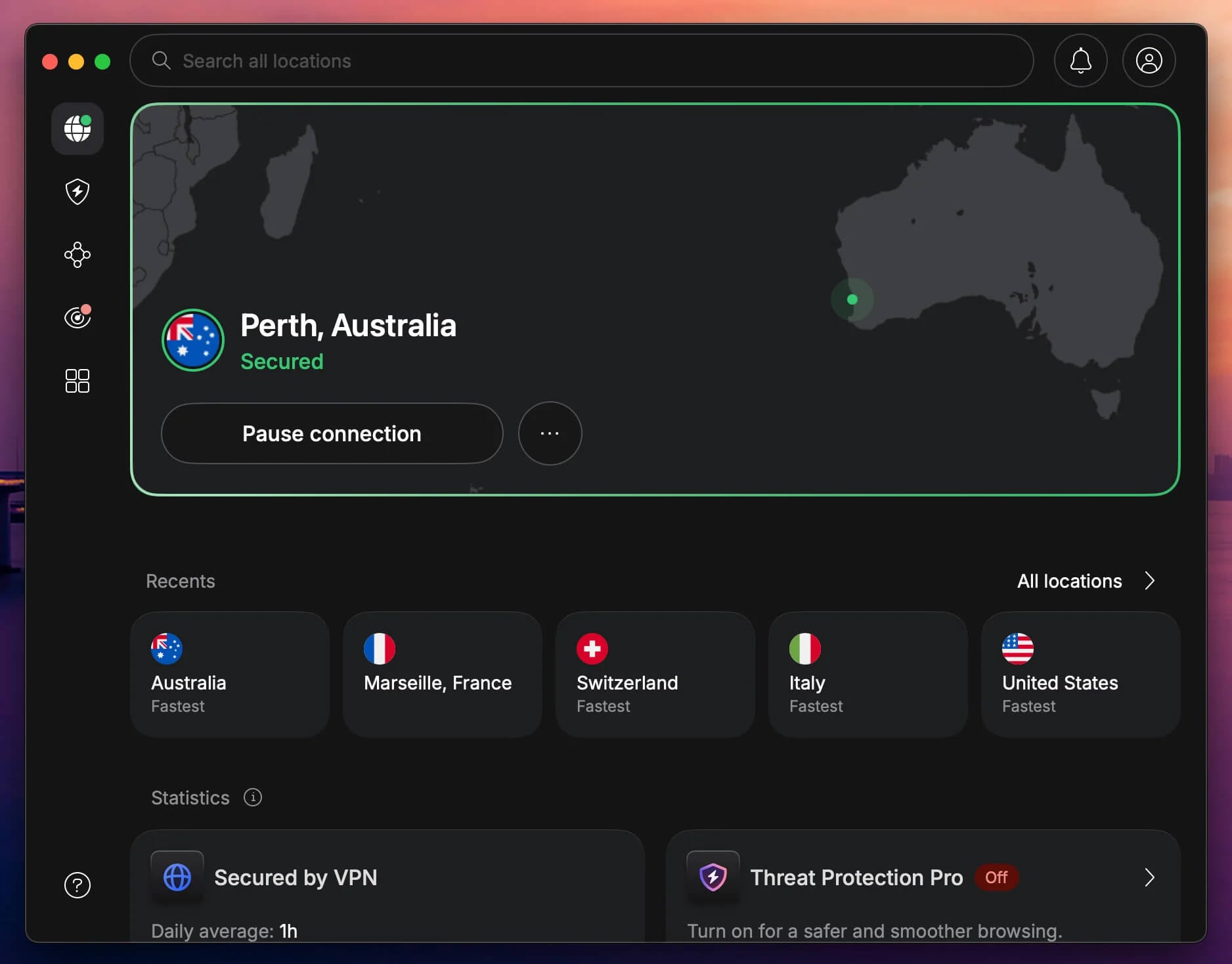
At a poker table, throughput is rarely the problem and latency usually is. NordVPN gave us the lowest round-trip times on nearby servers. Multi-tabling stayed responsive through long sessions, and the timer never counted down while waiting on a connection. Presets will get the most use here. One saved rule connects to a chosen server and opens the client together, so a session starts the same way every time.
Browser extensions cover the web client without tunneling the whole device. Dark web monitoring watches for your email address turning up in a breach dump, useful on an account with a cashier attached. Our NordVPN review covers the rest of the toolset. The 27-month Basic plan is $3.49 a month, $94.23 charged up front. Extras beyond the VPN belong to the higher tiers. There’s a 30-day refund window.
2. Proton VPN: Best PokerStars VPN for Privacy
Pros
- No-logs policy audited
- Swiss court oversight
- Accepts anonymous payment
- Kill switch is reliable
- Wide country coverage
Cons
- Learning curve on desktop
- No Smart DNS
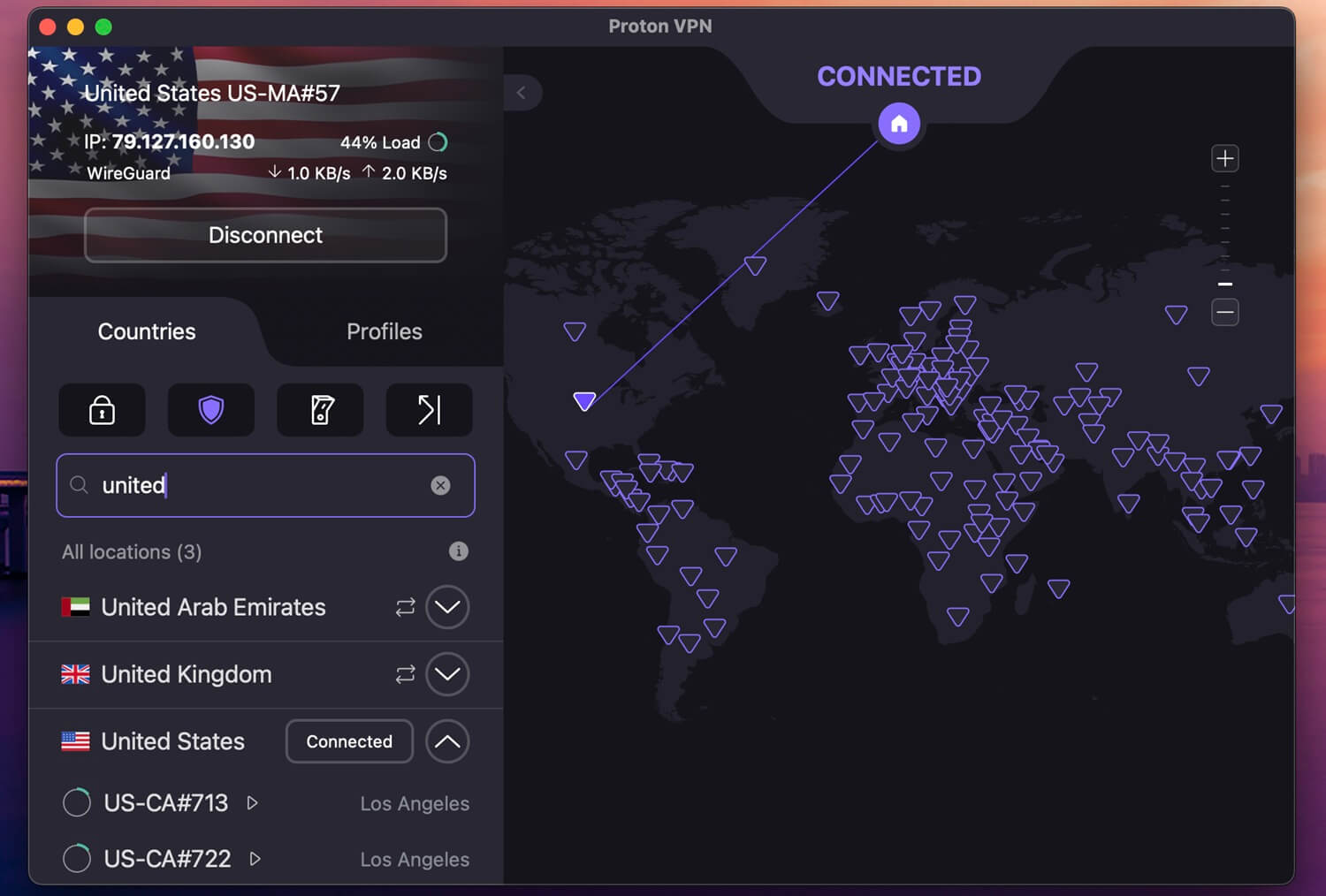
Proton VPN comes from the Swiss team behind Proton Mail, and privacy is the product. Foreign data requests have to clear a Swiss court, and Proton VPN publishes what it receives. The apps are open source and have been audited, and payment by Bitcoin or cash keeps the subscription off a card statement.
The kill switch stayed up through every forced disconnect we threw at it, which is the failure mode that costs a hand. Coverage is 148 countries. Proton VPN’s desktop layout is busy and rewards a bit of patience early on. Two years of Plus comes to $71.76, or $2.99 monthly, on 10 devices. Refunds are pro rata within 30 days.
3. ExpressVPN: Lowest-Latency PokerStars VPN
Pros
- Consistent speed retention
- Leak tests passed clean
- Works on smart TVs
- Simple server picker
- Long-standing KPMG audits
Cons
- Sparse manual settings
- Trial is mobile only
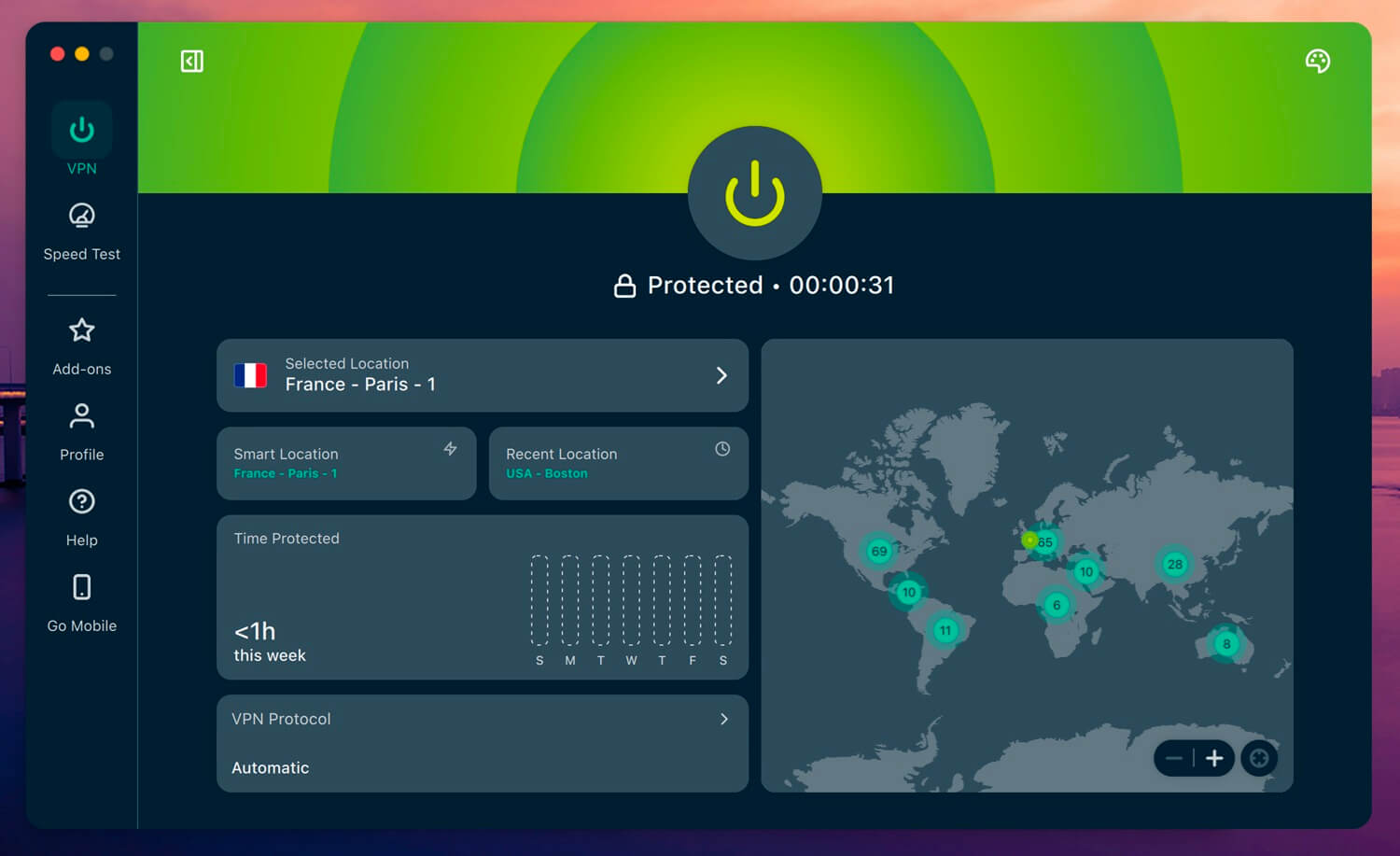
ExpressVPN gave the steadiest numbers over the distance. Speed retention stayed near 85% on long-haul connections, and there were no timeouts or frozen tables across a full session. DNS, IPv6, and WebRTC leak tests came back clean on every platform. Device support stretches to routers and smart TVs, so a household setup covers everything at once. The speed comparison has the full figures.
ExpressVPN asks $83.72 for its 28-month Basic term, $2.99 a month, with renewal at $99.95 annually, which is my only gripe. The free trial is 3 days and mobile-only, though the 30-day refund covers desktop.
4. Private Internet Access: Best Value PokerStars VPN
Pros
- Protocol and cipher control
- SOCKS5 proxy included
- Every device covered
- Transparency reports
- Cheapest of the 4
Cons
- US company
- Menus feel crowded
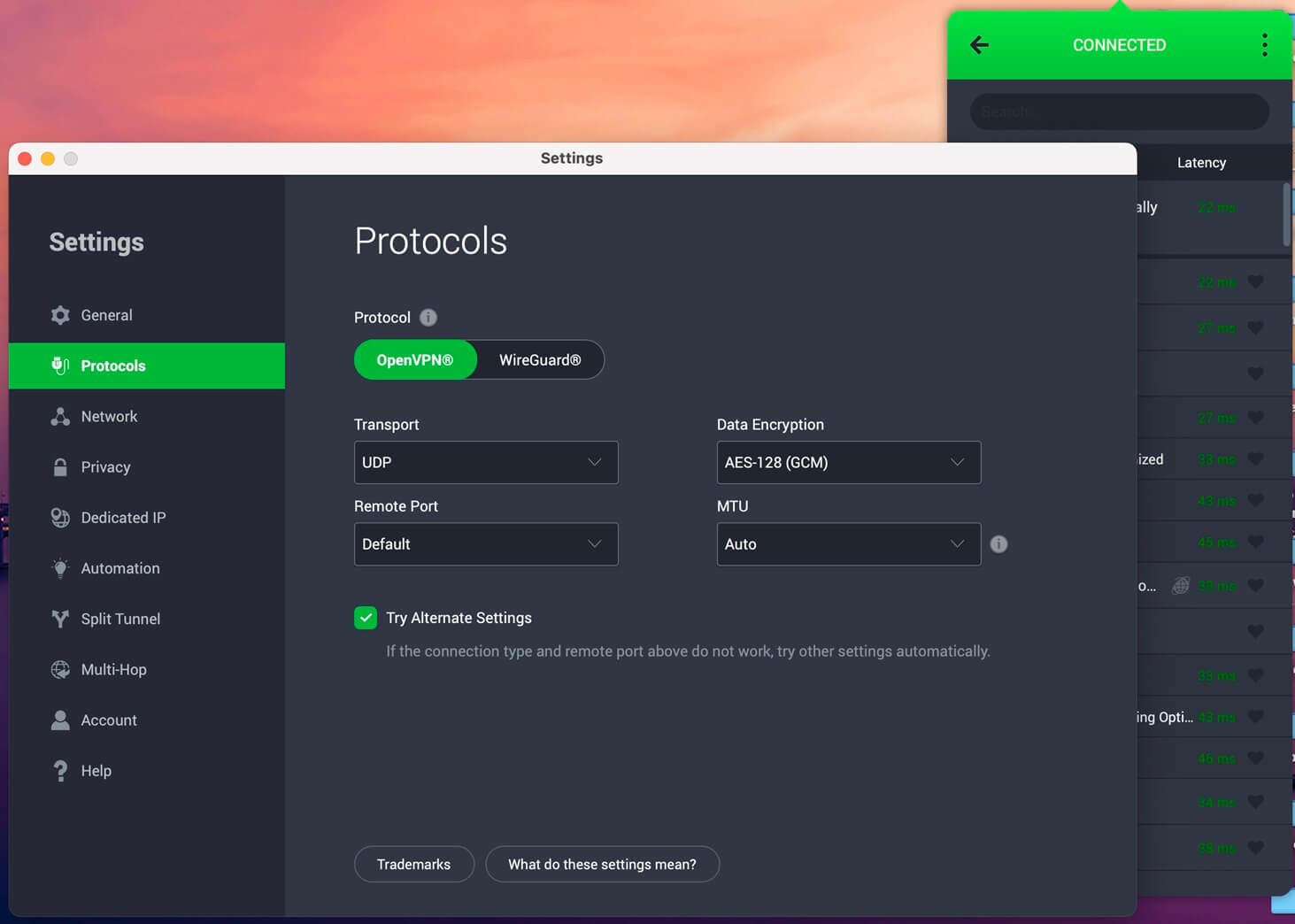
PIA is the pick for players who want the settings exposed. Encryption steps between AES-128 and AES-256, OpenVPN and WireGuard are selectable, MTU is editable, and a SOCKS5 proxy comes with the VPN. Speeds stayed near 85% of our baseline on WireGuard, enough for cash games and live dealer tables open simultaneously. US courts have sought user records from PIA and come away empty.
Deloitte reviewed the policy in 2022, 2024, and 2025. PIA also publishes transparency reports. Details are in our PIA review, and the NordVPN comparison puts the two side by side. Being American-owned is the trade-off, offset by that court record. The price is $2.19 a month on unlimited devices.
Buy at Private Internet Access
Compare the Best VPN for PokerStars
| NordVPN | Proton VPN | ExpressVPN | PIA VPN | |
| Best for | Overall | Privacy | Latency | Configurability |
| Speed retention | Over 90% | Around 85% | Around 85% | Around 85% |
| Fastest protocol | NordLynx | WireGuard | Lightway Turbo | WireGuard |
| Devices | 10 | 10 | 10-14 | Unlimited |
| Anonymous payment | Crypto | Crypto and cash | Crypto | Crypto |
| Starts from | $3.49/mo | $2.99/mo | $2.99/mo | $2.19/mo |
| Refund policy | 30 days | 30 days | 30 days | 30 days |
What a VPN Does for a Poker Account
- Protects the cashier on shared networks. Deposits and withdrawals made from a hotel or convention Wi-Fi pass through hardware owned by the venue. Encryption removes that exposure.
- Keeps your session off ISP records. Domains you connect to end up in your ISP’s logs. Behind a tunnel, only the VPN endpoint appears there.
- Stops throttling on long sessions. Some ISPs slow sustained connections. Hiding the traffic type avoids that trigger.
- Blocks phishing aimed at poker accounts. Fake client downloads and cloned login pages are common in this category, and the malware filters in NordVPN and ExpressVPN catch most of them.
Conclusion
PokerStars real-money poker now belongs to FanDuel in Michigan, New Jersey and Pennsylvania, one shared pool across the three, and nowhere else in the country. Elsewhere, PokerStars.com and the locally licensed sites cover most of Europe, Canada and Latin America. A VPN doesn’t extend that map. Carrier-based location checks and an agreement not to disguise your IP address are why.
What it does is protect a legitimate account on a network you don’t control. NordVPN gave us the lowest latency and the most useful automation. Proton VPN is the privacy choice. ExpressVPN was the steadiest over distance, and PIA VPN costs the least while exposing every setting.
Frequently Asked Questions
💸 Where can you play PokerStars for real money in the US?
Michigan, New Jersey, and Pennsylvania, all through PokerStars on FanDuel since April 2026. The three states share one player pool, and players must be 21 and physically present.
⚖️ Is using a VPN with PokerStars legal?
Yes, in most countries. The US terms are stricter: wagering through a Michigan license holder from outside the state is described there as a federal offense under the Wire Act.
🔎 Does PokerStars detect VPNs?
Yes. Its US terms require players to opt into carrier-based location checks, and customers agree not to disguise the IP address of the device they're using.
🆓 Does a free VPN work for online poker?
No, not reliably. Free plans cap data, slow under load, and add latency that costs hands at the table. Most also lack the leak protection a real-money account needs.
💂♂️ Is PokerStars available in the UK?
Yes. PokerStars is licensed by the UK Gambling Commission and accepts British players for real-money poker and casino games with no regional restrictions within Great Britain.