Windscribe can connect in China, but no single setting connects on every network, and Windscribe’s own help center says so. The app includes three tools for restricted networks: Stealth, WStunnel, and AmneziaWG presets. All three are on the free plan. We haven’t tested Windscribe in China. We measured what each anti-censorship setting costs in speed on a UK server, and we checked what the free plan includes before a trip.
Windscribe in China: Setup Steps for October 2026
- Install Windscribe and confirm your email before you travel. Confirmation increases the free allowance from 2 GB to 10 GB a month.
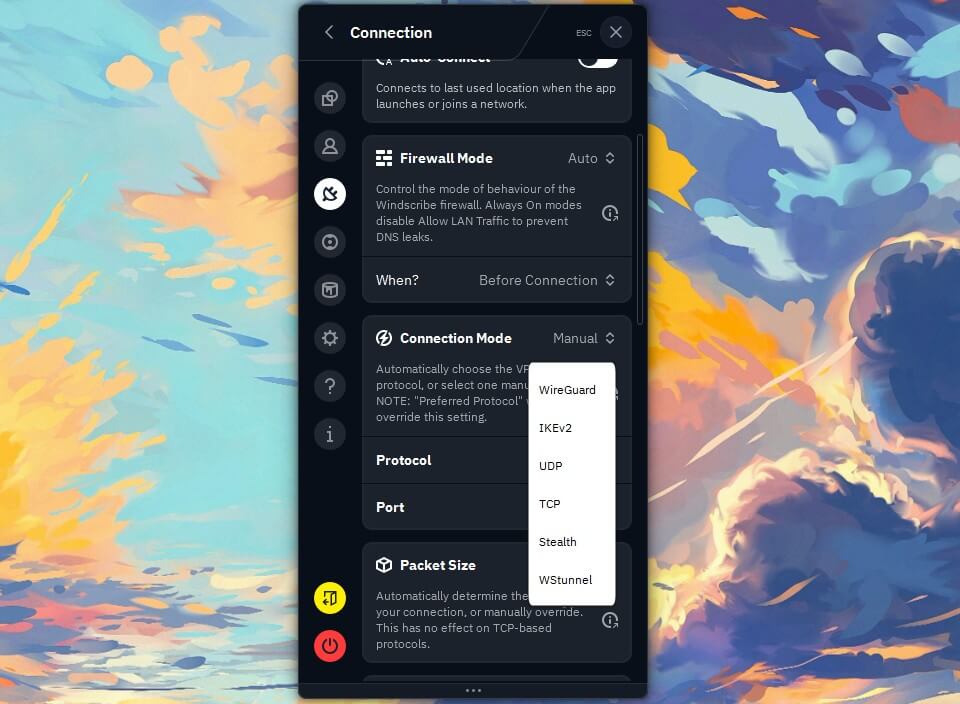
- Open Preferences, then Connection, and set Connection Mode to Manual.
- Select Stealth on port 443, and switch to WStunnel if Stealth doesn’t connect.
- Turn on Protocol Tweaks in the Anti-Censorship panel, on Windows or on your phone, to try the Amnezia presets.
- Connect to several locations, including Hong Kong, until one opens blocked sites.
- Install a second VPN as a backup before the trip.
How China Blocks VPN Connections
China’s Great Firewall blocks Google, YouTube, WhatsApp, and many foreign news sites. It also blocks the VPNs used to open them, with three main methods:
- Deep packet inspection identifies VPN protocols by the pattern of their traffic, even when the content is encrypted.
- IP address blocking cuts off known VPN servers.
- DNS poisoning answers requests for blocked sites with false IP addresses.
Blocking usually increases around politically sensitive dates, such as national holidays and major Party meetings. Windscribe’s anti-censorship settings use obfuscation, which disguises VPN traffic as ordinary web traffic.
Windscribe’s Anti-Censorship Settings
Windscribe recommends Stealth and WStunnel for China, starting on port 443 and moving to another server when one doesn’t connect.
- Stealth wraps OpenVPN in a TLS tunnel, so the connection resembles an ordinary HTTPS session.
- WStunnel sends OpenVPN traffic through a WebSocket, the format many web apps use for live data.
- Protocol Tweaks applies AmneziaWG presets, which change the pattern of WireGuard traffic. The presets are named for Russia, Iran, and general use, and none of them target China.
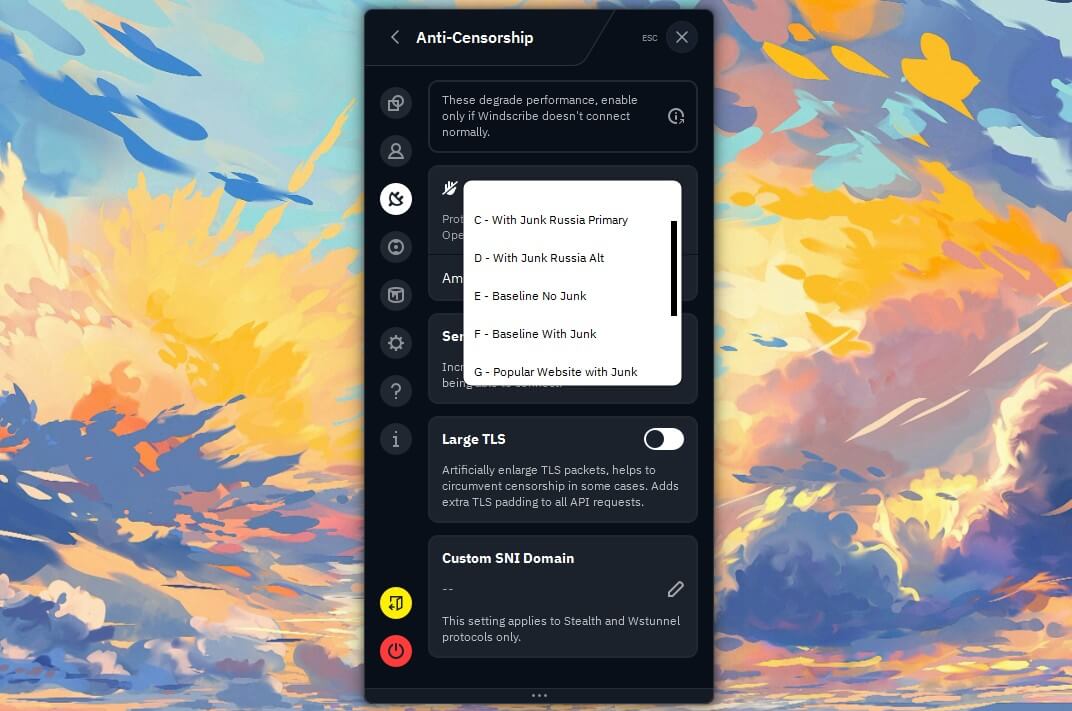
The panel also includes Large TLS, Server Routing, and a custom SNI domain, and the app warns that these settings reduce performance. The phone app has the same Anti-Censorship settings as the Windows app. Outside these settings, the app works as described in our Windscribe review.
How Much Speed Each Setting Costs
We measured every setting on Windscribe’s UK server in September 2026. The PC used Windows 11 on a wired 190.36 Mbps connection with 19.37 Mbps upload and a 10 ms ping, and all tests used free accounts. China isn’t part of our testing, so the results show the speed cost of each setting, not whether it connects there.
| Setting | Download/upload | Ping: idle, under load (down/up) | Below WireGuard |
| WireGuard | 182.00/18.63 Mbps | 48 ms, 75/78 ms | n/a |
| WireGuard, Amnezia Baseline No Junk | 181.07/18.29 Mbps | 48 ms, 84/76 ms | 0.5% |
| WireGuard, Amnezia Baseline With Junk | 177.43/17.58 Mbps | 49 ms, 88/ 79 ms | 2.5% |
| Stealth | 175.61/17.53 Mbps | 52 ms, 84/91 ms | 3.5% |
| Stealth with Large TLS | 173.55/17.26 Mbps | 52 ms, 91/96 ms | 4.6% |
| OpenVPN UDP | 172.24/18.68 Mbps | 48 ms, 80/77 ms | 5.4% |
| WStunnel | 143.91/17.92 Mbps | 51 ms, 142/151 ms | 20.9% |
| OpenVPN TCP | 127.87/18.43 Mbps | 48 ms, 247/681 ms | 29.7% |
- Stealth kept most of WireGuard’s speed, and Large TLS added a small extra cost on top.
- WStunnel was the slower of Windscribe’s two recommended protocols, with ping under load above 140 ms in both directions.
- The Amnezia presets cost the least, and the version with junk packets cost slightly more than the one without.
- OpenVPN TCP was the slowest setting, and its upload ping under load was the highest of any result.
- Most settings connected in 5 to 6 seconds. WireGuard and OpenVPN UDP took about 3.
Does Windscribe’s Free Plan Work in China?
The free plan includes Stealth, WStunnel, and the Anti-Censorship panel, so none of the settings we measured require a paid plan. Hong Kong is on the free location list, and the free plan allows unlimited devices at once. Data is the limit. The free plan allows 2 GB a month, or 10 GB with a confirmed email, and Windscribe’s free servers disconnect once the data is used up.
Our speed tests used most of one account’s 10 GB, and we finished testing on a second free account. Upgrading removes the data limit. The Yearly plan costs $69, or $5.75 a month, and the Monthly plan is $9. Build a Plan charges $1 a month for each location you add. For other no-cost options, see our best free VPNs and our guide to free VPNs for China.
Where Windscribe Falls Short in China
- The setup is manual. Stealth and WStunnel require switching Connection Mode to Manual, and Windscribe says a combination that works today may fail later.
- No preset targets China. Every Amnezia preset is labeled for another country or for general use.
- Mainland China has no Windscribe servers. Chinese streaming apps load through Hong Kong instead.
- 10 GB covers little video. Regular streaming on the free plan uses up the allowance quickly.
Backup VPNs for China
A second VPN helps on days when none of Windscribe’s settings connect. We haven’t tested these three in China, and each one uses its own obfuscation method. All three appear in our best VPN rankings, our Windscribe alternatives guide covers more options, and our China VPN guide tracks which VPNs connect there.
NordVPN: Best for Two Obfuscation Methods
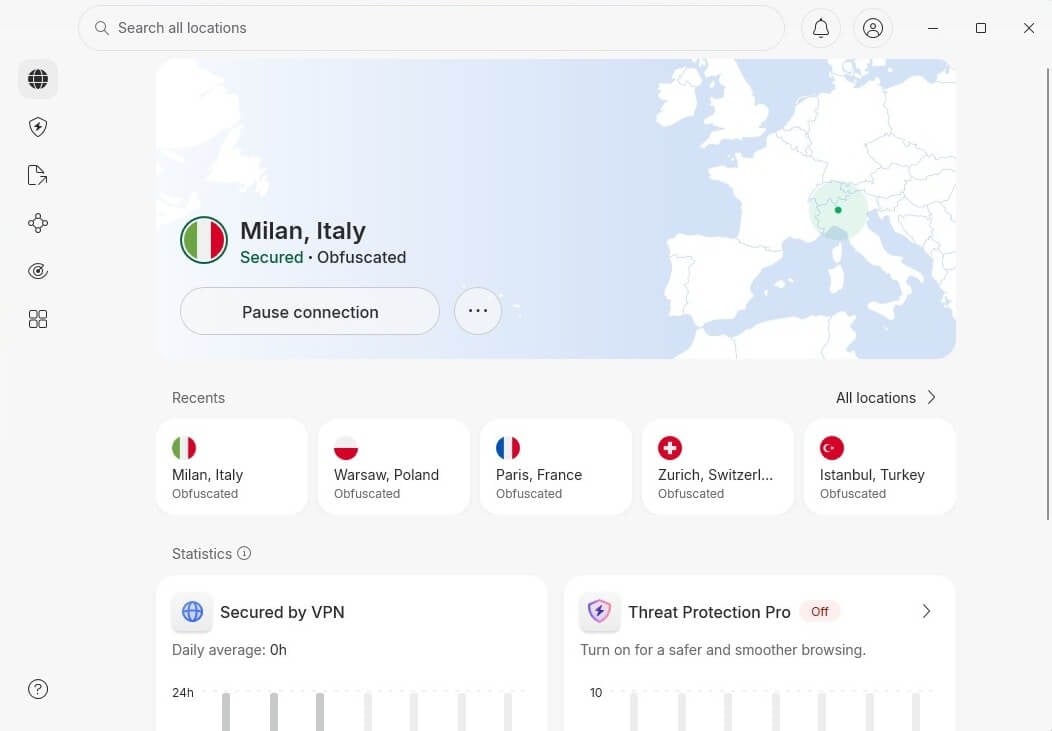
NordVPN offers obfuscated servers, which disguise OpenVPN TCP traffic. NordWhisper is a good alternative, a protocol built to look like ordinary web traffic. On our UK server, the obfuscated servers measured 167.79 Mbps and NordWhisper 161.13 Mbps. Both are on in the app’s settings. The Basic plan is $3.49 a month on the 27-month term. Our Windscribe vs NordVPN comparison puts the two VPNs side by side.
Proton VPN: Best Free Plan With Stealth
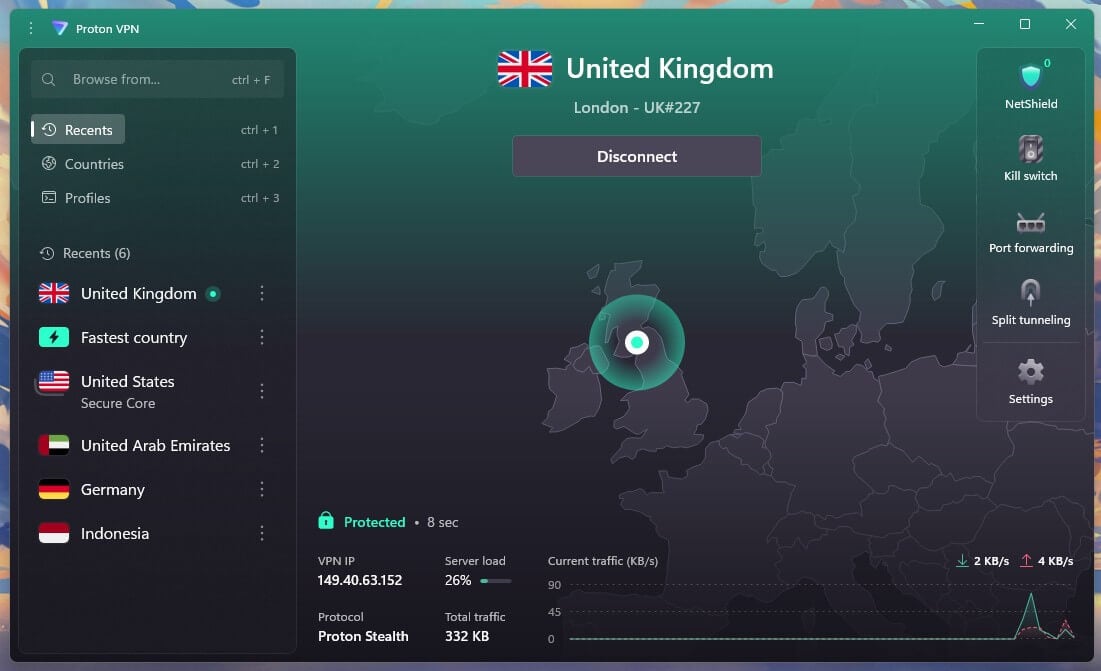
Proton VPN’s Stealth protocol disguises the connection as ordinary TLS traffic, and it’s included on the free plan. On our UK server, Stealth measured 175.41 Mbps, 1.9% below Proton VPN’s own WireGuard result. The free plan has no data cap, but free accounts can’t choose a server country. The VPN Plus plan is $2.99 a month on the two-year term.
ExpressVPN: Best for Obfuscation Without Setup
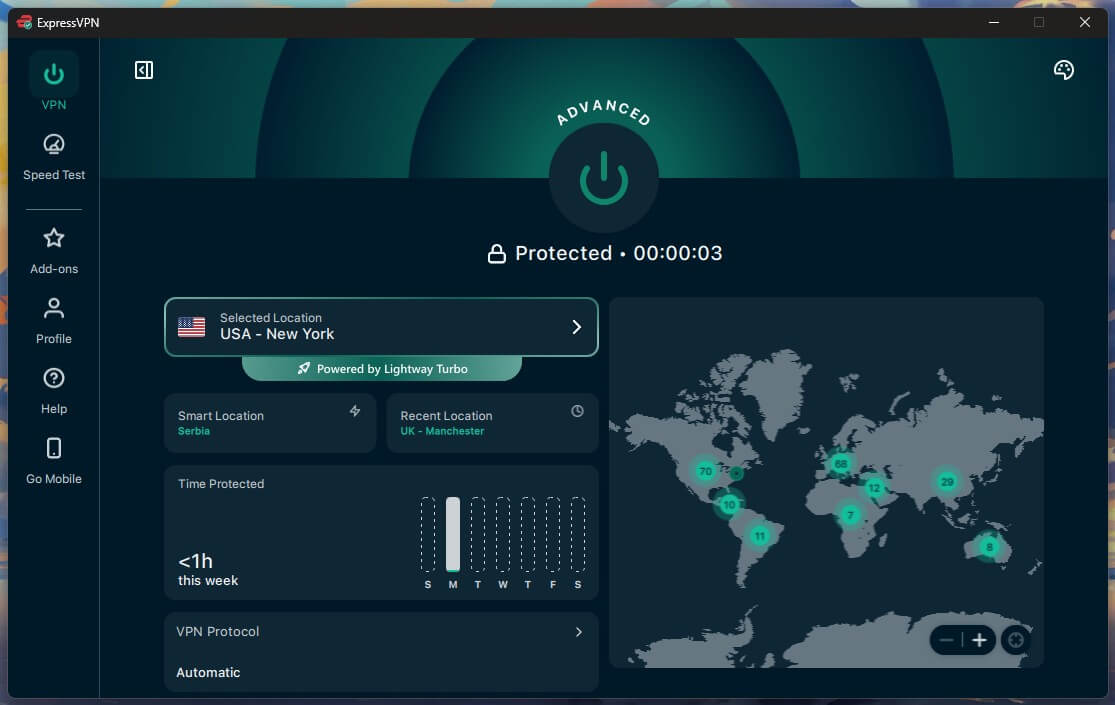
ExpressVPN obfuscates every Lightway connection automatically. On our UK server, Lightway measured 185.74 Mbps with that obfuscation active. Its Basic plan is priced at $2.99 a month for 28 months. Setup details for China are in our ExpressVPN in China guide.
Is It Legal to Use a VPN in China?
China allows only government-approved VPN services, and foreign VPNs like Windscribe don’t have that approval. A 2017 notice from the Ministry of Industry and Information Technology banned setting up or renting unapproved cross-border channels, VPNs included.
Enforcement has mostly targeted people selling VPN access, although some individual users have been fined. Check the current rules before you travel, especially for work in journalism or activism.
Does Windscribe Work in China? Our Verdict
Windscribe’s free plan includes every anti-censorship setting the app offers, and Stealth costs little speed in our tests. The catch is effort and data. Each setting has to be chosen by hand, no preset is built for China, and 10 GB doesn’t last long. Set Windscribe up before you fly, try Stealth first and WStunnel second, and keep a second VPN for days when neither connects.
Frequently Asked Questions
Does Windscribe VPN work in China?
Yes, on some networks. Windscribe connects in China through Stealth, WStunnel, or its AmneziaWG presets, but the working setting depends on the network and can change without warning.
Is Windscribe's free plan enough for China?
Yes, with a data limit. Every anti-censorship setting is available to free users, but the allowance is 2 GB a month, rising to 10 GB once an email address is confirmed.
Which Windscribe protocol works best in China?
Stealth is the first choice. It disguises OpenVPN as encrypted web traffic at a small speed cost. WStunnel is the fallback, and both protocols work on port 443.
Does Windscribe have servers in China?
No. Windscribe doesn't operate servers in mainland China. Hong Kong is the nearest option, and it's available on the free plan as well as the paid plans.
How much does Windscribe cost?
Paid Windscribe starts at $9 a month. A yearly subscription is $69, and Build a Plan charges per location. The free plan is available with a data cap.
Is it legal to use a VPN in China?
No, not without approval. Chinese rules require VPN services to have government approval, and foreign VPNs lack it. Penalties have mostly fallen on sellers, with some fines for individual users.