Since mid-2025, ETECSA has capped peso top-ups at 6 GB of mobile data a month, with anything more sold in dollars. For many Cubans, every megabyte now counts, and the state company that rations the data also operates the only network on the island. A VPN is worth those megabytes in two situations.
A visitor on hotel Wi-Fi in Varadero can keep US banking and streaming apps working while the network sees only scrambled traffic. A resident can read independent outlets such as elTOQUE, which ETECSA blocks, because the request leaves Cuba encrypted and arrives through a server abroad.
Those two groups don’t get the same choice of VPNs, however. US sanctions shape which customers many VPN companies accept, and the answer for someone living in Havana differs from the one for someone flying in.
Best VPN for Cuba: Quick Summary
- NordVPN: Best for travelers, with servers in Miami and Mexico and obfuscation for filtered networks
- Proton VPN: Best for Cuban residents, with no country restrictions and a free plan
- ExpressVPN: Best for simple apps on unstable Wi-Fi, plus a Cuban server location
- Private Internet Access: Best for Cubans abroad, with a Cuban location and no device limit
- Surfshark: Best for limited data plans, with built-in ad blocking and no device limit
Comparing VPNs for Cuba
| VPN | Cuban server location | Nearby servers | Speed loss (UK, US, Japan average) | Obfuscation | Terms for Cuban residents |
|---|---|---|---|---|---|
| NordVPN | No | Miami, Mexico, Bahamas, Jamaica | 7.8% (NordLynx) | Obfuscated servers (NordWhisper) | Excludes residents of sanctioned countries |
| Proton VPN | Yes, paid plans | Mexico, Jamaica, Dominican Republic | 10.2% (WireGuard) | Stealth, on every plan | No country restriction |
| ExpressVPN | Yes | Miami, Tampa, Mexico, Bahamas | 7.8% (Lightway) | Automatic | Excludes residents where sanctions apply |
| Private Internet Access | Yes | Miami, Mexico, Jamaica, Bahamas | 12.7% (WireGuard) | Shadowsocks proxy (OpenVPN only) | Lists Cuba as a country it can’t serve |
| Surfshark | No | Miami, Mexico, Bahamas, Costa Rica | 9.6% (WireGuard) | Camouflage Mode (OpenVPN) | Excludes sanctioned countries |
The Best VPNs for Cuba in 2026
1. NordVPN: Best for Travelers to Cuba
Pros
- Servers in Miami, Mexico, and the Caribbean
- Obfuscated servers for restrictive Wi-Fi
- Meshnet connects to your computer at home
- Unblocked Netflix US, Hulu, and BBC iPlayer
- Independently audited no-logs policy
Cons
- No Cuban server location
- Terms exclude people living in Cuba
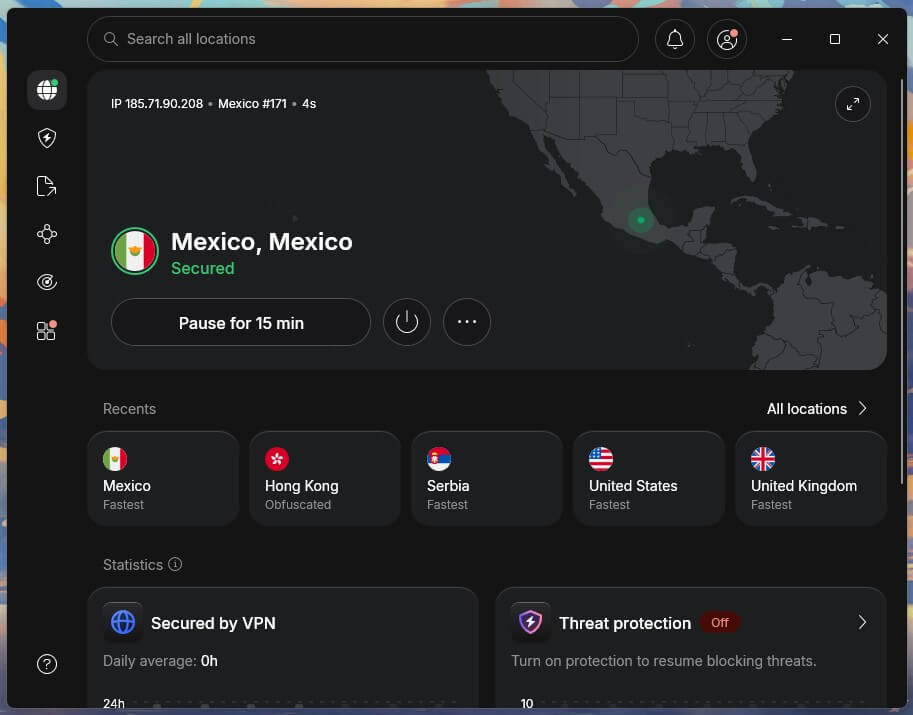
For a trip to Cuba, we’d install NordVPN first. It has no Cuban server, but its servers in Miami and Mexico are close, and our standard tests on servers in the UK, the US, and Japan showed a 7.8% speed loss, too small to feel on Cuba’s slower networks.
On a hotel or ETECSA network that blocks VPNs, switch to NordVPN’s obfuscated servers, which make the connection look like everyday web browsing. Meshnet comes with every plan, including the two-year Basic plan at a little under $3.50 monthly.
From a casa particular in Havana, Meshnet lets your laptop browse through your computer back home, so your bank recognizes the connection and doesn’t flag a login from abroad. There’s one limit for locals.
NordVPN’s terms rule out customers who live under comprehensive US sanctions, and Cuba falls into that group, so it’s a VPN for visitors. Residents have a better option in Proton VPN.
2. Proton VPN: Best for Cubans Living on the Island
Pros
- No country restrictions in its terms
- Stealth obfuscation, including on the free plan
- Cuban server location on paid plans
- Swiss company with audited no-logs policy
- Free plan with no data cap
Cons
- No country choice on the free plan
- Didn’t unblock Hulu or ITVX
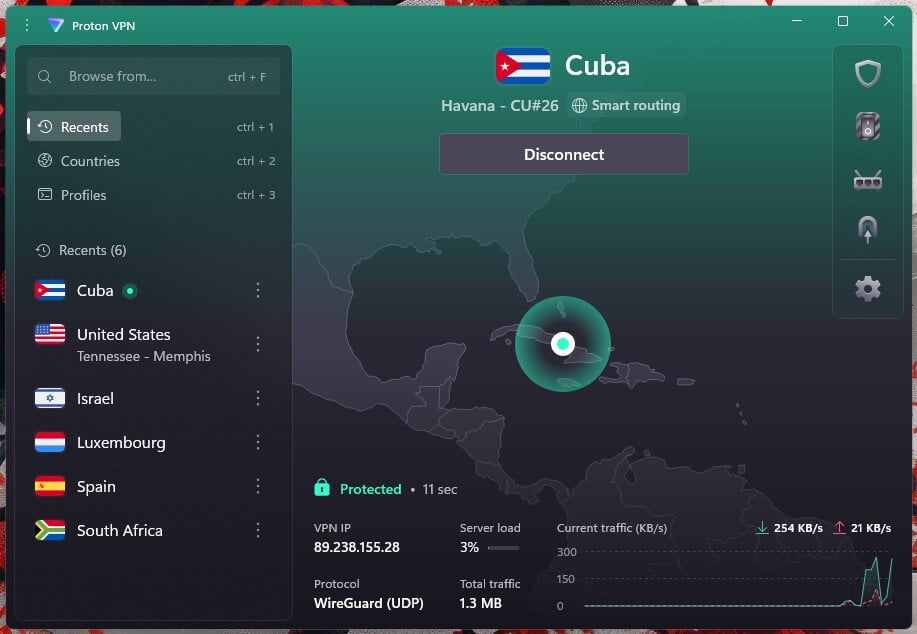
Proton VPN is a Swiss company, and its terms don’t exclude any country, which makes it the most practical choice for people who live in Cuba. An independent audit confirms it keeps no logs, and its app code is public for inspection, which is reassuring in a country where the only ISP is state-owned.
For about $3 monthly on a two-year subscription, the VPN Plus plan adds a Cuban server location. Stealth, Proton’s obfuscation protocol, makes VPN traffic resemble regular HTTPS browsing, and free accounts can use it.
In our tests, Stealth cost under 2% of the speed of a plain connection, so you can leave it enabled on ETECSA networks without noticing a difference. Proton’s free tier sets no data limit and is a good start for staying anonymous online in Cuba, though you can’t choose the country on it.
On paid plans, Proton VPN unblocked most streaming services in our tests but couldn’t unblock Hulu or ITVX, so travelers who want American TV are better off with NordVPN.
3. ExpressVPN: Best for One-Tap Connections on Shaky Wi-Fi
Pros
- Cuban server location for Cubans abroad
- Obfuscation turns on automatically
- Lightway reconnects quickly after Wi-Fi drops
- Unblocked Netflix US and BBC iPlayer
- Servers in Miami and Tampa
Cons
- Higher price at renewal
- Sanctions clause in its terms
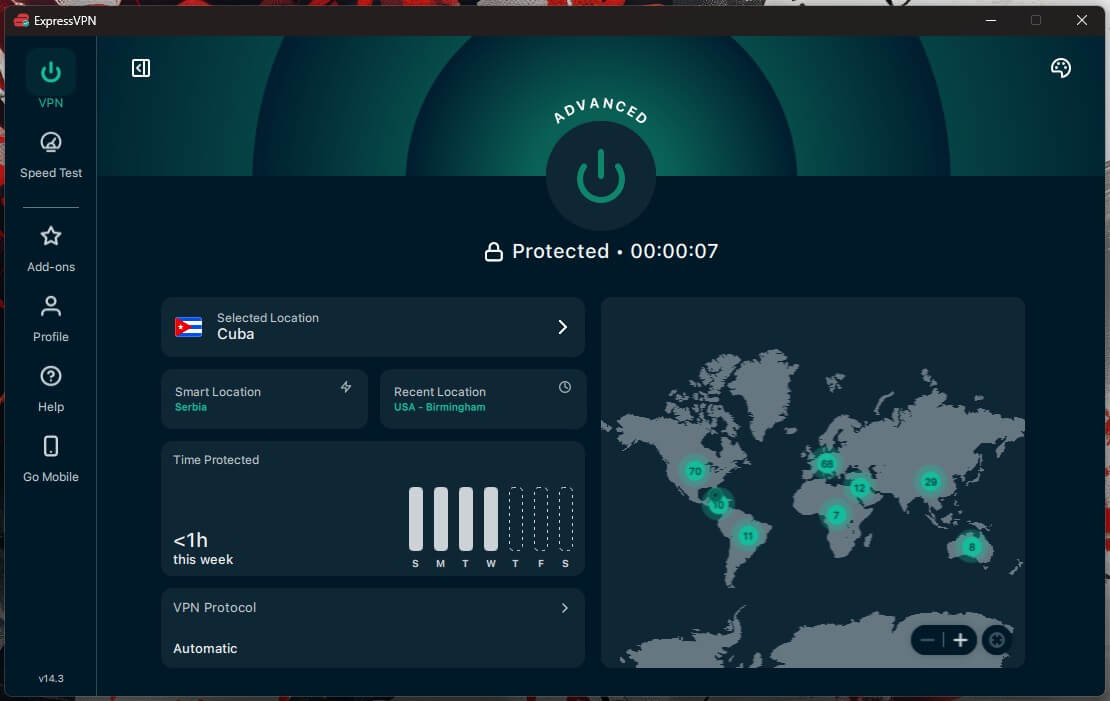
Cuba’s Wi-Fi parks and hotel networks drop often, and ExpressVPN copes with that best. Lightway, ExpressVPN’s in-house protocol, connected in under two seconds in our tests and recovers quickly when you move from Wi-Fi to mobile data.
Its obfuscation activates by itself on networks that filter VPN traffic, so a first-time user has nothing to configure. For Cubans in Spain or the US, ExpressVPN offers a Cuban server location, and its Florida servers are the closest options for travelers on the island.
It passed our streaming tests, with Netflix US and BBC iPlayer among the services it unblocked. Its terms include a sanctions clause similar to NordVPN’s, so the same advice applies: it’s a good fit for visitors and the Cuban diaspora.
Paying for two years brings the Basic plan to roughly $3 a month, and the renewal price is higher, so use the 30-day money-back guarantee to try it on Cuban Wi-Fi before the trip ends.
4. Private Internet Access: Best for Cuban Families Abroad
Pros
- New Cuban server location
- No limit on connected devices
- No-logs policy proven in US courts
- Open-source apps
Cons
- Doesn’t serve customers in Cuba
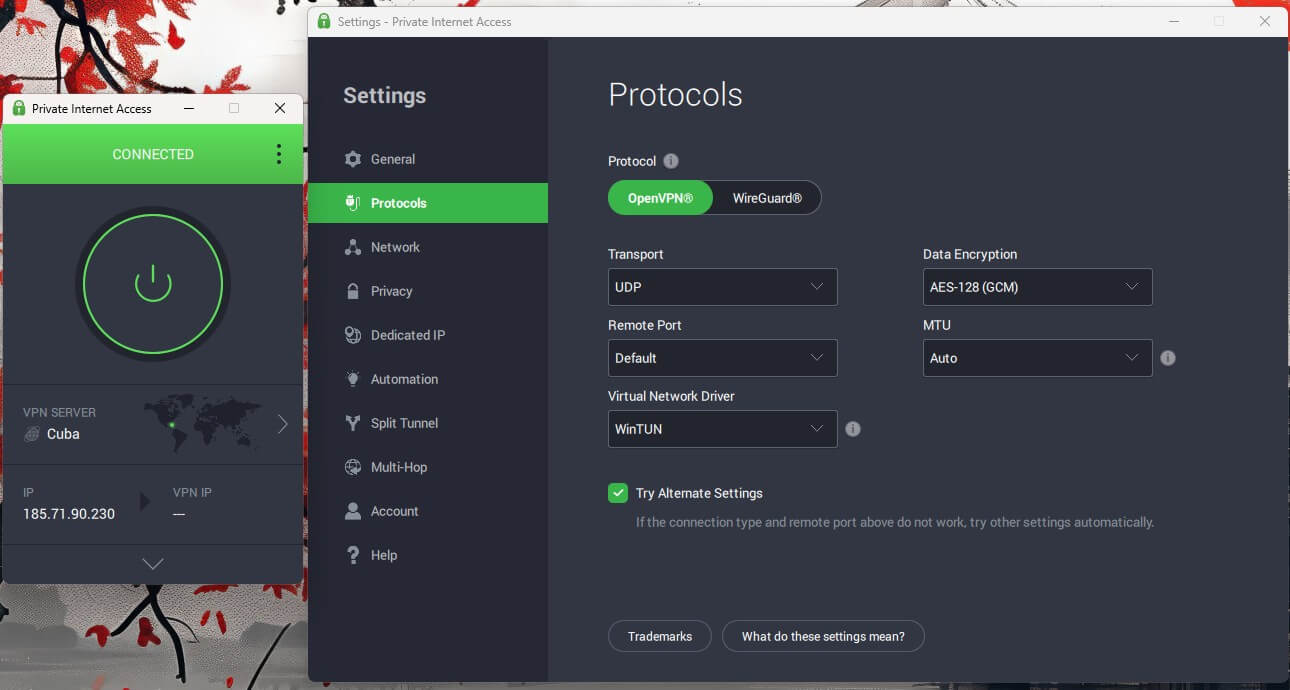
- Windows app starts on OpenVPN
- Didn’t unblock HBO Max or Prime Video
Private Internet Access added a Cuban server location in September 2026, and it puts no limit on how many devices share one subscription. That’s useful for a family in Miami that wants every phone and laptop on one account, with a Cuban IP address ready when a site from home requires one.
PIA’s help center is direct about the other side: as a US company, it can’t offer service to customers in Cuba. Treat it as a VPN for Cubans abroad. Its no-logs claim has also been tested in US court cases, where PIA had no user records to produce.
Speed was respectable, with a 12.7% loss on average. Windows users should change the protocol to WireGuard, since the app defaults to OpenVPN. It couldn’t unblock HBO Max or Prime Video, so keep NordVPN or ExpressVPN for American catalogs.
With its long-term plan near $2 a month, PIA is among the best VPN deals for a large household.
5. Surfshark: Best for Stretching a Limited Data Plan
Pros
- Built-in ad and tracker blocking
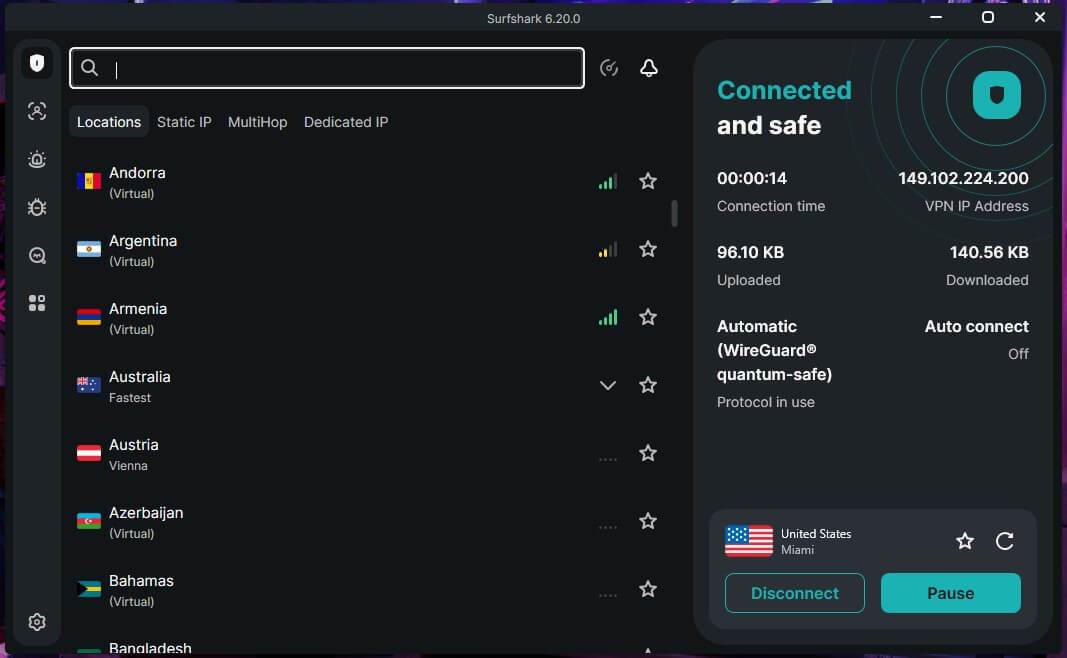
- Servers in Miami, Mexico, and the Bahamas
- Unlimited simultaneous devices
- Unblocked Netflix US and HBO Max
- Camouflage Mode hides VPN use on OpenVPN
Cons
- Missing a server location in Cuba
- Terms exclude sanctioned countries
- Slower to connect at times
On a rationed data plan, ads and trackers eat into every gigabyte, and Surfshark’s CleanWeb blocks them on phones and laptops alike. Fewer ads also means pages load faster on Cuba’s slow connections.
Surfshark lacks a Cuban location, yet its Miami, Mexico, and Bahamas servers are nearby, and in our standard tests it showed a 9.6% speed loss, comfortably fast for browsing and video calls. For streaming, Surfshark unblocked Netflix US, HBO Max, and most of the services in our tests.
When a network blocks VPN connections, switch the protocol to OpenVPN, where Camouflage Mode makes the connection look like regular traffic. Surfshark is a Dutch company, and its terms include the same kind of sanctions clause as NordVPN’s, which limits it to visitors and Cubans abroad.
It can be slow to connect at times, so start the VPN a moment before you open a banking or video app. A two-year plan is roughly $2.50 a month and covers every phone in a traveling family.
What ETECSA Blocks, and What US Sanctions Block
Cuba’s restrictions come from two directions. At home, ETECSA filters the network: Freedom House rates Cuba 19 out of 100 for internet freedom, independent news sites remain blocked, and Telegram and other apps went offline during the 2021 protests. A server outside Cuba lets you access blocked websites again.
Once you connect, ETECSA sees only encrypted traffic, so it can’t tell which apps you use or slow down specific ones. That also protects you from ISP throttling, where an ISP deliberately slows chosen services. ETECSA still sees how much data you use and when, so a VPN doesn’t hide the fact that you’re online.
From the outside, the US embargo closes other doors. Several US online stores and services don’t serve Cuba and block Cuban IP addresses, and Google Play doesn’t offer paid apps or in-app purchases there. That’s why subscribing to a VPN inside its Android app from Cuba won’t work.
Buy the subscription before you fly, or have a family member abroad pay for it. Using a VPN is legal in Cuba. No Cuban law bans one, and Decree-Law 35 of 2021 targets content the state considers harmful.
Posting that content through a VPN is still punishable, and people have received prison sentences for social media posts. Some VPN websites are also blocked at times, so install a VPN with an audited no-logs policy before you arrive, if you’re a tourist.
Living in Cuba or Visiting: Which VPNs You Can Use
The sanctions clauses in NordVPN’s, ExpressVPN’s, Surfshark’s, and PIA’s terms affect one group only. A tourist or a visiting relative who lives in the US, Spain, or Mexico pays from home, connects from Havana, and remains within those terms.
A resident who signs up anyway risks an account being closed without a refund, and paying from Cuba is difficult in the first place. Proton VPN avoids both issues. It’s based in Switzerland, its terms name no restricted countries, and its free plan requires no payment.
A Cuban resident can start on the free plan and move to VPN Plus later if someone abroad can pay for it.
Free VPNs and Psiphon in Cuba
In Cuba, paying for a VPN is often the hardest step, so free options deserve a closer look:
- Proton VPN free: Our first choice. It has no data cap, includes Stealth obfuscation, and keeps no logs. The country is chosen for you, and the Cuban location is for paying users only.
- Windscribe free: A 10 GB monthly allowance after email confirmation, with its own obfuscation protocols. It’s a useful backup when Proton VPN won’t connect.
- Psiphon: A free censorship circumvention tool that’s popular in Cuba and connects on networks where many VPNs fail. It doesn’t promise the privacy of a no-logs VPN, so use it to access blocked sites and keep Proton VPN for private browsing.
- Unknown free apps: The risky choice on a monitored network. Many earn their money by selling browsing data, the very thing you’re trying to protect, so stick to the free VPNs we trust.
Every VPN adds a little data to each connection for encryption. On a 6 GB peso allowance, lower video quality to standard definition and keep the VPN for browsing, messaging, and news.
Getting a Cuban IP Address From Abroad
Cuban sites and apps can treat visitors from abroad differently, a practice called geo-blocking. Cuban server locations are available on Proton VPN, ExpressVPN, and PIA, so connecting to one makes those sites see a Cuban IP address.
If a site still shows its foreign version, clear its cookies and reload, since many sites remember the location of your last visit. The same method works in reverse for Americans on the island.
On a US server, your usual services, from Netflix to Hulu outside the United States, show your home catalog.
How to Set Up a VPN for Cuba
- Subscribe before you travel, outside Cuba, where card payments and app-store purchases work. NordVPN comes with a 30-day money-back guarantee.
- Install the app on every device and sign in while you’re still at home.
- Enable obfuscation: obfuscated servers on NordVPN, Stealth on Proton VPN, or the automatic setting on ExpressVPN.
- Connect to a nearby server in Miami or Mexico for everyday browsing in Cuba, or to a Cuban server location when you’re abroad and want Cuban sites.
- Enable the kill switch, which blocks all traffic whenever the VPN connection fails, so nothing leaks over open Wi-Fi.
Verdict
For Cubans on the island, the first question is whether a VPN will accept them, and Proton VPN does. Its free plan disguises VPN traffic on ETECSA networks and keeps no logs, and VPN Plus is there for when a relative abroad can cover the subscription.
Visitors have more choice. Our top choice for a trip is NordVPN: its Miami and Mexico servers are close, it kept speed losses low in our tests, and Meshnet keeps your bank seeing a familiar connection. ExpressVPN is the simpler app for unstable Wi-Fi, Surfshark’s ad blocker stretches a data allowance, and PIA covers a whole family abroad for less.
Before you board, connect once with obfuscation enabled and save your nearest server as a favorite. App stores and VPN websites are unreliable from Cuba, and fixing a setup over a hotel hotspot takes far longer than at home.
FAQ
Is it legal to use a VPN in Cuba?
Yes. No Cuban law bans VPN use. Decree-Law 35 punishes content the state considers harmful; posting it through a VPN doesn't make it legal, and some VPN websites are blocked at times.
Does NordVPN work in Cuba?
Yes, for visitors. NordVPN connects from Cuban networks and offers obfuscated servers, but it offers no Cuban location, and its terms don't cover people who reside in an embargoed country such as Cuba.
Can you download apps from Google Play in Cuba?
Yes, but only free ones. Google lists Cuba among the countries where paid apps and in-app purchases aren't available, so an Android VPN subscription has to be bought outside the island.
Does a VPN use more mobile data?
Yes, slightly. Encryption adds a small amount of overhead to every connection, so a VPN uses a little more of a mobile data allowance than the same browsing without one.
Can a VPN work during an internet blackout in Cuba?
No. A VPN only works on top of an existing internet connection, so when ETECSA's network or the power grid fails, there's nothing for the VPN to encrypt or forward.
Why do some websites block Cuban IP addresses?
Many US companies don't serve Cuba because of the US embargo, so their sites and apps block Cuban IP addresses. Connecting through a server outside Cuba replaces the Cuban IP address.